David,
While screen readers are indeed a proven technology, adding them can be
a surprisingly difficult task - especially depending upon the screen
reading approached used. All of the "screen scraping" screen readers
(what I call "second generation screen readers") depend upon specific
idiosyncrasies of how graphics rendering is done - and require that (for
example) text rendering go through a single shared bottleneck in order
to find out what that text is and track it in an Off-screen Model. The
third generation approach is built on top of a platform accessibility
API or set of accessibility services (such as Orca on GNOME using AT-SPI
or VoiceOver on Macintosh). This requires that the platform in question
make such an API/services and that the apps expose information via that
technique.
The long term expectation for OLPC is that something like the Orca
screen reader would work on top of AT-SPI. Since Sugar makes use of
many GNOME libraries, this is a natural assumption. Unfortunately the
inter-process communication mechanism for AT-SPI is CORBA, which is very
heavy-weight and not easily stuffed into the small RAM envelope of
OLPC. This is being addressed by a project to migrate AT-SPI to DBUS,
which is much lighter weight. That process/project can be monitored at
it's "web home" at
http://www.linuxfoundation.org/en/Accessibility/ATK/AT-SPI/AT-SPI_on_D-Bus
Once that is done, it should be possible to bring Orca to the OLPC, at
which point the task(s) will be focused around Sugar and the apps.
Meanwhile, as Jim Gettys points out, it is also possible to stuff a
general Linux + GNOME desktop (+ CORBA + Orca) onto an OLPC, though you
may need to beef it up a bit with flash, etc. And it'll be rather slow,
and it looses some of what makes OLPC special and interesting at the
software level (so in that case, perhaps what would be better is a
netbook that will run Fedora or Ubuntu or OpenSolaris much better than
you would get with any of those on OLPC hardware).
As to why this work I've described above hasn't already been completed,
with resources dedicated to it by the OLPC project itself (vs. waiting
for the open source community to get around to doing this at a somewhat
slower pace), I'll have to leave that topic to Jim Gettys. I would
point out from my own experience at (smaller) commercial companies prior
to coming to Sun and working on open source accessibility - you must
always be sensitive to what your customers are telling you they want,
even when you know about needs that those customers may not be asking
about. Software engineering is something of a zero-sum game: if you are
putting effort in one area, it means that effort can't be going into
some other area. If you are adding features explicitly requested by
customers, those same staff are probably not available to add features
that customers aren't asking for. And it is still a bit too rare of a
thing for a customer to place accessibility high on their list of
required features (something Section 508 in the U.S. has been incredibly
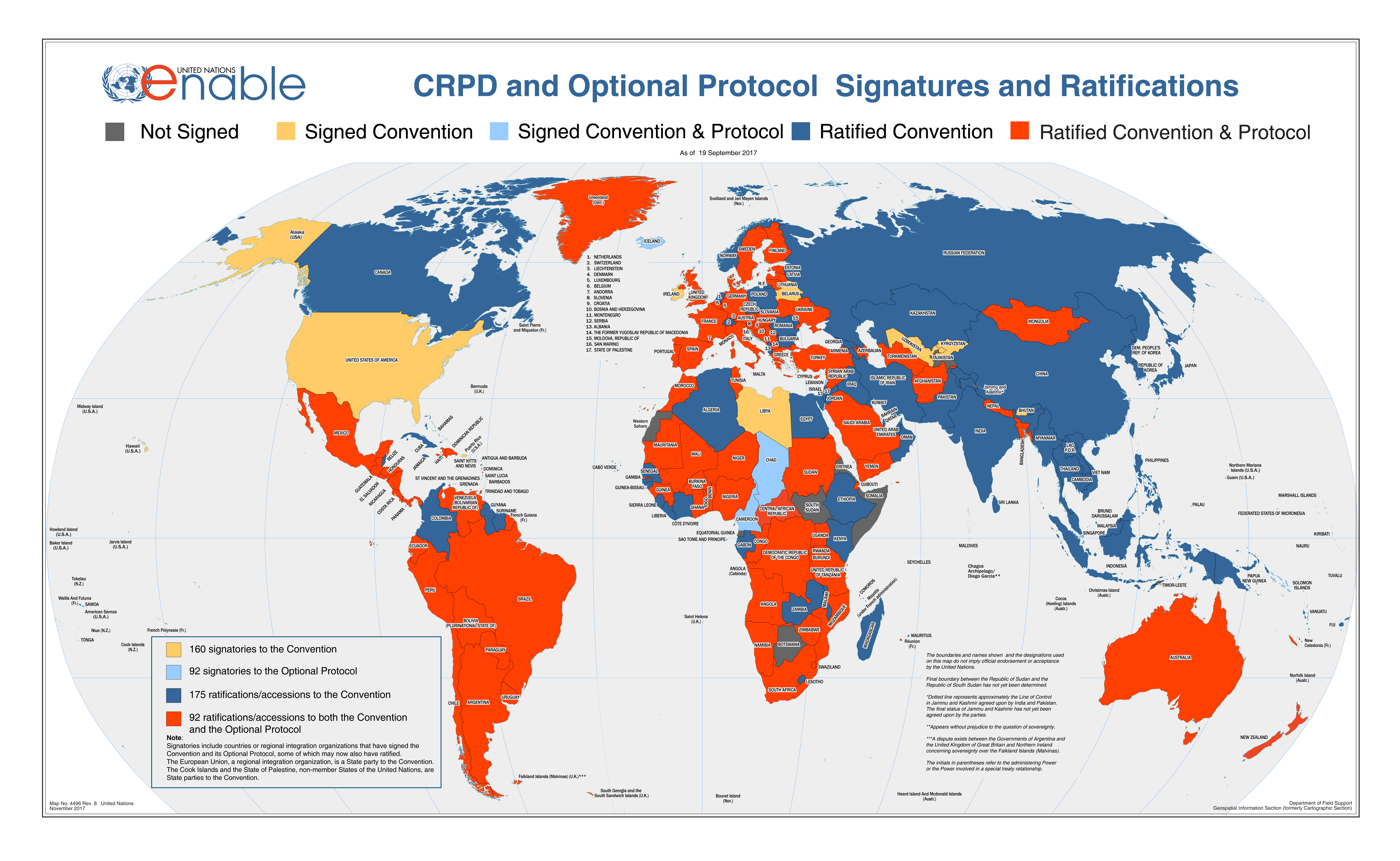
helpful in doing for Federal sales in America). I expect that with
ratification of the U.N. Declaration on the Rights of Disabled Persons
(see http://www.un.org/disabilities/countries.asp?navid=12&pid=166 for
the list of signatory countries and
http://www.un.org/disabilities/documents/maps/enablemap.jpg for a nice
world-map showing signatory status), many more potential OLPC customers
are going to start asking about accessibility, which will help enable
engineers working on Sugar and OLPC generally to bump up the priority of
accessibility work.
Regards,

Peter Korn
Accessibility Architect & Principal Engineer,
Sun Microsystems, Inc.
In reading more about accessibility and OLPC project, it seems to me
that designing accessibility features into the laptops wasn't a
priority. I would suggest that accessibility needs to be added to the
mission statement. Once this happens I feel that accessibility would
be give the proper attention an resources it deserves.
According to the OLPC wiki
<http://wiki.laptop.org/go/Our_software#Accessibility>http://wiki.laptop.org/go/Our_software#Accessibility,
" <http://wiki.laptop.org/go/Our_software#Accessibility>We've heard
that 10% of the world's population, or more than 600 million people,
live with life altering disabilities, and two thirds of those persons
are in developing countries (UN statistics)"
This would seem to justify incorporating accessibility into the
mission statement.
Again, screen readers are a proven technology. It shouldn't be
difficult to add this functionality. There are more than enough blind
kids in the world to justify this.
I don't mean to offend those working on accessibility for this
project. I think this is a great project but more attention should be
given to make the laptops more accessible.
Thanks,
David
On Thu, Nov 27, 2008 at 11:41 AM, <[EMAIL PROTECTED]
<mailto:[EMAIL PROTECTED]>> wrote:
    Hi All,

    I have an OLPC machine on loan.  I'm blind, and am wondering about
    the current state of play regarding facilities such as screen
    readers which would allow me to access this machine.  Can anyone
    tell me if there are features currently built into the OLPC
    machines which will give me screen reader functionality, and if so
    how to access them.  Alternatively, is it possible to load an
    application such as Orca onto the oLPC machine and is there
    documentation about how this works?

    Regards,

    Tim Pennick

    Tim Pennick
    Senior Researcher
    BT Innovate
    _________________________
    Office: +44 (0) 1473 642797
    Email: [EMAIL PROTECTED] <mailto:[EMAIL PROTECTED]>

    Visit the BT Innovation site: _http://www.btplc.com/innovation_

    This email contains BT information, which may be privileged or
    confidential.
    It's meant only for the individual(s) or entity named above. If
    you're not the intended recipient, note that disclosing, copying,
    distributing or using this information is prohibited. If you've
    received this email in error, please let me know immediately on
    the email address above. Thank you. We monitor our email system,
    and may record your emails.
    British Telecommunications plc
    Registered office: 81 Newgate Street London EC1A 7AJ
    Registered in England no: 1800000


    _______________________________________________
    accessibility mailing list
    [email protected] <mailto:[email protected]>
    http://lists.laptop.org/listinfo/accessibility


------------------------------------------------------------------------

_______________________________________________
accessibility mailing list
[email protected]
http://lists.laptop.org/listinfo/accessibility
_______________________________________________
accessibility mailing list
[email protected]
http://lists.laptop.org/listinfo/accessibility