Impedance matching is a topic that many new comers don't have a real
grip on and no wonder.  There are so many strange applications and
problems.  So I will take this opportunity to tell what I have learned.
(OR NOT some may disagree)
1. Matching source impedance to load will cause the source to deliver
the most power to the load.  This is a math fact. For instance a 12 Volt
lead acid battery with and internal resistance of .05 ohms when attached
to a resistance of .05 ohms will deliver its maximum power of 720 watts.
If the load resistance is decreased lower than the internal resistance
of the battery the current will increase but not as fast as the voltage
across the load decreases so the product (E * I) is something less than
the power at the matched impedance.  When the internal resistance of the
source is matched to the load and max power is transferred, you must
realize that the source is dropping half the voltage and dissipating the
same power as the load, 720 watts in the above case.

        This may not be desirable!!  Maximum power transfer is seldom
the reason for a recommended load resistance.  Desired output,
efficiency, and distortion products are what should to be considered.


2.  The recommended load impedance for something like a microphone
seldom has anything to do with power transfer from microphone to input
circuit.  The things to watch for here are damping effects verses
frequency response, and the voltage gain of the input circuit.

        If the load on the microphone is too low of a resistance the
microphone will have very good damping but low output voltage and often
will fall short of the desire frequency response.  In the case of
piezoelectric devices this is generally a loss of low frequency
response.  If the load provided by the input circuit is too high the
damping is not good.  Resonances may occur and some times even
oscillations. Damping is the ability of a mechanical device to stop
vibrating after the source of energy that started it vibrating is
removed.  Guitar stings and piano strings are designed to vibrate after
they are struck.  The will vibrate for quite a while or until "damped"
by fingers.  This is not the desired effect that we want from a
microphone.  Instead we want the microphone diaphragm to follow the
incoming wave front of air, and not to take off on its on vibration.  If
damped well, it will more closely produce a voltage waveform that
resembles the air movement wave.  Some times it is more desirable to put
a much lower resistance on the microphone and let the output and
frequency response drop off some then add more amplification and
equalization to the input circuit.  But be careful with over doing the
equalization as this can cause phase shifts.  Phase shifts can alter the
waveform a lot and quite noticeable in the lower frequency bass notes.
Remember that the voice is not a sine wave but a complex waveform of
many shapes. Yes these shapes can be broken down mathematically to sine
wave frequencies but the phase relationship and amplitude of the many
frequencies is what gives the certain shape to a specific wave front of
air.  Changing the phase of only one part of the group of frequencies
will change the additive shape of the result, especially if equalization
is done in a very narrow band of frequencies.  Equalization curves
should be gradual changes to get the desired results and avoid sharp
changes in the curves.

Placing a resistance in series with the input circuit will allow the
microphone more freedom to produce and this may be desirable depending
on the microphone but it will also cause a loss of damping and more gain
in the input circuit will be required.  In some cases this may be just
turning up the MIC gain.

I have found the condenser cartridges from Radio Shack to be quite good.
I mounted two of them on a circuit board and built a mixing amp right on
the board to combine there outputs.  For what reason, I'm not sure.
Something told me that if the cartridges had different frequency
responses that putting two together would be a broader response and if
they didn't then it would hurt. Anyway, the amplified MIC will work into
loads as low as 1000 ohms with an output voltage of 2 Volts at close
range.  I have it currently attached to a line level input of the speech
amplifier with an input resistance of 500K ohms.  There is no damping
problem here because it is one amplifier driving another at the proper
level.  The Microphone cartridges them selves or decouple with 1200 ohm
resistor in series with each cartridge output and then at the junction
there is a 470 ohm to ground. This type of circuit provides isolation,
one cartridge from the other so that one doesn't drive the other to much
and provides damping for each.  The junction of the 3 resistors is
connected to the input of a two transistor amplifier circuit.  I could
have got enough gain from one transistor but I needed the phase reversal
of the second stage to match the phase from another input for a XTAL MIC
that was on the speech amp.  In case there was someone else in the shack
they could have their on MIC, and the phases of the two would match.
The circuit board, cartridges, two xsistor amp, and LEDs for power
indication are all mounted in and old gutted out Shure 55 housing that
went through a flood.

SEE http://www.qsl.net/wa5bxo/power.html


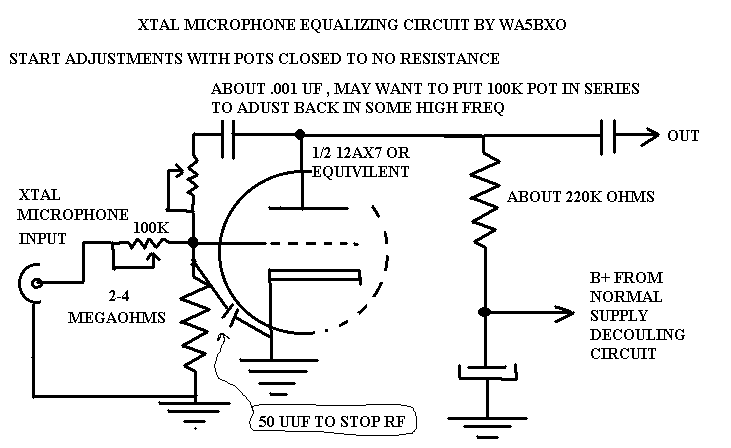
And http://www.qsl.net/wa5bxo/xtal-mic-eq.gif

Sorry I never drew the schematic for the home brewed MIC in the Shure 55
case.  It was just one of those thrown together design as you look at
the scope type projects and I don't even know what Xsistors I used
except they were low signal type NPNs in a small plastic case.  Some day
I'll take it apart and try to draw it up.