Hi,
I don't know which request generated that response.

while to BroadCast you must have been passing intent, so put your url in
that intent using putExtra(Key,your url);
on BroadCastReceiver, you will have onReceive( Context c, Intent intent);
so extract that from intent, like intent.getString(Key);
In that way you can identify the response of particular request.
hope will help you.

Regards
Imran Ali

On Tuesday, May 29, 2012 5:29:38 PM UTC+5:30, Oleksandr Kruk wrote:
>
> Thanks Kristopher,
>
> Actually that's exactly what I have, an API which provides the developer
> with access
> to all necessary data structure and manipulation.
>
> I made a draft just to explain better whats the problem:
>
>
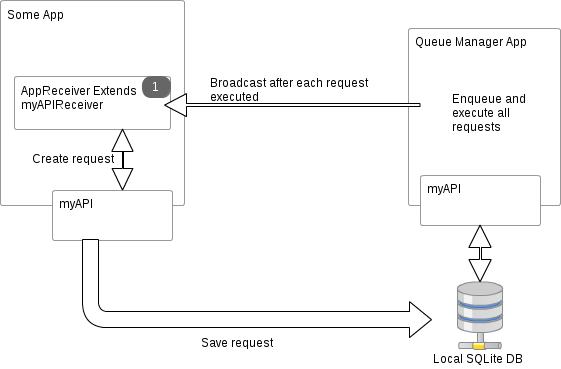
> <https://lh3.googleusercontent.com/-_NG1V3-5Rck/T8S4hnlIxWI/AAAAAAAAAD4/kGPgsRqkBxE/s1600/requestExec.png>
> The number 1 is a broadcast receiver that reacts on an action of request
> execution
> by Queue Manager service. The problem is that in the receiver (1) I have
> no way
> to know what I am supposed to do with that response, because I don't know
> which
> request generated that response. I guess I must pass some context
> information
> from "Some App" to "Queue Manager App" and then back after executing. It
> can be a name of
> method to execute or something like that.
>
>
>
>
>
>
> On Tuesday, 29 May 2012 10:31:01 UTC+1, Kristopher Micinski wrote:
>>
>> It sounds like what you want is basically a message queue..
>>
>> However, for a cross app solution, I think you'd want something that
>> stores the data persistently somewhere, such as on disk.  I'd probably
>> make an API backed by a service that apps would interface to
>> implementing this, if I were you...
>>
>> kris
>>
>> On Tue, May 29, 2012 at 5:06 AM, Oleksandr Kruk <[email protected]>
>> wrote:
>> > Thanks for your answer TreKing!
>> >
>> > I am sorry, that was an unclear expression, by "apps offline" I meant
>> they
>> > are not running.
>> >
>> > Exactly, you understood well, but I think I failed to explain that the
>> time
>> > frame between storing requests and executing them can be
>> > anything like an hour, a day, a month, etc.. So in this context, when
>> an
>> > application receives a response, lets say through a broadcast intent
>> > it wont know for which request that response was received. Thats why
>> having
>> > a callback method associated to request would be better than simply
>> > an intent with the result.
>> >
>> > Imagine a situation:
>> > You are in a remote area with no network, you take a landscape photo,
>> open
>> > facebook app and
>> > simply post that photo (without network). This post would remain in my
>> > framework until you have network, which is indefinite time.
>> > Now, at the moment you connect to network, lets say two days, it will
>> be
>> > posted on facebook (by ManagerApp) and facebook app will get a response
>> from
>> > ManagerApp.
>> > If you send that response as a broadcast to facebook app, how it is
>> supposed
>> > to know that that response is related to that specific photo post you
>> made
>> > days ago.
>> >
>> > Remember that I don't want to make developers to maintain mappings
>> between
>> > their app requests and future response in order to solve this
>> situation,
>> > all the information must be on the side of the framework (it's cleaner
>> I
>> > guess).
>> >
>> >
>> > Thanks again
>> >
>> >
>> >
>> >
>> > On Tuesday, 29 May 2012 09:16:50 UTC+1, TreKing wrote:
>> >>
>> >> On Mon, May 28, 2012 at 10:55 AM, Oleksandr Kruk <[email protected]>
>>
>> >> wrote:
>> >>>
>> >>> How can this IntentService update each App information using their
>> >>> business logic when
>> >>> the Apps are offline?
>> >>
>> >>
>> >> What do you mean "when the apps are offline"?
>> >>
>> >> If I understand you correctly, you would simply have to launch an
>> intent
>> >> or trigger a broadcast from your IntentService that has the
>> information the
>> >> other apps care about. The other apps would have to know the details
>> of the
>> >> intent or broadcast structure in order to properly listen for it.
>> >>
>> >> The intent would contain the data the app in question was requesting,
>> in
>> >> some known format. You would not have to know anything about their
>> business
>> >> logic, that would be up to them.
>> >>
>> >>
>> >>
>> -------------------------------------------------------------------------------------------------
>>
>>
>> >> TreKing - Chicago transit tracking app for Android-powered devices
>> >>
>> > --
>> > You received this message because you are subscribed to the Google
>> > Groups "Android Developers" group.
>> > To post to this group, send email to
>> [email protected]
>> > To unsubscribe from this group, send email to
>> > [email protected]
>> > For more options, visit this group at
>> > http://groups.google.com/group/android-developers?hl=en
>>
>
> On Tuesday, 29 May 2012 10:31:01 UTC+1, Kristopher Micinski wrote:
>>
>> It sounds like what you want is basically a message queue..
>>
>> However, for a cross app solution, I think you'd want something that
>> stores the data persistently somewhere, such as on disk.  I'd probably
>> make an API backed by a service that apps would interface to
>> implementing this, if I were you...
>>
>> kris
>>
>> On Tue, May 29, 2012 at 5:06 AM, Oleksandr Kruk <[email protected]>
>> wrote:
>> > Thanks for your answer TreKing!
>> >
>> > I am sorry, that was an unclear expression, by "apps offline" I meant
>> they
>> > are not running.
>> >
>> > Exactly, you understood well, but I think I failed to explain that the
>> time
>> > frame between storing requests and executing them can be
>> > anything like an hour, a day, a month, etc.. So in this context, when
>> an
>> > application receives a response, lets say through a broadcast intent
>> > it wont know for which request that response was received. Thats why
>> having
>> > a callback method associated to request would be better than simply
>> > an intent with the result.
>> >
>> > Imagine a situation:
>> > You are in a remote area with no network, you take a landscape photo,
>> open
>> > facebook app and
>> > simply post that photo (without network). This post would remain in my
>> > framework until you have network, which is indefinite time.
>> > Now, at the moment you connect to network, lets say two days, it will
>> be
>> > posted on facebook (by ManagerApp) and facebook app will get a response
>> from
>> > ManagerApp.
>> > If you send that response as a broadcast to facebook app, how it is
>> supposed
>> > to know that that response is related to that specific photo post you
>> made
>> > days ago.
>> >
>> > Remember that I don't want to make developers to maintain mappings
>> between
>> > their app requests and future response in order to solve this
>> situation,
>> > all the information must be on the side of the framework (it's cleaner
>> I
>> > guess).
>> >
>> >
>> > Thanks again
>> >
>> >
>> >
>> >
>> > On Tuesday, 29 May 2012 09:16:50 UTC+1, TreKing wrote:
>> >>
>> >> On Mon, May 28, 2012 at 10:55 AM, Oleksandr Kruk <[email protected]>
>>
>> >> wrote:
>> >>>
>> >>> How can this IntentService update each App information using their
>> >>> business logic when
>> >>> the Apps are offline?
>> >>
>> >>
>> >> What do you mean "when the apps are offline"?
>> >>
>> >> If I understand you correctly, you would simply have to launch an
>> intent
>> >> or trigger a broadcast from your IntentService that has the
>> information the
>> >> other apps care about. The other apps would have to know the details
>> of the
>> >> intent or broadcast structure in order to properly listen for it.
>> >>
>> >> The intent would contain the data the app in question was requesting,
>> in
>> >> some known format. You would not have to know anything about their
>> business
>> >> logic, that would be up to them.
>> >>
>> >>
>> >>
>> -------------------------------------------------------------------------------------------------
>>
>>
>> >> TreKing - Chicago transit tracking app for Android-powered devices
>> >>
>> > --
>> > You received this message because you are subscribed to the Google
>> > Groups "Android Developers" group.
>> > To post to this group, send email to
>> [email protected]
>> > To unsubscribe from this group, send email to
>> > [email protected]
>> > For more options, visit this group at
>> > http://groups.google.com/group/android-developers?hl=en
>>
>
> On Tuesday, 29 May 2012 10:31:01 UTC+1, Kristopher Micinski wrote:
>>
>> It sounds like what you want is basically a message queue..
>>
>> However, for a cross app solution, I think you'd want something that
>> stores the data persistently somewhere, such as on disk.  I'd probably
>> make an API backed by a service that apps would interface to
>> implementing this, if I were you...
>>
>> kris
>>
>> On Tue, May 29, 2012 at 5:06 AM, Oleksandr Kruk <[email protected]>
>> wrote:
>> > Thanks for your answer TreKing!
>> >
>> > I am sorry, that was an unclear expression, by "apps offline" I meant
>> they
>> > are not running.
>> >
>> > Exactly, you understood well, but I think I failed to explain that the
>> time
>> > frame between storing requests and executing them can be
>> > anything like an hour, a day, a month, etc.. So in this context, when
>> an
>> > application receives a response, lets say through a broadcast intent
>> > it wont know for which request that response was received. Thats why
>> having
>> > a callback method associated to request would be better than simply
>> > an intent with the result.
>> >
>> > Imagine a situation:
>> > You are in a remote area with no network, you take a landscape photo,
>> open
>> > facebook app and
>> > simply post that photo (without network). This post would remain in my
>> > framework until you have network, which is indefinite time.
>> > Now, at the moment you connect to network, lets say two days, it will
>> be
>> > posted on facebook (by ManagerApp) and facebook app will get a response
>> from
>> > ManagerApp.
>> > If you send that response as a broadcast to facebook app, how it is
>> supposed
>> > to know that that response is related to that specific photo post you
>> made
>> > days ago.
>> >
>> > Remember that I don't want to make developers to maintain mappings
>> between
>> > their app requests and future response in order to solve this
>> situation,
>> > all the information must be on the side of the framework (it's cleaner
>> I
>> > guess).
>> >
>> >
>> > Thanks again
>> >
>> >
>> >
>> >
>> > On Tuesday, 29 May 2012 09:16:50 UTC+1, TreKing wrote:
>> >>
>> >> On Mon, May 28, 2012 at 10:55 AM, Oleksandr Kruk <[email protected]>
>>
>> >> wrote:
>> >>>
>> >>> How can this IntentService update each App information using their
>> >>> business logic when
>> >>> the Apps are offline?
>> >>
>> >>
>> >> What do you mean "when the apps are offline"?
>> >>
>> >> If I understand you correctly, you would simply have to launch an
>> intent
>> >> or trigger a broadcast from your IntentService that has the
>> information the
>> >> other apps care about. The other apps would have to know the details
>> of the
>> >> intent or broadcast structure in order to properly listen for it.
>> >>
>> >> The intent would contain the data the app in question was requesting,
>> in
>> >> some known format. You would not have to know anything about their
>> business
>> >> logic, that would be up to them.
>> >>
>> >>
>> >>
>> -------------------------------------------------------------------------------------------------
>>
>>
>> >> TreKing - Chicago transit tracking app for Android-powered devices
>> >>
>> > --
>> > You received this message because you are subscribed to the Google
>> > Groups "Android Developers" group.
>> > To post to this group, send email to
>> [email protected]
>> > To unsubscribe from this group, send email to
>> > [email protected]
>> > For more options, visit this group at
>> > http://groups.google.com/group/android-developers?hl=en
>>
>

--
You received this message because you are subscribed to the Google
Groups "Android Developers" group.
To post to this group, send email to [email protected]
To unsubscribe from this group, send email to
[email protected]
For more options, visit this group at
http://groups.google.com/group/android-developers?hl=en