Really interesting! So, there is a relationship between my problem and the
length/number of wires.
I have a fixed length of all my wires: about 8cm (this value corresponds to
half of my breadboard width).
The advantage of this length is that I can reach components that are far and
components that are near (so it is more reusable).
That is a big constraint to work at 12 Mhz if it requires to have a limited
length/number of wires.
I will try to reduce the number of wires and if it does not work, I will not
have the choice: I will create shorter wires (specific for this circuit, so
less reusable).

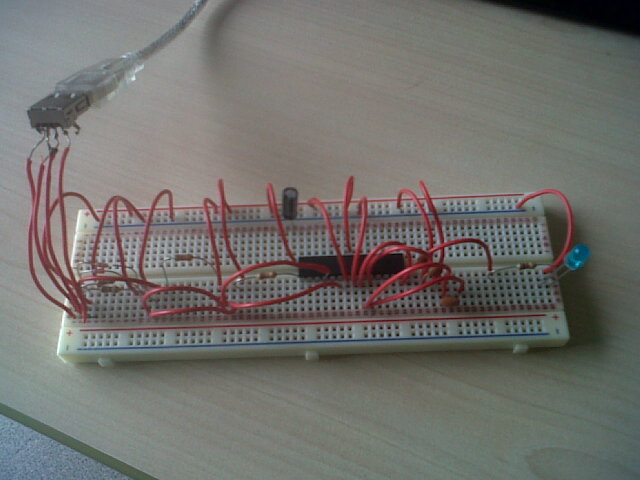
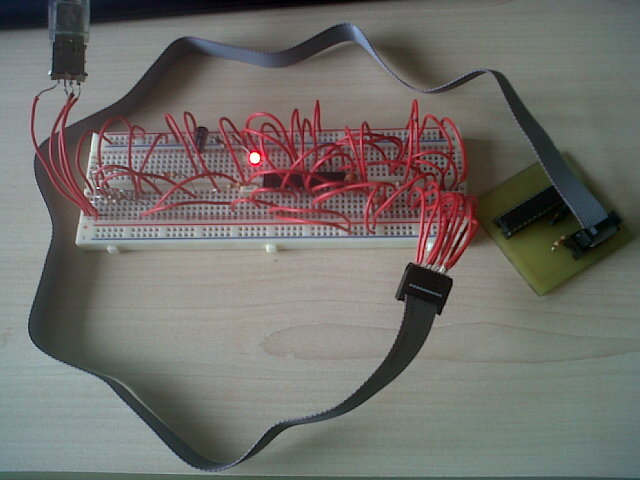
I have just successfully done a circuit using a lot of useless wires here:
http://yugiohjcj.free.fr/elec-vusb-led-1.jpg
http://yugiohjcj.free.fr/elec-vusb-led-2.jpg
It is an USB connected breadboard that is controlled by a program on the
computer [1, 2].
I can switch on or switch off the LED.
In this case, I have no problem... Do you know why I have problems with the
USBasp project and not with this one?

[1] https://www.youtube.com/watch?v=iA15vqa0Rk8
[2] http://www.wzona.info/2012/10/usb-duomenu-perdavimas-atmega.html
> Hi,
> The real problem is capacitance on USB wires. Long story short: the USB
> cables should be short as possible since USB working at 12 MHz (at least
> USBasp).
> Also 12 MHz crystal should be very close to AVR chip. Long wires make
> troubles :)
> Regards
>    Martin
>
> > > This is a photo of my breadboard:
> > > http://yugiohjcj.free.fr/usbasp.jpg
>
> It looks as if you have "too many wires". This schematic should have
> just the CPU, a couple of wires to USB and a few (4) wires going to
> the target. Together with two zeners and a two resistors, I expect
> about 12 wires in total. I'm seeing about 3 times too many.
>
>         Roger.
>

_______________________________________________
AVR-chat mailing list
[email protected]
https://lists.nongnu.org/mailman/listinfo/avr-chat