I suspect they are looking for testers….er…dummies?
From: [email protected]
[mailto:[email protected]] On Behalf Of Meiers, Steve
Sent: Monday, December 06, 2010 3:11 PM
To: 'Aaron Crandall'; bikies
Subject: Re: [Bikies] Interesting...


Lots of unanswered questions


Swedish Hövding (Chieftan) Airbag
Headgear Makes its Debut


  _____

Summary: Is the Swedish airbag bike headgear a reality? Can it really protect
the way a traditional helmet does? We are waiting to see test results and
answer a lot of questions.

  _____


The Hövding web page <http://www.hovding.com/en_index.php>  introduces headgear
that is based on the airbag principle, with an inflating protective bonnet
designed to deploy when the rider crashes. There is a video of one test crash
<http://translate.google.com/translate?js=n&prev=_t&hl=en&ie=UTF-8&layout=2&eotf=1&sl=sv&tl=en&u=http%3A%2F%2Fwww.hovding.se%2Fhow.php>
 .

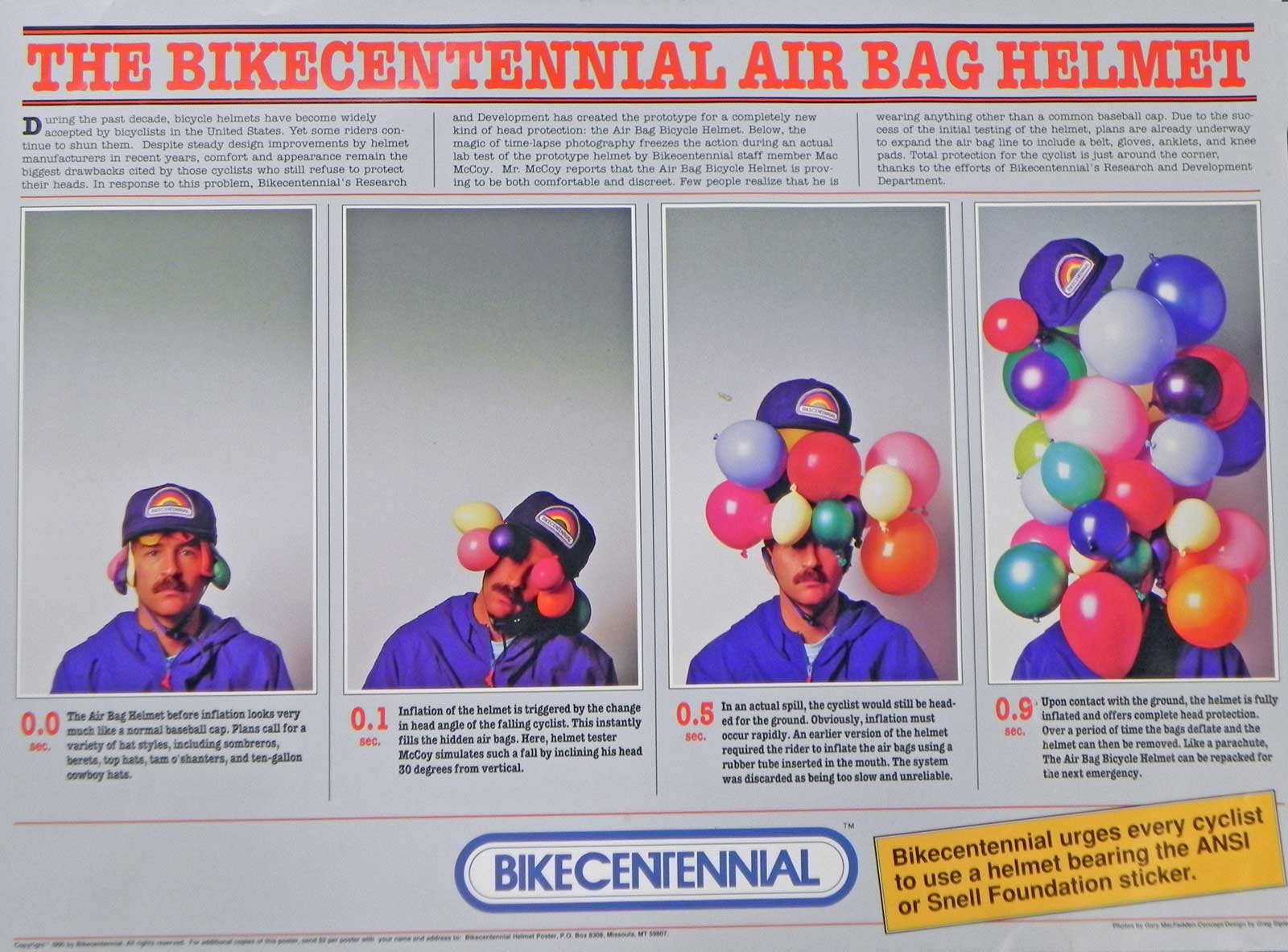
Airbag helmets have been the subject of conversation for years, often
accompanied by satiric photos of riders with balloons on their heads
<http://www.helmets.org/images/pbikec.jpg> . But this one is a serious attempt
to put the mechanism to work.

The device

The device is a project of two Swedish designers who founded the Hövding
company, and has been in design and development for five years before it was
introduced in October of 2010. The designers wanted to create a product that
would not cause "helmet hair" and would appeal to those who would not wear a
normal bike helmet.

The airbag is nylon, and inflates with a gas generator when embedded gyros and
accelerometers tell it a crash is taking place. The gyros have to be powered
during use, so the Chieftan has a rechargeable battery. That seems like a real
drawback to us, since the user has to be aware of the battery charge level
(there are led indicators) and remember to keep it charged. After a crash the
manufacturer wants the headgear back to check its embedded "black box" for
recorded movements prior to your crash. They offer "a discount" on the
replacement. That implies that this is not a multi-use product.

The video shows a test dummy on a bicycle struck from behind by a car indicated
as moving at 20 kph (12 mph). The dummy is thrown backwards over the hood and
impacts its head on the flat part of the windshield. The bag deploys prior to
the impact.

That is one specific scenario. But did the helmet perform? You can see the
helmet appear to bottom out and let the head hit the windshield anyway, and
there is no instrumentation trace visible registering how many g's the dummy
head saw. And what would happen in a simple fall? Or a collision with a tree
branch or utility pole? The mirror of a bus, or the front of a bus or truck?
And if the cyclist had not been stationary, but had been traveling at a speed
near that of the car? And what if there is another impact after the bag begins
to lose air? Nothing in the Hövding web site addresses those questions. The
greatest danger in using the device would be impacting something with a bare
head if the device did not deploy. We are not going to be easy to convince that
it will always be there.

Can it pass standards?

Helmet lab testing normally includes testing wet, cold and hot samples. They
are tested against rounded anvils and curbstone anvils as well as flat ones.
The test would have to be of a fully-inflated Chieftan. How well would this
device perform against a grapefruit-shaped anvil, or one that was the shape of
a curb? Would it perform after being immersed in water for four hours? Would it
pass the positional stability test once it was inflated? Would it perform at
-15 and plus 50 degrees Centigrade? (That's 5 to 122 degrees F.) All of these
questions assume testing on conventional equipment as called out in the CPSC
standard, and there are good reasons based on field experience for each of the
test parameters.

We doubt that the Chieftan can pass CPSC, and it would have to for the US
market. The CPSC definition of a helmet is

"Bicycle helmet means any headgear that either is marketed as, or implied
through marketing or promotion to be, a device intended to provide protection
from head injuries while riding a bicycle. (Section 1203.4.2 (b))

That seems to encompass the Chieftan. Hövding says they expect to introduce the
device in the European market in 2011 at more than $300 US. We don't know if it
would be required to pass the CEN helmet standard to be sold in Europe. It
might simply be certified for the CE mark. European test rigs are very
different, and we don't know if it would pass the EN 1078 standard or not. EN
1078 defines a helmet as "an item to be worn on the head and intended to absorb
the energy of an impact, thus reducing the risk of injury to the head." That
would seem to exclude the Chieftan. Hövding must have some idea of that, but we
could not find any reference to standards on their Web site.

Other questions

The Chieftan raises other questions: what about wearability? Would it be
comfortable? Sweaty in hot weather? There is a statement about not being able
to wash the collar that we do not understand. Could it interfere with neck
flexibility while riding? While crashing? Could it injure the rider's neck as
it deployed?

It is not possible to answer questions based on the manufacturer's Web site and
video. But this may prove to be a welcome advance in head protection, and there
is no need to be too skeptical until we see more.

Other applications

If the device can detect all crash scenarios, the mechanism could be used to
deploy other forms of protection for other body parts. APC Helmets has an
airbag system in a motorcycle helmet <http://www.apcsystem.com/eng/videos.php>
, but they have fitted the airbag to deploy under the helmet as a neck support
in the event of a crash. In that case if the airbag does not deploy you still
have the protection of a conventional helmet. Hit Air has a system with an
airbag jacket <http://www.bikebone.com/Air-Vest-Motorcycle-Airbag-Hit-Air.htm>
that deploys when a rider is thrown from the motorcycle and a tether is yanked.
The problem is that in certain scenarios the airbag will not open, as when the
motorcycle and rider crash together into a barrier. For equestrian use it might
not deploy if the horse rolls on the rider.

Significance

Perhaps the greatest significance of the Hövding announcement is that at least
somebody is trying to solve the helmet problem for those who will not destroy
their hair styles, and to address the problem encountered by shared bike
programs. Shared bike programs all over the world are in need of an easily
transportable helmet or one that can be dispensed from vending machines at very
low cost for users of shared bicycle programs who did not think to bring a
helmet or do not want to carry one. There is at least one folding helmet from
Dahon <file:///C:\bhsi\helmet10.htm#dahon>  currently available in Europe, but
it does not meet US standards and is expensive. If the Hövding works, and if it
does not substitute collar destruction for hair-do destruction, it could be an
advance.

Stay tuned, the airbag helmet is bound to be interesting!

  _____

This page was last revised on: December 5, 2010.


Steve Meiers

Safety educator

(608) 267-1102

Box 2986

Madison WI 53701

[email protected]

From: [email protected]
[mailto:[email protected]] On Behalf Of Aaron Crandall
Sent: Monday, December 06, 2010 2:54 PM
To: bikies
Subject: [Bikies] Interesting...


>From the Milwaukee Bike listserv:


This could be the solution we’ve all been looking for
<http://www.huffingtonpost.com/2010/11/20/the-invisible-helmet-inve_n_781575.html>

http://www.huffingtonpost.com/2010/11/20/the-invisible-helmet-inve_n_781575.html
 an inflatable bike helmet.


Aaron
_______________________________________________
Bikies mailing list
[email protected]
http://lists.danenet.org/listinfo.cgi/bikies-danenet.org