And I'm going to give away the secret of teaching anyone to ride a bike:
kids, first-time adults, any age. I don't know if this will help the
original poster, but if he's not feeling confident, it might. YMMV
The nice thing about this method is that it does not require a special
bike, like a "crank forward" that Richard suggested, or a recumbent or
trike. Obviously, for folks that have balance issues, two wheels may be a
bigger problem than just learning to ride. Also, recumbents and
crank-forward bikes can help with back, leg, arm, or other body problems
and pains. But if you just want to learnto ride, this will work, and you
can borrow any old bike that is about the right size.

How to teach anyone to ride a bike:

1. Lower the seat, so the person can put their feet flat on the ground
while sitting on the seat. Not their tip toes, not flat foot while standing
over the top tube. (This is very uncomfortable to pedal once you get the
hang of bicycling, but it's the way to start off before you know how to
stay up.)

2. Remove the pedal entirely. You not have a bike that you can scoot along
with your feet.The pedals won't knock you in the shins, and you just put
your feet down to balance.

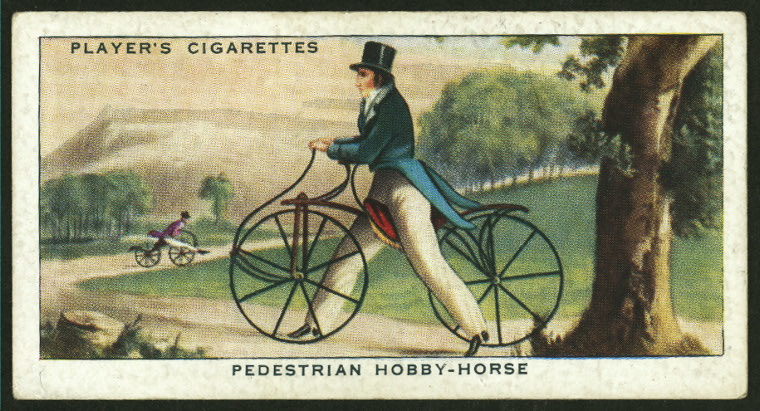
3. Learn to scoot along with the bike as it is. Many people have probably
seen toddlers on wooden or plastic
bikes<http://en.wikipedia.org/wiki/Balance_bicycle>doing exactly this.
But the earliest
bikes also had this
form<http://2.bp.blogspot.com/-o21Jz68roDw/UKZuIpNv_sI/AAAAAAAAMEo/qXNx09daqEo/s1600/hobby.jpg>
.

4. Try picking up your feet once you get a good glide going. Or try going
down a very gentle slope to get a nice long glide, where you can practice
steering. Not too fast, but enough to feel what it's like to steer.

5. Put one pedal on the bike. Put it on the side the rider feels most
comfortable pushing down on. Or more to the point, put the pedal on the
opposite side from where the rider naturally wants to put down his/her foot
to stop.

6. With that one pedal just past the up position - about 2:00 on a clock -
start at the top of a very gentle slope and push down on the pedal and
glide down the slope. All the rider has to do is push down and keep his/her
foot on the pedal, balance and steer. This will give the ride the feeling
of what it is like to "start." (A driveway works great for this, but only
if you know there are no cars coming. You NEVER want to ride into the
street if there is any possibility of traffic. This is especially if you
are teaching a child, as they don't "get" traffic like adults do, and
riding out from a driveway is very high on the reasons kids get hit by
cars. A slight slope on a trail or sidewalk is a better choice, if you can
find a good location.)

7. Once the rider feels OK with that one pedal, add the other one. Gain,
practice pushing down on the one pedal and gliding, but now the rider will
need to practice getting his/her other foot into position.

8. Once that is OK, practice pushing down with the other foot. One pedal
stroke, then stop. Two pedal strokes, stop, etc.

9. Maybe now is the time to try helping the person get started by the
traditional hold-run-push-release method, but by now the person should be
able to start pedaling a little bit after getting a start on a slope.
 Convince the new rider that going faster actually helps keep the bike
straight. As all bicyclists know, going slow on a bike is really hard and
you wobble all over the place.

10. Raise the seat a half inch at a time when the new rider feels OK
starting and stopping. Even long-time bicyclists sometimes have their seat
too low because they want to be able to touch the ground easily while
seated. This is actually a very inefficient pedaling position and also
tiring for longer rides when you can't fully extend your legs. Hence the
"crank-forward" bikes that both allow a full leg extension and putting your
feet on the ground while seated. (Bike fit is another matter entirely, so
i'll leave that alone for now.)

I actually taught an adult to ride with this method, and it was very
satisfying for both of us.

Good luck!

Robbie Webber
Transportation Policy Analyst
State Smart Transportation Initiative
www.ssti.us
608-263-9984 (o)
608-225-0002 (c)
[email protected]


On Tue, Feb 25, 2014 at 7:16 PM, Richard Schwinn <[email protected]
> wrote:

> So sorry to hear about your stroke.
>
> If you don't yet have a full range of motion and a reestablished sense of
> balance, the first place to start is to get a confident pedaling motion
> back, best done on a stationary bike for now.  Once you feel comfortable
> with that, a crank-forward design might be a good next step confidence
> builder.  By then you'll have a pretty good idea if you're ready for a full
> upright bike.  Besides, this will give you chance for the ice to melt -
> hopefully.
>
> For what it's worth,
>
> Richard Schwinn
> Waterford, WI.
> _______________________________________________
> Bikies mailing list
> [email protected]
> http://lists.danenet.org/listinfo.cgi/bikies-danenet.org
>
_______________________________________________
Bikies mailing list
[email protected]
http://lists.danenet.org/listinfo.cgi/bikies-danenet.org