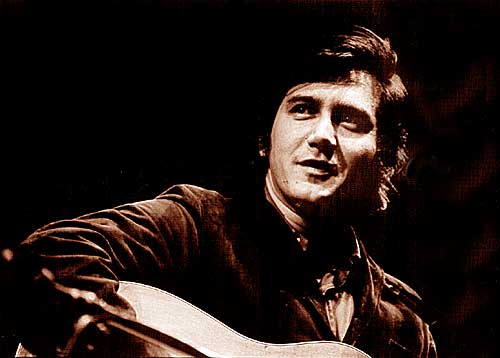
Phil Ochs Songs: http://betty.hypermax.net.au/ochs.htm
FROM:  OBITUARY FOR A FRIEND: Twenty Years Late ~
By Marty Gallanter

On a damp April morning, twenty-years ago, my friend Phil Ochs took
his own life. Such was the nature of our "friendship" that nearly a
week passed before I heard the news. Another friend, who knew that I
had been close to Phil in the old days, heard eulogizing on WBAI radio
(New York City), figured out what happened, and called me. Had he not
phoned, more weeks might have passed before word reached me. With just
so little fanfare, an icon of the Sixties, arguably one of the best
singer-songwriters of the decade, disappeared with only a few notified
to mourn.

The death of Phil Ochs was not news because, in part, Phil himself had
not been newsworthy for several years. His internal demons, some from
his mind and others from a bottle, helped to isolate Phil from friends
and fans. By the last days, most who were left were related by blood.
I guess that the loneliness, like for many suicides, made life too
hard. I'm guessing because I hadn't seen Phil Ochs for years. My last
memories are imprinted differently than for those who were with him at
the end.

I met Phil Ochs in 1962 in Greenwich Village. I was still in high
school. He had dropped out of college in Ohio and was not long in New
York. Phil played the early opening set at one of those pass-the-hat
coffee houses where a high-school buddy and I, new to the folk scene,
constituted the entire audience. We forced him to perform forty
minutes of Woodie Guthrie tunes. Later, when the house was full and
the man returned for his second time on stage, we heard the genius of
this singer-songwriter. We sat with our mouths open, listening to a
full-set of his own topical-political music. Some songs were
laugh-out-loud funny and others were coated with the anger that would
eventually make the decade more than memorable. For me, that was the
day the Sixties started.

Afterward, I went backstage to apologize for making him sing anything
other than his own music. It was the best apology I ever made because
the act became the starting point of our friendship. And, as a friend
and a fan, I witnessed some significant moments in his career. He rode
to his first AM New York radio performance in my 1950 Plymouth, an
appearance that I had personally arranged. I listened as he rehearsed
the songs that became the demo that became the first album. And I
ferried him up Sixth Avenue and down Fifth, over and over, when he
found the front seat of my car to be an inspirational song-writing
environment. I was with him for a few of his early career highlights
and he repaid me by being with me for most of my major life events.

Being a Jewish boy from a middle class, middle-of-the-road family,
Phil Ochs was a new experience for me. I'd met my first genuine
radical before I even knew the word "radical" had a political meaning.
To Ochs, music was a means to carry a message. And he had friends that
felt the same way. Over the next few months, I found myself in the
presence of Tom Paxton, Pete Seeger, Patrick Sky, Peter LaFarge and
even, on two separate occasions, Bob Dylan himself. I was too young
and naive to even know how impressed I should be.

Phil and his friends looked at things through different eyes.
Established opinion was challenged because it was established
opinion... no further criteria required. Examinations of marathon
issues often took place late at night, when the clubs and coffee
houses were closed and the debate, mixed with an occasional new song,
was the centerpiece until dawn. Though many discussions took place in
bars, no one drank much in those days. There were many cigarettes but
no other drugs beyond small amounts of alcohol and lots of caffeine.
Those conversations were filled with an unending optimism that claimed
young men and women could change the world for the better if only they
were willing. In those dialogues, this child started to grow up.

Because of Phil Ochs, I did things I would not have done without him.
I defied my father and took the 1950 Plymouth to the great Civil
Rights March on Washington where I heard and saw, for the one time in
my life, the Reverend Martin Luther King, Jr. In one of those twists
of living, Phil couldn't go with me. His first (and only) child was
about to be born and he said his wife would kill him if he was away
when that happened. Almost a year later, I babysat for that child in
Phil's room in the Cliff Walk Manor during the 1964 Newport Folk
Festival. She wouldn't go to sleep until I picked up a guitar and
played some of her father's music.

Phil Ochs radicalized me. He took the liberal Jewish teen and
transformed him into a real political person. He didn't change me
through brain-washing or constant polemic. Phil Ochs made my partisan
feet march through the simple, straightforward sense of his music. He
did this for me and for tens of thousands of others back in those good
times when the focus of the national crusade still was caring for
others.

When I got to college, I gravitated toward the activists and married
one of them... because of Phil Ochs. I invested myself in the
"Movement," first for Civil Rights and then for Peace, because of Phil
Ochs. I would never have ended up in the commune had I not met Phil,
nor in Mississippi, nor in Chicago. These were the places his path
carried me. Those two civil rights arrests would not have appeared in
my FBI file, the same arrests I will point to proudly when my someday
grandchild asks me what I did in those times. In the coincidences of
radical life, one of those arrests centered around Tom Hayden who
later became a Chicago Seven defendant and sat in Judge Hoffman's
court as Phil Ochs testified for our side.

Even now, having moved to rural Minnesota where I am often an advocate
for issues unique to this farmer's world... when I write an article or
call my congressman, I am coming from where Phil sent me.

I lost personal touch with Phil Ochs when he moved to California. I
bought his records, listened as his "I Ain't a'Marchin' Anymore"
became a signature song of the anti-war movement and his "There But
for Fortune" became a top-forty hit recorded by Joan Baez. I watched
his occasional television appearances, went to a few concerts but
never backstage. Having been a friend and a confidant, I just couldn't
bring myself to be one more fan trying to get an autograph. So I chose
to stay in the crowd and enjoy the memory close up and the man from
far away.

An article in the October, 1976 edition of Esquire, by John Berendt
was headlined with "While the Movement died a natural death, the music
died by hanging." He was only half right. The Movement did not die, it
evolved. Despite what those on the right say, even now, there are lots
of us who remain true believers and live those beliefs most days of
our lives. But Phil Ochs did die, twenty-years ago, on damp April
morning and I still miss him.
---
Photo:  http://www.altmanphoto.com/phil.ochs.sm.jpeg
---
Songs About Phil Ochs ~

The Parade's Still Passing By
By Harry Chapin

I got the news today
That you refused to play
Cause you never made number one
But it's not just the words
It's the deeds that are heard
When all is said and done
Kings take their crowns
They melt them all down
Trying to get the gold out
You went to hell and
Even when you weren't selling
You never ever sold out.

You weren't no leader,
You were more like a bleeder
Who was trying to cry for us all
You weren't no sage
But your sense of outrage
Sounded like a trumpet call
Fifteen years ago
In the old folky show
You were just one voice in the crowd
But now with so few singing
Your voice would have been ringing
Out 'bout twice as loud.

There but for fortune
Say a small circle of friends
Some may see the changes
So few see the ends
The pleasures of the harbor
Have come to you at last
You may not be marching anymore
But the parade's still going past.

I'm not taking the blame
That we killed you
You know you did that to yourself
But it was kind of a shame
That you played that game
You were better than anyone else
One shot of your bottle
Got you full throttle
It was the friend that was always there
But your greatest gift
And the curse you lived with
Was that you could always care.
---
Legends
By Sammy Walker

The first time that I called you in that old
New York hotel
It was Halloween all over with that trick you
played so well
I woke you up from dreaming singing songs
of yesterday
We took a drive to Newport to hear
St. Peter play

chorus:
Dust on you mouth, legends on your mind
Hanging out with Bogart in some
bygone place and time
Sing me your sweet Changes when I'm
feeling down and blue
And I'll treasure precious hours that
I stole away with you

Oh the muggy nights in Soho, I had
so much to learn
You gave me wings to fly away and
asked for no return
Lon Chaney's ghost beside you wore
the face of Mickey Finn
And I never once suspected that
you and he were friends

The last that I saw you you weren't
really even there
I cried when I heard you come across
out on the air
You bid your last farewell just like
your first hello
And I'll always think about you when
I pass through Ohio
---
I Dreamed I Saw Phil Ochs Last Night
By Billy Bragg

i dreamed i saw phil ochs last night
alive as you or me
says i to phil "you're ten years dead"
"i never died' says he
"i never died" says he

the music business killed you phil
they ignored the things you said
and cast you out when fashions changed
says phil "but i ain't dead"
says phil "but i ain't dead"

the fbi harassed you phil
they smeared you with their lies
says he "but they could never kill
what they could not compromise
i never compromised"

"though fashion's changed and critics sneered
the songs that i have sung
are just as true tonight as then
        the struggle carries on
        the struggle carries on"

with the song of freedom rings out loud
from valleys and from hills
where people stand up for their rights
phil ochs is with us still
phil ochs inspires us still.
---
Phil
By Tom Paxton

I opened the paper, there was your picture
Gone, gone, gone by your own hand
I couldn't believe it, the paper was shakin'
Gone, gone, gone by your own hand

I know I'm gonna spend the rest of my
lifetime wondering why
You found yourself so badly hurt you had to die

I opened the paper, there was your picture
Gone, gone, gone by your own hand
The phone started ringing, had I heard about it?
I shook every time I heard it ring
What was my reaction? I put the phone down
That was the only news that was fit to sing

They ask about Dylan, about MacDougal
Street and Third
Question piled on question and each
question more absurd

I opened the paper, there was your picture
Gone, gone, gone by your own hand

Oh, I remember "There But For Fortune",
There but for fortune you and I would go
Fortune turned its back on you,
Or so it must have seemed to you,
Christ alone knows what was the final blow

The last time I saw you, the last time I saw you,
Bleeker Street outside the Other End
I told you I'd see you, I got distracted
I never saw your face again

I heard that you were feeling stronger every day
I heard that you were well with good things
on their way

Then I opened the paper, there was your picture
Gone, gone, gone by your own hand.
---
Photo:  http://betty.hypermax.net.au/ochs3.jpg
---
Phil Ochs' testimony at the Chicago Seven trial (Hilarious) ~

MR. KUNSTLER: Will you state your full name, please?
THE WITNESS: Philip David Ochs.
MR. KUNSTLER: What is your occupation?
THE WITNESS: I am a singer, a folksinger.
MR. KUNSTLER: Now, Mr. Ochs, can you indicate what kind of songs you
sing?

THE WITNESS: I write all my own songs and they are just simple
melodies with a lot of lyrics.  They usually have to do with current
events and what is going on in the news.  You can call them topical
songs, songs about the news, and then developing into more
philosophical songs later.

MR. KUNSTLER: Now, Mr. Ochs, did there ever come a time when you met
any of the defendants at this table?

THE WITNESS: Yes.  I met Jerry Rubin in 1964 when he was organizing
one of the first teach-ins against the war in Vietnam in Berkeley.  He
called me up.  He asked me to come and sing.

MR. KUNSTLER: Now did you have any occasion after that to receive
another such call from Mr. Rubin?

THE WITNESS: I met him a few times later in regard to other political
actions.  I met him in Washington at the march they had at the
Pentagon incident, at the big rally before the Pentagon.

MR. KUNSTLER: Now, Mr. Ochs, have you ever been associated with what
is called the Youth International Party, or, as we will say, the
Yippies?

THE WITNESS: Yes.  I helped design the party, formulate the idea of
what Yippie was going to be, in the early part of 1968.

MR. KUNSTLER: Can you indicate to the Court and jury what Yippie was
going to be, what its purpose was for its formation?

THE WITNESS: The idea of Yippie was to be a form of theater politics,
theatrically dealing with what seemed to be an increasingly absurd
world and trying to deal with it in other than just on a straight
moral level.  They wanted to be able to act out fantasies in the
street to communicate their feelings to the public.

MR. KUNSTLER: Now, were any of the defendants at the table involved in
the formation of the Yippies?

THE WITNESS: Yes, Jerry Rubin and Abbie Hoffman.

MR. KUNSTLER: Can you just point to and identify which one is Jerry
Rubin and which one is Abbie Hoffman?

THE WITNESS: Yes, Jerry Rubin with the headband and Abbie Hoffman with
the smile.

MR. KUNSTLER: Can you indicate in general to the Court and jury what
the plans were for the Yippies in Chicago during the Democratic
National Convention?

THE WITNESS: The plans were essentially--
MR. FORAN: I object.
THE COURT: I sustain the objection.

MR. KUNSTLER: Your Honor, one of the central roles in this case is the
Yippie participation around the Democratic National Convention.

THE COURT: I don't see that allegation in the indictment.

MR. KUNSTLER: Well, the indictment charges these two men with certain
acts in connection with the Democratic National Convention.

THE COURT: These two men and others, but not as Yippies, so-called,
but-- as individuals.

MR. KUNSTLER: All right, your Honor, I will rephrase the question.
Did there come a time when Jerry and Abbie discussed their plans?

THE WITNESS: Yes, they did, around the middle of January at Jerry's.
Present there, besides Abbie and Jerry, I believe, was Paul Krassner
and Ed Sanders.  Tim Leary was there at one point.

MR. KUNSTLER: Can you tell the conversation from Jerry and Abbie, as
to their plans in coming to Chicago around the Democratic National
Convention?

THE WITNESS: OK.  Jerry Rubin planned to have a Festival of Life
during the National Convention, basically representing an alternate
culture.  They would theoretically sort of spoof the Convention and
show the public, the media, that the Convention was not to be taken
seriously because it wasn't fair, and wasn't going to be honest, and
wasn't going to be a democratic convention.  They discussed getting
permits.  They discussed flying to Chicago to talk with Mayor Daley.
They several times mentioned they wanted to avoid violence.  They went
out of their way on many different occasions to talk with the Mayor or
anybody who could help them avoid violence--

MR. KUNSTLER: Now, Mr. Ochs, do you know what guerrilla theater is?

THE WITNESS: Guerrilla theater creates theatrical metaphors for what
is going on in the world outside.
For example, a guerrilla theater might do, let us say, a skit on the
Viet Cong, it might act out a scene on a public street or in a public
park where some actually play the Viet Cong, some actually play
American soldiers, and they will dramatize an event, basically create
a metaphor, an image, usually involving humor, usually involving a
dramatic scene, and usually very short.  This isn't a play with the
theme built up.  It's just short skits, essentially.

MR. KUNSTLER: Did Jerry Rubin or Abbie Hoffman ask you to do anything
at any time?

MR. FORAN: I object to that.
THE COURT: I sustain the objection.
MR. FORAN: I object to it as leading and suggestive.

MR. KUNSTLER: Did you have any discussion with Abbie and Jerry about
your role?
THE WITNESS: Yes.  In early February at Abbie's apartment.

MR. KUNSTLER: Can you state what Abbie Hoffman and Jerry Rubin said to
you and what you said to them?

THE WITNESS: They discussed my singing at the Festival of Life.  They
asked me to contact other performers to come and sing at the Festival.
I talked to Paul Simon of Simon and Garfunkel.  I believe I talked
with Judy Collins.

MR. KUNSTLER: Did there come a time, Mr. Ochs, when you came to
Chicago in 1968?

THE WITNESS: I came campaigning for Eugene McCarthy on M-Day, which I
believe was August 15, at the Lindy Opera House, I believe.

MR. KUNSTLER: After you arrived in Chicago did you have any discussion
with Jerry?

THE WITNESS: Yes, I did.  We discussed the nomination of a pig for
President.

MR. KUNSTLER: Would you state what you said and what Jerry said.

THE WITNESS: We discussed the details.  We discussed going out to the
countryside around Chicago and buying a pig from a farmer and bringing
him into the city for the purposes of his nominating speech.

MR. KUNSTLER: Did you have any role yourself in that?

THE WITNESS: Yes, I helped select the pig, and I paid for him.

MR. KUNSTLER: Now, did you find a pig at once when you went out?

THE WITNESS: No, it was very difficult.  We stopped at several farms
and asked where the pigs were.

MR. KUNSTLER: None of the farmers referred you to the police station,
did they?

THE WITNESS: No.
MR. FORAN: Objection.
THE COURT: I sustain the objection.

MR. KUNSTLER: Mr. Ochs, can you describe the pig which was finally
bought?

MR. FORAN: Objection.
THE COURT., I sustain the objection.

MR. KUNSTLER: Would you state what, if anything, happened to the pig?

THE WITNESS: The pig was arrested with seven people.
MR. KUNSTLER: When did that take place?

THE WITNESS: This took place on the morning of August 23, at the Civic
Center underneath the Picasso sculpture.

MR. KUNSTLER: Who were those seven people?

THE WITNESS: Jerry Rubin.  Stew Albert, Wolfe Lowenthal, myself is
four; I am not sure of the names of the other three.

MR. KUNSTLER: What were you doing when you were arrested?

THE WITNESS: We were arrested announcing the pig's candidacy for
President.

MR. KUNSTLER: Did Jerry Rubin speak?

THE WITNESS: Yes, Jerry Rubin was reading a prepared speech for the
pig---the opening sentence was something like, "I, Pigasus, hereby
announce my candidacy for the Presidency of the United States." He was
interrupted in his talk by the police who arrested us.

MR. KUNSTLER: What was the pig doing during this announcement?

MR. FORAN: Objection.

MR. KUNSTLER: Do you remember what you were charged with?

THE WITNESS: I believe the original charge mentioned was something
about an old Chicago law about bringing livestock into the city, or
disturbing the peace, or disorderly conduct, and when it came time for
the trial, I believe the charge was disorderly conduct.

MR. KUNSTLER: Were you informed by an officer that the pig had
squealed on you?

MR.  FORAN: Objection.  I ask it be stricken.
THE WITNESS: Yes.

THE COURT: I sustain the objection.  When an objection is made do not
answer until the Court has ruled. . .
*  *  *  *  *  *
MR. KUNSTLER:  Now, I call your attention to Sunday, August 25, 1968.
Did you have any occasion to see Jerry Rubin?

THE WITNESS: Well, ultimately I saw him at his apartment in Old Town
that night.

MR. KUNSTLER: Do you remember approximately what time that was?

THE WITNESS: I guess it was around, maybe, 9:30 approximately 9:30,
10:00.  He was laying in bed.  He said he was very ill.  He was very
pale.  We had agreed to go to Lincoln Park that night, and so I said,
"I hope You are still going to Lincoln Park." He said, "I don't know
if I can make it, I seem to he very ill." I cajoled him, and I said, I
said, "Come on. you're one of the Yippies.  You can't not go to
Lincoln Park." He said, "OK," and he got up, and he went to Lincoln
Park with me, and I believe Nancy, his girlfriend, and my girlfriend
Karen, the four of us walked from his apartment to Lincoln Park.

MR. KUNSTLER: And did you enter the park?

THE WITNESS: Just the outskirts, I mean we basically stood in front of
the Lincoln Hotel, and walked across the street from the Lincoln Hotel
and stood in the outskirts of the park.

MR. KUNSTLER: Now, did there come a time when people began to leave
Lincoln Park?

THE WITNESS: Yes, I guess it was around eleven o'clock at night.

MR. KUNSTLER: What did you do at that time?

THE WITNESS: Continued standing there.  We stood there and watched
them run right at us, as a matter of fact.

MR. KUNSTLER: Who was with you at this time?
THE WITNESS: The same people I mentioned before.

MR. KUNSTLER: Had you been together continuously since You first left
the apartment?

THE WITNESS: Continuously.

MR. KUNSTLER: And from the time you left the apartment to this time,
did you see Jerry Rubin wearing a helmet at any time?

THE WITNESS: No.

MR. KUNSTLER: By the way, how long have you known Jerry Rubin?

THE WITNESS: I have known Jerry Rubin approximately four years.

MR. KUNSTLER: Have you ever seen him smoke a cigarette?

THE WITNESS: No.

MR. KUNSTLER: Mr. Ochs, you said there came a time when you left the
area.  Where did you go?

THE WITNESS: We walked through the streets following the crowd.

MR. KUNSTLER: And can you describe what you saw as you followed the
crowd?

THE WITNESS: They were just chaotic and sort of unformed, and people
just continued away from the park and just seemed to move, I think
toward the commercial area of Old Town where the nightclubs are and
then police Clubs were there too, and it was just a flurry of movement
of people all kinds of ways.

MR. SCHULTZ: If the Court please, the witness was asked what he
observed and that was not responsive to the question.  If you would
simply tell the witness to listen carefully to the question so he can
answer the questions.

THE COURT: I did that this morning.  You are a singer but you are a
smart fellow, I am sure.

THE WITNESS: Thank you very much.  You are a judge and you are a smart
fellow.

THE COURT: I must ask you to listen carefully to the questions of the
lawyer and answer the question.  Answer the questions; do not go
beyond them.

MR. KUNSTLER: At any time, did you see Jerry Rubin enter Lincoln Park?

THE WITNESS: No.

MR. KUNSTLER: Now, Mr. Ochs, I call your attention to sometime in the
vicinity of 6:00 p.m. Tuesday, August 27.  Did you see Jerry Rubin?

THE WITNESS: Yes, in Lincoln Park.  He asked me to come and sing at a
meeting.

MR. KUNSTLER: Do you know what time approximately you sang after
arriving there, how long after arriving there?

THE WITNESS: Approximately a half-hour.

MR. KUNSTLER: Was anything happening in that half-hour while you were
there?

THE WITNESS: Bobby Seale was speaking.
MR. KUNSTLER: Did Jerry Rubin speak at all?
THE WITNESS: Yes, after I sang.
MR. KUNSTLER: Did you sing a song that day?
THE WITNESS: Yes, "I Ain't Marching Anymore."
MR. KUNSTLER: Did you sing at anybody's request?
THE WITNESS: At Jerry Rubin's request. .

MR. KUNSTLER: I am showing you what has been marked at D-147 for
identification and I ask you if you can identify that exhibit.

THE WITNESS: This is the guitar I played "I Ain't Marching Anymore"
on.

THE COURT: How can you tell? You haven't even looked at it.

THE WITNESS: It is my case.
THE COURT: Are you sure the guitar is in there?
THE WITNESS: I am checking.

MR. KUNSTLER: Open it up, Mr. Ochs, and see whether that is your
guitar,

THE WITNESS: That is it, that is it.

MR. KUNSTLER: Now, would you stand and sing that song so the jury can
hear the song that the audience heard that day?

MR. SCHULTZ: If the Court please, this is a trial in the Federal
District Court.  It is not a theater.  We don't have to sit and listen
to the witness sing a song.  Let's get on with the trial.  I object.

MR. KUNSTLER: Your Honor, this is definitely an issue in the case.
Jerry Rubin has asked for a particular song to be sung.  What the
witness sang to the audience reflects both on Jerry Rubin's intent and
on the mood of the crowd.

THE COURT: I sustain the objection.

MR. KUNSTLER: Your Honor, he is prepared to sing it exactly as he sang
it on that day,

THE COURT: I am not prepared to listen, Mr. Kunstler.

MR. KUNSTLER: Do you recall how long after you sang in Lincoln Park
that you were somewhere else?

THE WITNESS: I arrived at the next place around seven-thirty, quarter
to eight at the Coliseum.

MR. KUNSTLER: Were any of the defendants present at that time?

THE WITNESS: Abbie Hoffman was there, and I do not remember if Jerry
Rubin was there.

MR. KUNSTLER: Where did you see Abbie Hoffman first that night at the
Coliseum?

THE WITNESS: When he raced in front of me on the stage when I was
introduced to Ed Sanders.  He said, "Here's Phil Ochs," and as I
walked forward, Abbie Hoffman raced in front of me and took the
microphone and proceeded to give a speech.  I was upstaged by Abbie
Hoffman.

MR. KUNSTLER: At the time when you first saw Abbie Hoffman there that
night, can you approximate as best you can the time it was when you
first saw him take the microphone?

THE WITNESS: Approximately 8:30.
MR. KUNSTLER: Your Honor, I have no further questions.
*  *  *  *  *  *
MR. SCHULTZ: You were at the Bandshell, were you not?
THE WITNESS: Yes.
MR. SCHULTZ: What time did you arrive at the Bandshell?

THE WITNESS: I don't remember.  I'd guess it was around three or after
in the afternoon.

MR. FORAN: You seem to have a little trouble with time.  Do you carry
a watch with you?

THE WITNESS: Just lately.

MR. FORAN: As a matter of fact, when it comes to time during that
week, it is pretty much of a guess, isn't it?

THE WITNESS: I guess so.

MR. FORAN: And the time you arrived at the Coliseum it was 9:00 or
9:30, isn't that right?  Or at 6:00 or 6:30?

THE WITNESS: No, because the normal opening time of the shows was
around 8:00 and I think the show was starting when I got there.  That
is a safer guess than the other time.

MR. FORAN: It is still a guess though, isn't it?
THE WITNESS: Yes, it is a guess.

MR. SCHULTZ: And now you say at the Coliseum, Abbie Hoffman upstaged
you, is that right?

THE WITNESS: Yes.  I was walking toward the microphone and he raced in
front of me.

MR. SCHULTZ: And he led the crowd in a chant of "Fuck LBJ" didn't he?

THE WITNESS: Yes, yes, I think he did.

MR. SCHULTZ:  You didn't remember that on direct examination very
well, didn't you?

THE WITNESS:  I guess not.

MR. SCHULTZ:  Abbie Hoffman is a friend of yours, isn't he?

THE WITNESS:  Yes and no.

MR. SCHULTZ:  Now in your plans for Chicago, did you plan for public
fornication in the park?

THE WITNESS:  I didn't.

MR. SCHULTZ: In your discussions with either Rubin or Hoffman did you
plan for public fornication in the park?

THE WITNESS: No, we did not seriously sit down and plan public
fornication in the park.

MR. SCHULTZ: Did Rubin say at any of these meetings that you must
cause disruptions during the Convention and on through Election Day,
mass disruptions?

THE WITNESS: No.

MR. SCHULTZ: Was there any discussion when you were planning your
Yippie programs by either Rubin or Hoffman of going into the downtown
area and taking over hotels for sleeping space?

THE WITNESS: No.

MR. SCHULTZ: Did the defendant Rubin during your planning discussion
tell you if he ever had the opportunity and at one of his earliest
opportunities he would, when he found some policemen who were isolated
in the park, draw a crowd around him and bring the crowd to the
policemen and attack the policemen with rocks and stones and bottles,
and shout profanities at the policemen, tell them to take off their
guns and fight?  Did he ever say he was going to do that?

THE WITNESS: No, he didn't, Mr. Schultz.

MR. SCHULTZ: Now, Mr. Ochs, you say that on Sunday night you were with
Mr. Rubin all night, is that right?

THE WITNESS: From 9:30 maybe, until after 12:00.

MR. SCHULTZ: And of course you have been told by somebody that there
is evidence that Mr. Rubin was in Lincoln Park that night, isn't that
right?  Well, were you told, or not?

THE WITNESS:  Yes.

MR. SCHULTZ:  Were you told that somebody saw him with a cigarette in
his hand?

THE WITNESS:  No, I was not told that.
MR. SCHULTZ:  Well, what were you told, please?

THE WITNESS:  I was told very little.  I was told that Jerry was
accused of something

MR. SCHULTZ: Who told you all these things?

THE WITNESS: Mr. Kunstler told me the one thing, not all these things,
something that Jerry was accused of something in the park on Sunday
night, and that's all I was told, nothing else.

MR. SCHULTZ: You don't want to get Mr. Kunstler into trouble, do you?

MR. KUNSTLER: Your Honor, first of all--

MR. SCHULTZ: Suddenly he backs off--suddenly he backs off.  It is all
too patent, your Honor.

THE COURT: Will the record show that Mr. Kunstler--

MR. KUNSTLER: Yes, I did, your Honor, I think it is a disgraceful
statement in front of a jury.

THE COURT: --threw a block of papers noisily to the floor.

MR. KUNSTLER: All right.  I dropped papers noisily to the floor.

THE COURT: I shall not hear from you in that tone, sir.

MR. KUNSTLER: I am sorry for putting the paper on the table, and it
fell off onto the floor, but to say in front of a jury, "That is too
patent" and "What are you backing off for?" I think, your Honor, any
Court in the land would hold that is unconscionable conduct, and if I
am angry, I think I am righteously so in this instance.

THE COURT: That will be all.
Continue with your cross-examination.

MR. SCHULTZ: In any event, Mr. Ochs, you are absolutely sure you never
really went beyond the fringes of the park with Jerry Rubin that
night, isn't that right?

THE WITNESS: Yes.

MR. SCHULTZ: You just stood right along the fringes all that night,
you never went in to see what was happening at the command post, did
you?

THE WITNESS: No.

MR. SCHULTZ: You never walked in to see what was happening at the
fieldhouse, did you?

THE WITNESS: No.
MR. SCHULTZ: That is all, your Honor.
THE COURT: You may step down.
(witness excused)
THE COURT: Don't forget your guitar.
THE WITNESS: I won't.
THE COURT: Call your next witness.
---
Photo:  http://www.jimmccrary.com/pages/page5/images/09ochs.jpg
---
You Can't Get Stoned Enough ~
By Phil Ochs

When the troubles of the world rest upon your weary shoulder
When the wind that blows upon your face is blowing colder
And every hour tells you you're getting older
No you can't get stoned enough

Chorus:

And you're high high high high
That's all you want to do
Any way you get there, yeah
That's alright with you
You've been warned warned warned warned
Seems that's all you've heard
But today is your trouble tomorrow's only a word

When your baby says she'll stick with you until the end
And then she says she only wants to be your friend
And you find yourself alone out in the street again
No you can't get stoned enough

And when you start to feelin' that no one cares
And it seems that all your good time friends have disappeared
And you reach into the night and find that nobody's there
No you can't get stoned enough
---
Photo:  http://www.in.gr/bioimg/O2_01.jpg
---


--
King Daevid MacKenzie, WLSU-FM 88.9 La Crosse, Wisconsin, USA
http://laxradio.blogspot.com http://wpr.org/music/
http://ultimajock.blogspot.com
"Why do people take drugs anymore, when reality has become a hallucination?"
LEWIS BLACK


------------------------ Yahoo! Groups Sponsor --------------------~-->
Ever feel sad or cry for no reason at all?
Depression. Narrated by Kate Hudson.
http://us.click.yahoo.com/Ntf6vA/esnJAA/d1hLAA/0NYolB/TM
--------------------------------------------------------------------~->

Apply for Commercial Real Estate loans online and submit your deal to dozens of
hungry lenders in just minutes. Loan programs for all types of business and
commercial real estate. Apply anytime at http://realestatezoo.com

b i s e x u a l
===============
a bifem.net publication

Post message: [email protected]
Subscribe:  [EMAIL PROTECTED]
Unsubscribe:  [EMAIL PROTECTED]
List owner:  [EMAIL PROTECTED]
Web Site: http://groups.yahoo.com/group/Bisexual


Yahoo! Groups Links

<*> To visit your group on the web, go to:
    http://groups.yahoo.com/group/Bisexual/

<*> To unsubscribe from this group, send an email to:
    [EMAIL PROTECTED]

<*> Your use of Yahoo! Groups is subject to:
    http://docs.yahoo.com/info/terms/