Gear And Pulley Speeds
When building or modifying machinery it is necessary to calculate the size
of gears or pulleys required to run a tool at a certain speed. Sometimes it
is relatively simple, if you are replacing a 3450 RPM motor with a 1725 RPM
one usually all you have to do is double the size of the pulley on the motor
to run the machine at the same speed.

Going the other way, replacing a 1725 RPM motor with a 3450 RPM motor may
not be so simple if the driving pulley on the motor is already a small
diameter. The required pulley would be too small to be practical so the
driven pulley would have to be replaced, however if this pulley is already
fairly large, doubling the size of it would again be impractical. To get
around this the pulley on the motor will have to be somewhat smaller and the
pulley on the machine will have to be somewhat larger, this can be
calculated using a formula.

Gear Speeds & Sizes

Speed of Driven Gear = Teeth on driving gear multiplied by RPM of driving
gear divided by teeth on driven gear.

Teeth of Driven Or Driving Gear = Teeth on gear multiplied by its RPM
divided by RPM required.

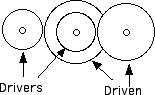
Speed of Last Driven Gear

Divide product of driving gear sizes (number of teeth) by product of driven
gear sizes and multiply quotient by RPM of first driving gear, this equals
speed of last driven gear.

http://benchnotes.com/Gear%20and%20pulley%20Speeds/gears.jpg

Ratios of Gear Drives

A gear ratio indicates the speed relationship between driving and driven
gears. For example if a driving gear has 15 teeth and the driven gear has 45
teeth the ratio is 45 divided by 15 which equals 3 giving a ratio of 3 to 1.

Pulley Speeds and Sizes

Size of Driven or Driving Pulley = Diameter of pulley multiplied by its RPM
divided by RPM required.

Speed of Last Driven Pulley

Divide product of driving pulley diameters by product of driven pulley
diameters and multiply quotient br RPM of first driving pulley, this equals
speed of last driven pulley.


Power Twist Link Belt


Turn your tools into smooth operators! Reduce vibration on table saws, drill
presses, and other tools by as much as 35% with this unique belt. Whereas
traditional belts can stretch and become misshapen (creating vibration as
they rotate), the Power Twist Link Belt is made up of interlocking segments
of polyurethane elastomer and multiple plies of polyester fabric that retain
their original shape, thereby reducing vibration. What's more, you can
easily add or subtract links to get optimal tension on most machines!

 <http://www.rockler.com/product.cfm?page=6040&sid=AF078> Power Twist Link
Belt

 <http://www.rockler.com/product.cfm?page=6040&sid=AF078> Power Twist Link
Belt


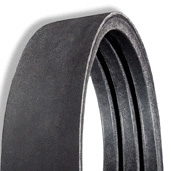
http://benchnotes.com/Gear%20and%20pulley%20Speeds/ribs.jpg

Problems such as whipping and twisting with multiple belt driven
applications may be alleviated using a single bonded style belt.


[Non-text portions of this message have been removed]