On Sat, Nov 04, 2000 at 11:22:37PM -0600, Dan Minette wrote:

> Well, I've gotten some numbers from a Rice University site. It is
> argued that the KT type impact, the dinasour killer, happens about
> once every 10-8 years.  That is a kill all of humanity type strike.
> Kill 1 million people strikes happen every 200k years. Kill 10,000
> people strikes happen every few hundered years. Integrate them out,
> and it probably is higher than a one in 250,000 chance...which is the
> likelyhood of being killed by lightning.

Death odds are generally quoted as deaths per 100,000 people per year.
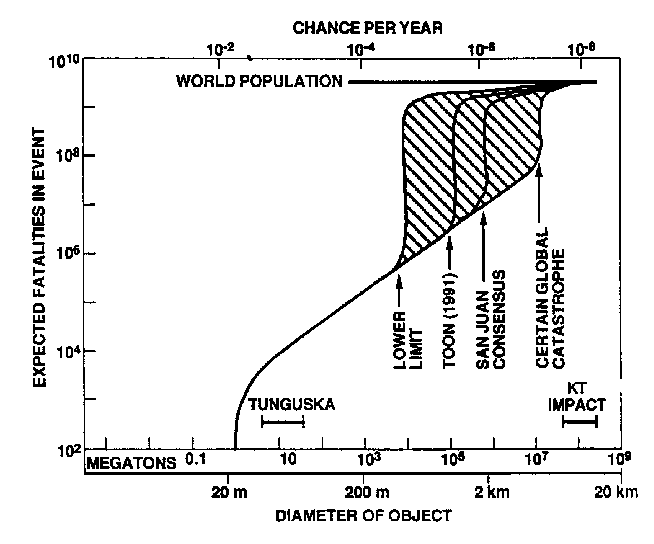
Using a chart from the link provided by Dan,

  http://www.ruf.rice.edu/~leeman/Spaceguard_figure_2-5.gif

and making some assumptions (biggest assumption was that they binned
their probabilities for asteroid sizes in orders of magnitude of
diameter, i.e., 20m, 200m, 2km, etc.) I get that the average number of
worldwide fatalities per year due to asteroids over a very long time
period (billions of years) would be in the range 100 to 1000 which gives

  (asteroids) 0.001 to 0.01 deaths per hundred thousand per year

Most of the deaths in that bizarre average come from an asteroid of
several kilometers in diameter, of which about 10 should hit the earth
over a period of 10 million years (about 1 hit every million years).
Another interesting number from that chart is that about 10 asteroids
large enough to kill more than 10,000 people should impact the earth in
the next 10,000 years.

According to these pages

  http://www.nsc.org/lrs/statinfo/odds.htm
  http://www.stats.org/spotlight/2200.html

for lighting the figure is in the range

  (lightning) 0.02 to 0.04 deaths per hundred thousand per year (in the U.S.)

So being killed by an asteroid is slightly less likely than being killed
by lightning.

But this is comparing apples to oranges, since lightning usually only
kills a small number of people, but an asteroid could kill everyone
on earth. If we were to just count the probability of a single person
being hit by a smallish meteorite, we come up with something around
0.00001 deaths per hundred thousand per year (this number is derived
from statistics on cars hit by meteorites). Also, the asteroid odds are
strange, since to get the probabilities it is necessary to average over
millions of years and make assumptions about the human population. And
since I have no idea what will happen to humans on that time scale, I
just assumed the population of the world would be 6 billion people over
that time. Which is a baseless assumption.

In other words, don't read much meaning into those numbers.

For reference, here are some more meaningful number. They are deaths per
hundred thousand per year stats (mostly from the NSC's page):

deaths per hundred
thousand per year        cause
-------------------------------------------------------------
870                    U.S. death rate (total for all causes)
200                    coronary heart disease
 16                    motor vehicles
 12                    suicide
  8                    homicide
  6                    falls
  1.4                  fire
  0.4                  air or space transport
  0.3                  struck by falling object (NOT meteorite!)
  0.02                 lightning
  0.003                fireworks
  0.00001              struck by small meteorite


--
"Erik Reuter" <[EMAIL PROTECTED]>       http://www.erikreuter.com/