Subject: The ARRL Contest Update for January 28, 2015
If you are having trouble reading this message, you can see the original at:
http://www.arrl.org/contests/update/?issue=2015-01-28

 The ARRL ContestUpdate <http://www3.arrl.org/nl/cu/nlcuhead.gif>

January 28, 2015

Editor: Ward Silver, NØAX <mailto:[email protected]>

 <http://www.arrl.org/contests/update/> Contest Update Archive

Contest Calendar <http://www.arrl.org/contests/calendar.html>

ARRL Home Page <http://www.arrl.org/>

 <http://www.arrl.org/nladclick.php?n=cu&i=2015-01-28&t=t> Ad


IN THIS ISSUE

*       On Your Marks, Get Set, Sprint! <>
*       Northern Contests from VT, MN, BC, and FYBO <>
*       New Rules for DXCC and ARRL VHF+ Contests <>
*       HFTA Terrain Files - Automated at Last! <>
*       The Northern Lights Began to Glow <>
*       ARRL SS and IARU HF Results Online <>
*       Protect that Front End <>
*       Receive Antennas for All <>
*       Field Day - Ham Radio's Open House <>

NEW HF OPERATORS - THINGS TO DO

Now it's your turn to be an on-the-air or in-the-shack Elmer! The School Club
Roundup is a great opportunity to help students and other new hams successfully
make contacts. Starting on February 9th, they'll probably be on mostly after
school but listen for the teams any time! There are a couple of fast-paced
sprint contests, too - the newly re-sponsored SSB Sprint is this weekend and
the NCJ-sponsored CW Sprint follows on the next weekend.

BULLETINS

There are no bulletins in this issue

BUSTED QSOS

Errors in the previous issue were apparently hard to find!

CONTEST SUMMARY

Complete information <>  for all contests follows the Conversation <>  section

January 31-February 1

*       Feld-Hell WAAAEO Sprint
*       Worldwide EME Contest
*       UBA Contest--Phone
*       SSB Sprint
*       OK1WC Memorial Contest (Feb 2)
*       ARS Spartan Sprint--CW (Feb 3)
*       CWOps Weekly Mini-CWT Tests (Feb 4)

February 7-8

*       North American Sprint--CW
*       School Club Roundup (Feb 9)
*       NS Weekly RTTY Sprint (Feb 6)
*       NS Weekly Sprint--CW (Feb 6)
*       YL-OM Contest (Feb 6)
*       Triathlon DX Contest
*       Vermont QSO Party
*       YLISSB QSO Party
*       Ten-Ten Winter Phone QSO Party
*       Black Sea Cup International
*       Straight Key Weekend Sprintathon
*       FYBO Winter QRP Field Day
*       Minnesota QSO Party
*       Straight Key Party
*       British Columbia QSO Party
*       XE Int'l RTTY Contest
*       AM QSO Party
*       Classic Exchange--Phone
*       Milwaukee FM Simplex Contest

NEWS, PRESS RELEASES, AND GENERAL INTEREST

At the ARRL Board meeting on January 16-17, changes
<http://www.arrl.org/news/arrl-board-okays-changes-to-dxcc-program-vhf-and-above-contesting-rules>
  were approved to the DXCC program rules regarding remote operation and to the
VHF+ contest program rules. The DXCC changes aligned the awards's rules with
those of the ARRL contest program which have been in effect for several years.
The new rules for VHF+ contesting go into effect with the June VHF Contest and
allow the use of spotting assistance, self-spotting, and multiple-band
transmissions in all categories of operation. Updates to the online rules for
both DXCC and contests will be published soon.


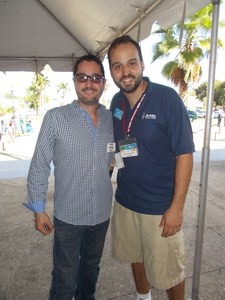
<http://www3.arrl.org/nl/cu/image/Contest%20Update%20-%202015%20Jan%2028/Felipe%20NP4Z%20and%20Otis%20NP4G%20at%20KP4%20Convention%20-%20N0AX.jpg>


On the left is a familiar contester - Felipe NP4Z. His companion is the ARRL
Southeaster Division's Assistant Director, Otis NP4G, who was also very busy as
chairman of the Puerto Rico State Convention in Hatillo, PR on the islands
northwest coast. I had a great time - wonderful hospitality at a nice place to
be in late January - highly recommended! (Photo by NØAX)

Reverse Beacon Network (RBN) contributors (current or prospective) can now find
everything they need online to be able to send CW and RTTY Skimmer Server spots
to the RBN using a single Aggregator and a single QS1R SDR receiver. The
information, plus a new version of Aggregator is all on the RBN website
<http://www.reversebeacon.net/pages/Aggregator+19>  in three relatively small
downloads. (Thanks, Pete N4ZR)

It's hard to remember the days before integrated circuits! Here's an
interesting history, "25 Microchips That Shook The World
<http://spectrum.ieee.org/semiconductors/processors/25-microchips-that-shook-the-world#comments>
 " from IEEE Spectrum. One of my favorites is missing but it's hard to argue
that the collection in the article weren't important. (Thanks, Dennis N6KI)

Imagine a multi-dimensional hamfest and you have...a Maker Faire
<http://makerfaire.com/> ! Here are four upcoming events that will have
something fun for every ham including a combo with the South Florida Tropical
Hamboree <http://hamboree.org/> :

*       Hamboree Mini Maker Faire (FL): January 30-31
*       Caguas Mini Maker Faire (Puerto Rico): January 31
*       Boulder Mini Maker Faire (CO): January 31-February 1
*       Kalispell Mini Maker Faire (MT): February 28

There are a lot of interesting protocols being devised for HF data. To test out
their creations, inventors usually get an experimental license from the FCC.
From the list of those licenses
<http://www.tvtechnology.com/distribution/0099/list-of-experimental-licenses-reveals-interesting-hf-data-comm-experiments/274152>
  and the stated purpose behind them, we can get an idea of what technology
might be headed our way! (Thanks, Tim K3LR)

A updated prediction for future solar cycles
<http://solarscience.msfc.nasa.gov/predict.shtml>  has been released by NASA. I
can't say 10 meter fans will be very happy but the low banders are probably
celebrating in the streets! Summarizing the report, "Cycle 24 will be a low
cycle very likely to be followed by several other low or even lower cycles -
supported by the current and historical data. Make the most of the current band
conditions and upcoming DXpeditions - it certainly looks as if we are heading
toward a 'Propagation Winter.'" (From ARRL Propagation Bulletins
<http://arrl.org/w1aw-bulletins-archive-propagation>  ARLP003 and ARLP004)

Maybe these fancy sunspot spectacles <http://dashtoons.com/Spex.html>  will
help out with propagation and speaking of Gotham beams, they aren't all off the
air. The story "W3AU, VU2MV, VU2JN and the Gotham Beam!
<http://www.k3lr.com/2015/beam.htm> " tells the tale of one such monobander put
to work once again. (Thanks, Tim K3LR)

Could that gigantic radio burst
<http://science.slashdot.org/story/15/01/19/200205/astronomers-record-mystery-radio-signals-from-55-billion-light-years-away>
  detected from 5.5 billion light years away just be some alien amateur testing
a new solar-system-sized amplifier? Or maybe it was just the start of a CQ
Galaxy-Wide Contest! Maybe it was a very short DXpedition to a black hole -
"This was our first view of the AHHHHHHHhhhhhh....!


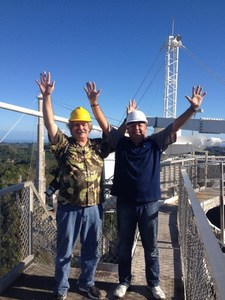
<http://www3.arrl.org/nl/cu/image/Contest%20Update%20-%202015%20Jan%2028/K7JA%20and%20WP3R%20at%20Arecibo%20-%20by%20KL7MF.jpg>


Look ma, no hams, er, hands! That's Chip K7JA (left) and Arecibo Observatory
Head of Telescope Operations and RFI/Spectrum Manager, Angel WP3R doing "The
Gentry" (after K9PG) on the catwalk of the suspended receiver structure. It's a
long way down to the dish! (Photo by KL7MF)

The Super Check Partial (SCP) databases used by most contest logging software
is maintained by Stu K6TU. He is preparing an update to the database and
requests that you send him recent contest logs. More info on the SCP database
and contributing logs is available online <http://www.supercheckpartial.com/> .

The Missouri QSO Party <http://www.w0ma.org/mo_qso_party/index.html> , coming
up on April 4-5, has made some major changes to the exchange, bands, modes, and
other rules this year. Be sure your logging software supports these changes.
(Thanks, George ABØRX)

Following up on the recent article
<http://www.slate.com/articles/technology/future_tense/2013/04/green_bank_w_v_where_the_electrosensitive_can_escape_the_modern_world.single.html>
  about the National Radio Quiet Zone and the people who flock there, the ARRL
relayed a note from Rob N3RW about getting permission to use the HF Bruce Array
<http://rudys.typepad.com/ant/files/antenna_array_80160m.pdf>  at the National
Radio Observatory's <http://www.nrao.edu/>  entrance. On 17 meters, few
stations were willing to believe he was running just 5 watts! The Bruce Array
at the entrance to the Green Bank site is a rebuild of the antenna used by
physicist Karl Jansky who in the 1930s studied radio noise for the Bell
System's HF radio circuits. More about Jansky and the antennas can be found in
ARRL Propagation Bulletin ARLP004
<http://arrl.org/w1aw-bulletins-archive-propagation> .

Web Site of the Week - Stu K6TU has automated the process of generating terrain
profiles for use with N6BV's HF Terrain Analysis (HFTA) program. To support
HFTA's modeling, a user must first obtain a terrain profile which describes the
height of terrain around the antenna location. This process is cumbersome and
time consuming as the source of the data must be located, downloaded, then
processed with MicroDEM. Terrain Profile Requests are available to any user
with a registered account on K6TU.NET at no charge and no subscription to Stu's
propagation prediction service is necessary. Stu's site maintains copies of
both the USGS National Elevation Dataset (for the United States) and the NASA
Shuttle Radar Topography Mission dataset enabling fast turnaround of requests.

WORD TO THE WISE

In line with this issue's Conversation  <> piece, what are all those Field Day
class abbreviations, anyway? The Utah Amateur Radio Club figured them all out
and posted an explanation <http://user.xmission.com/~uarc/anounce1.html>  on
their website. Now all we have to do is pick one - hmmmm, 2B or not 2B, that
must be the question! (Thanks, Tim N9PUZ)

 <http://www.arrl.org/nladclick.php?n=cu&t=i&i=2015-01-28&p=0> Ad

SIGHTS AND SOUNDS


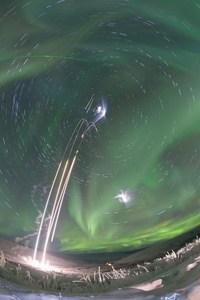
<http://www3.arrl.org/nl/cu/image/Contest%20Update%20-%202015%20Jan%2028/Sounding%20Rockets%20Launch%20Into%20Aurora%20-%20NASA.jpg>


No word on whether the geomagnetic storm which sparked this Alaskan aurora also
created some VHF+ contest propagation but these sounding rockets certainly
logged some great data! (Photo courtesy of NASA)

A geomagnetic storm erupted during the early hours of January 26th, sparking a
surprise display of bright auroras around the Arctic Circle. Scientists took
the opportunity to launch four sounding rockets from Alaska's Poker Flat
Research Range to study the effect of solar storms on the upper atmosphere. You
can see a picture of the colorful launch at right and more information is
available in the Spaceweather <http://spaceweather.com/>  archives for that
date.

Here's a great review
<https://medium.com/starts-with-a-bang/throwback-thursday-the-camera-that-changed-the-universe-3c3b2c8ad951>
  of the last 25 years of the Hubble Space Telescope, including some
astonishing images (and some new ones). A ham radio note - Sandra Faber
(married to Andy AE6Y) was the scientist who figured out what was wrong with
Hubble's mirrors and how to fix it. She was recently awarded the National Medal
of Science <http://www.zimbio.com/photos/Sandra+M.+Faber>  - well done!
(Thanks, Bob N6TV)

What really is the difference between a hard drive (HD) and a solid-state drive
(SSD)? This video
<http://www.engineeringtv.com/video/What-s-the-Difference-Between-a>  explains
the two technologies and shows how they are constructed.

What would have happened if Google had been invented in the 1960s
<http://www.masswerk.at/google60/> ? Let's just say you'd be playing with a
full deck! (If you get that joke, you're officially a computer science
old-timer.) And you can play Spacewar on it, too, the game with the first-ever
hyperspace button.

RESULTS AND RECORDS

The ARRL Contest Branch's Contest Results Page is a busy place these days as
both sets of preliminary results for the November Sweepstakes by VE4XT (CW) and
N2IC (Phone) have been posted. The complete 2014 IARU HF Championship package
is about to be published as soon as staff can return to work after the snow,
including the full results by Nate N4YDU which are already published, Line
Scores in an expanded format developed by John K9JK; and Log Checking Reports.
(The latest IARU results have changes in the Top Ten tables for CW QRP due to a
disqualification.) Plus, PDF versions of the QST articles for the August UHF
and 10 GHz and Up Contests are now available. (Thanks, ARRL Contest Branch
Manager, Matt W1MSW)


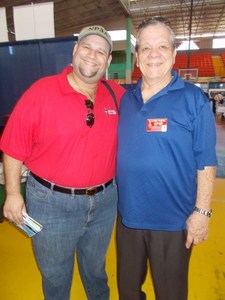
<http://www3.arrl.org/nl/cu/image/Contest%20Update%20-%202015%20Jan%2028/Eric%20NP3A%20and%20Tele%20KP4P%20at%20KP4%20Convention%20-%20N0AX.jpg>


Two more fellows whose calls are probably in your log - Eric NP3A (left) and
Tele KP4P - were spotted at the Contest University (CTU) sessions of the Puerto
Rico State Convention. (Photo by NØAX)

The June VHF Contest section records have been updated through 2014 and are now
on the ARRL Contest Records <http://www.arrl.org/contest-records>  web page. In
addition, the CQ WW VHF Contest High Score Lists
<http://www.cqww-vhf.com/records.htm?>  through 2014 have been posted. Please
contact Curt K9AKS <mailto:[email protected]>  with additions or corrections.

OPERATING TIP

What happens if you enter "Cut Numbers
<http://www.qsl.net/zs1an/contesting_faq.html#cut-numbers> " in QSO lines of a
Cabrillo-formatted log? You'll be hearing lots of them in the upcoming ARRL DX
CW Contest, so here's the straight scoop. First, the character string is read
from the submitted log. Then...

1.      Any instance of W or WATTS are removed from the string.

2.      If the string is one character long containing K, it is transformed to
1000

3.      Similarly, 1K and KILO become 1000

4.      All characters are removed which are not a numeral (0-9), A, E, N, T,
or O

5.      Replacements are then made: 'A' with '1', 'E' with '5', 'N' with '9',
'T' with '0', and 'O' with '0'

6.      If the result is 000, it is replaced with 1000

7.      Finally, the resulting set of characters are converted to an integer
value for checking against other logs.

 <http://www.arrl.org/nladclick.php?n=cu&t=i&i=2015-01-28&p=1> Ad

TECHNICAL TOPICS AND INFORMATION

Rather than learn about receiver front-end protection the hard way, Pete N4ZR
developed his front-end protector with the help of George W2VJN. It costs less
than $5 and is easy to build, too!

The article "Satellite Anatomy 101
<http://www.edn.com/electronics-blogs/out-of-this-world-design/4438371/Satellite-anatomy-101>
 " in EDN magazine is a great overview of commercial satellite technology.
Amateur satellite users will also find a lot of useful information there.

Frank KR1ZAN relays word of an Instructables project
<http://www.instructables.com/id/Dead-Bug-Prototyping-and-Freeform-Electronics/?ALLSTEPS>
  with some ideas on "dead bug prototyping" and creating some electronic
conversation pieces. He also provides the hot tip that Dremel has released a
new line of VersaFlame™ and VersaTip™
<http://www.dremel.com/en-us/Tools/Pages/ToolDetail.aspx?pid=2000-01#.VMFLo8b7a0c>
  butane torches.


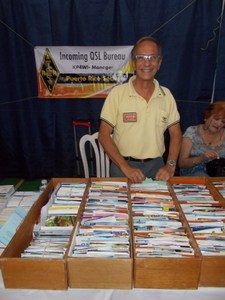
<http://www3.arrl.org/nl/cu/image/Contest%20Update%20-%202015%20Jan%2028/Luis%20KP4WI%20-%20KP4%20QSL%20Buro%20Manager%20-%20N0AX.jpg>


Where do your KP4 QSL Bureau cards go? Bureau Manager, Luis KP4WI, makes sure
they get to the right place! (Photo by NØAX)

Here are a couple bargain-hunter tips from Evan K9SQG: Full-circumference fuel
line clamps from an auto parts store can be used to hold shield braid on the
connections of a vacuum relay. For restoring bases of microphones and other
appliances, you'll find adhesive-backed felt in fabric stores. (Thanks, Evan
K9SQG)

Two recent articles in the January 2015 issue of High Frequency Electronics
<http://www.highfrequencyelectronics.com/>  are of interest to amateurs:
"Changing the Operating Frequency of an RF Power Amplifier" by Donna Vigneri
KF7SJF and "Achieving First-Pass Success in PCB-Based Filter and Matching
Circuit Designs" by Muir, Dunleavy, and Weller. The issue is available in the
online archives.

The day of not having to etch away copper to create a printed-circuit board
seems to be here. Finally, the name "printed-circuit" is accurate! The new
Voxel8 3D printer
<http://www.gizmag.com/voxel8-3d-electronics-printer/35489/?utm_source=Gizmag+Subscribers&utm_campaign=fdafc9632a-UA-2235360-4&utm_medium=email&utm_term=0_65b67362bd-fdafc9632a-91581189>
  uses a new silver-based highly conductive ink instead of the carbon-based
inks in previous printers. (Thanks, Dennis N6KI)

Field emission devices are starting to get some attention again as described in
the IEEE Spectrum article, "Introducing the Vacuum Transistor: A Device Made of
Nothing". (Thanks, Bill W8LV)

Technical Web Site of the Week - Eric NO3M has developed quite a system for
distributing the signals of receive antennas to a variety of receivers. He
wrote it up as an article <http://ncjweb.com/features/mayjun12feat.pdf>
published in the May/June 2012 issue of the National Contest Journal. It can
handle up to 128 physical antennas and four receivers, controlled via an RS-485
serial interface.

CONVERSATION

Field Day - Ham Radio's Open House

With a blizzard blanketing our New England hams, isn't it a bit too early to be
thinking about Field Day? (I hear all of you Field Day committees laughing out
there!) Successful planning is already getting underway and may have been going
on for some time. Having been on both sides of the fence, I can tell you that
waiting until April to start the process is a good way to miss the boat!
Knowing that my readers include leaders from across the amateur spectrum, I
ask, "How can we make a difference?"

Last year was a time of celebration and reflection on our first century but
it's time to take off the party hats and look to the future. Our society is
awash in wireless technology and users of it. Let's take our story to those
users, awaken them to the presence of radio among them, and show them how they
can participate, whether from a scientific interest, to provide a service to
their fellow citizens, or simply to enjoy connecting with other peoples.


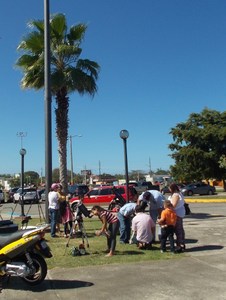
<http://www3.arrl.org/nl/cu/image/Contest%20Update%20-%202015%20Jan%2028/Sidewalk%20Astronomers.jpg>


Here are some sidewalk solar astronomers from the Sociedad de Astronomia del
Caribe in front of the Puerto Rico State Convention last weekend. Note the
interest of kids and teens! (Photo by NØAX)

Instead of hiding our Field Day operations in some out of the way location, set
up shop where the public can't possibly miss noticing your activity. After all,
following a disaster, it's likely that you'll be providing public service from
just such a location, so it's good practice. Imagine your group operating from
a city park or the local sports field complex, attracting a steady stream of
passers-by, kids between games, families out for a picnic, a bicycle club -
anyone having some weekend fun.

"What is this beehive of activity with the antennas and tents? It's a ham radio
open house, and look, they have free coffee and cookies!" Ten minutes later,
they're on their way with some information in their heads and a handout in
their pocket, or better yet, they've stored your club's website address in
their smartphone. They now know a lot more about Amateur Radio than they did at
breakfast!

Field Day is structured perfectly to act as our version of "open house." A
typical group will be active on HF with voice, supported by CW and digital mode
operation. Taking advantage of the "free" VHF station, an all-band rig will be
making QSOs on 6 meters and up with some simple antennas on a temporary mast.
Someone will have an FM rig monitoring the talk-in and simplex channels for a
few more QSOs. Someone else will set up an alternative power source since the
bonus points encourage innovation and experimentation. A Get On The Air (GOTA)
station will allow visitors to try voice or PSK31 contacts. The ARES folks
might bring their comm trailer or set up a portable station. That all-important
radiogram to the Section Manager could be sent through the Winlink system.
Here, take a look at this APRS map! And so forth.

I assume that I have lots of experienced readers with a lifetime of operating
and station construction experience. Let's put that to work showing our fellow
citizens what we're about. While the late-night CW shift is important, become a
ham radio ambassador for the weekend, as well. Instead of focusing exclusively
on QSO totals, make your metric for success the number of flyers, business
cards, and QR code scans you disburse to the visitors.

We all know a friendly CQ will bring out the callers and so, too, will a
welcoming layout encourage visitors to take a look. Instead of setting up what
looks like a crime scene investigation or a defensive perimeter around Fort
Wireless, make it easy for someone to overcome their natural hesitancy and
visit our world. Even better, go out to where they are, invite them in, and ask
them about their interests! Assign your group's chattier members to show them
around. Create a Visitor's Logbook and record each Visitor QSO with just as
much relish as working a new section. Get their contact information and follow
up afterwards with more radio goodies and an invitation to a club function
geared toward the non-ham.

Be ready for the inevitable "Do you still do that?" question with "Not only do
we still do that but look at this!" It's a pretty safe bet that most of the
public is completely unaware of what radio can do. Set up a long-distance WiFi
link using the 2.4 GHz amateur channels with a cool-looking Yagi or
"barbeque-grill" dish. Will there be a visible ISS pass around sunset? If so,
help people see it for the first time and while you're at it, digipeat through
its on-board packet system. Got a telescope? Point it at the Moon and invite
one of the local moonbouncers to fire up and bounce a signal off the lunar
surface. Set up a workbench and use the time to build a kit, make cables,
assemble an antenna, write a program...do stuff!

The future of Amateur Radio depends on us. The ARRL can open doors, provide
materials, suggest and share ideas, but individual hams have to close the sale,
just as our Elmers did for us. We can't do it behind closed gates. After all,
"The more you do anything that don't look like advertising the better
advertising it is." said Will Rogers. Now it's open house, are we ready?

73, Ward NØAX

 <http://www.arrl.org/nladclick.php?n=cu&t=i&i=2015-01-28&p=2> Ad

CONTESTS

28 January through 10 February

An expanded, downloadable version of QST's Contest Corral in PDF format
<http://www.arrl.org/contest-calendar>  is available. Check the sponsor's Web
site for information on operating time restrictions and other instructions.

HF CONTESTS

North American Sprint--CW, from Feb 8, 0000Z to Feb 8, 0359Z. Bands (MHz):
3.5-14. Exchange: Both call signs, serial, name, and S/P/C. Logs due: 7 days.
Rules <http://www.ncjweb.com>

School Club Roundup--Phone,CW,Digital, from Feb 9, 1300Z to Feb 13, 2359Z.
Bands (MHz): 1.8-28, 50+. Exchange: RS(T), Class, S/P/C. Logs due: 15 days.
Rules <http://www.arrl.org/school-club-roundup>

Feld-Hell WAAAEO Sprint--Digital, from Jan 31, 0000Z to Jan 31, 2359Z. Bands
(MHz): 1.8-28, 50. Exchange: RST, S/P/C, Feld-Hell member nr. Logs due: 7 days.
Rules <http://www.feldhellclub.org>

UBA Contest--Phone, from Jan 31, 1300Z to Feb 1, 1300Z. Bands (MHz): 3.5-28.
Exchange: RS, serial, and ON province. Logs due: 2 weeks. Rules
<http://www.uba.be/en/hf/contest-rules>

SSB Sprint--Phone, from Feb 1, 0000Z to Feb 1, 0400Z. Bands (MHz): 3.5-14.
Exchange: Both call signs, serial, name, and S/P/C. Logs due: 7 days. Rules
<http://ssbsprint.com>

OK1WC Memorial Contest--Phone,CW, from Feb 2, 1630Z to Feb 2, 1730Z. Bands
(MHz): 3.5, 7. Weekly on Monday, see website for bands. Exchange: RS(T) and
serial. Logs due: 5 days. Rules <http://www.memorial-ok1wc.cz>

ARS Spartan Sprint--CW, from Feb 3, 0200Z to Feb 3, 0400Z. Bands (MHz): 3.5-28.
Monthly on the first Monday evening local time. Exchange: RST, S/P/C, and
power. Logs due: 2 days. Rules <http://www.arsqrp.blogspot.com>

CWOps Weekly Mini-CWT Tests--CW, from Feb 4, 1300Z - See website. Multiple time
periods. Bands (MHz): 1.8-28. Weekly on Wednesday, 28 to 38 kHz above band
edge. Exchange: Name and member number or S/P/C. Logs due: 2 days. Rules
<http://www.cwops.org/cwt.html>

NS Weekly RTTY Sprint--Digital, from Feb 6, 0145Z to Feb 6, 0215Z. Bands (MHz):
3.5-14. Weekly on Thursday evenings local time. Exchange: Serial, name, and
S/P/C. Logs due: 2 days. Rules <http://www.ncccsprint.com>

NS Weekly Sprint--CW, from Feb 6, 0230Z to Feb 6, 0300Z. Bands (MHz): 1.8-14.
Weekly on Thursday evenings local time. Exchange: Serial, name, and S/P/C. Logs
due: 2 days. Rules <http://www.ncccsprint.com>

YL-OM Contest--Phone,CW,Digital, from Feb 6, 1400Z to Feb 8, 0200Z. Bands
(MHz): 1.8-28. Exchange: Call sign, RST, serial and S/P/C. Logs due: 30 days.
Rules <http://www.ylrl.org>

Triathlon DX Contest--Phone,CW,Digital, from Feb 7, 0000Z to Feb 7, 2359Z.
Bands (MHz): 3.5-28. Exchange: RS(T) and serial. Logs due: 28 Feb. Rules
<http://www.triathlon-dx-contest.gr>

Vermont QSO Party--Phone,CW,Digital, from Feb 7, 0000Z to Feb 8, 2400Z. Bands
(MHz): 1.8-28, 50,144. Exchange: RS(T) and VT county or S/P/C. Logs due: 30
days. Rules <http://www.ranv.org>

YLISSB QSO Party--CW, from Feb 7, 0000Z to Feb 8, 2359Z. Bands (MHz): 1.8-28.
Exchange: Call sign, RS(T), ISSB number. Logs due: Mar 21. Rules
<http://www.ylsystem.org>

Ten-Ten Winter Phone QSO Party--Phone, from Feb 7, 0001Z to Feb 8, 2359Z. Bands
(MHz): 28. Exchange: Call sign, name, QTH, 10-10 number. Logs due: 15 days.
Rules <http://www.ten-ten.org>

Black Sea Cup International--Phone,CW, from Feb 7, 1200Z to Feb 8, 1159Z. Bands
(MHz): 1.8-28. Exchange: RS(T) and HQ ID, member nr or ITU zone. Logs due: 30
days. Rules <http://www.bscc.ucoz.ru>

Straight Key Weekend Sprintathon--CW, from Feb 7, 1200Z to Feb 7, 2359Z. Bands
(MHz): 1.8-28, 50. Exchange: RST, QTH, name, member nr if member. Logs due: 5
days. Rules <http://www.skccgroup.com>

FYBO Winter QRP Field Day--Phone,CW, from Feb 7, 1400Z to Feb 7, 2400Z. Bands
(MHz): 1.8-28. Exchange: RS(T), S/P/C, name, power, temp in deg F. Logs due: 30
days. Rules <http://www.azscqrpions.com>

Minnesota QSO Party--Phone,CW,Digital, from Feb 7, 1400Z to Feb 7, 2359Z. Bands
(MHz): 1.8-28. CW 1.850, 3.550, 7.050, 14.050, 21.050, 28.050; SSB 1.870,
3.850, 7.250, 14.270, 21.350, 28.450 MHz. Exchange: Name and MN county or
S/P/C. Logs due: Mar 15. Rules <http://www.w0aa.org>

Straight Key Party--CW, from Feb 7, 1600Z to Feb 7, 1900Z. Bands (MHz): 3.5.
Exchange: RST, serial, category, name, age. Logs due: Feb 28. Rules
<http://www.agcw.de>

British Columbia QSO Party--Phone,CW,Digital, from Feb 7, 1600Z to Feb 8,
0400Z. Bands (MHz): 1.8-28. CW 1.815, 3.535, 7.035, 14.035, 21.035, 28.305; SSB
1.845, 3.85, 7.23, 14.25, 21.3, 28.4 MHz; Digital per band plan. Exchange: RST
and BC district or S/P/Territory or DX. Logs due: Mar 31. Rules
<http://orcadxcc.org>

XE Int'l RTTY Contest--Digital, from Feb 7, 1800Z to Feb 8, 1759Z. Bands (MHz):
3.5-28. Exchange: RST and XE state or serial. Logs due: 30 days. Rules
<http://www.rtty.fmre.mx>

AM QSO Party--Phone, from Feb 7, 2300Z to Feb 8, 2300Z. Bands (MHz): 1.8-14.
Exchange: RS, name, and S/P/C. Logs due: 4 weeks. Rules
<http://www.antiquewireless.org>

Classic Exchange--Phone, from Feb 8, 1400Z to Feb 9, 0800Z. Bands (MHz):
1.8-28, 50,144, AM--1.890, 3.880, 7.160, 7.290, 14.286, 21.420, 29.000, 50.400,
144.300; SSB--1.885, 3.870, 7.280, 14.270, 21.370, 28.390, 50.125, 144.200 MHz.
Exchange: RST, QTH, model of rcvr and xmtr. Logs due: 30 days. Rules
<http://www.classicexchange.org>

VHF+ CONTESTS

School Club Roundup--Phone,CW,Digital, from Feb 9, 1300Z to Feb 13, 2359Z.
Bands (MHz): 1.8-28, 50+. Exchange: RS(T), Class, S/P/C. Logs due: 15 days.
Rules <http://www.arrl.org/school-club-roundup>

Worldwide EME Contest--Phone,CW, from Jan 31, 0000Z to Feb 1, 2400Z. Bands
(MHz): 144, 432. Exchange: TMO/RS(T) and "R". Logs due: Jun 15. Rules
<http://www.dubus.org>

Vermont QSO Party--Phone,CW,Digital, from Feb 7, 0000Z to Feb 8, 2400Z. Bands
(MHz): 1.8-28, 50,144. Exchange: RS(T) and VT county or S/P/C. Logs due: 30
days. Rules <http://www.ranv.org>

Straight Key Weekend Sprintathon--CW, from Feb 7, 1200Z to Feb 7, 2359Z. Bands
(MHz): 1.8-28, 50. Exchange: RST, QTH, name, member nr if member. Logs due: 5
days. Rules <http://www.skccgroup.com>

Classic Exchange--Phone, from Feb 8, 1400Z to Feb 9, 0800Z. Bands (MHz):
1.8-28, 50,144, AM--1.890, 3.880, 7.160, 7.290, 14.286, 21.420, 29.000, 50.400,
144.300; SSB--1.885, 3.870, 7.280, 14.270, 21.370, 28.390, 50.125, 144.200 MHz.
Exchange: RST, QTH, model of rcvr and xmtr. Logs due: 30 days. Rules
<http://www.classicexchange.org>

Milwaukee FM Simplex Contest--Phone, from Feb 8, 1900Z to Feb 8, 2130Z. Bands
(MHz): 50-440. Exchange: Call sign and 4-char grid square. Logs due: Mar 16.
Rules <http://www.w9rh.org>

LOG DUE DATES

January 28 through February 10

*       January 29 - QRP Fox Hunt <http://www.qrpfoxhunt.org/winter_rules.htm>
*       January 30 - CQ 160-Meter Contest, CW <http://www.cq160.com/rules.htm>
*       January 30 - SKCC Sprint <http://www.skccgroup.com/sprint/sks/>
*       January 31 - Lighthouse Christmas Lights QSO Party
<http://arlhs.com/LCL-2014.html>
*       January 31 - Original QRP Contest
<http://www.qrpcc.de/contestrules/oqrpr.html>
*       January 31 - RAC Winter Contest
<https://www.rac.ca/en/rac/programmes/contests/files/2014%20Winter%20Contest%20Rules%20%20-%20English-French.pdf>

*       January 31 - AGCW Happy New Year Contest
<http://www.agcw.org/index.php/en/contests-and-cw-activities/happy-new-year-contest>

*       January 31 - SARTG New Year RTTY Contest
<http://www.sartg.com/contest/nyrules.htm>
*       January 31 - QRP Fox Hunt <http://www.qrpfoxhunt.org/winter_rules.htm>
*       January 31 - CWops Mini-CWT Test <http://www.cwops.org/cwt.html>
*       February 1 - NCCC Sprint Ladder <http://www.ncccsprint.com/rules.html>
*       February 1 - International Naval Contest
<http://www.marinefunker.de/eng/show.php3?pos=16>
*       February 1 - NCCC RTTY Sprint <http://www.ncccsprint.com/rttyns.html>
*       February 1 - Locust QSO Party
<http://www.k6vva.com/lqp/LQP58_Rules.pdf>
*       February 3 - Kid's Day <http://www.arrl.org/kids-day>
*       February 3 - ARRL RTTY Roundup <http://www.arrl.org/rtty-roundup>
*       February 5 - ARS Spartan Sprint <http://www.arsqrp.blogspot.com/>
*       February 7 - Feld Hell Sprint
<https://sites.google.com/site/feldhellclub/Home/contests/sprints/waaaeo-sprint>

*       February 8 - EUCW 160m Contest <http://www.eucw.org/eu160.html>
*       February 8 - QRP ARCI Fireside SSB Sprint
<http://www.qrparci.org/contests/fireside-sprint>
*       February 8 - North American SSB Sprint Contest
<http://ssbsprint.com/rules/>
*       February 9 - REF Contest, CW
<http://concours.ref-union.org/reglements/actuels/reg_cdfhf_dx.pdf>

ARRL Information

Click here <mailto:[email protected]>  to advertise in this newsletter, space
subject to availability.

Your One-Stop Resource for Amateur Radio News and Information

 <http://www.arrl.org/join> Join or Renew Today!

ARRL membership includes  <http://www.arrl.org/qst> QST, Amateur Radio's most
popular and informative journal, delivered to your mailbox each month.

Subscribe to  <http://www.arrl.org/ncj> NCJ - the National Contest Journal.
Published bimonthly, features articles by top contesters, letters, hints,
statistics, scores, NA Sprint and QSO Parties.

Subscribe to  <http://www.arrl.org/qex> QEX - A Forum for Communications
Experimenters. Published bimonthly, features technical articles, construction
projects, columns and other items of interest to radio amateurs and
communications professionals.

Free of charge to ARRL members: Subscribe
<http://www.arrl.org/myarrl-account-management#!/edit-info-email_subscriptions>
 to The ARRL Letter (weekly digest of news and information), the ARES E-Letter
(monthly public service and emergency communications news), Division and
Section news -- and much more!

ARRL offers a wide array of  <http://www.arrl.org/arrl-store> products to
enhance your enjoyment of Amateur Radio. Visit the site often for new
publications, specials and sales.

Donate <https://www.arrl.org/arrl-donation-form>  to the fund of your choice --
support programs not funded by member dues!

Reprint permission can be obtained by sending email to [email protected] with
a description of the material and the reprint publication.

ACKNOWLEDGEMENTS

ARRL Contest Update wishes to acknowledge information from WA7BNM's Contest
Calendar <http://www.hornucopia.com/contestcal>  and SM3CER's Contest Calendar
<http://www.sk3bg.se/contest> .

 <http://www.arrl.org/nladclick.php?n=cu&i=2015-01-28&t=r&p=0> Ad
 <http://www.arrl.org/nladclick.php?n=cu&i=2015-01-28&t=r&p=1> Ad
 <http://www.arrl.org/nladclick.php?n=cu&i=2015-01-28&t=r&p=2> Ad
 <http://www.arrl.org/nladclick.php?n=cu&i=2015-01-28&t=r&p=3> Ad
 <http://www.arrl.org/nladclick.php?n=cu&i=2015-01-28&t=r&p=4> Ad


  _____

The ARRL Contest Update is published every other Wednesday (26 times each
year). ARRL members may subscribe at no cost or unsubscribe by editing their
Member Data Page as described at http://www.arrl.org/contests/update/.

Copyright © 2015 American Radio Relay League, Inc. All Rights Reserved

 <http://www.arrl.org/> www.arrl.org
_______________________________________________
BVARC mailing list
[email protected]
http://mail.bvarc.org/mailman/listinfo/bvarc_bvarc.org