The Cambodian Army: Open for Corporate
Sponsors<http://editorials.cambodia.org/2010/06/cambodian-army-open-for-corporate.html>
  By Brendan Brady / Phnom Penh
TIME
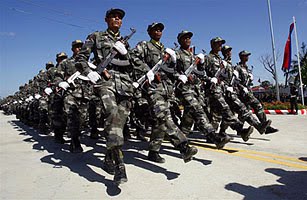
<http://4.bp.blogspot.com/_6tEhuix9rUU/TBBt9hwHWjI/AAAAAAAAAmQ/q7zfIpaCYS8/s1600/cambodia_military_0607.jpg>Members
of the Cambodian military take part in a parade on the outskirts of Phnom
Penh on Oct. 13, 2009
Chor Sokunthea / Reuters

A land dispute in March between a sugar-plantation developer and a small
community in the province of Kampong Speu motivated military police
stationed nearby to spring into action, ostensibly in order to prevent an
eruption of violence. It didn't take long, though, for the villagers to view
the supposed peacekeepers as intimidators.


It wasn't the first time military personnel were seen as supporting the
business interests of Ly Yong Phat, a prominent developer and Senator with
the country's ruling party. Last October in the province of Oddar Meanchey,
100 families were driven off their land by members of an infantry brigade
stationed in the area. They were moved to make way for another Ly
plantation, according to the local rights group Licadho. Now that Ly's
businesses will be officially sponsoring both of these military units
following a new government initiative, says Licadho's Mathieu Pellerin, "it
looks like a job-well-done payback." (See TIME's photo-essay "The Rise and
Fall of the Khmer Rouge.")

At the end of February, Cambodian Prime Minister Hun Sen kicked off a
program creating partnerships in which businesses would provide donations
for particular units of the Royal Cambodian Armed Forces. The government has
framed the initiative, which involves some 60 pairings, as facilitating the
magnanimous inclination of corporations operating in Cambodia to support the
welfare of the country's troops. Observers, however, caution that the
program will ultimately serve to further enmesh the country's powerbrokers —
political, military and business — into a network to serve their mutual
interests and ensure everyone's allegiance to the ruling party.

The Cambodian military regularly guards large-scale private land concessions
across the country, according to rights groups, and has been used to evict
the rural poor for business developments. Hun Sen's new policy, says
U.S.-based watchdog group Global Witness, is a step toward formalizing that
process. "Global Witness has documented links between Cambodia's military
and powerful business tycoons for many years now, so the relationships are
not new," says Eleanor Nichol, a campaigner with the group, which was
expelled from Cambodia in 2007 after publishing a report, fervently refuted
by the government, that linked prominent officials in the government,
military and business community with the illegal logging trade. "This latest
move ... to officially sanction these partnerships is particularly shocking
because it legitimizes a guns-for-hire scenario."

The government and companies participating in the new patronage program
reject claims that the partnerships could lead to improprieties. Ly Yong
Phat says his involvement in the program is to compensate for the military's
lack of funding for troops' basic needs. Corporate support, according to a
government memo, will "solve the dire situation of the armed forces, police,
military police and their families through a culture of sharing." The
government has responded to criticisms by specifying that donations would
likely come in the form of food and shelter. (See the top 10 news stories of
2009.)

The program has confounded regional security experts. "It's not unusual in
militarized states like Iran, Yemen, Turkey and Vietnam for the army to own
and run corporations, but the direct corporate sponsorship of active-duty
units is something new and very worrying," says John Harrison, a security
expert based in Singapore. The only country in the region that comes close
to having a similar system is Indonesia, says Carlyle Thayer, a professor of
Asian security affairs at Australia's University of New South Wales. Like
Cambodia, Indonesia has a long history of blurred lines between military and
political power. For years, Indonesia has used "foundations" to collect
donations from the private sector to compensate for shortages in public
military funding. While some of the money has been used for its intended
purpose of supporting military families, the system has promoted alliances
between the Indonesian army and companies wherein donations are exchanged
for "mafia-like" criminal services, according to Human Rights Watch.

Cambodia's army-sponsorship initiative goes against the grain of business
divestment in the militaries of China and Vietnam, says Thayer. Citing a
need to bolster security preparedness in the army, the Chinese government in
1998 forced its entrepreneurial army to sell off the majority of its
investments and compensated the subsequent revenue shortfall by increasing
defense spending. Two years ago, Vietnam called for a similar plan in the
name of army discipline. "Cambodia should heed [those] lessons," says
Thayer.

But unlike China and Vietnam, where booming economic growth helped bolster
state funding for the military, Cambodia's army is badly strapped for cash.
The problem is exacerbated by the deployment of large numbers of troops
along the border with Thailand, as the two countries continue to engage in a
protracted border-demarcation dispute. Even though the corporate donations
are ostensibly voluntary, organizing official partnerships raises questions
about the pressures companies will face to participate — and what benefits
will be extended, or denied, to them based on their contributions. The end
result, warn a litany of local and international rights groups, could be a
cash-driven race to the top among companies vying for government favor,
matched by a race to the bottom in state support of laypeople involved in
rows with influential corporations.

Observers have also raised concerns that the initiative could further skew
Cambodia's political landscape, which has seen a dramatic consolidation of
power by the ruling Cambodian People's Party over the past decade. "In times
of need, the public in many countries will spontaneously support their
military ... Cambodia's new program is something very different," says Rohan
Gunaratna, head of the International Center for Political Violence and
Terrorism Research in Singapore. By soliciting funds for the army, the
government can position itself to arouse nationalist fervor that will, in
turn, translate into support for its political backer: the ruling party
itself.

Read more:
http://www.time.com/time/world/article/0,8599,1995298,00.html#ixzz0qQF7lNK9

--
You received this message because you are subscribed to the Google Groups
"Cambodia Discussion (CAMDISC) - www.cambodia.org" group.
This is an unmoderated forum. Please refrain from using foul language.
Thank you for your understanding. Peace among us and in Cambodia.

To post to this group, send email to [email protected]
To unsubscribe from this group, send email to
[email protected]
For more options, visit this group at http://groups.google.com/group/camdisc
Learn more - http://www.cambodia.org