-

Saturday, September 11, 2010
"Vous les Americains Sont Pires que les Francais." -- you Americans are
worse than the
French<http://ki-media.blogspot.com/2010/09/vous-les-americains-sont-pires-que-les.html>
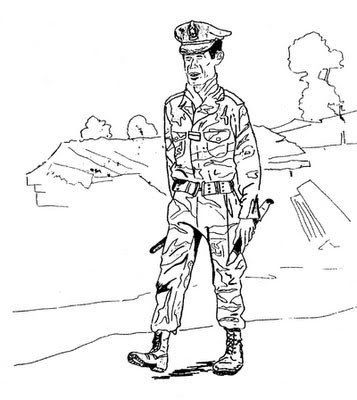
<http://1.bp.blogspot.com/_76xUgRgjZYM/TIsNwtEFtCI/AAAAAAAARFA/bJj3LIS5oi8/s1600/Khy+Hak.jpg>Chip
Beck's sketch of General Khy Hak

 General Khy Hak's final fate:

11th Brigade Commander, General Khy Hak was executed with his wife and five
children in 1975

"Vous les Americains Sont Pires que les Francais."

"Vous les Americains Sont Pires que les Francais" is the title of Chapter
27 of Never Fight Fair!, an oral history of the SEALS by Orr Kelly. Chapter
27 is a reminiscence of William G. "Chip" Beck, who served as an advisor
with the Cambodian Army as it fought a desperate battle against the Khmer
Rouge rebels from January 1974 until that fateful April 1975. Beck tells
the story of the heroic resistance of the anti-communist Cambodians and
especially of one man, Khy Hak who most exemplified and personified that
resistance. An excerpt:

<http://1.bp.blogspot.com/_76xUgRgjZYM/TIsMHj-N_lI/AAAAAAAARE4/U5V6qAKcKL8/s1600/Never+Fight+Fair.jpg>

I was an advisor to the 11th Cambodian Brigade at the time. I was the only
American in Kompong Thom, this little town in central Cambodia. There were
two other foreigners there -- a Norwegian doctor and a French priest. He
had been there twenty-eight years and spoke Cambodian like a native. We
used to call his congregation "the Christian soldiers." After he said Mass,
he would go out and show them how to put up a machine gun emplacement with
effective cross fire.

I had responsibility for an area between Kompong Thom and Siem Reap, where
Ankgor Wat is. I used to travel back and forth in that whole northern area.

I started out based in Siem Reap but I was so impressed by the quality of
the officers and what they were doing with the men in Kompong Thom that I
went back to the embassy and told them they needed a full timer down there
with the 11th Cambodian Brigade. They agreed.

The provincial governor was also a general whose name was Teap Ben. He was
the political provincial advisor and senior military person. The man in
charge of most of the combat forces was Col. Khy Hak, probably one of the
two military geniuses I have met in my life. The guy didn't go to school
until he was eleven years old and ended up completing the national military
academy at age eighteen at the top of his class.

Khy Hak had studied everything from Napoleon to Mao Tse Tung. In his
library I found these huge books on the Napoleonic battles. There were maps
where he had drawn in red and blue where the troops had gone and where they
had made their mistakes. He could think in strategic terms. He could send
massive troop units going out but also have his men infiltrate into the
Khmer Rouge as guerrillas. He could fight as a guerrilla or a major
tactician.

When the war started, these two guys were at Siem Reap, a little outpost.
They were maybe a major and a captain at the time. That became one of the
few places where, when the North Vietnamese and the Khmer Rouge started
running over Cambodia, they didn't get very far. They were not guys who sat
in there offices and worried about their next corruption deal. They would
go out and fight with the troops.

Khy Hak got wounded, for the first time in his life, during the battle for
Ankgor Wat. Instead of being evacuated, he had his men put him on a door
and carry him into battle while he was still bleeding. It was an incredible
battle because Khy Hak has a sense of history. He didn't want to use heavy
artillery to take out the North Vietnamese because he was afraid of
destroying the historic ruins of Ankgor wat. So he had his men go in and
fight hand to hand, tactical, down and dirty.

Kompong Thom had been overrun and almost taken by the Khmer Rouge in 1973,
the year before I got there, and when they sent Teap Ben and Khy Hak,
literally, the Khmer Rouge were in downtown Kompong Thom. The helicopter
flew these two guys in, wouldn't even land, as the troops were fighting to
get back into the city. Literally, they retook the city house by house.

By the time I got there, the Khmer Rouge were still surrounding the town
and attacking it, if not every day, every week. I was just so impressed by
what was going on I decided to make my own headquarters there. The longer I
stayed and saw what they were doing, the more impressed I got.

At one point in the dry season, Khy Hak had had enough of being surrounded
by the Khmer Rouge and said he was going to take back the territory beyond
the town perimeter. . . Khy Hak decided he and his brigade, under cover of
darkness, would walk out of Kompong Thom along Highway 5 and wreak havoc
among the Khmer Rouge. And they did. In the course of three days they
walked a hundred miles and they brought back 10,000 people from among the
Cambodian population. By the time a month and a half was finished, they had
brought back 45,000 people from the communist zone, brought them back into
a little town that previously had only 15,000 people in it.

When Khy Hak went out there, he didn't force the people to come back at
gunpoint. He would get up on a tree stump or a chair and talk to the
villagers.

He told them, "Look, there's corruption in the government, there's
corruption in the army. But if you come back I will try to protect you. The
Khmer Rouge will try to stop you from going. I will help you get back. Once
you reach safety in Kompong Thom, they will try to attack us and kill you.
I will try to protect you. It's going to be hard to feed you. You will have
to grow your own crops. We can't count on anybody but ourselves. But you
know what it's like out here under the communists. Choose. Make your choice.
"

And they made their choice, by the thousands.

I flew out in a chopper after the operation got going and I couldn't
believe my eyes. . . I stayed out there with troops for three days. I
really wasn't supposed to but Khy Hak challenged me, "How do you know that
I won't lie to you? Or someone will ask you if I'm lying. See for yourself.
You can tell them the truth." so I stayed there . . . As Khy Hak had
predicted, the more refugees we got into the town, the more of a political
embarrassment it was for the Khmer Rouge. They intensified the pressure on
Kompong Thom in March and April of 1974. . .

(Short of rice for the refugees and unable to get enough from USAID, Khy
Hak staged a raid out into the countryside)

. . . in an area where the Khmer Rouge had been stockpiling rice they had
taken from farmers. . . As we were pulling out, some mortar rounds started
falling. Khy Hak got on the radio -- the Khmer Rouge had the same radios he
had -- and issued a challenge: "This is Col. Khy Hak. Here is my precise
position. I will wait here for one hour. There is no need for you to shoot
at unarmed civilians who can't defend themselves. If you want to fight
somebody, fight me. I will wait. If you are not here in an hour, I will
figure you are too afraid to do it."

They didn't come. . .

(Beck tells the story of the bloody and heroic defense of Kompong Thom
against overwhelming numbers of Khmer Rouge.)

The day the siege of Kompong Thom was broken, with three hundred Khmer
Rouge left dead on the battlefield, the headlines in the world press, one
major newspaper -- I can't remember which one -- said: "Rebel rockets hit
Phnom Penh; Three Killed."

These defenders had killed three hundred to one thousand enemy soldiers in
bloody combat but there was never a story told about this.

For the rest of the dry season, things were pretty calm there. Khy Hak was
promoted to general the final year, in 1975, in the final months in Phnom
Penh.

He and I had worked out a plan where I would take his wife and children and
set them up on an escape route I had set up in northern Cambodia for the
civilians.

I didn't know when Operation Eagle Pull (the American evacuation) was going
to go. When I found out, I was several hundred miles away from his family.
I couldn't get to them directly. I had somebody else go over to the house
to ask Mrs. Khy Hak to leave with them. She refused. She didn't know her
husband wanted her to leave.

By the time he was able to get back to Phnom Penh, to the center of town as
the perimeter was falling, there was no way to get her out. He put his wife
and his five children -- beautiful little children, from four years old to
eight -- in a jeep. The Khmer Rouge caught them approaching the airport and
took them over to a pagoda.

One of my Cambodian soldiers who went back in and talked to witnesses said
they killed the little kids. They executed the children, then they shot his
wife. After making him witness that, they executed him. So they got their
revenge on him.

Chip Beck's sketch of General Khy Hak.

We then started hearing of many atrocities being committed. (After Phnom
Penh fell to the Khmer Rouge on 16 April 1975, as many as four million
Cambodians were slain by the victors over the next two years.) The Khmer
Rouge would get on the single sideband radios that had been part of the
military network. After the Americans had made the evacuation in Eagle
Pull, the Khmer Rouge would get on the radio and hold the key so you could
hear the office people being tortured and murdered on the air. . .

Unlike Vietnam, the Cambodians could have held out. We, the advisors, were
told we could supply the Cambodian army as long as they could fight. That's
what we told them. After we evacuated the country, that order was rescinded.

The French died at Dien Bien Phu. They were soundly defeated but they
fought and we just went out the back door.

We, the advisors who had lived with these people, sometimes for years, had
to sit there and listen to them on the radio calling to us, saying, "Where
are our supplies? We're still fighting. We're holding out."

Finally they ran out of ammunition. That's the only thing that made many of
these people surrender and then they were executed by the Khmer Rouge.

One of the last transmissions -- the last transmission I ever heard out of
Cambodia -- was a Cambodian colonel, just before they killed him. You could
hear them breaking down the door. You could hear him say, "Vous les
Americains Sont Pires que les Francais." -- you Americans are worse than
the French.


--

*

--
--
You received this message because you are subscribed to the Google Groups
"Cambodia Discussion (CAMDISC) - www.cambodia.org" group.
This is an unmoderated forum. Please refrain from using foul language.
Thank you for your understanding. Peace among us and in Cambodia.

To post to this group, send email to [email protected]
To unsubscribe from this group, send email to
[email protected]
For more options, visit this group at http://groups.google.com/group/camdisc
Learn more - http://www.cambodia.org
---
You received this message because you are subscribed to the Google Groups
"Cambodia Discussion (CAMDISC) - www.cambodia.org" group.
To unsubscribe from this group and stop receiving emails from it, send an email
to [email protected].
For more options, visit https://groups.google.com/groups/opt_out.