40 Year of Memos, Story Telling, Healing and Moving Forward for all
Cambodians
<http://www.sophanseng.info/2015/04/40-year-of-memos-story-telling-healing-and-moving-forward-for-all-cambodians/>Posted
by: *Cambodian <http://www.sophanseng.info/author/cambodian/>* |
Posted on: *April
18, 2015*
[image: 40 years]
<http://www.sophanseng.info/wp-content/uploads/2015/04/40-years.jpg>

Courtesy of ABC Australia

This 40 years, it is my first time to recall back my past turbulence and my
family. I was born at an architectural still house in the heart of Siem
Reap in 1976, one year after the ascending to power of the Khmer Rouge. I
am recalled by mother since I was very young on many things that I am
having difficulty to remember. I have remembered clearly only my birthday I
was frequently asked to recite it in Khmer traditional lunar calendar. My
father passed away since I was in the womb. I have never seen the face of
my father even though through the photo. Mother told that all family
pictures and photos were totally destroyed to avoid catching up as enemy
and facing death penalty. My mother passed away when I was 11 years old.
The bitter story has later little been told by my survival two older
sisters. All my four siblings were killed during the regime. I have no clue
tills today that how could I pen about them or figure out about their face
accurately?


During the Khmer Rouge period, I have no memory at all except some flashing
image occurring within my head on how bad I was crying inside the Buddhist
worshiping hall to ask for mom and to scavenge for food to eat. But I
remembered the starvation and famine during the presence of Vietnamese
solders patrolling surround my house in Phum Dang-het, Srok Chi Kraeng. I
think during 1979 to 1980, there was famine throughout the country.


Brief memory recalling by Sophoan Seng

In commemoration of 40 years when the Khmer Rouge came to power to lead a
country of extremism and jungle leadership.

This is the 40 years of memos, healing, story telling, and moving forwards.
Please, watch this video clip by RFA <https://youtu.be/oK4tJ3fywhU>

Botta, the high commissioner for youth and sports, stands at the end of a
row of suited men, arms behind his back, staring defiantly into the camera.
Lon Nol, the mystic “Marshal” that led the ill-fated and highly corrupt
republic, stands in the middle, leaning on his cane but still towering over
the rest.

“Most of them were killed by the Khmer Rouge,” Botta, now 72 and an
opposition MP, says.

It has been exactly forty years since the Khmer Rouge marched into Phnom
Penh on April 17, 1975.

By The Diplomat
<http://thediplomat.com/2015/04/remembering-the-fall-of-phnom-penh/>

**************

The stories I have heard since I was a young child continue haunt me, and
the bits and pieces of the puzzle never quite formed a solid picture of
what really happened. Forty years later, the story of my family’s
experience was still a mystery to me. While other stories from survivors
were clear in my mind, I never heard the entire story from my parents,
until now. Perhaps it was my frequent visits home, with cohorts of
inquisitive graduate students that prompted me to ask, in detail, the story
I had wanted to hear. It was never a question that surfaced in my mind as
one that should be asked. As a child of genocide survivors, it was
something I feared, something I ignored. Yet, the more students I brought
to Cambodia, the more their questions made me realize that the genocide was
something that needed to be told. My family’s story was not something to be
ignored, but rather something to be acknowledged, both for the survivors
themselves and for their children. And so begins the story of one family,
who much like the rest of the Khmer people, faced tragedy and immeasurable
sorrow, and somehow found a way to survive.

“Story Telling by Dr. Sothy Eng” by Huffington Post
<http://www.huffingtonpost.com/sothy-eng/40-years-after-the-cambodian-genocide-one-thing-my-parents-still-talk-about_b_7071852.html>

*********************

Sophal Ear <http://www.searac.org/board-of-directors?page=1>, SEARAC Board
Member, Occidental College Professor of Diplomacy & World Affairs, and TED
Fellow, tells the compelling story of his family’s escape from Cambodia
under the rule of the Khmer Rouge. He recounts his mother’s cunning and
determination to save her children in his 2009 TED Talk, “*Escaping the
Khmer Rouge.*” His mother passed away six months later.

“Story Telling by Dr. Sophal Ear” by SEARAC and TEDtalks
<http://www.40andforward.org/blog/2015/4/16/escaping-the-khmer-rouge>

********************

On April 17, 1975 — 40 years ago today — life as Ly knew it was shattered
when her hometown, the Cambodian capital of Phnom Penh, fell to the
genocidal Khmer Rouge regime of the Communist Party of Kampuchea.

Ly, then 13, was separated from her mother and two of her sisters who,
along with virtually the entire population of Phnom Penh — about two
million people — were sent on a forced march into the countryside to work.

Ly never saw them again, nor learned what happened to them. But about
20,000 people died from execution, starvation or exhaustion during this
exodus at gunpoint, according to war crimes prosecutors; the others were
subjected to slave labor in rural camps once they reached their
destination, where many met similar fates.

“Story Telling by Ly and her unexpected family reunion” by CNN
<http://www.cnn.com/2015/04/16/asia/cambodia-khmer-rouge-anniversary/index.html?fb_action_ids=10152688775896290&fb_action_types=og.shares>

**************

“The children’s arrival was not all smooth and happy,” recalls Gaffar
Peang-Meth, who became the point man for verifying many of their legal
status. Some news media reports suggested that the children were not all
orphans and openly questioned why they had been brought to the U.S. Gaffar
Peang-Meth responded that there was no authority in Phnom Penh to answer
such allegations.

Amid the mounting concern, the Immigration and Naturalization Service (INS)
ordered a temporary halt to the babylifts on April 16, just one day before
the Khmer Rouge seized Phnom Penh. Then deputy commissioner of the INS,
James Green, told the Washington* Post* that the agency would “launch a
full investigation to determine what these children’s backgrounds are and
how they got into the United States.”

TIME recalled the halting of adopting orphanages few days before KR seized
Phnom Penh by TIME Magazine
<http://time.com/3820620/cambodia-adoptees-khmer-rouge-orphans/?xid=fbshare>

*******************

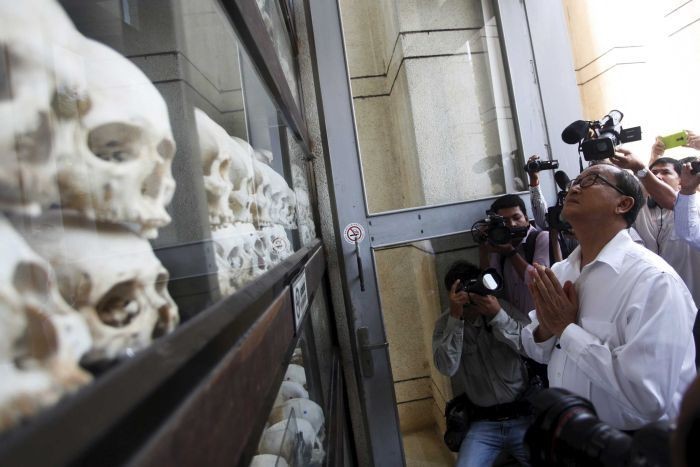
A few hundred people, including monks and elderly regime survivors,
gathered early Friday at Choeung Ek, the most notorious of the regime’s
“killing fields” on the capital’s outskirts, burning incense and saying
Buddhist prayers at a memorial stupa housing the skulls and bones of
victims.

Cambodia’s opposition leader, Sam Rainsy, led prayers at the former killing
fields.

He reminded Cambodians of the importance of the ongoing trials of surviving
Khmer Rouge leaders.

“It is why every year we remind the people in power to support the Khmer
Rouge tribunal,” he said.

“To proceed, and not to hinder in any way, the judicial proceedings that is
intended to bring justice to the Khmer people.”

“CNRP led by HE Sam Rainsy commemorate and dedicate merits to those victims
at Choeung Ek” by ABC Australia
<http://www.abc.net.au/news/2015-04-17/cambodia-40-years-since-fall-of-phnom-penh-to-khmer-rouge/6402226>

*******************

Friday marks 40 years since the Khmer Rouge first marched into Phnom Penh.
Over the following 44 months in the region of 2 million people from a
population of just over 8 million died – killed, starved or struck down by
disease – as Pol Pot’s brutal regime attempted to style Cambodia into a
classless, agrarian society.

Cambodia is still struggling to deal with its history, where personal
memory is politicised and the spectre of the Khmer Rouge is ever-present
but often wilfully ignored. Even the most basic term remains contentious:
can a regime be described as genocidal when so much of the killing of
Khmers was done by Khmers?

Nhem En, a survivor of sorts from that dark time, is an unwelcome reminder
of a knot of dilemmas that Cambodia is only starting to untangle – who to
blame; how to forgive; and how to understand a regime that implicated such
large swaths of the population in seemingly unfathomable cruelty.

By The Guardian
<http://www.theguardian.com/world/2015/apr/16/forty-years-after-genocide-cambodia-finds-complicated-truth-hard-to-bear>

--
--
You received this message because you are subscribed to the Google Groups
"Cambodia Discussion (CAMDISC) - www.cambodia.org" group.
This is an unmoderated forum. Please refrain from using foul language.
Thank you for your understanding. Peace among us and in Cambodia.

To post to this group, send email to [email protected]
To unsubscribe from this group, send email to
[email protected]
For more options, visit this group at http://groups.google.com/group/camdisc
Learn more - http://www.cambodia.org
---
You received this message because you are subscribed to the Google Groups
"Cambodia Discussion (CAMDISC) - www.cambodia.org" group.
To unsubscribe from this group and stop receiving emails from it, send an email
to [email protected].
For more options, visit https://groups.google.com/d/optout.