***  For details on how to be removed from this list visit the  ***
***          CCP4 home page http://www.ccp4.ac.uk         ***
Vincenzo Carbone wrote:
As a general guide, at what levels of occupancy do heavy atom sites
have to have before they become useful or too poor to use.
I just did a workshop at the ALS User's Meeting to address this very
question. The raw materials are available at:
http://bl831.als.lbl.gov/~jamesh/workshop/
To explain: one may recall the Crick-Magdoff equation (1959), which
estimates the magnitude of differences expected from the heavy atom
contribution:
delta-I ~ sqrt(2Nh/Np)*(fh/fp)

where:
delta-I is the average change in spot intensities
Nh is the number of heavy atoms
fh is the scattering factor of the heavy atom
Np is the number of protein atoms
fp is the scattering factor of the average protein atom (~7 electrons)

You can find this in Blundel and Johnson (1976) page 161
Their example points out that an Hg atom bound to a 24 kDa protein
should give an average change in intensity of 40%. You can do the math
for your favorite situation. The equation also seems to work if you
substitute f" for fh when you are trying to calculate the average
expected anomalous difference.
Now that you know how to calculate the difference you can expect to see,
you can ask the question: can you measure them accurately enough to
solve the structure. This is a very good question.
I have been experimenting with ways of establishing where this
"solvability threshold" is. My "preliminary finding" right now is that
you need to have a signal-to-noise ratio of 1 or better for your
DIFFERENCE data measurment for the structure solution to work. That is,
delta-I/sigma(delta-I) must be > 1 (on average) for the resolution range
of interest. This hypothesis does make some intuitive sense. How can
you use a measurment where the noise is bigger than the signal? The
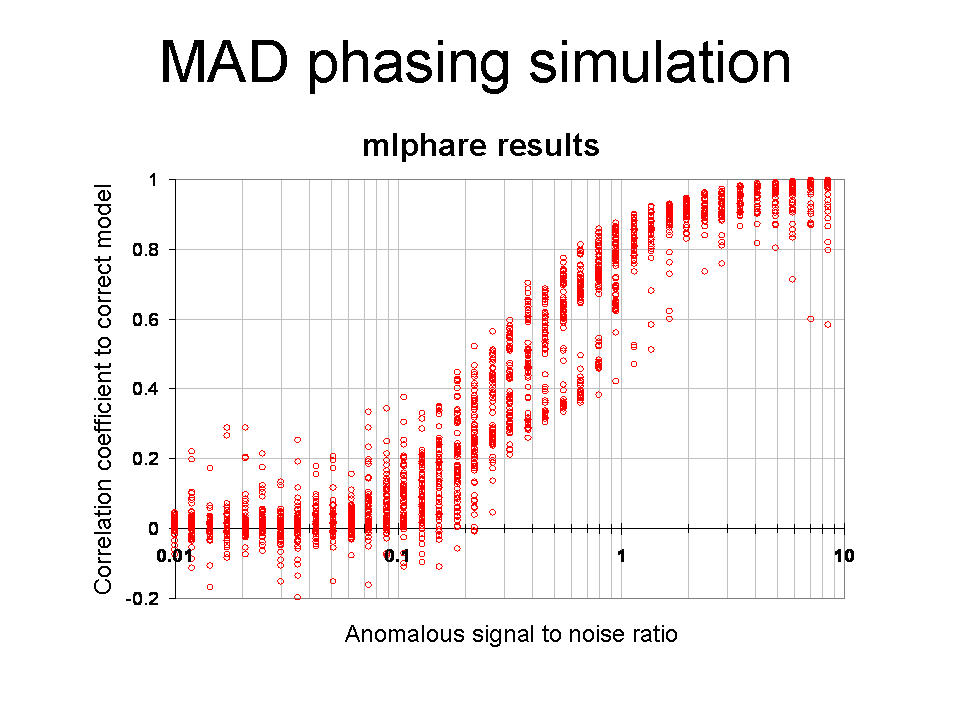
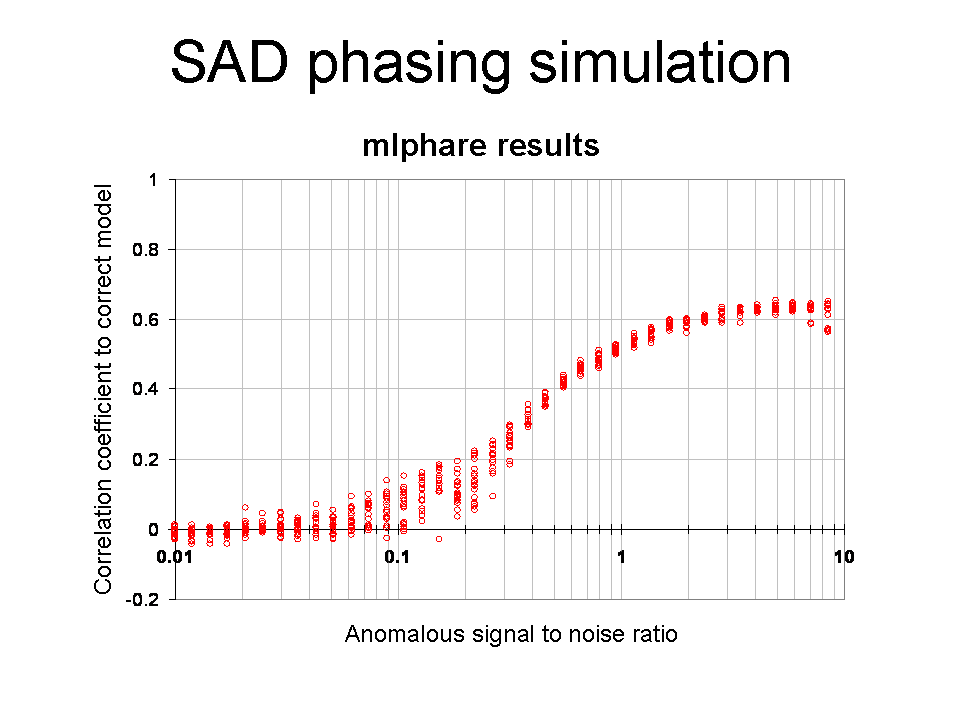
hypothesis does hold up in a few simulations I have done as well as the
results of one controlled experiment I have done here at ALS8.3.1. It
is also interesting to note that measuring delta-I/sigma(delta-I) to
better than 1 does not significantly improve the final map. The
transition between "solvable" and "unsolvable" seems to be pretty sharp.
The "marginal zone" appears to be where delta-I/sigma(delta-I) ranges
from 0.4 to 1.1 or so.
http://bl831.als.lbl.gov/~jamesh/workshop/MAD_simulation.png
http://bl831.als.lbl.gov/~jamesh/workshop/SAD_simulation.png
The problem with an anomalous signal-to-noise ratio of 1 is that you
can't tell if you got anything just by looking at the data. That is, if
you have no signal at all you still expect your DANOs to have an average
value that is equal to the average value of SIGDANO. However, the
signal does tend to be stronger for low-angle data. The "DelAnom
correlation between half-sets" analysis done by SCALA does appear to be
a good way of detecting pretty weak anomalous signals. I highly
recommend that you look at it.
Anyway, if you know what the expected anomalous difference should be,
then you can calculate the I/sd(I) you need in your data to measure a
difference that size with a signal-to-noise ratio equal to 1.
In this case, rearanging the Crick-Magdoff equation is useful:

I/sd(I) > 1.3 * sqrt(MW/sites)/f"

where:
I/sd(I) - is the signal-to-noise ratio of your data set (NOT
delta-I/sd(delta-I))
1.3 - is a bunch of constants
MW - is the molecular weight of the protein in Daltons (or atomic mass
units)
sites - is the number of heavy atom sites you expect
f"  - is the contribution of the heavy atom (in electron units)

This equation is posted on the wall at my beamline.
For example, we had a user do a Sulfur SAD experiment here with an 18
kDa protein and 6 S atoms. It took three spheres (3x360 degrees of
rotation) of data at 7keV to get the I/sd of their data up to 100
(required by the above equation). This turned out to be the amount of
data required to solve the structure. Using only two spheres of data
didn't work.
To incorporate an occupancy that is less than 1 just multiply the
"normal" fh of your heavy atom by the occupancy and do the above
calculation as usual.
Hope this is useful.

-James Holton
MAD Scientist