James, I think the problem is that your simulation just doesn't contain
enough atoms in the unit cell with correlated displacements to exhibit
significant optic DS, i.e. with only 1 or 2 atoms it will be dominated
by Einstein-model DS which as I explained before is locally uniform and
therefore can be fitted by a planar background function.
Cheers
-- Ian
-----Original Message-----
From: [email protected] [mailto:[email protected]]
On
Behalf Of James Holton
Sent: 29 January 2010 09:43
To: [email protected]
Subject: Re: [ccp4bb] Refining against images instead of only
reflections
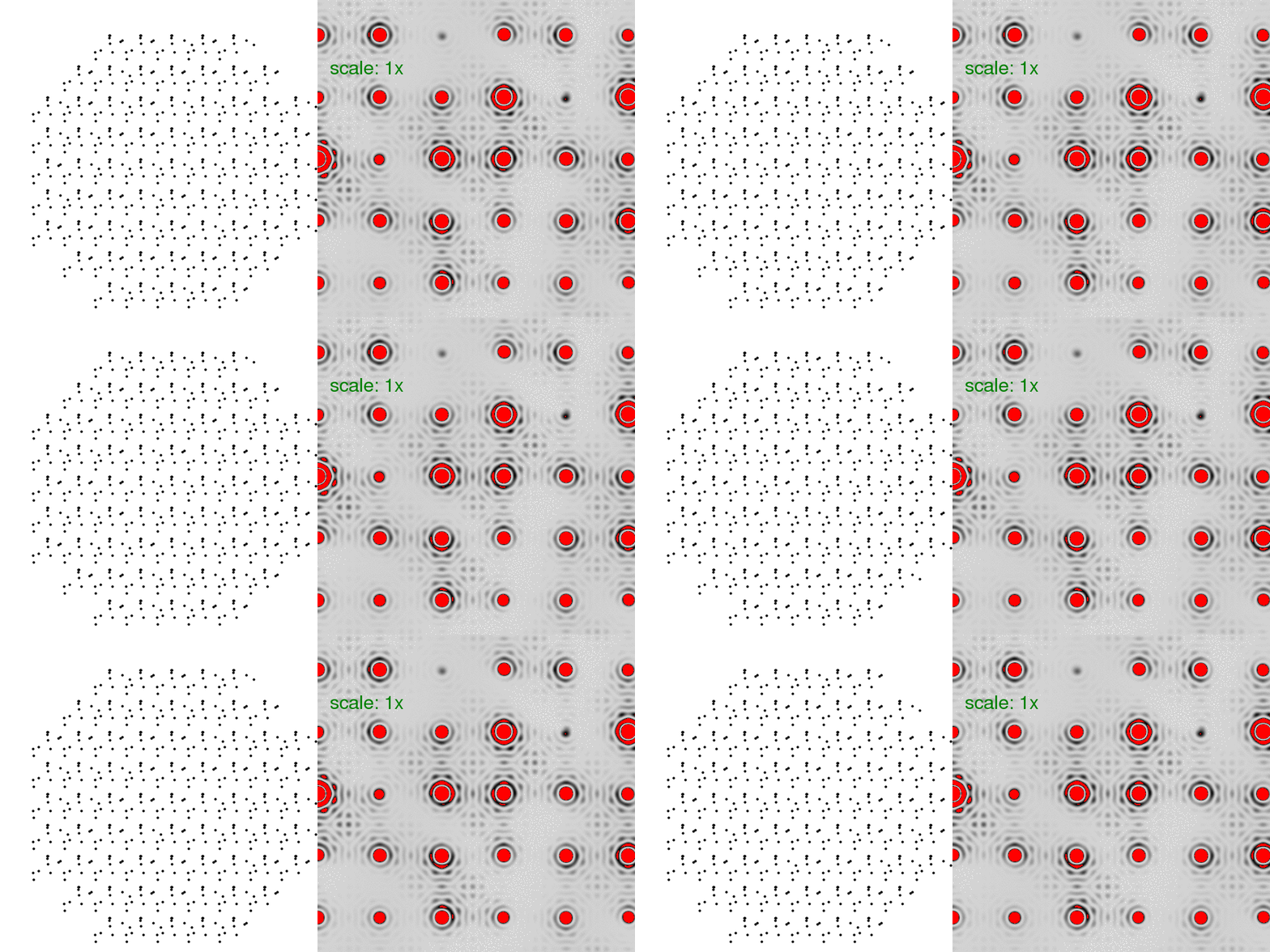
All I'm saying is that when I calculate the average general scattering
from 8192 random configurations of one disordered atom per unit cell:
http://bl831.als.lbl.gov/~jamesh/diffuse_scatter/xtal_diffuse.gif
and then subtract from that the general scattering from an
"occupancy-weighted model" with the two possible atom positions are at
half occupancy:
http://bl831.als.lbl.gov/~jamesh/diffuse_scatter/xtalAB_Fsum.gif
I get an difference image that shows only the smooth diffuse-scatter
background, with no spots to speak of:
http://bl831.als.lbl.gov/~jamesh/diffuse_scatter/xtals_diffuse_minus_Fsu
m.
gif
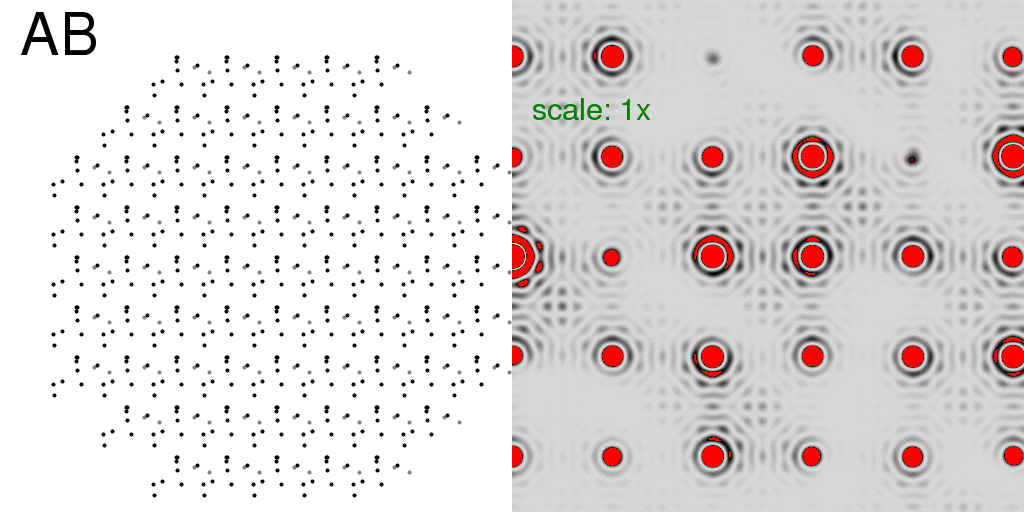
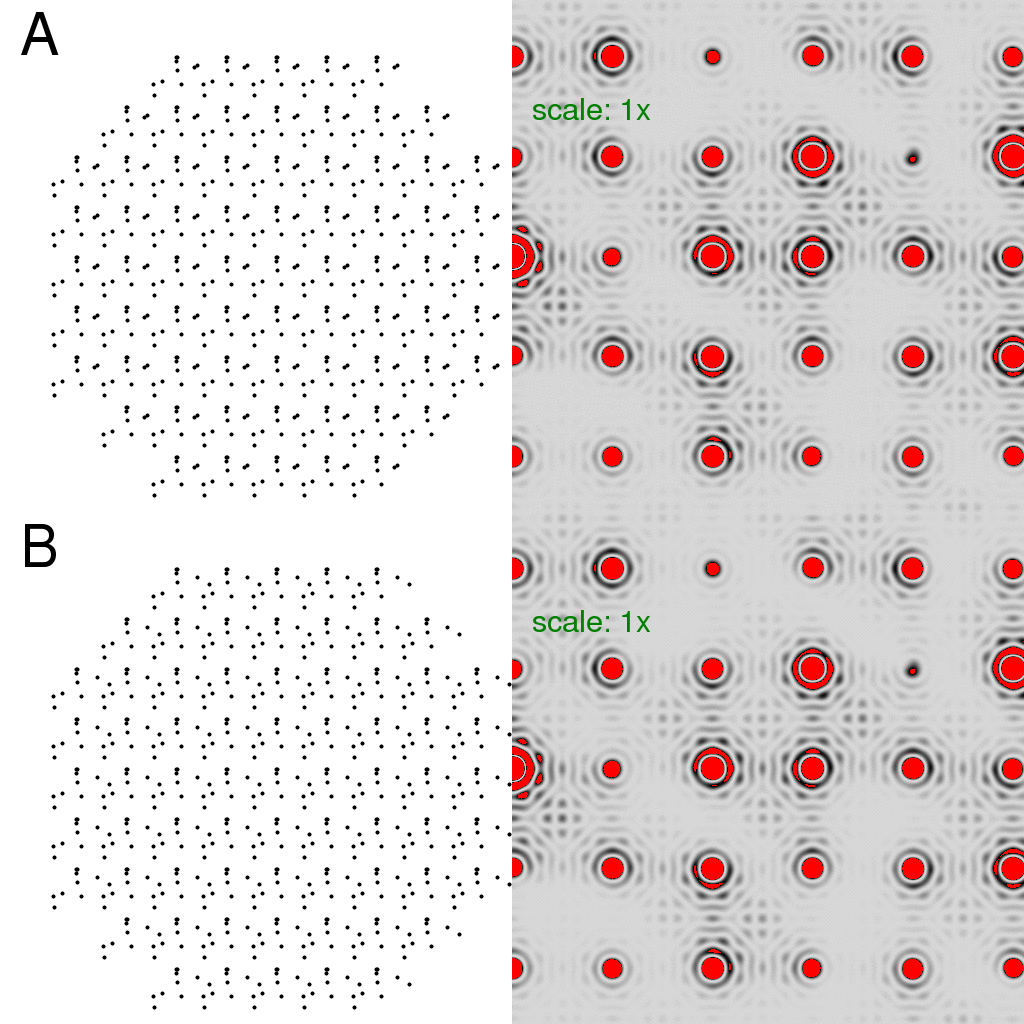
But, if I calculate the average general scattering from an "all A" and
an "all B" crystal:
http://bl831.als.lbl.gov/~jamesh/diffuse_scatter/xtalAB_Isum.gif
and subtract from it the same partial-occupancy model image as above:
http://bl831.als.lbl.gov/~jamesh/diffuse_scatter/xtalAB_Fsum.gif
I get an image where some of the spots have been subtracted out, but
others are still quite pronounced:
http://bl831.als.lbl.gov/~jamesh/diffuse_scatter/xtals_Isum_minus_Fsum.g
if
So, in the first case, the partial-occupancy model produced exactly
the
same background-subtracted spot intensities as the "unsynchronized
disorder" case, but this was not so when the disorder was
synchronized.
What did I do wrong?
As far as my "operational" definition of a "Bragg peak" (a term which
already has two definitions), I am merely suggesting that the
nearly-universal practice of subtracting the "local background" is a
very pragmatic definition of a "spot intensity". Nearly all available
data were collected in this way, and it actually is a reasonable thing
to do if the disorder from cell to cell is uncorrelated (as evidenced
above).
However, I totally agree with you that the disorder in protein
crystals
may well be correlated across large patches of unit cells. If that is
the case, then the "average occupancy model" that is all but
universally
implemented by refinement programs will never be able to explain the
background-subtracted spot intensities.
-James Holton
MAD Scientist


Ian Tickle wrote:
If all cells are completely unsynchronized, then the
occupancy-weighted
average electron density map of all the conformers will fully
explain
the background-subtracted spot intensities, but if there is
cell-to-cell synchronization: it won't!
This is not correct: as I tried to explain in a previous posting,
the
'optic' mode DS component which arises from what I would call 'short
to
medium range' correlated displacements (that is correlations due to
rigid side-chain motions, or of secondary-structure units,
individual
helices say, or of whole domains within the same molecule, or of
different molecules within the same unit cell), give rise to a
non-uniform DS distribution over the *whole* diffraction pattern.
You
can't assume that the contributions of the optic DS at the Bragg
positions are zero just because they can't be measured!  From the DS
equation there's absolutely no reason why the DS should be anything
other than non-uniform at the Bragg position as anywhere else.
Since
it's equally non-uniform over the whole pattern, including at and
around
the Bragg positions, a planar background correction can't possibly
remove it from the integrated Bragg intensities.  So it's simply not
correct to say that the mean electron density explains all the
intensity
at the Bragg positions.  There will be a residual I(diffuse) =
I(coherent) - I(Bragg) which is everywhere positive, as I
demonstrated.
I agree with you that what I would call 'long-range' correlations
between different unit cells contribute largely to the 'acoustic'
mode
DS which is centred largely *at* the Bragg peaks.  You say 'if' the
cells are completely unsynchronised, but that's a big 'if' -
certainly
you can't simply assume that it's true.

On another point you said you wanted an 'operational' definition of
I(Bragg).  I'm not entirely clear what you mean by that.  Are you
saying
that you want I(Bragg) to be the total background-subtracted
integrated
intensity under the peak at the Bragg position, i.e. what I'm
calling
I(coherent).  If so then it can't be the contribution from the mean
density at the same time! - seems to me that's what everyone means
by
I(Bragg) (including you I thought!) so changing the definition will
cause total confusion!

Cheers

-- Ian


Disclaimer
This communication is confidential and may contain privileged
information intended solely for the named addressee(s). It may not be
used
or disclosed except for the purpose for which it has been sent. If you
are
not the intended recipient you must not review, use, disclose, copy,
distribute or take any action in reliance upon it. If you have
received
this communication in error, please notify Astex Therapeutics Ltd by
emailing [email protected] and destroy all copies of the
message and any attached documents.
Astex Therapeutics Ltd monitors, controls and protects all its
messaging
traffic in compliance with its corporate email policy. The Company
accepts
no liability or responsibility for any onward transmission or use of
emails and attachments having left the Astex Therapeutics domain.
Unless
expressly stated, opinions in this message are those of the individual
sender and not of Astex Therapeutics Ltd. The recipient should check
this
email and any attachments for the presence of computer viruses. Astex
Therapeutics Ltd accepts no liability for damage caused by any virus
transmitted by this email. E-mail is susceptible to data corruption,
interception, unauthorized amendment, and tampering, Astex
Therapeutics
Ltd only send and receive e-mails on the basis that the Company is not
liable for any such alteration or any consequences thereof.
Astex Therapeutics Ltd., Registered in England at 436 Cambridge Science Park,
Cambridge CB4 0QA under number 3751674
Disclaimer
This communication is confidential and may contain privileged information intended solely for the named addressee(s). It may not be used or disclosed except for the purpose for which it has been sent. If you are not the intended recipient you must not review, use, disclose, copy, distribute or take any action in reliance upon it. If you have received this communication in error, please notify Astex Therapeutics Ltd by emailing [email protected] and destroy all copies of the message and any attached documents.
Astex Therapeutics Ltd monitors, controls and protects all its messaging traffic in compliance with its corporate email policy. The Company accepts no liability or responsibility for any onward transmission or use of emails and attachments having left the Astex Therapeutics domain. Unless expressly stated, opinions in this message are those of the individual sender and not of Astex Therapeutics Ltd. The recipient should check this email and any attachments for the presence of computer viruses. Astex Therapeutics Ltd accepts no liability for damage caused by any virus transmitted by this email. E-mail is susceptible to data corruption, interception, unauthorized amendment, and tampering, Astex Therapeutics Ltd only send and receive e-mails on the basis that the Company is not liable for any such alteration or any consequences thereof.
Astex Therapeutics Ltd., Registered in England at 436 Cambridge Science Park,
Cambridge CB4 0QA under number 3751674