Hi Bernhard,

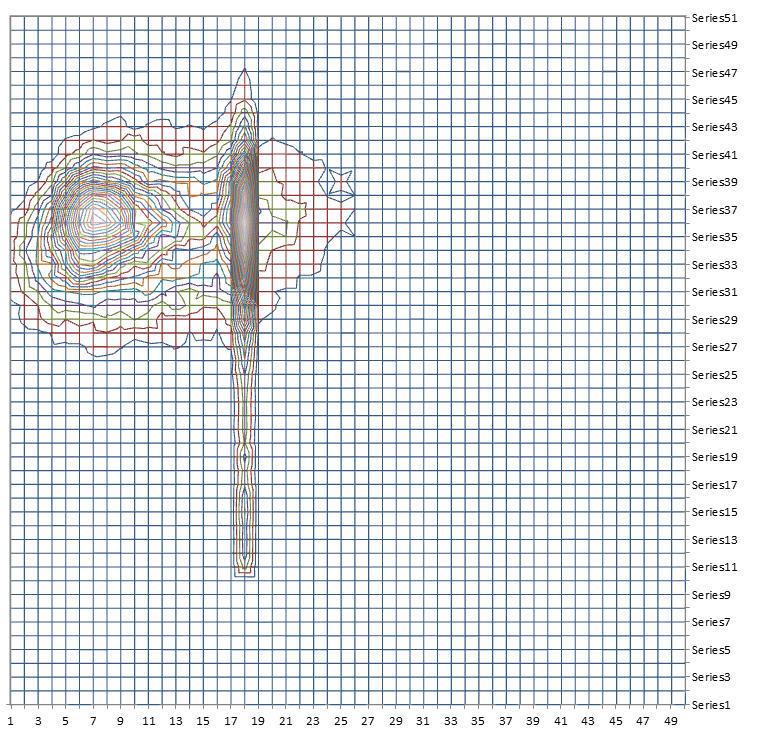
I just calculated k_sol and B_sol for all PDB entries that
     - have reflection data available,
     - I could re-compute the R-factor within 5%, and
     - R-work<30%
using a simple cctbx script. Here is what I get:
Distribution of k_sol:
     0.000 - 0.060      : 27
     0.060 - 0.120      : 12
     0.120 - 0.180      : 51
     0.180 - 0.240      : 182
     0.240 - 0.300      : 1770
     0.300 - 0.360      : 13819
     0.360 - 0.420      : 19731
     0.420 - 0.480      : 3039
     0.480 - 0.540      : 471
     0.540 - 0.600      : 256

Distribution of B_sol:
     0.000 - 31.300     : 4349
    31.300 - 62.600     : 29425
    62.600 - 93.900     : 4578
    93.900 - 125.200    : 597
   125.200 - 156.500    : 225
   156.500 - 187.800    : 84
   187.800 - 219.100    : 37
   219.100 - 250.400    : 23
   250.400 - 281.700    : 10
   281.700 - 313.000    : 30

It seems like the result of similar exercise done by Fokine and Urzhumtsev
(Acta Cryst. (2002). D58, 1387-1392) still holds (see figure 3 on page 1390
there).

Pavel


On Mon, Jan 30, 2012 at 11:10 AM, Bernhard Rupp (Hofkristallrat a.D.) <
[email protected]> wrote:

> Dear All,
>
> when I plot bulk solvent B and K extracted from EDS, an improbable and
> bimodal distribution appears.
> In the B_sol vs k_sol PDF a sharp line of values with B-sol of 70 appears
> (B-axis left to right, 0-200).
>
> http://www.ruppweb.org/images/b_sol_contour.jpg
> http://www.ruppweb.org/images/b_sol_surface.jpg
>
> According to a quick peak at EDS instructions,
> it uses the REFMAC flat bulk solvent model throughout  for bulk solvent
> correction.
>
> The main peak in fact has the expected distribution, but it seems that the
> sharp peak at B_sol=70
> represents some cut-off that in a certain set of calculations was used.
>
> For data mining it would be useful to know where/when these cutoffs were
> used.
>
> Best regards, BR
> -----------------------------------------------------------------
> Bernhard Rupp
> http://www.ruppweb.org/
> -----------------------------------------------------------------
>