Hey folks,
after my OmniUSB-thread has gone down the teleprinter way... I'll start
a new thread.
Did you now how I came to vintage computers? How I became some kind of
computer engineer? Probably not. It's so easy. Listen. Long story ahead.
In 1999 I started to study computer science. Java and algorithms and all
that clean stuff.
One day in autumn 2000 I had that idea: I need a Fernschreiber
(=teleprinter)! I had nothing to do with that stuff. And I did no know
how it worked. I even did not remember having seen one. It was just that
word in my head.
So I bought my first Siemens T100 (still here in the house, two floors
below me). It was a machine with strange connectors which made awful
noise when connected to power.
So I went to the library and found a good book from 1934. That told me
how the teleprinter works.
I then somehow soldered a simple interface to connect that beast to the
parallel (!!!) port of my Linux server (the first hachti.de server was a
mainboard and a harddisk in the corner of my student home where we had
10mbit LAN acess and fixed IP. I even did a DNS reverse mapping
philipp.vorstrasse.uni-bremen.de for my IP).
At that time all about programming I knew was Turbo Pascal, some Z80
machine language (not assembly language, I programmed that beast in hex)
and a bit Java. I didn't even know much about Linux. The server back
then had been setup by someone else who was in need of a server. So he
used it as well.
I used the parallel port because I had an idea how to control the pins.
I knew that there was something ugly called serial port but I had not
yet made the connection that this was EXACTLY what I would have needed.
To program that thing I needed some software. So I went to the bookstore
at noon. Will never forget that. Bought the O'Reilly Linux Kernel
drivers book (the one with the horse) and started to write my first C
program ever. It was a kernel module. The Kernel must have been Linux
2.2. It was frustrating. But after a decent 30 hour nonstop session and
hundreds of reboots (haha, of my web and mail server which was also
running X from time to time) I really had some bitbang code which made
the teleprinter say what I wanted it to say.
I soon realised that with a multitasking OS like Linux I had the choice
of outputting correct data using busy wait in Kernel or outputting a
mess when the system gets under load. So I learned THAT lesson.
I decided that I needed something else. Because I had heard of other
people working with something called PIC Microcontroller, I bought one
and a programmer. And a breadboard. That evil 16f84 was sitting there on
my desk, naked, and did - nothing.
Getting the PIC up and running was pure horror. The hardest architecture
I've ever mastered. Since then I know: PIC is a load of complete shit!
In the end I failed to create a RS232 (had learned that in the meantime)
to teleprinter converter but had the idea to hook up two teleprinters
using modems. TelexPhone was born. The project (telexphone.net) was
eventually kind of stolen a few years later and continued to something
still in existence called i-telex over internet. That was never what I
wanted because the V21 modems (hard to find!!) are bit transparent. That
means that the teleprinters on both sides of the wire run as synchronous
as with a real wire between them. Very cool. The TelexPhone used a
16f876 with a approx 2k cooperative multitasking system written entirely
in assembly. It was somehow modular. I managed to hook in modules with
private main loop and init parts by writing an impressive linker script
which automated that.
Hey, I was 21 and did all that on my own! Please do NOT laugh!
In the meantime someone somewhere invented something called eBay. And
because It's always good to have several different devices of the same
type and even better to have several examples of each those different
devices, I had an eBay search for "Lochstreifen" which means punched
paper tape. Paper tape for teleprinter, of course.
One day I found an offer "Honeywell H316 minicomputer" which sounded
interesting. With paper tape. And no pictures. In Switzerland. A quick
search (probably already google? I used altavista.digital.com before)
told me that this could be an interesting toy. So I bought it for the
incredible amount of SFr 450.
Borrowed a car and went there. What I found was some messy stuff
somewhere on an uninsulated attic in Switzerland. Very dirty. I nearly
turned down the deal because it all looked so crappy. The seller
admitted that he had kept the stuff in that open attic since beginning
of the 1980s.
I took it home. Had to drive TWICE from Bremen to Switzerland to get it
all. And it was a lucky buy.
After fiddling and cleaning around some weeks (never seen a minicomputer
before!) and reading the manuals, I found out that the PSU had a slight
problem which lead to unjustified shutdown. After I had solved that by
pulling out one of the security circuit card from the PSU, it powered up
the computer. And it magically worked instantly exactly as the manual
told me. That was in 2004. The H316 has never since then failed a single
time. Only issue are some contact issues with some memory cabling which
may happen after moving the machine.
Since then I have never had to switch a chip or a lamp or whatever. No
single failure. Not one failed CPU or memory test (except when I stress
the cable's card edge connector). It's so amazing that it became boring.
Programming in FORTRAN IV? Read the manual, punch tape, use the
compiler, linking loader and libraries as described in the manual -
works. No secret shit. And The machine came with all that software as
nice source code listing and binary paper tapes.
While still wandering around on my Olympus of quality, I got a call by a
teleprinter friend who asked me if I would take a pdp8 computer. I
thought that bit of that infamous DEC mess could be a good counter
example for my H316's unlimited quality and went to pick up the pdp8.
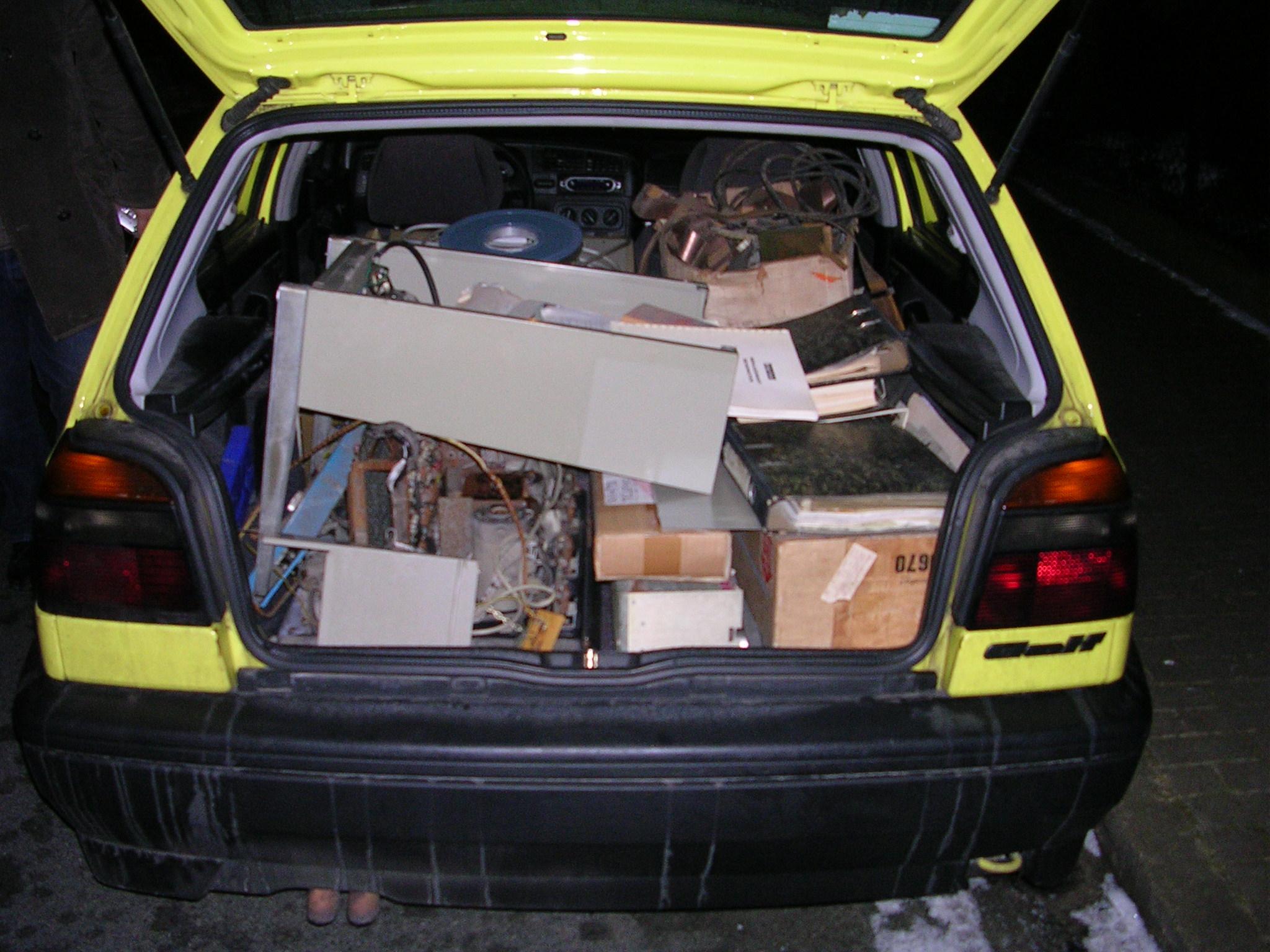
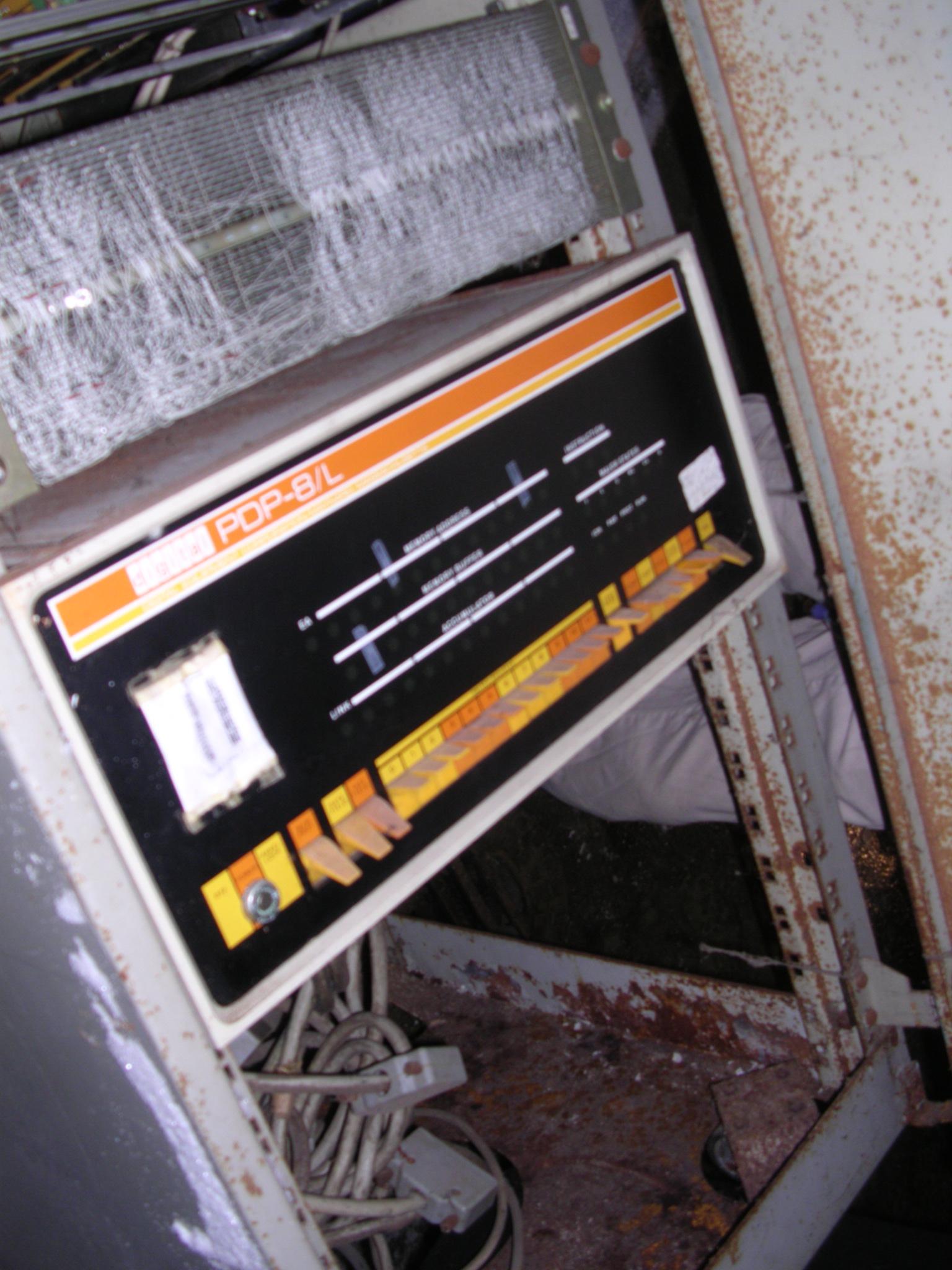
The day ended with my yellow car completely stuffed with rusty pdp8/l,
and lots of other stuff. It were three machines. The tape drives and
racks were fubar and went to scrap.
http://pdp8.hachti.de/gallery/haul/dscn0750_full.jpg
http://pdp8.hachti.de/gallery/haul/dscn0751_full.jpg
http://pdp8.hachti.de/gallery/haul/dscn2109_full.jpg

That was the beginning of the end. It just happened. Later 8/e, lab8/e etc.
And I had to admit that playing with Omnibus pdp8 is absolutely amazing!
It's a great toy! I think the pdp8/e (not straight-8, 8/i, /s or
whatever) is one of the greatest toys ever made. There are many games,
it breaks regularly while still giving you a chance to be satisfied
after fixing it. And it's so versatile!
And digging through those blurry schematics is a game in its own right!
For the Honeywell everything comes in high quality print, completely
correct, no derivations and workarounds. With DEC it can be an adventure
to get an overview over a hardware, its features, ECOs and FCOs and what
else could happen.
Someday I also made a pdp8 in an FPGA. That was during the time I wanted
to be a chip designer. But the only place where I could to ASIC design
(I did my diploma thesis about a video generator FPGA design) was closed
down instead of hiring me. Thank you, Silicon Image!
Currently I'm working for a Bosch/Denso joint venture doing Linux
security for car multimedia systems. In my free time I have just started
to construct a Märklin model railroad digital decoder which I will try
to sell commercially (the competition use closed source PIC stuff. I use
GPLv3 AVR code). And I run a letterpress print shop with the biggest
machine being over 5 metric tons.
In the printshop there's also an 8/e. And I have inherited a forklift.
Don't know why I wrote this... Just wanted to write it. The teleprinter
discussion... It was the teleprinter discussion....
I never learned to get that paper... I just had the right toys.

That's it for now :-)