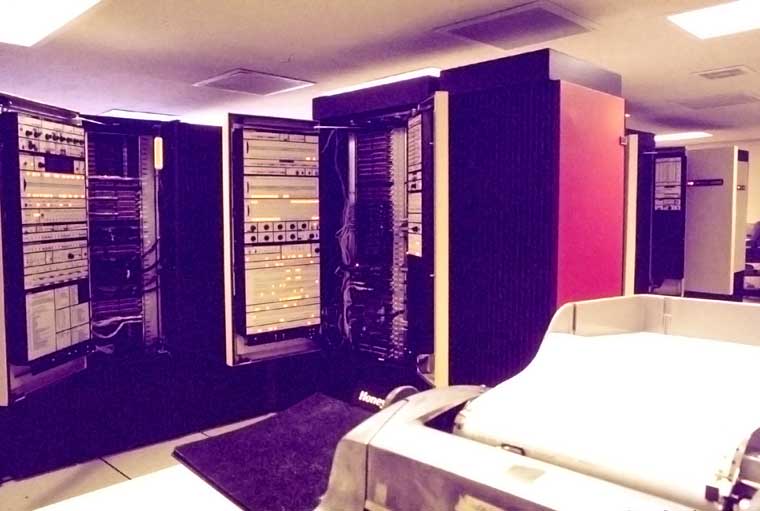
from  what  I was  told,  many versions of   machines by Big H  were used
to run multics over the span of  time.  Ed#


In a message dated 7/26/2017 9:59:19 A.M. US Mountain Standard Time,
[email protected] writes:
On Wed,  Jul 26, 2017 at 7:37 AM, Noel Chiappa via cctalk  <
[email protected]> wrote:

> So, I've been collecting  images of 'Multics' 'front' panels from around
the
> Internet, intending  to do a gallery.
>
> (I should explain that, in common with  mainframes of that era, a Multics
> system had a variety of different  kinds of boxes - CPUs, memories, etc -
> but
> also others,  intended to support the multi-CPU 'utility' concept. It was
> possible  to take, say, a running 3-CPU system, split off a CPU, bring
that
>  up
> as a separate system, then later bring that down, and add it back  to the
> running system! This was actually done at the MIT site, to  allow
> development
> work in the evenings on the OS  software.)
>
> The Multicians site has a nice picture of a Multics  system with the some
of
> the panels swung open (they're actually  'diagnostic' panels, so would
> normally
> be swung  shut):
>
>    http://www.multicians.org/mulimg/h6180-doors-open-big.jpg
>
> The  CPU is the one in the center (the panel on the left is an IOM, 'I/O
>  Multiplexor', one of the other kinds of box).
>
>
> So,  anyway,I had this large collection of pictures, and asked: Tom Van
>  Vleck,
> the maintainer of the Multicians Web site what the other  (non-CPU) panels
> on
> offer might be, and his reaction was  (roughly) 'some of the CPU panels
> there
> might not be Multics  CPU panels'.
>
> (Honeywell had an entire line,  the
>
>    https://en.wikipedia.org/wiki/Honeywell_6000_series
>
> but most  models in that line ran an OS called GECOS (later GCOS), not
> Multics.  So possibly those CPU 'front' panels are from some other 6000
>  series
> CPU.)
>
> His reasoning was that they don't have  the Appending Unit sections: to
> explain
> this, Multics used an  extra box (the Appending Unit), inserted between
the
> CPU
> and  the memory, to implement the paging and segmentation of Multics, and
>  most
> 6000-series CPUs did not have this.
>
> If you look  at this image of what is probably the Multics CPU panel now
at
>  the
> LCM:
>
>    http://ana-3.lcs.mit.edu/~jnc/tech/multics/jpg/_1020903.jpg
>
> it  has an Appending Unit section at the top. (BTW, are there any pictures
>  online of LCM panel? All I could find was the video, which is  admittedly
> ultra-cool.) See the "APU Scroll" section (first full-width  section), for
> the
> Appending Unit, at the top in this detailed  shot:
>
>    http://ana-3.lcs.mit.edu/~jnc/tech/multics/jpg/_1020899.jpg
>
>  It's not an extra panel: the CPU panel on a Multics machine, although
the
> same
> overall size, has a different configuration, with the  APU sections.
>
>
> However, the suspect CPU panels don't  have those sections; see an image
of
> one
>  here:
>
>    http://ana-3.lcs.mit.edu/~jnc/tech/multics/jpg/multics_panel.jpg
>
>  with detailed images here:
>
>    http://ana-3.lcs.mit.edu/~jnc/tech/multics/jpg/multics_panel_cu1.jpg
>    http://ana-3.lcs.mit.edu/~jnc/tech/multics/jpg/multics_panel_cu2.jpg
>    http://ana-3.lcs.mit.edu/~jnc/tech/multics/jpg/multics_panel_cu3.jpg
>
>  Which is not _definitive_ that they aren't from a Multics machine, but
it
> certainly raises a big question mark. So, the question is, 'are  they
> Multics
> panels, just for some reason without the APU  section, or what'?
>
> So maybe these are from some other  Honeywell Series 6000 CPU? If so, does
> anyone knows which Honeywell  6000 series machine (it pretty much has to
be
> from one of them) they  are from?
>
>       Noel
>