Hi.
I like the more generic x/y_coordinate_index name, but I'm wondering if
x and y have too strong an association to projected coordinate systems.
I also like u/v, but that may be too strongly associated for some people
with vector components (wind, for example). What do the rest of you
think? Here are some names that come to mind. Feel free to suggest
something better!
 * mesh_grid_i_index, mesh_grid_j_index
 * grid_i_index, grid_j_index
 * grid_i_coordinate, grid_j_coordinate
 * x_coordinate_index, y_coordinate_index
 * index_x_coordinate, index_y_coordinate (this ordering matches the
   projection_x/y_coordinate naming)
 * u_coordinate, v_coordinate
 * i_coordinate, j_coordinate
 * grid_row_coordinate, grid_column_coordinate
 * row_coordinate, column_coordinate

The more I look at these, the more I like the last two.
As for a definitions, how about something like this variation on the
ones for the projection_x/y_coordinate?
   column_coordinate: "column" indicates the fastest-changing dimension
   of a two-dimensional grid, when this is not associated with a
   spatial coordinate dimension such as longitude or projected X,
   positive with increasing column. The column coordinate, possibly in
   conjunction with the row coordinate, serves as a parametric driver
   mapping abstract grid positions to spatial coordinates such as
   latitude and longitude.

   row_coordinate: "row" indicates the the slowest-changing dimension
   of a 2-dimensional grid, when this is not associated with a spatial
   coordinate dimension such as latitude or projected Y, positive with
   increasing row. The row and column coordinates serve as a parametric
   driver mapping abstract grid positions to spatial coordinates such
   as latitude and longitude.

Grace and peace,

Jim

On 3/31/17 5:37 PM, Sebastien Villaume wrote:
Hi all,

I have checked both IPSL and CNRM CMIP5 datasets. It is indeed NEMO datasets and it is probably a ORCA tripolar grid in both
cases. I write "probably" because it is not clear and conclusive without plotting the datasets: lat and lon are 2D
fields, the datasets define 2 extra 1D coordinates "i" and "j" to be used as mesh indices (but without a
proper standard name). The datasets also have bounds for lat and lon, defined as "lat_vertices" and
"lon_vertices" which I think is one solution to describe the tripolar grid. I would prefer something more standardized
and documented so that one can quickly identify from the metadata that it is a tripolar grid (defining the resolution, where are
the poles, how it is derived, etc.)

I would like to propose for addition standard names to support the mesh
indices/coordinates:

"mesh_grid_i/j_index" suggested by Jim
or
"x/y_coordinate_index" suggested by Jonathan

I let the experts in standard names decide which pair suits best the present
case.

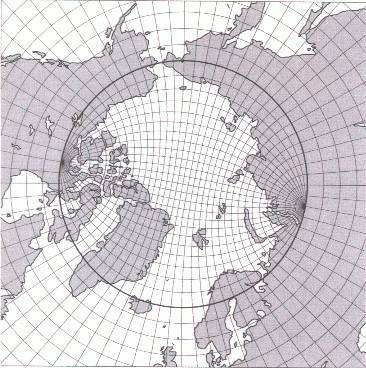
Regarding tripolar grids characteristics, I did some research and came to the conclusion that
"Murray tripolar grids" are not identical to "ORCA/NEMO tripolar grids". This
is true even without considering characteristics like the grid resolution, the location of the
poles or where the latitude boundary is placed between the modified and unmodified parts.

The Murray tripolar grid (used by GFDL) has its "north" poles on the boundary
as shown here: https://www.gfdl.noaa.gov/wp-content/uploads/pix/user_images/mw/bipolar.gif

The ORCA/NEMO tripolar grids have the "north" poles within the modified regions
but not on the boundary as shown in my original post:
http://www.geomar.de/typo3temp/pics/globe_grid2_14_b8edb639ae.png

This complicates things...


____________________________________

Dr. Sébastien Villaume
Analyst
ECMWF Shinfield Park,
Reading RG2 9AX, UK
+44 7825 521592
[email protected]
____________________________________

----- Original Message -----
From: "James Orr" <[email protected]>
To: "Karl Taylor" <[email protected]>
Cc: [email protected]
Sent: Thursday, 30 March, 2017 23:01:54
Subject: Re: [CF-metadata] CF compliant tripolar grid representation

The IPSL and CNRM cimate models that participated in CMIP5 both used the NEMO
model (ORCA2 and ORCA1 configurations) with tripolar grids.  Both provided
output the was CF compliant.

James

On Thu, 30 Mar 2017, Karl Taylor wrote:
Hi Sebastien,

More than one group stored output on a tripolar grid in CMIP5.  I'm pretty
sure they did it in a CF-conforming way.  I know at least some of the GFDL
model output was reported on a tripolar grid, as described at
http://nomads.gfdl.noaa.gov/CM2.X/oceangrid.html (or search on "tripolar
grid" for additional links).  You could look to their example, and see if you
think it is done correctly.

I don't think extensions or modifications to CF are needed for tripolar
grids.

best regards,
Karl

On 3/30/17 9:42 AM, Jim Biard wrote:
Sébastien,

If I'm not mistaken, we would need to propose a new grid_mapping to be
added to the Conventions that would define a Tripolar Coordinate Reference
System, along with any attributes that don't currently exist that are
needed to complete the definition. I did a search for a standard tripolar
CRS in proj4 or epsg, and was unable to find one. Is it possible to make
such a definition?

Regarding the standard names for your X and Y coordinate variables, I think
you could use "projection_x/y_coordinate" once a grid_mapping has been
defined. Of course you could always leave the attribute off, since a
standard_name attribute is not a requirement.

If making a new grid_mapping is not feasible, you could request standard
names along the lines of mesh_grid_i_index and mesh_grid_j_index. These
standard names would (on reading their definitions) make it clear that the
measurements are on a mesh grid for which there is no CRS. At least that's
what comes to mind at the moment.

Grace and peace,

Jim

On 3/30/17 11:52 AM, Sebastien Villaume wrote:
Hello all,

I am looking for the best approach to describe in a CF compliant way the
tripolar grids usually used in NEMO configurations.

Basically, the difference with a usual bipolar grid (north pole-south
pole) is that the north pole is split into 2 poles moved over Canada and
Russia (to have distortions/singularities not over the ocean). A good
visual representation can be found here:

http://www.geomar.de/typo3temp/pics/globe_grid2_14_b8edb639ae.png
everything south of the green line (40degN) is identical to a regular
grid, but everything north of it is computed using a technique described
here:

Madec, G. and M. Imbard, 1996 : A global ocean mesh to overcome the north
pole singularity. Clim. Dyn., 12, 381–388.


The usual NEMO output of the grid looks like this:

      float longitude(y, x) ;
          longitude:standard_name = "longitude" ;
          longitude:units = "degrees_east" ;
          longitude:long_name = "longitude" ;
      float latitude(y, x) ;
          latitude:standard_name = "latitude" ;
          latitude:units = "degrees_north" ;
          latitude:long_name = "latitude" ;


Basically both latitudes and longitudes need to be specified for each grid
point, hence lat and lon are 2D arrays. This is not a problem itself but I
would like to give more information through maybe grid_mapping or crs so
it is clear that the grid is tripolar. This is useful information if one
want to project/interpolate this back to a more regular representation.

Looking at the CF conventions, I can see that grids can be fairly nicely
documented but nothing for tripolar grids.

Is there some documentation/guidelines on how to derive a proper
grid_mapping/crs with valid attributes for tripolar grids?

I would also like to add to my netcdf file a way to better describe axes:

      double y(y) ;
          y:units = "1" ;
          y:long_name = "j-index of mesh grid" ;
          y:standard_name = ??? ;
      double x(x) ;
          x:units = "1" ;
          x:long_name = "i-index of mesh grid" ;
          x:standard_name = ??? ;

what would be the standard name of these?

Thanks,

____________________________________

Dr. Sébastien Villaume
Analyst
ECMWF Shinfield Park,
Reading RG2 9AX, UK
+44 7825 521592
[email protected]  ____________________________________
_______________________________________________
CF-metadata mailing list
[email protected]
http://mailman.cgd.ucar.edu/mailman/listinfo/cf-metadata
--
CICS-NC <http://www.cicsnc.org/> Visit us on
Facebook <http://www.facebook.com/cicsnc>         *Jim Biard*
*Research Scholar*
Cooperative Institute for Climate and Satellites NC <http://cicsnc.org/>
North Carolina State University <http://ncsu.edu/>
NOAA National Centers for Environmental Information <http://ncdc.noaa.gov/>
/formerly NOAA’s National Climatic Data Center/
151 Patton Ave, Asheville, NC 28801
e: [email protected] <mailto:[email protected]>
o: +1 828 271 4900

/Connect with us on Facebook for climate
<https://www.facebook.com/NOAANCEIclimate> and ocean and geophysics
<https://www.facebook.com/NOAANCEIoceangeo> information, and follow us on
Twitter at @NOAANCEIclimate <https://twitter.com/NOAANCEIclimate> and
@NOAANCEIocngeo <https://twitter.com/NOAANCEIocngeo>. /


_______________________________________________
CF-metadata mailing list
[email protected]
http://mailman.cgd.ucar.edu/mailman/listinfo/cf-metadata
--
CICS-NC <http://www.cicsnc.org/> Visit us on
Facebook <http://www.facebook.com/cicsnc>         *Jim Biard*
*Research Scholar*
Cooperative Institute for Climate and Satellites NC <http://cicsnc.org/>
North Carolina State University <http://ncsu.edu/>
NOAA National Centers for Environmental Information <http://ncdc.noaa.gov/>
/formerly NOAA’s National Climatic Data Center/
151 Patton Ave, Asheville, NC 28801
e: [email protected] <mailto:[email protected]>
o: +1 828 271 4900
/Connect with us on Facebook for climate
<https://www.facebook.com/NOAANCEIclimate> and ocean and geophysics
<https://www.facebook.com/NOAANCEIoceangeo> information, and follow us
on Twitter at @NOAANCEIclimate <https://twitter.com/NOAANCEIclimate> and
@NOAANCEIocngeo <https://twitter.com/NOAANCEIocngeo>. /
_______________________________________________
CF-metadata mailing list
[email protected]
http://mailman.cgd.ucar.edu/mailman/listinfo/cf-metadata