paul-rogers commented on issue #11933:
URL: https://github.com/apache/druid/issues/11933#issuecomment-1272429473
   @FrankChen021, thanks for the link! Yes, the proposal is based on the pull
model _within_ each fragment. When we get to distribution (i.e. "multi-stage"),
we envision a _push_ model between fragments. That way, we get the simplicity
of the pull model with the performance of the push model.

   To explain this a bit more, let's remember that, in a distributed system, we
don't run the entire operator DAG single-threaded: we slice the query into
fragments, perhaps on the same node, more typically across multiple nodes.
(Druid's scatter/gather is the simplest possible distributed DAG: it has two
slices.) The Drill version of this idea is explained
[here](https://drill.apache.org/docs/drill-query-execution/).

   Within a fragment, operators work using the Volcano pull model. The code for
this is quite simple as is illustrated by the operators in the PR. Each
operator is stateful: it does the work to return one row (or, more typically,
one batch) reading as many input rows as it needs. It is trivial to order the
inputs, starting them one by one as in a union.

   The push model is common in search engines, I understand. However, it
becomes quite complex once one has multiple branches (i.e. joins, unions,
etc.). Suppose we have a single-thread DAG with a join. We've got two leaves,
both of which want to push data up to the join. But, a hash join, say, wants to
first read the build side, only later the probe side. This is trivial with the
Volcano model, but quite messy with pull. As it turns out, I once worked on a
query engine that used the push model: it was, indeed, quite complex. Far more
complex than the Volcano model of Drill and Impala.

   The benefit of pull is concurrency: each fork in the DAG pretty much demands
to be run in a separate thread (or process or node), with some kind of
queue-based exchange between operators. If only Druid were written in Go: we'd
get the pull model for free! Otherwise, we get this benefit in the Volcano
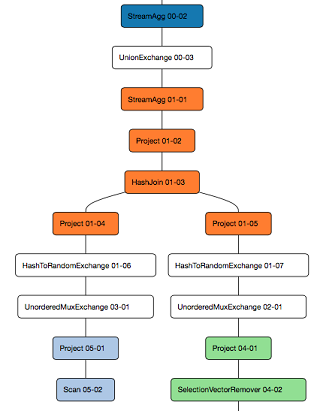
model by introducing distribution. But, what we distribute are _slices_ of
operators, not individual operators. Each running slice is a _fragment_. (Scan
slices, for example may be replicated dozens or hundreds of time, each of those
copies is a fragment.) The way we visualize this idea is with a [query
profile](https://drill.apache.org/docs/query-profiles/). Here is a [typical
one](https://drill.apache.org/images/docs/vis_graph.png) from Drill.

   In Drill and Impala, fragments use the push model. Leaf fragments (typically
scans) start running immediately and push results to their downstream
fragments, pausing if the receiver queue fills. For example, in that hash join
example, the build side scan fragment will pump batches to the join which
builds the hash table. The probe side scan will get blocked quickly because the
hash join won't read from the receive queue until the hash table is built.

   One can turn the Volcano push model into a pull model simply by making all
fragments contain a single operator. This is, in fact, what MSQ does with its
frame processors: each frame processor does a single operation. In practice,
however, such a design incurs unnecessary overhead. The operator-per-fragment
model is great for "big" operators such as distributed sorts, distributed
aggregations, etc. (And for the native queries which MSQ runs in its frame
processors.) We will find, however, that other operators are "small" and don't
provide benefit when run as a separate fragment: the overhead becomes
unproductive. For example, a limit, filter, or projection on top of a join:
might as well do those in the same fragment as the join itself.

   You pointed to ClickHouse. Consider [this
image](https://presentations.clickhouse.com/meetup24/5.%20Clickhouse%20query%20execution%20pipeline%20changes/#processors-1).
 In the proposed design, the image would normally be inverted (root at the
top). There would likely be exchanges where branches converge, which is a
logical place to slice the DAG into fragments. The "Expression", "Project",
"Extremes" and "Limit Checking" would likely be combined into a single fragment.

   In short, the proposed design (borrowed heavily from other projects)
proposes to combine the simplicity of the Volcano pull model for individual
operators (i.e. within a fragment), with the benefits of the push model between
fragments. Does this make sense?


--
This is an automated message from the Apache Git Service.
To respond to the message, please log on to GitHub and use the
URL above to go to the specific comment.

To unsubscribe, e-mail: [email protected]

For queries about this service, please contact Infrastructure at:
[email protected]


---------------------------------------------------------------------
To unsubscribe, e-mail: [email protected]
For additional commands, e-mail: [email protected]