This is an automated email from the ASF dual-hosted git repository.

abukor pushed a commit to branch gh-pages
in repository https://gitbox.apache.org/repos/asf/kudu.git
The following commit(s) were added to refs/heads/gh-pages by this push:
new afc3c96 [blog] Cross post from Boris Tyukin
afc3c96 is described below
commit afc3c964dbbd477f4625016fb1064d94f021b705
Author: Greg Solovyev <[email protected]>
AuthorDate: Fri Jun 26 15:24:54 2020 -0700
[blog] Cross post from Boris Tyukin
Original post:
https://boristyukin.com/building-near-real-time-big-data-lake-part-2/
Rendered version on my fork: https://grishick.github.io/kudu/blog/
I had to use <img> tags for the larger images
instead of regular markdown in order to make the
larger images fit on page.
Change-Id: I4113e68797653628cdb5b2f92a1105024589d83c
Reviewed-on: http://gerrit.cloudera.org:8080/16117
Reviewed-by: Alexey Serbin <[email protected]>
Reviewed-by: Attila Bukor <[email protected]>
Tested-by: Attila Bukor <[email protected]>
---
...-07-30-building-near-real-time-big-data-lake.md | 257 +++++++++++++++++++++
1 file changed, 257 insertions(+)
diff --git a/_posts/2020-07-30-building-near-real-time-big-data-lake.md
b/_posts/2020-07-30-building-near-real-time-big-data-lake.md
new file mode 100644
index 0000000..81471ff
--- /dev/null
+++ b/_posts/2020-07-30-building-near-real-time-big-data-lake.md
@@ -0,0 +1,257 @@
+---
+layout: post
+title: Building Near Real-time Big Data Lake
+author: Boris Tyukin
+---
+
+Note: This is a cross-post from the Boris Tyukin's personal blog [Building
Near Real-time Big Data Lake: Part
2](https://boristyukin.com/building-near-real-time-big-data-lake-part-2/)
+
+This is the second part of the series. In [Part
1](https://boristyukin.com/building-near-real-time-big-data-lake-part-i/)
+I wrote about our use-case for the Data Lake architecture and shared our
success story.
+
+<!--more-->
+## Requirements
+Before we embarked on our journey, we had identified high-level requirements
and guiding principles.
+It is crucial to think it through to envision who and how will use your Data
Lake. Identify your
+first three projects to keep them while you are building the Data Lake.
+
+The best way is to start a few smaller proof-of-concept projects: play with
various distributed
+engines and tools, run tons of benchmarks, and learn from others, who
implemented a similar solution
+successfully. Do not forget to learn from others' mistakes too.
+
+We had settled on these 7 guiding principles before we started looking at
technology and architecture:
+1. Scale-out, not scale-up.
+2. Design for resiliency and availability.
+3. Support both real-time and batch ingestion into a Data Lake.
+4. Enable both ad-hoc exploratory analysis as well as interactive queries.
+5. Replicate in near real-time 300+ Cerner Millennium tables from 3
remote-hosted Cerner Oracle RAC
+instances with average latency less than 10 seconds (time between a change
made in Cerner EHR system
+by clinicians and data ingested and ready for consumption in Data Lake).
+6. Have robust logging and monitoring processes to ensure reliability of the
pipeline and to simplify
+troubleshooting.
+7. Reduce manual work greatly and ease the ongoing support.
+
+We decided to embrace the benefits and scalability of Big Data technology. In
fact, it was a pretty
+easy sell as our leadership was tired of constantly buying expensive software
and hardware from
+big-name vendors and not being able to scale-out to support an avalanche of
new projects and requests.
+
+We started looking at Change Data Capture (CDC) products to mine and ship
database logs from Oracle.
+
+We knew we had to implement a metadata- or code-as-configuration driven
solution to manage hundreds
+of tables, without expanding our team.
+
+We needed a flexible orchestration and scheduling tool, designed with
real-time workloads in mind.
+
+Finally, we engaged our and Cerner's leadership early, as it would take time
to hash out all the
+details, and to make their DBAs confident that we were not going to break
their production systems
+by streaming 1000s of messages every second 24x7. In fact, one of the goals
was to relieve production
+systems from analytical workloads.
+## Platform selection
+First off, we had to decide on the actual platform. After spending 3 months
researching, 4 options
+emerged, given the realities of our organization:
+1. On-premises virtualized cluster, using preferred vendors, recommended by
our infrastructure team.
+2. On-premises Big Data appliance (bundled hardware and software, optimized
for Big Data workloads).
+3. Big Data cluster in cloud, managed by ourselves (IaaS model, which just
means renting a bunch of
+VMs and running Cloudera or Hortonworks Big Data distribution).
+4. A fully managed cloud data platform and native cloud data warehouse
(Snowflake, Google BigQuery,
+Amazon Redshift, and etc.)
+
+Each option had a long list of pros and cons, but ultimately we went with
option 2. The price was
+really attractive, it was a capital expense (our finance people rightfully
hate subscriptions), the
+best performance, security, and control.
+
+It was in 2017 when we made a decision. While we could not provision cluster
resources and add nodes
+with a click of button and we learned that software and hardware upgrades were
a real chore, it was
+still very much worth that as we've saved a 7 number figure for the
organization to get the
+performance we needed.
+
+Owning hardware also made a lot of sense for us as we could not forecast our
needs far enough in the
+future and we could get a really powerful 6 node cluster for a fraction the
cost that we would end
+up paying in subscription fees in the next 12 months. Of course, it did help
that we already had a
+state-of-the-art data center and people managing it.
+
+Fully-managed or serverless architecture was not really an option back then,
but if you asked me
+today, this would be the first thing I would look at if I had to build a data
lake today
+(definitely check AWS Lake Formation, AWS Athena, Amazon Redshift, Azure
Synapse, Snowflake and
+Google BigQuery).
+
+Your organization, goals, projects and situation could be very different and
you should definitely
+evaluate cloud solutions, especially in 2020 when prices are decreasing, cloud
providers are
+extremely competitive and there are new attractive pricing options with 3 year
commitment. Make sure
+you understand the cost and billing model. Or, hire a company (there are
plenty now), that will
+explain your cloud bills before you get a horrifying check.
+
+Some of the things to consider:
+
+1. Existing data center infrastructure and access to people, supporting it.
+2. Integration with current tools (BI, ETL, Advanced Analytics etc.) Do they
stay on-premises or can
+be moved into cloud to avoid networking lags or charges for data egress?
+3. Total ownership cost and cost to performance ratio.
+4. Do you really need elasticity? This is the first thing that cloud advocates
are preaching but
+think if and how this applies to you.
+5. Is time-to-market so crucial for you, or you can wait a few months to build
Big Data
+infrastructure on-premises to save some money and get much better performance
and control of
+physical hardware?
+6. Are you okay with locking yourself in to vendor's solution XYZ? This is an
especially crucial
+question if you are selecting a fully managed platform.
+7. Can you easily change your cloud provider? Or can you even afford to put
all your trust and faith
+in a single cloud provider?
+
+Do your homework, spend a lot of time reading and talking to other people
(engineers and architects,
+not sales reps), and make sure you understand what you are signing up for.
+
+And remember, there is no magic! You still need to architect, design, build,
support, test, and make
+good choices and use common sense. No matter what your favorite vendor tells
you. You might save
+time by spinning up a cluster in minutes, but you still need people to manage
all that. You still
+need great architects and engineers to realize benefits from all that hot new
tech.
+
+## Building blocks
+
+Once we agreed on the platform of our choice, powered by Cloudera Enterprise
Data Hub, we started
+prototyping and benchmarking various engines and tools that came with it. We
looked at other
+open-source projects, as nothing really prevents you from installing and using
any open-source
+product you desire and trust. One of these products for us was Apache NiFi,
which proved to be a
+tremendous value.
+
+After a lot of trials and errors, we decided on this architecture:
+
+<img src="https://boristyukin.com/content/images/pipelinearchitecture.png";
width="100%"/>
+
+One of the toughest challenges we faced right away was the fact that most of
the Big Data data
+engines were not designed to support mutable data but rather immutable
append-only data. All the
+workarounds we had tried did not work for us and no matter what we did with
partitioning strategy,
+we just needed a simple ability to update and delete data, not only insert.
Anyone who worked with
+RDBMS or legacy columnar databases takes this capability for granted, but
surprisingly it is a very
+difficult task in Big Data world.
+
+We considered Apache HBase, but the performance of analytics-style ETL and
interactive queries was
+really bad. We were blown away by Apache Impala's performance on HDFS as no
matter what we threw at
+Impala, it was hundreds of times faster...but we could not update data in
place.
+
+At about the same time, Cloudera released and open-sourced Apache Kudu project
that became part of
+its official distribution. We got very excited about it (refer to our
benchmarks
[here](http://boristyukin.com/benchmarking-apache-kudu-vs-apache-impala/)), and
decided
+to proceed with Kudu as a storage engine, while using Apache Impala as SQL
query engine. One of the
+ambitious goals of Apache Kudu is to cut the need for the infamous [Lambda
architecture](https://en.wikipedia.org/wiki/Lambda_architecture).
+
+After talking to 7 vendors and playing with our top picks, we selected a
Change Data Capture product
+(Oracle GoldenGate for Big Data edition). It deserves a separate post but
let's just say it was the
+only product out of 7, that was able to handle complexities of the source
Oracle RAC systems and
+offer great performance without the need to install any agents or software on
the actual production
+database. Other solutions had a very long list of limitations for Oracle
systems, make sure to read
+and understand these limitations.
+
+Our homegrown tool
[MetaZoo](http://boristyukin.com/how-to-ingest-a-large-number-of-tables-into-a-big-data-lake-or-why-i-built-metazoo/)
+has been instrumental to bring order and peace, and that's why it earned
+its own blog post!
+
+## How it works
+Initial ingest is pretty typical - we use Sqoop to extract data from Cerner
Oracle databases, and
+NiFi helps orchestrate initial load for hundreds of tables. Actually, this
NiFi flow below can
+handle initial ingest of hundreds of tables!
+
+<img src="https://boristyukin.com/content/images/nifi_initial.png";
width="100%" />
+
+Our secret sauce though is
[MetaZoo](http://boristyukin.com/how-to-ingest-a-large-number-of-tables-into-a-big-data-lake-or-why-i-built-metazoo/).
+MetaZoo generates optimal parameters for Sqoop (such as a number of mappers,
split-by column, and so
+forth), generates DDLs for staging and final tables, and SQL commands to
transform data before they
+land in the Data Lake. MetaZoo also provides control tables to record status
of every table.
+
+The throughput of Sqoop is nothing but amazing. Gone are the days when we had
to ask Cerner to dump
+tables on a hard-drive and ship it by snail mail (do not ask how much it cost
us!). And we like how
+YARN queues help to limit the load on production databases.
+
+To give you one example, a few years ago it took us 4 weeks to reload
`clinical_event` table from
+Cerner using Informatica into our local Oracle database. With Sqoop and Big
Data, it was done in 11
+hours!
+
+This is what happens during the initial ingest.
+
+First, MetaZoo gathers relevant metadata from source system about tables to
ingest, and based on
+that metadata will generate DDL scripts, SQL commands snippets, Sqoop
parameters, and more. It will
+initialize tables in MetaZoo control tables as well.
+
+Then NiFi picks a list of tables to ingest from MetaZoo control tables and run
the following steps
+to:
+
+* Execute and wait for Sqoop to finish.
+* Apply some basic rules to map data types to the corresponding data types in
the lake. We convert
+timestamps to a proper time zone as well. While you do not want to do any
heavy processing or or any
+data modeling in Data Lake and keep data closer to raw format as much as you
can, some light
+processing upfront goes a long way and make it easier for analysts and
developers to use these
+tables later.
+* Load processed data into final tables after some basic validation.
+* Compute Impala statistics.
+* Set initial ingest status to completed in MetaZoo control tables so it is
ready for real-time
+streaming.
+
+Before we kick off the initial ingest process, we start Oracle GoldenGate
extracts and replicats
+(that's the actual term) to begin capturing changes from a database and send
them into Kafka. Every
+message, depending on database operation type and GoldenGate configuration,
might have before/after
+table row values, operation type and database commit transaction time (it only
extracts changes for
+committed transactions). Once the initial ingest is finished, and because
GoldenGate continues
+sending changes since the moment we started, we can now start real-time ingest
flow in NiFi.
+
+A side benefit of decoupling GoldenGate from Kafka and NiFi and Kudu is to
make this process
+resilient to failures. This allows us as well to bring one of these systems
down for maintenance
+without much impact.
+
+Below is the NiFi flow than handles real-time streaming from
Oracle/GoldenGate/Kafka and persists
+data into Kudu:
+
+<img src="https://boristyukin.com/content/images/nifi_rt.png"; width="100%"/>
+
+1. NiFi flow consumes Kafka messages, produced by GoldenGate. Every table from
every domain has
+its own Kafka topic. Topics have only one partition to preserve the original
order of messages.
+2. New messages are queued in NiFi, using a simple First-In-First-Out pattern
and grouped by a
+table. It is important to ensure the order of messages but still process
tables concurrently.
+3. Messages are transformed, using the same basic rules we apply during the
initial ingest.
+4. Finally, messages are persisted into Kudu. Some of them represent INSERT
type operation, which
+results in brand new rows added to Kudu tables. Other messages are UPDATE and
DELETE operations.
+And we have to deal with an exotic PK_UPDATE operation, when a primary key was
changed for some
+reason in the source system (e.g. PK=111 was renamed to 222). We had to write
a custom Kudu client
+to handle all these cases using Java Kudu API that was fun to use. NiFi
allowed us to write custom
+processors and integrate that custom Kudu code directly into our flow.
+5. Useful metrics are stored in a separate Kudu table. We collect number of
messages processed,
+operation type (insert, update, delete or primary key update), latency,
important timestamps.
+Using this data, we can optimize and tweak the performance of the pipeline,
and to monitor it by
+visualizing data on a dashboard.
+
+The entire flow handles 900+ tables today (as we capture 300 tables from 3
Cerner domains).
+
+We process ~2,000 messages per second or 125MM messages per day. GoldenGate
accumulates 150Gb worth
+of database changes per day. In Kudu, we store over 120B rows of data.
+
+Our average latency is 6 seconds and the pipeline is running 24x7.
+
+## User experience
+I am biased, but I think this is a game-changer for analysts, BI developers,
or any data people.
+What they get is an ability to access near real-time production data, with all
the benefits and
+scalability of Big Data technology.
+
+Here, I run a query in Impala to count patients, admitted to our hospitals
within the last 7 days,
+who are still in the hospitals (not discharged yet):
+
+
+
+Then 5 seconds later I run the same query again to see numbers changed - more
patients got admitted
+and discharged:
+
+]
+
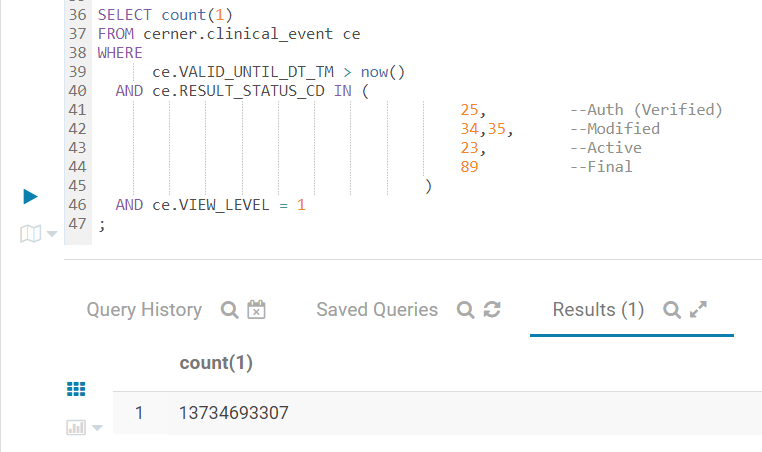
+This query below counts certain clinical events in the 20B row Kudu table
(which is updated in near
+real-time). While it takes 28 seconds to finish, this query would never even
finish I ran it against
+our Oracle database. It found 13.7B events:
+
+
+
+## Credits
+Apache Impala, Apache Kudu and Apache NiFi were the pillars of our real-time
pipeline. Back in 2017,
+Impala was already a rock solid battle-tested project, while NiFi and Kudu
were relatively new. We
+did have some reservations about using them and were concerned about support
if/when we needed it
+(and we did need it a few times).
+
+We were amazed by all the help, dedication, knowledge sharing, friendliness,
and openness of Impala,
+NiFi and Kudu developers. Huge thank you to all of you who helped us alone the
way. You guys are
+amazing and you are building fantastic products!
+
+To be continued...
\ No newline at end of file



