Author: dlester
Date: Fri Oct  9 15:46:55 2015
New Revision: 1707762

URL: http://svn.apache.org/viewvc?rev=1707762&view=rev
Log:
Update Mesos website.
Added:
mesos/site/publish/documentation/latest/images/containerizer_isolator_api.png
(with props)
mesos/site/source/documentation/latest/images/containerizer_isolator_api.png
(with props)
Modified:
mesos/site/publish/documentation/architecture/index.html
mesos/site/publish/documentation/fetcher-cache-internals/index.html
mesos/site/publish/documentation/latest/architecture/index.html
mesos/site/publish/documentation/latest/fetcher-cache-internals/index.html
mesos/site/source/documentation/latest/architecture.md
mesos/site/source/documentation/latest/fetcher-cache-internals.md
Modified: mesos/site/publish/documentation/architecture/index.html
URL:
http://svn.apache.org/viewvc/mesos/site/publish/documentation/architecture/index.html?rev=1707762&r1=1707761&r2=1707762&view=diff
==============================================================================
--- mesos/site/publish/documentation/architecture/index.html (original)
+++ mesos/site/publish/documentation/architecture/index.html Fri Oct 9
15:46:55 2015
@@ -83,11 +83,11 @@
<div class="col-md-8">
<h1>Mesos Architecture</h1>
-<p><img
src="http://mesos.apache.org/assets/img/documentation/architecture3.jpg";
alt="Mesos Architecture" /></p>
+<p><img src="images/architecture3.jpg" alt="Mesos Architecture" /></p>
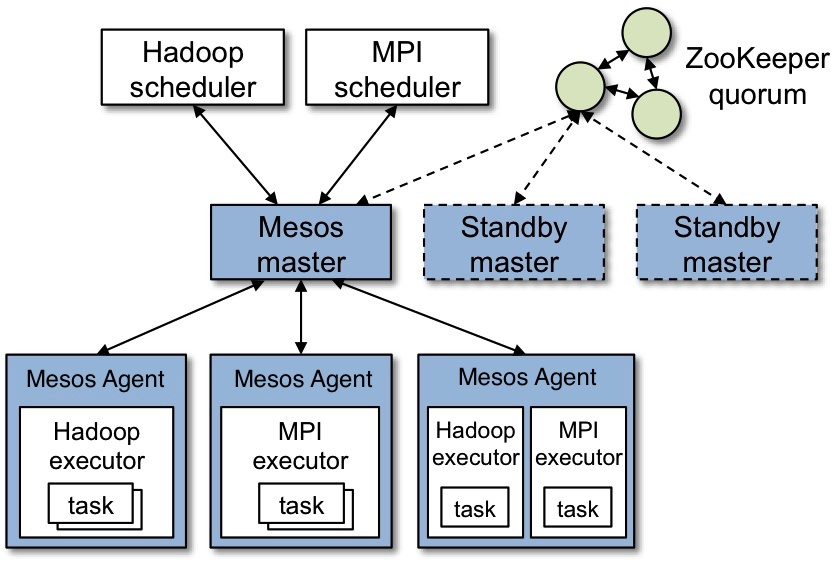
<p>The above figure shows the main components of Mesos. Mesos consists of a
<em>master</em> daemon that manages <em>slave</em> daemons running on each
cluster node, and <em>mesos applications</em> (also called <em>frameworks</em>)
that run <em>tasks</em> on these slaves.</p>
-<p>The master enables fine-grained sharing of resources (cpu, ram, …)
across applications by making them <em>resource offers</em>. Each resource
offer contains a list of <slave ID, resource1: amount1, resource2, amount2,
...>. The master decides <em>how many</em> resources to offer to each
framework according to a given organizational policy, such as fair sharing, or
strict priority. To support a diverse set of policies, the master employs a
modular architecture that makes it easy to add new allocation modules via a
plugin mechanism.</p>
+<p>The master enables fine-grained sharing of resources (cpu, ram, …)
across applications by making them <em>resource offers</em>. Each resource
offer contains a list of <slave ID, resource1: amount1, resource2, amount2,
…>. The master decides <em>how many</em> resources to offer to each
framework according to a given organizational policy, such as fair sharing, or
strict priority. To support a diverse set of policies, the master employs a
modular architecture that makes it easy to add new allocation modules via a
plugin mechanism.</p>
<p>A framework running on top of Mesos consists of two components: a
<em>scheduler</em> that registers with the master to be offered resources, and
an <em>executor</em> process that is launched on slave nodes to run the
framework’s tasks (/documentation/latest/see the <a
href="app-framework-development-guide/">App/Framework development guide</a> for
more details about application schedulers and executors). While the master
determines <strong>how many</strong> resources are offered to each framework,
the frameworks' schedulers select <strong>which</strong> of the offered
resources to use. When a frameworks accepts offered resources, it passes to
Mesos a description of the tasks it wants to run on them. In turn, Mesos
launches the tasks on the corresponding slaves.</p>
@@ -95,7 +95,7 @@
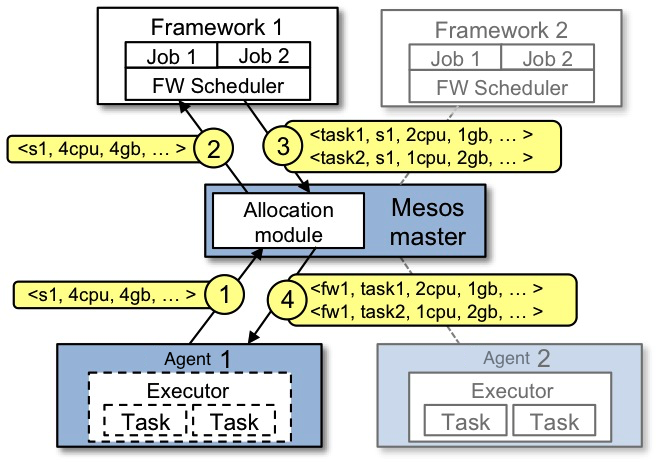
<p>The figure below shows an example of how a framework gets scheduled to run
a task.</p>
-<p><img
src="http://mesos.apache.org/assets/img/documentation/architecture-example.jpg";
alt="Mesos Architecture" /></p>
+<p><img src="images/architecture-example.jpg" alt="Mesos Architecture" /></p>
<p>Let’s walk through the events in the figure.</p>
Modified: mesos/site/publish/documentation/fetcher-cache-internals/index.html
URL:
http://svn.apache.org/viewvc/mesos/site/publish/documentation/fetcher-cache-internals/index.html?rev=1707762&r1=1707761&r2=1707762&view=diff
==============================================================================
--- mesos/site/publish/documentation/fetcher-cache-internals/index.html
(original)
+++ mesos/site/publish/documentation/fetcher-cache-internals/index.html Fri Oct
9 15:46:55 2015
@@ -136,7 +136,7 @@
<p>Based on this setup, the main program flow in the fetcher process is
concerned with assembling a list of parameters to the mesos-fetcher program
that describe items to be fetched. This figure illustrates the high-level
collaboration of the fetcher process with mesos-fetcher program runs. It also
depicts the next level of detail of the fetcher process, which will be
described in the following section.</p>
-<p><img src="images/fetch_components.jpg?raw=true" alt="Fetcher Separation of
Labor" /></p>
+<p><img src="images/fetch_components.jpg" alt="Fetcher Separation of Labor"
/></p>
<h3>Cache state representation and manipulation</h3>
@@ -148,7 +148,7 @@
<p>This figure illustrates the different states which a cache entry can be
in.</p>
-<p><img src="images/fetch_state.jpg?raw=true" alt="Fetcher Cache State" /></p>
+<p><img src="images/fetch_state.jpg" alt="Fetcher Cache State" /></p>
<p>While a cache entry is referenced it cannot be evicted by a the current or
any other concurrent fetch attempt in order to make space for a download of a
new cache file.</p>
@@ -171,7 +171,7 @@
<p>As menitoned above, the fetcher process' main control flow concerns sorting
out what to do with each URI presented to it in a fetch request. An overview of
the ensuing control flow for a given URI is depicted in this figure.</p>
-<p><img src="images/fetch_flow.jpg?raw=true" alt="Determining Fetcher Actions"
/></p>
+<p><img src="images/fetch_flow.jpg" alt="Determining Fetcher Actions" /></p>
<p>After going through this procedure for each URI, the fetcher process
assembles the gathered list of per-URI actions into a JSON object
(<code>FetcherInfo</code>), which is passed to the mesos-fetcher program in an
environment variable. The possible fetch actions for a URI are shown at the
bottom of the flow chart. After they are determined, the fetcher process
invokes mesos-fetcher.</p>
@@ -204,7 +204,7 @@
<h3>Cache eviction</h3>
-<p><img src="images/fetch_evict1.jpg?raw=true" alt="Before eviction" /></p>
+<p><img src="images/fetch_evict1.jpg" alt="Before eviction" /></p>
<p>The resources named “A” and “B” have been fetched
with caching into sandbox 1 and 2 below. In the course of this, two cache
entries have been created and two files have been downloaded into the cache and
named “1” and “2”. (Cache file names have unique names
that comprise serial numbers.)</p>
@@ -216,11 +216,11 @@
</ol>
-<p><img src="images/fetch_evict2.jpg?raw=true" alt="After eviction" /></p>
+<p><img src="images/fetch_evict2.jpg" alt="After eviction" /></p>
<p>The next figure then shows what happens if the first URI is fetched once
again. Here we also assume the cache being so filled up that eviction is
necessary and this time the entry and file for “B” are the
victims.</p>
-<p><img src="images/fetch_evict3.jpg?raw=true" alt="After another eviction"
/></p>
+<p><img src="images/fetch_evict3.jpg" alt="After another eviction" /></p>
</div>
</div>
Modified: mesos/site/publish/documentation/latest/architecture/index.html
URL:
http://svn.apache.org/viewvc/mesos/site/publish/documentation/latest/architecture/index.html?rev=1707762&r1=1707761&r2=1707762&view=diff
==============================================================================
--- mesos/site/publish/documentation/latest/architecture/index.html (original)
+++ mesos/site/publish/documentation/latest/architecture/index.html Fri Oct 9
15:46:55 2015
@@ -83,11 +83,11 @@
<div class="col-md-8">
<h1>Mesos Architecture</h1>
-<p><img
src="http://mesos.apache.org/assets/img/documentation/architecture3.jpg";
alt="Mesos Architecture" /></p>
+<p><img src="images/architecture3.jpg" alt="Mesos Architecture" /></p>
<p>The above figure shows the main components of Mesos. Mesos consists of a
<em>master</em> daemon that manages <em>slave</em> daemons running on each
cluster node, and <em>mesos applications</em> (also called <em>frameworks</em>)
that run <em>tasks</em> on these slaves.</p>
-<p>The master enables fine-grained sharing of resources (cpu, ram, …)
across applications by making them <em>resource offers</em>. Each resource
offer contains a list of <slave ID, resource1: amount1, resource2, amount2,
...>. The master decides <em>how many</em> resources to offer to each
framework according to a given organizational policy, such as fair sharing, or
strict priority. To support a diverse set of policies, the master employs a
modular architecture that makes it easy to add new allocation modules via a
plugin mechanism.</p>
+<p>The master enables fine-grained sharing of resources (cpu, ram, …)
across applications by making them <em>resource offers</em>. Each resource
offer contains a list of <slave ID, resource1: amount1, resource2, amount2,
…>. The master decides <em>how many</em> resources to offer to each
framework according to a given organizational policy, such as fair sharing, or
strict priority. To support a diverse set of policies, the master employs a
modular architecture that makes it easy to add new allocation modules via a
plugin mechanism.</p>
<p>A framework running on top of Mesos consists of two components: a
<em>scheduler</em> that registers with the master to be offered resources, and
an <em>executor</em> process that is launched on slave nodes to run the
framework’s tasks (/documentation/latest/see the <a
href="app-framework-development-guide/">App/Framework development guide</a> for
more details about application schedulers and executors). While the master
determines <strong>how many</strong> resources are offered to each framework,
the frameworks' schedulers select <strong>which</strong> of the offered
resources to use. When a frameworks accepts offered resources, it passes to
Mesos a description of the tasks it wants to run on them. In turn, Mesos
launches the tasks on the corresponding slaves.</p>
@@ -95,7 +95,7 @@
<p>The figure below shows an example of how a framework gets scheduled to run
a task.</p>
-<p><img
src="http://mesos.apache.org/assets/img/documentation/architecture-example.jpg";
alt="Mesos Architecture" /></p>
+<p><img src="images/architecture-example.jpg" alt="Mesos Architecture" /></p>
<p>Let’s walk through the events in the figure.</p>
Modified:
mesos/site/publish/documentation/latest/fetcher-cache-internals/index.html
URL:
http://svn.apache.org/viewvc/mesos/site/publish/documentation/latest/fetcher-cache-internals/index.html?rev=1707762&r1=1707761&r2=1707762&view=diff
==============================================================================
--- mesos/site/publish/documentation/latest/fetcher-cache-internals/index.html
(original)
+++ mesos/site/publish/documentation/latest/fetcher-cache-internals/index.html
Fri Oct 9 15:46:55 2015
@@ -136,7 +136,7 @@
<p>Based on this setup, the main program flow in the fetcher process is
concerned with assembling a list of parameters to the mesos-fetcher program
that describe items to be fetched. This figure illustrates the high-level
collaboration of the fetcher process with mesos-fetcher program runs. It also
depicts the next level of detail of the fetcher process, which will be
described in the following section.</p>
-<p><img src="images/fetch_components.jpg?raw=true" alt="Fetcher Separation of
Labor" /></p>
+<p><img src="images/fetch_components.jpg" alt="Fetcher Separation of Labor"
/></p>
<h3>Cache state representation and manipulation</h3>
@@ -148,7 +148,7 @@
<p>This figure illustrates the different states which a cache entry can be
in.</p>
-<p><img src="images/fetch_state.jpg?raw=true" alt="Fetcher Cache State" /></p>
+<p><img src="images/fetch_state.jpg" alt="Fetcher Cache State" /></p>
<p>While a cache entry is referenced it cannot be evicted by a the current or
any other concurrent fetch attempt in order to make space for a download of a
new cache file.</p>
@@ -171,7 +171,7 @@
<p>As menitoned above, the fetcher process' main control flow concerns sorting
out what to do with each URI presented to it in a fetch request. An overview of
the ensuing control flow for a given URI is depicted in this figure.</p>
-<p><img src="images/fetch_flow.jpg?raw=true" alt="Determining Fetcher Actions"
/></p>
+<p><img src="images/fetch_flow.jpg" alt="Determining Fetcher Actions" /></p>
<p>After going through this procedure for each URI, the fetcher process
assembles the gathered list of per-URI actions into a JSON object
(<code>FetcherInfo</code>), which is passed to the mesos-fetcher program in an
environment variable. The possible fetch actions for a URI are shown at the
bottom of the flow chart. After they are determined, the fetcher process
invokes mesos-fetcher.</p>
@@ -204,7 +204,7 @@
<h3>Cache eviction</h3>
-<p><img src="images/fetch_evict1.jpg?raw=true" alt="Before eviction" /></p>
+<p><img src="images/fetch_evict1.jpg" alt="Before eviction" /></p>
<p>The resources named “A” and “B” have been fetched
with caching into sandbox 1 and 2 below. In the course of this, two cache
entries have been created and two files have been downloaded into the cache and
named “1” and “2”. (Cache file names have unique names
that comprise serial numbers.)</p>
@@ -216,11 +216,11 @@
</ol>
-<p><img src="images/fetch_evict2.jpg?raw=true" alt="After eviction" /></p>
+<p><img src="images/fetch_evict2.jpg" alt="After eviction" /></p>
<p>The next figure then shows what happens if the first URI is fetched once
again. Here we also assume the cache being so filled up that eviction is
necessary and this time the entry and file for “B” are the
victims.</p>
-<p><img src="images/fetch_evict3.jpg?raw=true" alt="After another eviction"
/></p>
+<p><img src="images/fetch_evict3.jpg" alt="After another eviction" /></p>
</div>
</div>
Added:
mesos/site/publish/documentation/latest/images/containerizer_isolator_api.png
URL:
http://svn.apache.org/viewvc/mesos/site/publish/documentation/latest/images/containerizer_isolator_api.png?rev=1707762&view=auto
==============================================================================
Binary file - no diff available.
Propchange:
mesos/site/publish/documentation/latest/images/containerizer_isolator_api.png
------------------------------------------------------------------------------
svn:mime-type = application/octet-stream
Modified: mesos/site/source/documentation/latest/architecture.md
URL:
http://svn.apache.org/viewvc/mesos/site/source/documentation/latest/architecture.md?rev=1707762&r1=1707761&r2=1707762&view=diff
==============================================================================
--- mesos/site/source/documentation/latest/architecture.md (original)
+++ mesos/site/source/documentation/latest/architecture.md Fri Oct 9 15:46:55
2015
@@ -4,11 +4,11 @@ layout: documentation
# Mesos Architecture
-
+
The above figure shows the main components of Mesos. Mesos consists of a
*master* daemon that manages *slave* daemons running on each cluster node, and
*mesos applications* (also called *frameworks*) that run *tasks* on these
slaves.
-The master enables fine-grained sharing of resources (cpu, ram, ...) across
applications by making them *resource offers*. Each resource offer contains a
list of <slave ID, resource1: amount1, resource2, amount2, ...>. The master
decides *how many* resources to offer to each framework according to a given
organizational policy, such as fair sharing, or strict priority. To support a
diverse set of policies, the master employs a modular architecture that makes
it easy to add new allocation modules via a plugin mechanism.
+The master enables fine-grained sharing of resources (cpu, ram, ...) across
applications by making them *resource offers*. Each resource offer contains a
list of <slave ID, resource1: amount1, resource2, amount2, ...>. The
master decides *how many* resources to offer to each framework according to a
given organizational policy, such as fair sharing, or strict priority. To
support a diverse set of policies, the master employs a modular architecture
that makes it easy to add new allocation modules via a plugin mechanism.
A framework running on top of Mesos consists of two components: a *scheduler*
that registers with the master to be offered resources, and an *executor*
process that is launched on slave nodes to run the framework's tasks
(/documentation/latest/see the [App/Framework development
guide](app-framework-development-guide/) for more details about application
schedulers and executors). While the master determines **how many** resources
are offered to each framework, the frameworks' schedulers select **which** of
the offered resources to use. When a frameworks accepts offered resources, it
passes to Mesos a description of the tasks it wants to run on them. In turn,
Mesos launches the tasks on the corresponding slaves.
@@ -16,7 +16,7 @@ A framework running on top of Mesos cons
The figure below shows an example of how a framework gets scheduled to run a
task.
-
+
Let's walk through the events in the figure.
Modified: mesos/site/source/documentation/latest/fetcher-cache-internals.md
URL:
http://svn.apache.org/viewvc/mesos/site/source/documentation/latest/fetcher-cache-internals.md?rev=1707762&r1=1707761&r2=1707762&view=diff
==============================================================================
--- mesos/site/source/documentation/latest/fetcher-cache-internals.md (original)
+++ mesos/site/source/documentation/latest/fetcher-cache-internals.md Fri Oct
9 15:46:55 2015
@@ -45,7 +45,7 @@ Besides minor complications such as arch
Based on this setup, the main program flow in the fetcher process is concerned
with assembling a list of parameters to the mesos-fetcher program that describe
items to be fetched. This figure illustrates the high-level collaboration of
the fetcher process with mesos-fetcher program runs. It also depicts the next
level of detail of the fetcher process, which will be described in the
following section.
-
+
### Cache state representation and manipulation
@@ -58,7 +58,7 @@ A cache entry corresponds directly to a
This figure illustrates the different states which a cache entry can be in.
-
+
While a cache entry is referenced it cannot be evicted by a the current or any
other concurrent fetch attempt in order to make space for a download of a new
cache file.
@@ -78,7 +78,7 @@ Every increment is recorded in a list. A
As menitoned above, the fetcher process' main control flow concerns sorting
out what to do with each URI presented to it in a fetch request. An overview of
the ensuing control flow for a given URI is depicted in this figure.
-
+
After going through this procedure for each URI, the fetcher process assembles
the gathered list of per-URI actions into a JSON object (`FetcherInfo`), which
is passed to the mesos-fetcher program in an environment variable. The possible
fetch actions for a URI are shown at the bottom of the flow chart. After they
are determined, the fetcher process invokes mesos-fetcher.
@@ -101,7 +101,7 @@ Besides, everything touched in 1/a and 1
### Cache eviction
-
+
The resources named "A" and "B" have been fetched with caching into sandbox 1
and 2 below. In the course of this, two cache entries have been created and two
files have been downloaded into the cache and named "1" and "2". (Cache file
names have unique names that comprise serial numbers.)
@@ -110,8 +110,8 @@ The next figure illustrates the state af
1. Remove the cache entry for "A" from the fetcher process' cache entry table.
Its faded depiction is supposed to indicate this. This immediately makes it
appear as if the URI has never been cached, even though the cache file is still
around.
2. Proceed with fetching "C". This creates a new cache file, which has a
different unique name. (The fetcher process remembers in its cache entry which
file name belongs to which URI.)
-
+
The next figure then shows what happens if the first URI is fetched once
again. Here we also assume the cache being so filled up that eviction is
necessary and this time the entry and file for "B" are the victims.
-
+
Added:
mesos/site/source/documentation/latest/images/containerizer_isolator_api.png
URL:
http://svn.apache.org/viewvc/mesos/site/source/documentation/latest/images/containerizer_isolator_api.png?rev=1707762&view=auto
==============================================================================
Binary file - no diff available.
Propchange:
mesos/site/source/documentation/latest/images/containerizer_isolator_api.png
------------------------------------------------------------------------------
svn:mime-type = application/octet-stream





