This is an automated email from the ASF dual-hosted git repository.

jiayu pushed a commit to branch master
in repository https://gitbox.apache.org/repos/asf/sedona.git
The following commit(s) were added to refs/heads/master by this push:
new d2ef44134f [DOCS] Update the SedonaDB announcement blog post (#2362)
d2ef44134f is described below
commit d2ef44134fe0bbd0bee3a28943203dbfd1b2745f
Author: Jia Yu <[email protected]>
AuthorDate: Wed Sep 24 00:57:03 2025 -0700
[DOCS] Update the SedonaDB announcement blog post (#2362)
---
.gitignore | 3 +
README.md | 31 ++++---
docs-overrides/main.html | 2 +-
docs/blog/.authors.yml | 32 ++++---
docs/blog/posts/intro-sedonadb.md | 131 +++++++++++++++-------------
docs/image/blog/sedonadb1/image1.png | Bin 76709 -> 0 bytes
docs/image/blog/sedonadb1/image2.png | Bin 150429 -> 0 bytes
docs/image/blog/sedonadb1/sf1-09242025.png | Bin 0 -> 20887 bytes
docs/image/blog/sedonadb1/sf10-09242025.png | Bin 0 -> 25154 bytes
9 files changed, 115 insertions(+), 84 deletions(-)
diff --git a/.gitignore b/.gitignore
index ef4bf2f91f..596041ef01 100644
--- a/.gitignore
+++ b/.gitignore
@@ -48,3 +48,6 @@ target
*.min.css.map
*.min.js
*.min.js.map
+
+# Ignore node_modules in docs-overrides
+docs-overrides/node_modules/
diff --git a/README.md b/README.md
index 8977c76157..2e0ba4801a 100644
--- a/README.md
+++ b/README.md
@@ -36,6 +36,16 @@
[](https://github.com/apache/sedona/graphs/commit-activity)
[](https://github.com/apache/sedona/issues?q=is%3Aissue%20state%3Aopen%20label%3A%22good%20first%20issue%22)
+## 🚀 **NEW: SedonaDB & SpatialBench - Latest Apache Sedona Subprojects**
+
+**SedonaDB** - A single-node analytical database engine with geospatial as a
first-class citizen. Perfect for developers who want Sedona's spatial analytics
power without distributed system complexity.
+
+**SpatialBench** - A comprehensive benchmark for assessing geospatial SQL
analytics query performance across database systems.
+
+**[Read the full announcement blog post
→](https://sedona.apache.org/latest/blog/2025/09/24/introducing-sedonadb-a-single-node-analytical-database-engine-with-geospatial-as-a-first-class-citizen/)**
| **[SedonaDB →](https://sedona.apache.org/sedonadb)** | **[SpatialBench
→](https://sedona.apache.org/spatialbench)**
+
+---
+
| Download statistics | **Maven** | **PyPI**
| Conda-forge
[...]
|----------------------------|------------|----------------------------------------------------------------------------------------------------------------------------------------------------------------------------------------------------------------------------------------------------------------------------------------------------------------------------------------------|------------------------------------------------------------------------------------------------------------------
[...]
| Apache Sedona | 330k/month | [](https://pepy.tech/project/apache-sedona)
[](https://pepy.tech/project/apache-sedona)
| [](https://anaconda.
[...]
@@ -47,6 +57,7 @@
- [Join the community](#join-the-community)
- [What is Apache Sedona?](#what-is-apache-sedona)
- [Features](#features)
+- [Apache Sedona subprojects](#apache-sedona-subprojects)
- [When to use Sedona?](#when-to-use-sedona)
- [Use Cases:](#use-cases)
- [Code Example:](#code-example)
@@ -58,7 +69,6 @@
- [Building Sedona](#building-sedona)
- [Documentation](#documentation)
- [Star History](#star-history)
-- [Contributors](#contributors)
- [Powered by](#powered-by)
<!-- END doctoc generated TOC please keep comment here to allow auto update -->
@@ -101,6 +111,11 @@ Some of the key features of Apache Sedona include:
These are some of the key features of Apache Sedona, but it may offer
additional capabilities depending on the specific version and configuration.
+## Apache Sedona subprojects
+
+* **SedonaDB**: A single-node analytical database engine with geospatial as a
first-class citizen - [GitHub](https://github.com/apache/sedona-db) |
[Website](https://sedona.apache.org/sedonadb)
+* **SpatialBench**: A benchmark for assessing geospatial SQL analytics query
performance across database systems -
[GitHub](https://github.com/apache/sedona-spatialbench) |
[Website](https://sedona.apache.org/spatialbench)
+
## When to use Sedona?
### Use Cases:
@@ -187,7 +202,7 @@ We provide a Docker image for Apache Sedona with Python
JupyterLab and a single-
pip install apache-sedona
```
-* To compile the source code, please refer to [Sedona
website](https://sedona.apache.org/latest-snapshot/setup/compile/)
+* To compile the source code, please refer to [Sedona
website](https://sedona.apache.org/latest/setup/compile/)
* Modules in the source code
@@ -206,10 +221,10 @@ We provide a Docker image for Apache Sedona with Python
JupyterLab and a single-
## Documentation
-* [Spatial SQL in
Sedona](https://sedona.apache.org/latest-snapshot/tutorial/sql/)
-* [Integrate with GeoPandas and
Shapely](https://sedona.apache.org/latest-snapshot/tutorial/geopandas-shapely/)
-* [Working with Spatial R in
Sedona](https://sedona.apache.org/latest-snapshot/api/rdocs/)
-* [Sedona Python API
Documentation](https://sedona.apache.org/latest-snapshot/api/pydocs/)
+* [Spatial SQL in Sedona](https://sedona.apache.org/latest/tutorial/sql/)
+* [Integrate with GeoPandas and
Shapely](https://sedona.apache.org/latest/tutorial/geopandas-shapely/)
+* [Working with Spatial R in
Sedona](https://sedona.apache.org/latest/api/rdocs/)
+* [Sedona Python API
Documentation](https://sedona.apache.org/latest/api/pydocs/)
Please visit [Apache Sedona website](http://sedona.apache.org/) for detailed
information
@@ -217,10 +232,6 @@ Please visit [Apache Sedona
website](http://sedona.apache.org/) for detailed inf
[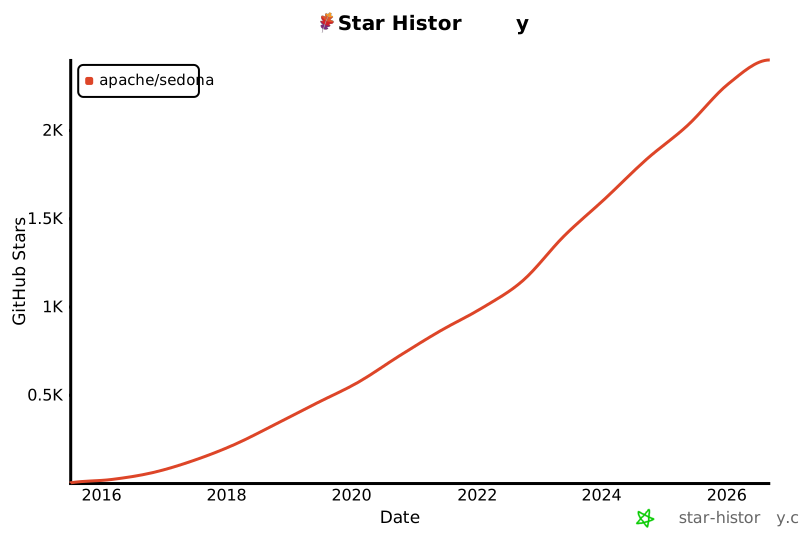](https://www.star-history.com/#apache/sedona&Date)
-## Contributors
-
-[](https://github.com/apache/sedona/graphs/contributors)
-
## Powered by
<a href="https://www.apache.org/";>
diff --git a/docs-overrides/main.html b/docs-overrides/main.html
index 6c3098ad20..4b5302ed2f 100644
--- a/docs-overrides/main.html
+++ b/docs-overrides/main.html
@@ -17,7 +17,7 @@ You're not viewing the latest stable version.
{% block header %}
<div style="background: #CA463A; color: white; text-align: center; padding:
0.5rem;">
- <a href="https://sedona.apache.org/sedonadb/"; title="Announcement">📢
Introducing SedonaDB: A single-node analytical database engine with geospatial
as the first-class citizen.</a>
+ <a
href="/blog/2025/09/24/introducing-sedonadb-a-single-node-analytical-database-engine-with-geospatial-as-a-first-class-citizen/"
title="Announcement">📢 Introducing SedonaDB: A single-node analytical database
engine with geospatial as the first-class citizen.</a>
</div>
{{ super() }} {# This renders the original header below your test bar #}
{% endblock %}
diff --git a/docs/blog/.authors.yml b/docs/blog/.authors.yml
index 368b8341ca..b5a3f335df 100644
--- a/docs/blog/.authors.yml
+++ b/docs/blog/.authors.yml
@@ -29,26 +29,34 @@ authors:
description: Director of Customer Engineering & Product Led Growth,
Wherobots
avatar:
https://media.licdn.com/dms/image/v2/D4E03AQHxYTrEgc53_g/profile-displayphoto-shrink_200_200/profile-displayphoto-shrink_200_200/0/1722352936567?e=2147483647&v=beta&t=X10Z02O2UX8IRmbypcw-m-jbIDeNsPWWL-YOPX_v1XQ
jia:
- name: Jia
- description: Sedona PMC
+ name: Jia Yu
+ description: Apache Sedona PMC chair
avatar:
https://media.licdn.com/dms/image/v2/D5603AQEez8EVYH82LQ/profile-displayphoto-shrink_400_400/profile-displayphoto-shrink_400_400/0/1719619666312?e=1761782400&v=beta&t=4xYyTp1peAtupNdaPfbWEYbdMjMMbcdHWEbqO7Y-2dw
dewey:
- name: Dewey
- description: Software Engineer
+ name: Dewey Dunnington
+ description: Apache Sedona Contributor, Apache Arrow PMC member
avatar:
https://media.licdn.com/dms/image/v2/C5603AQEQpLYQ6u-a8Q/profile-displayphoto-shrink_400_400/profile-displayphoto-shrink_400_400/0/1630000445999?e=1761782400&v=beta&t=dR8biUFIxB_KL1nYXTibNrjaRzTAkfc3LO6FSfRPREE
kristin:
- name: Kristin
- description: Software Engineer
+ name: Kristin Cowalcijk
+ description: Apache Sedona PMC member
avatar: https://avatars.githubusercontent.com/u/5501374?v=4
feng:
- name: Feng
- description: Software Engineer
+ name: Feng Zhang
+ description: Apache Sedona Committer
avatar:
https://media.licdn.com/dms/image/v2/C5603AQEuI_xKhOjapA/profile-displayphoto-shrink_400_400/profile-displayphoto-shrink_400_400/0/1645716542340?e=1761782400&v=beta&t=6vDu04f9Mun3LXoQaTs-C9DVSSZcH1LaasulqWqpliw
james:
- name: James
- description: Software Engineer
+ name: James Willis
+ description: Apache Sedona Contributor
avatar:
https://media.licdn.com/dms/image/v2/C4E03AQETRcdZDZNlRg/profile-displayphoto-shrink_400_400/profile-displayphoto-shrink_400_400/0/1516810351294?e=1761782400&v=beta&t=AlPGe5RqTMd6gfh4qEILx9XsivRWnIM5KIdVSx7AzFE
pranav:
- name: Pranav
- description: Software Engineer
+ name: Pranav Toggi
+ description: Apache Sedona Committer
avatar:
https://media.licdn.com/dms/image/v2/D4E03AQE1XVwinur7-w/profile-displayphoto-shrink_400_400/profile-displayphoto-shrink_400_400/0/1729284611733?e=1761782400&v=beta&t=B1SOzUOz9CW0J0LEVICMLztKFLAwDg3okem5p-VE--4
+ jess:
+ name: Jess Pavlin
+ description: Apache Sedona Contributor
+ avatar: https://avatars.githubusercontent.com/u/202656197?v=4
+ peter:
+ name: Peter Nguyen
+ description: Apache Sedona Contributor
+ avatar: https://avatars.githubusercontent.com/u/115442597?v=4
diff --git a/docs/blog/posts/intro-sedonadb.md
b/docs/blog/posts/intro-sedonadb.md
index 015e1aae81..2917f2fd4e 100644
--- a/docs/blog/posts/intro-sedonadb.md
+++ b/docs/blog/posts/intro-sedonadb.md
@@ -2,14 +2,20 @@
date:
created: 2025-09-24
links:
- - Apache Sedona Discord: https://discord.com/invite/9A3k5dEBsY
+ - SedonaDB: https://sedona.apache.org/sedonadb/
+ - SpatialBench: https://sedona.apache.org/spatialbench/
authors:
- dewey
+ - kristin
- feng
+ - peter
+ - jess
+ - pranav
+ - james
- jia
- - kristin
- matt_powers
-title: "Introducing SedonaDB: A spatial-first query engine"
+ - kelly
+title: "Introducing SedonaDB: A single-node analytical database engine with
geospatial as a first-class citizen"
---
<!--
@@ -31,28 +37,41 @@ title: "Introducing SedonaDB: A spatial-first query engine"
# under the License.
-->
-The Apache Sedona community is excited to announce the initial release of
SedonaDB.
+!!! info
+ 🚀🎉 Big News! 🎉🚀
-SedonaDB is the first open-source, single-node analytical database engine that
treats spatial data as a first-class citizen.
+ We’re celebrating the launch of SedonaDB & SpatialBench with a special
Apache Sedona Community Office Hour!
-<!-- more -->
+ 📅 October 7, 2025
+
+ ⏰ 8–9 AM Pacific Time
+
+ 📍 Online
+
+ 🔗 [Sign up here](https://bit.ly/3UBmxFY)
+
+The Apache Sedona community is excited to announce the initial release of
[SedonaDB](https://sedona.apache.org/sedonadb)! 🎉
+
+SedonaDB is the first open-source, single-node analytical database engine that
treats spatial data as a first-class citizen. It is developed as a subproject
of Apache Sedona.
+
+Apache Sedona powers large-scale geospatial processing on distributed engines
like Spark (SedonaSpark), Flink (SedonaFlink), and Snowflake (SedonaSnow).
SedonaDB extends the Sedona ecosystem with a single-node engine optimized for
small-to-medium data analytics, delivering the simplicity and speed that
distributed systems often cannot.
-Written in Rust, it’s lightweight, blazing fast, and spatial-native. Out of
the box, it provides:
+<!-- more -->
-* Full support for spatial types, joins, CRS (coordinate reference systems),
and functions on top of industry-standard query operations.
-* Query optimizations, indexing, and data pruning features under the hood that
make spatial operations just work with high performance.
-* Pythonic and SQL interfaces familiar to developers, plus APIs for R and Rust.
-* Flexibility to run in single-machine environments on local files or data
lakes.
+## 🤔 What is SedonaDB
-SedonaDB utilizes Apache Arrow and Apache DataFusion, providing everything you
need from a modern, vectorized query engine. However, it also delivers the
unique ability to run high-performance spatial workloads easily, without
requiring extensions. It's for builders who need a spatial-first query engine.
+Written in Rust, SedonaDB is lightweight, blazing fast, and spatial-native.
Out of the box, it provides:
-SedonaDB is easy to download and run on your local machine or in the cloud.
You can install it easily in any runtime.
+* 🗺️ Full support for spatial types, joins, CRS (coordinate reference
systems), and functions on top of industry-standard query operations.
+* ⚡ Query optimizations, indexing, and data pruning features under the hood
that make spatial operations just work with high performance.
+* 🐍 Pythonic and SQL interfaces familiar to developers, plus APIs for R and
Rust.
+* ☁️ Flexibility to run in single-machine environments on local files or data
lakes.
-Apache Sedona already adds geospatial support to Apache Spark (SedonaSpark),
Apache Flink (SedonaFlink), and Snowflake (SedonaSnow). SedonaDB is an
excellent small data complement to the existing big data/streaming Sedona
libraries.
+SedonaDB utilizes Apache Arrow and Apache DataFusion, providing everything you
need from a modern, vectorized query engine. What sets it apart is the ability
to process spatial workloads natively, without extensions or plugins.
Installation is straightforward, and SedonaDB integrates easily into both local
development and cloud pipelines, offering a consistent experience across
environments.
-The initial release of SedonaDB provides a comprehensive suite of geometric
vector operations and seamlessly integrates with GeoArrow, GeoParquet, and
GeoPandas. Subsequent releases will support all popular spatial functions,
including functions for raster data.
+The initial release of SedonaDB provides a comprehensive suite of geometric
vector operations and seamlessly integrates with GeoArrow, GeoParquet, and
GeoPandas. Future versions will support all popular spatial functions,
including functions for raster data.
-## SedonaDB quickstart example
+## 🚀 SedonaDB quickstart example
Start by installing SedonaDB:
@@ -120,7 +139,7 @@ where ST_Intersects(cities.geometry, countries.geometry)
The code utilizes `ST_Intersects` to determine if a city is contained within a
given country.
-Here’s the result of the query:
+Here's the result of the query:
```
┌───────────────┬─────────────────────────────┬───────────┐
@@ -135,25 +154,23 @@ Here’s the result of the query:
└───────────────┴─────────────────────────────┴───────────┘
```
-The code above is an example of a point-in-polygon join. The point represents
the city, and the polygon represents the area that represents the country.
SedonaDB can easily perform spatial joins with optimizations, such as
effectively utilizing spatial indices where required and adapting join
strategies at runtime based on samples of the input data.
-
-These types of spatial operations can be relatively slow for engines that are
not optimized for spatial data. SedonaDB is optimized for these spatial
computations.
-
-## Apache Sedona SpatialBench
+The example above performs a point-in-polygon join, mapping city locations
(points) to the countries they fall within (polygons). SedonaDB executes these
joins efficiently by leveraging spatial indices where beneficial and
dynamically adapting join strategies at runtime using input data samples. While
many general-purpose engines struggle with the performance of such operations,
SedonaDB is purpose-built for spatial workloads and delivers consistently fast
results.
-To test our work on SedonaDB, we also needed to develop a mechanism to
evaluate its performance and speed. As a result of this, and other motivations,
we also created Apache Sedona SpatialBench, which is a new standard for
measuring the performance of spatial data processing engines and databases. We
will discuss the benefits and capabilities of SpatialBench in more detail in
our next blog.
+## 📊 Apache Sedona SpatialBench
-## Single-node spatial benchmarks
+To test our work on SedonaDB, we also needed to develop a mechanism to
evaluate its performance and speed. This led us to develop Apache Sedona
SpatialBench, a benchmark for assessing geospatial SQL analytics query
performance across database systems.
-Let’s compare the performance of SedonaDB vs. GeoPandas and DuckDB Spatial for
some representative spatial queries as defined in
[SpatialBench](https://sedona.apache.org/spatialbench/). Here are the results
for Scale Factor 1 (SF 1):
+Let's compare the performance of SedonaDB vs. GeoPandas and DuckDB Spatial for
some representative spatial queries as defined in
[SpatialBench](https://sedona.apache.org/spatialbench/).
-{ align=center
width="80%" }
+Here are the results from SpatialBench v0.1 for Queries 1–12 at scale factor 1
(SF1) and scale factor 10 (SF10).
-And here are the results for SF 10:
+{ width="400" }
+{ width="400" }
+{: .grid }
-{ align=center
width="80%" }
+SedonaDB demonstrates balanced performance across all query types and scales
effectively to SF 10. DuckDB excels at spatial filters and some geometric
operations but faces challenges with complex joins and KNN queries. GeoPandas,
while popular in the Python ecosystem, requires manual optimization and
parallelization to handle larger datasets effectively. An in-depth performance
analysis can be found in the [SpatialBench
website](https://sedona.apache.org/spatialbench/single-node-benchmarks/).
-Here’s an example of the SpatialBench query #8 SQL code that works for
SedonaDB and DuckDB:
+Here’s an example of the SpatialBench Query #8 that works for SedonaDB and
DuckDB:
```sql
SELECT b.b_buildingkey, b.b_name, COUNT(*) AS nearby_pickup_count
@@ -162,7 +179,9 @@ GROUP BY b.b_buildingkey, b.b_name
ORDER BY nearby_pickup_count DESC
```
-Here’s what the query returns:
+This query intentionally performs a distance-based spatial join between points
and polygons, followed by an aggregation of the results.
+
+Here's what the query returns:
```
┌───────────────┬──────────┬─────────────────────┐
@@ -205,15 +224,11 @@ result = (
)
```
-SedonaDB optimizes query execution behind the scenes. GeoPandas requires more
manual optimizations for better performance. If you have experience tuning
GeoPandas code and would like to help optimize it, please comment on [this
issue](https://github.com/apache/sedona-spatialbench).
-
-DuckDB Spatial offers optimized spatial join capabilities, enabling the quick
execution of some queries, but it errors out for other queries. We encourage
the DuckDB community to investigate these issues.
-
-## SedonaDB CRS management
+## 🗺️ SedonaDB CRS management
SedonaDB manages the CRS when reading/writing files, as well as in DataFrames,
making your pipelines safer and saving you from manual work.
-Let’s compute the number of buildings in the state of Vermont to highlight the
CRS management features embedded in SedonaDB.
+Let's compute the number of buildings in the state of Vermont to highlight the
CRS management features embedded in SedonaDB.
Start by reading in a FlatGeobuf file that uses the EPSG 32618 CRS with
GeoPandas and then convert it to a SedonaDB DataFrame:
@@ -268,7 +283,7 @@ where ST_Intersects(buildings.geometry, vermont.geometry)
).show()
```
-This command correctly errors out because the tables have different CRSs. For
safety, SedonaDB errors out rather than give you the wrong answer! Here’s the
error message that’s easy to debug:
+This command correctly errors out because the tables have different CRSs. For
safety, SedonaDB errors out rather than give you the wrong answer! Here's the
error message that's easy to debug:
```
SedonaError: type_coercion
@@ -289,7 +304,7 @@ where ST_Intersects(buildings.geometry,
ST_Transform(vermont.geometry, 'EPSG:432
).show()
```
-We now get the correct result:
+We now get the correct result!
```
┌──────────┐
@@ -302,11 +317,11 @@ We now get the correct result:
SedonaDB tracks the CRS when reading/writing files, converting to/from
GeoPandas DataFrames, or when performing DataFrame operations, so your spatial
computations run safely and correctly!
-## Realistic example with SedonaDB
+## 🎯 Realistic example with SedonaDB
-Let’s now turn our attention to a KNN join, which is a more complex spatial
operation.
+Let's now turn our attention to a KNN join, which is a more complex spatial
operation.
-Suppose you’re analyzing ride-sharing data and want to identify which
buildings are most commonly near pickup points, helping understand the
relationship between trip origins and nearby landmarks, businesses, or
residential structures that might influence ride demand patterns.
+Suppose you're analyzing ride-sharing data and want to identify which
buildings are most commonly near pickup points, helping understand the
relationship between trip origins and nearby landmarks, businesses, or
residential structures that might influence ride demand patterns.
This query finds the five closest buildings to each trip pickup location using
spatial nearest neighbor analysis. For every trip, it identifies the five
buildings that are geographically closest to where the passenger was picked up
and calculates the exact distance to each of those buildings.
@@ -347,25 +362,19 @@ Here are the results of the query:
└───────────┴───────────────────────────────┴───────────────┴───────────────┴──────────────────────┘
```
-This is one of the queries from
[SpatialBench](https://github.com/apache/sedona-spatialbench/).
-
-## Why SedonaDB was built in Rust
-
-SedonaDB is built in Rust to leverage performance, fine-grained memory
management capabilities, and an expansive ecosystem of data libraries.
-
-Rust is a high-performance, memory-safe programming language.
+This is one of the queries from
[SpatialBench](https://github.com/apache/sedona-spatialbench/).
-The Rust data ecosystem is mature, and SedonaDB leverages Rust libraries like
[Apache DataFusion](https://github.com/apache/datafusion),
[GeoArrow](https://github.com/geoarrow/geoarrow), and
[georust/geo](https://github.com/georust/geo).
+## 🦀 Why SedonaDB was built in Rust
-Whereas Spark, as a database engine, exposes several extension points that
allow Sedona Spark to optimize spatial queries in a distributed setting, on a
single node, DataFusion exposes stable and well-documented APIs for pruning,
specialized physical operators like spatial joins, and optimizer rules at the
logical and execution levels. This allowed us to add deep spatial awareness
throughout the engine while maintaining non-spatial type and function coverage
that users need and expect. N [...]
+SedonaDB is built in Rust, a high-performance, memory-safe language that
offers fine-grained memory management and a mature ecosystem of data libraries.
It takes full advantage of this ecosystem by integrating with projects such as
[Apache DataFusion](https://github.com/apache/datafusion),
[GeoArrow](https://github.com/geoarrow/geoarrow), and
[georust/geo](https://github.com/georust/geo).
-## Why SedonaDB and SedonaSpark are Both Needed
+While Spark provides extension points that let SedonaSpark optimize spatial
queries in distributed settings, DataFusion offers stable APIs for pruning,
spatial operators, and optimizer rules on a single node. This enabled us to
embed deep spatial awareness into the engine while preserving full non-spatial
functionality. Thanks to the DataFusion project and community, the experience
was both possible and enjoyable.
-SedonaSpark is an excellent option for users who have large geospatial
datasets or an existing production Spark runtime. For example, if you have a
large 4-terabyte vector dataset and want to join it with a large raster
dataset, then SedonaSpark is clearly the best option.
+## ⚖️ Why SedonaDB and SedonaSpark are Both Needed
-But Spark has limitations for smaller datasets. It is slow to run locally,
cumbersome to install, and challenging to tune.
+SedonaSpark is well-suited for large-scale geospatial workloads or
environments where Spark is already part of your production stack. For
instance, joining a 100 GB vector dataset with a large raster dataset. For
smaller datasets, however, Spark's distributed architecture can introduce
unnecessary overhead, making it slower to run locally, harder to install, and
more difficult to tune.
-SedonaDB is better for smaller datasets and when running computations locally.
The SedonaDB spatial functions are compatible with the SparkSedona functions,
so SQL chunks that work for one engine will usually work for the other. Over
time, we will ensure that both project APIs are fully interoperable. Here’s an
example of a chunk to analyze the Overture buildings table that works for both
engines.
+SedonaDB is better for smaller datasets and when running computations locally.
The SedonaDB spatial functions are compatible with the SedonaSpark functions,
so SQL chunks that work for one engine will usually work for the other. Over
time, we will ensure that both project APIs are fully interoperable. Here's an
example of a chunk to analyze the Overture buildings table that works for both
engines.
```
nyc_bbox_wkt = (
@@ -389,20 +398,20 @@ WHERE
LIMIT 5;
```
-## Next steps
+## 🚀 Next steps
While SedonaDB is well-tested and provides a core set of features that can
perform numerous spatial analyses, it remains an early-stage project with
multiple opportunities for new features.
Many more ST functions are required. Some are relatively straightforward, but
others are complex.
-The community will add built-in support for other spatial file formats, such
as GeoPackage and GeoJSON, to SedonaDB. You can read data in these formats
into GeoPandas DataFrames and convert them to SedonaDB DataFrames in the
meantime.
+The community will add built-in support for other spatial file formats, such
as GeoPackage and GeoJSON, to SedonaDB. You can read data in these formats into
GeoPandas DataFrames and convert them to SedonaDB DataFrames in the meantime.
-Raster support is also on the roadmap, which is a complex undertaking, so it’s
an excellent opportunity to contribute if you’re interested in solving
challenging problems with Rust.
+Raster support is also on the roadmap, which is a complex undertaking, so it's
an excellent opportunity to contribute if you're interested in solving
challenging problems with Rust.
-Refer to the [SedonaDB v0.2
milestone](https://github.com/apache/sedona-db/milestone/1) for more details on
the specific tasks outlined for the next release. Additionally, feel free to
create issues, comment on the Discord, or start GitHub discussions to
brainstorm new features.
+Refer to the [SedonaDB v0.2
milestone](https://github.com/apache/sedona-db/milestone/1) for more details on
the specific tasks outlined for the next release. Additionally, feel free to
create issues, comment on the Discord, or start GitHub discussions to
brainstorm new features.
-## Join the community
+## 🤝 Join the community
-The Apache Sedona community has an active Discord community, monthly user
meetings, and regular contributor meetings.
+The Apache Sedona community has an active Discord community, monthly user
meetings, and regular contributor meetings.
-SedonaDB has a [well-defined
roadmap](https://github.com/apache/sedona-db/milestones) and welcomes
contributions from the community. Feel free to request to take ownership of an
issue, and we will be happy to assign it to you. You’re also welcome to join
the contributor meetings, and the other active contributors will be glad to
help you get your pull request over the finish line!
+SedonaDB welcomes contributions from the community. Feel free to request to
take ownership of an issue, and we will be happy to assign it to you. You're
also welcome to join the contributor meetings, and the other active
contributors will be glad to help you get your pull request over the finish
line!
diff --git a/docs/image/blog/sedonadb1/image1.png
b/docs/image/blog/sedonadb1/image1.png
deleted file mode 100644
index df65546a29..0000000000
Binary files a/docs/image/blog/sedonadb1/image1.png and /dev/null differ
diff --git a/docs/image/blog/sedonadb1/image2.png
b/docs/image/blog/sedonadb1/image2.png
deleted file mode 100644
index 4c090dff39..0000000000
Binary files a/docs/image/blog/sedonadb1/image2.png and /dev/null differ
diff --git a/docs/image/blog/sedonadb1/sf1-09242025.png
b/docs/image/blog/sedonadb1/sf1-09242025.png
new file mode 100644
index 0000000000..34f146fcb8
Binary files /dev/null and b/docs/image/blog/sedonadb1/sf1-09242025.png differ
diff --git a/docs/image/blog/sedonadb1/sf10-09242025.png
b/docs/image/blog/sedonadb1/sf10-09242025.png
new file mode 100644
index 0000000000..0a400fca53
Binary files /dev/null and b/docs/image/blog/sedonadb1/sf10-09242025.png differ

