Author: gertv
Date: Wed Dec  8 22:12:33 2010
New Revision: 1043722

URL: http://svn.apache.org/viewvc?rev=1043722&view=rev
Log:
SMX4-630: Add servicemix-eip documentation (thanks to iocanel)
Modified:

servicemix/documentation/trunk/src/main/webapp/jbi/components/servicemix-eip.conf

Modified:
servicemix/documentation/trunk/src/main/webapp/jbi/components/servicemix-eip.conf
URL:
http://svn.apache.org/viewvc/servicemix/documentation/trunk/src/main/webapp/jbi/components/servicemix-eip.conf?rev=1043722&r1=1043721&r2=1043722&view=diff
==============================================================================
---
servicemix/documentation/trunk/src/main/webapp/jbi/components/servicemix-eip.conf
 (original)
+++
servicemix/documentation/trunk/src/main/webapp/jbi/components/servicemix-eip.conf
 Wed Dec  8 22:12:33 2010
@@ -5,12 +5,21 @@ The servicemix-eip component is a routin
 This component is based on the great Enterprise Integration Patterns book.

 h4. Namespace and xbean.xml
-The namespace URI for the servicemix-bean JBI component is
{{http://servicemix.apache.org/eip/1.0}}.  This is an example of an
{{xbean.xml}} file with a namespace definition with prefix {{bean}}.
+The namespace URI for the servicemix-bean JBI component is
{{http://servicemix.apache.org/eip/1.0}}.  This is an example of an
{{xbean.xml}} file with a namespace definition with prefix {{eip}}.
 {pygmentize:lang=xml}
-<beans xmlns:drools="http://servicemix.apache.org/eip/1.0";>
-
-  <!-- add one of the eip endpoint definitions here -->
-
+<beans xmlns="http://www.springframework.org/schema/beans";
+      xmlns:xsi="http://www.w3.org/2001/XMLSchema-instance";
+      xmlns:eip="http://servicemix.apache.org/eip/1.0";
+      xsi:schemalocation="http://www.springframework.org/schema/beans
http://www.springframework.org/schema/beans/spring-beans-2.5.xsd";>
+  <!-- Pipeline example -->
+  <eip:pipeline service="test:pipeline" endpoint="endpoint">
+  <eip:transformer>
+    <eip:exchange-target service="test:transformer" />
+  </eip:transformer>
+  <eip:target>
+    <eip:exchange-target service="test:trace" />
+  </eip:target>
+</eip:pipeline>
 </beans>
 {pygmentize}

@@ -28,4 +37,236 @@ The servicemix-eip component defines sev
 - {{eip:resequencer}} :: Implements the Resequencer EIP
 - {{eip:async-bridge}} :: Handles an InOut exchange by correlating to separate
InOnly exchanges

-{snippet:id=content-based-router|lang=xml|url=servicemix/components/engines/servicemix-eip/trunk/src/test/resources/org/apache/servicemix/eip/spring.xml|pygmentize=true}
\ No newline at end of file
+
+\\
+In addition, this component can use all ServiceMix flows (including clustered
and transactional flows), can be configured to be resilient to crashes and
supports full fail-over to another node when clustered.
+
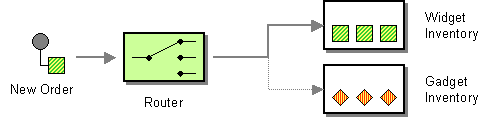
+h3. Content Based Router
+
+ContentBasedRouter can be used for all kind of content-based routing.
+This pattern implements the [Content-Based
Router|http://www.enterpriseintegrationpatterns.com/ContentBasedRouter.html]
pattern.
+\\
+!http://www.enterpriseintegrationpatterns.com/img/ContentBasedRouter.gif!
+\\
+{snippet:id=content-based-router|lang=xml|url=servicemix/components/engines/servicemix-eip/trunk/src/test/resources/org/apache/servicemix/eip/spring.xml|pygmentize=true}{snippet}
+
+h4. Endpoint properties
+{include:jbi/components/_servicemix-eip-content-based-router.conf}
+
+h3. Message Filter
+MessageFilter allows filtering incoming JBI exchanges. As it drops unwanted
messages and in an InOut exchange a response is required, MessageFilter and
InOut MEPs cannot be used together.
+This pattern implements the [Message
Filter|http://www.enterpriseintegrationpatterns.com/Filter.html] pattern.
+\\
+!http://www.enterpriseintegrationpatterns.com/img/MessageFilter.gif!
+\\
+{snippet:id=message-filter|lang=xml|url=servicemix/components/engines/servicemix-eip/trunk/src/test/resources/org/apache/servicemix/eip/spring.xml|pygmentize=true}{snippet}
+h4. Endpoint properties
+{include:jbi/components/_servicemix-eip-message-filter.conf}
+
+h3. Pipeline
+The Pipeline component is a bridge between an In-Only (or Robust-In-Only) MEP
and an In-Out MEP.  When the Pipeline receives an In-Only MEP, it will send the
input in an In-Out MEP to the tranformer destination and forward the response
in an In-Only MEP to the target destination.
+
+The old org.apache.servicemix.components.util.PipelineComponent will be
deprecated.  This one offers the same feature but can be safely clustered and
use in a transactional enviromnent.
+\\
+{snippet:id=pipeline|lang=xml|url=servicemix/components/engines/servicemix-eip/trunk/src/test/resources/org/apache/servicemix/eip/spring.xml|pygmentize=true}{snippet}
+\\
+In the default configuration, faults sent by the transformer component are
sent back to the consumer as faults if the exchange MEP supports them, or as
errors (for InOnly exchanges).  This behavior can be changed by setting the
{{sendFaultsToTarget}} attribute to {{true}}, in which case faults will be sent
to the target component, or by adding a {{faultsTarget}} element where faults
should be sent.
+h4. Endpoint properties
+{include:jbi/components/_servicemix-eip-pipeline.conf}
+
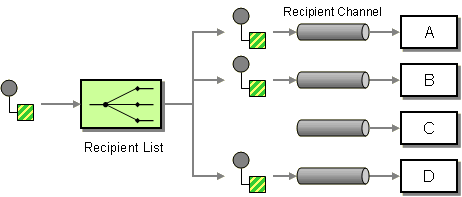
+h3. Static Recipeint List
+The StaticRecipientList component will forward an input In-Only or
Robust-In-Only exchange to a list of known recipients.
+This component implements the [Recipient
List|http://www.enterpriseintegrationpatterns.com/RecipientList.html] pattern,
with the limitation that the recipient list is static.
+\\
+!http://www.enterpriseintegrationpatterns.com/img/RecipientList.gif!
+\\
+{snippet:id=static-recipient-list|lang=xml|url=servicemix/components/engines/servicemix-eip/trunk/src/test/resources/org/apache/servicemix/eip/spring.xml|pygmentize=true}{snippet}
+h4. Endpoint properties
+{include:jbi/components/_servicemix-eip-static-recipient-list.conf}
+
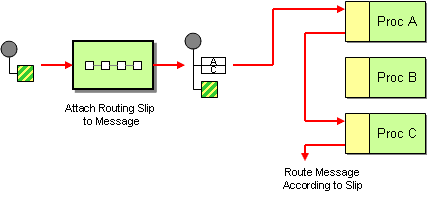
+h3. Static Routing Slip
+A RoutingSlip component can be used to route an incoming In-Out exchange
through a series of target services.
+This component implements the [Routing
Slip|http://www.enterpriseintegrationpatterns.com/RoutingTable.html] pattern,
with the limitation that the routing table is static.
+This component only uses In-Out MEPs and errors or faults sent by targets are
reported back to the consumer, thus interrupting the routing process.
+\\
+!http://www.enterpriseintegrationpatterns.com/img/RoutingTableSimple.gif!
+\\
+{snippet:id=static-routing-slip|lang=xml|url=servicemix/components/engines/servicemix-eip/trunk/src/test/resources/org/apache/servicemix/eip/spring.xml|pygmentize=true}{snippet}
+h4. Endpoint properties
+{include:jbi/components/_servicemix-eip-static-routing-slip.conf}
+
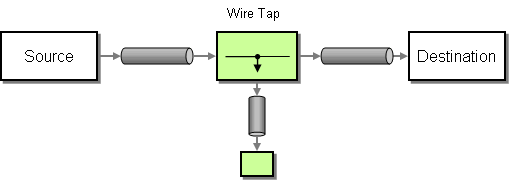
+h3. Wire Tap
+A WireTap component can be used to forward a copy of the input message to a
listener in a proxy fashion.
+This component implements the
[WireTap|http://www.enterpriseintegrationpatterns.com/WireTap.html] pattern.
+It can handle all four standard MEPs, but will only send an In-Only MEP to the
listener.
+The originating service must be configured to send messages to the WireTap
directly.
+In the case of an In-Out MEP, this means that the WireTap needs to be
configured to send the exchange along to the destination service.
+
+!http://www.enterpriseintegrationpatterns.com/img/WireTap.gif!
+\\
+{snippet:id=wire-tap|lang=xml|url=servicemix/components/engines/servicemix-eip/trunk/src/test/resources/org/apache/servicemix/eip/spring.xml|pygmentize=true}{snippet}
+\\
+Similar to the example above, the WireTap can also be used:
+* to forward the output message of an exchange using <eip:outListener/>
+* to forward the fault message of an exchange using <eip:faultListener/>
+
+h4. Endpoint properties
+{include:jbi/components/_servicemix-eip-wire-tap.conf}
+
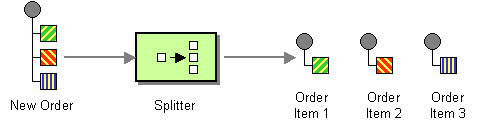
+h3. XPath Splitter
+The XPathSplitter component implements the
[Splitter|http://www.enterpriseintegrationpatterns.com/Sequencer.html] pattern
using an xpath expression to split the incoming xml.
+\\
+!http://www.enterpriseintegrationpatterns.com/img/Sequencer.gif!
+\\
+{snippet:id=xpath-splitter|lang=xml|url=servicemix/components/engines/servicemix-eip/trunk/src/test/resources/org/apache/servicemix/eip/spring.xml|pygmentize=true}{snippet}
+h4. Endpoint properties
+{include:jbi/components/_servicemix-eip-xpath-splitter.conf}
+
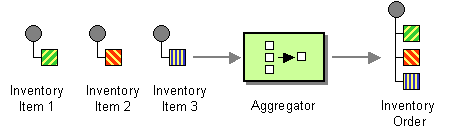
+h3. Split Aggregator
+The SplitAggregator is an aggregator mainly usefull to collect messages that
have been created using a splitter.
+It relies on several properties that should be set on the exchanges (count,
index, correlationId).
+
+!http://www.enterpriseintegrationpatterns.com/img/Aggregator.gif!
+\\
+{snippet:id=slit-aggregator|lang=xml|url=servicemix/components/engines/servicemix-eip/trunk/src/test/resources/org/apache/servicemix/eip/spring.xml|pygmentize=true}{snippet}
+h4. Endpoint properties
+{include:jbi/components/_servicemix-eip-split-aggregator.conf}
+
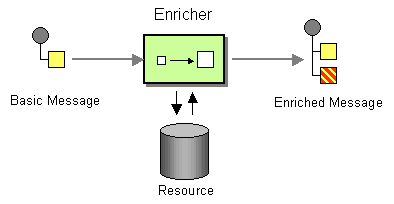
+h3. Content Enricher
+With a Content Enricher you can extract additional information from a source
and add this information to your message. This is useful if the calling service
for example extracts a 'userID' and your target system is only aware of a
'userName'. By using the Content-Enricher you could extract this information
from a source system and add this additional information ('userName') to your
message.
+\\
+!http://www.enterpriseintegrationpatterns.com/img/DataEnricher.gif!
+\\
+{pygmentize:lang=xml}
+<eip:content-enricher service="test:contentEnricher" endpoint="endpoint">
+  <eip:enricherTarget>
+    <eip:exchange-target service="test:additionalInformationExtracter" />
+  </eip:enricherTarget>
+  <eip:target>
+    <eip:exchange-target service="test:myTarget" />
+  </eip:target>
+</eip:content-enricher>
+{pygmentize}
+h4. Endpoint properties
+{include:jbi/components/_servicemix-eip-content-enricher.conf}
+
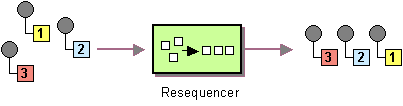
+h3. Eip Resequencer
+
+A resequencer re-orders incoming In-Only or Robust-In-Only exchanges and sends
them synchronously to a targets service. Synchronous sending ensures that
messages arrive in correct order at the target service. This component
implements the
[Resequencer|http://www.enterpriseintegrationpatterns.com/Resequencer.html]
pattern.
+\\
+!http://www.enterpriseintegrationpatterns.com/img/Resequencer.gif!
+\\
+It works on (continuous) streams of message exchanges using a timeout policy.
Since the resequencer doesn't make batch reads there's no need to know the
number of messages to be re-ordered in advance (although a {{capacity}}
parameter prevents the resequencer from running out of memory). If the maximum
out-of-sequence time difference between messages in a message stream is known,
the resequencer's {{timeout}} parameter should be set to this value
(milliseconds). In this case it is guaranteed that all elements of a stream are
delivered in correct order to the target service. The lower the {{timeout}}
value is compared to the out-of-sequence time difference the higher is the
probability for out-of-sequence messages sent by this resequencer. Large
{{timeout}} values should be supported by sufficiently high {{capacity}} values.
+\\
+For comparing elements of a sequence the resequencer component can be
configured with a sequence element comparator. A default comparator is provided
that compares message exchanges based on {{Long}} sequence numbers. This
comparator expects the sequence number to be the value of the
{{org.apache.servicemix.eip.sequence.number}} property of the exchanges's
{{in}}\-NormalizedMessage. The name of the property can be customized in the
comparator configuration (see below). You may also provide a custom comparator
by implementing the
[SequenceElementComparator|http://svn.apache.org/viewvc/servicemix/components/engines/servicemix-eip/trunk/src/main/java/org/apache/servicemix/eip/support/resequence/SequenceElementComparator.java?view=markup]
 interface.
+\\
+{pygmentize:lang=xml}
+ <eip:resequencer
+   service="sample:Resequencer"
+   endpoint="ResequencerEndpoint"
+   comparator="#comparator"
+   capacity="100"
+   timeout="2000">
+   <eip:target>
+     <eip:exchange-target service="sample:SampleTarget" />
+   </eip:target>
+ </eip:resequencer>
+ <!-- Configure default comparator with custom sequence number property -->
+ <eip:default-comparator id="comparator" sequenceNumberKey="seqnum"/>
+{pygmentize}
+\\
+A running example can be downloaded from [here|^resequencer-sample.zip]. In
this example, a custom-coded message sender sends messages in "wrong" order to
the resequencer. The resequencer re-orders these messages and (synchronously)
sends them to a file sender-endpoint. The file sender-enpoint writes the
messages (in proper order) to the {{work/output}} directory.
+h4. Endpoint properties
+{include:jbi/components/_servicemix-eip-resequencer.conf}
+
+h3. Async Bridge
+
+The AsyncBridge expects an InOut mep as input. It then uses the exchange id of
the InOut mep as the correlation id and creates an InOnly message by copying
the input message and sends it to the target (with the correlation id set as a
property). Next it expects an InOnly to come back with the same correlation id
property. When this happens, the message is copied to the out message of the
original exchange and sent back. If no response is received during the
configured amount of time (timeout property in milliseconds), an error will be
sent back to the original consumer.
+
+{pygmentize:lang=xml}
+ <eip:async-bridge
+  service="sample:AsyncBridge"
+  endpoint="AsyncBridgeEndpoint"
+  <eip:target>
+    <eip:exchange-target service="sample:SampleTarget" />
+  </eip:target>
+</eip:async-bridge>
+{pygmentize}
+h4. Correlation Id
+
+There is a convention between the AsyncBridge and the target on how the
correlation id is transmitted. The correlation id can only be transmitted from
the AnsycBridge to the target using a message property . The property name can
be customized. On the other hand, the correlation id coming back from the
target could be set in a message property or the message payload. The
AsyncBridge could use an Expression to extract the correlation id from the
message returning from the target.
+\\
+{pygmentize:lang=xml}
+ <eip:async-bridge
+         service="sample:AsyncBridge"
+         endpoint="AsyncBridgeEndpoint"
+         responseCorrIdProperty="correlationIdProperty"
+         responseCorrId="#responseCorrIdExpression">
+         <eip:target>
+             <eip:exchange-target service="sample:SampleTarget" />
+         </eip:target>
+ </eip:async-bridge>
+
+ <bean id="responseCorrIdExpression"
class="org.apache.servicemix.expression.JAXPStringXPathExpression" >
+       <contructor-arg value="/my-response/message/@corrId"/>
+ </bean>
+{pygmentize}
+\\
+As you can see from the sample above the responseCorrIdProperty is used to set
the name of the property that the target will query to get the correlation id
sent by the AsyncBridge. In other words, the target will do something like this
to extract the correlation id
+\\
+{pygmentize:lang=xml}
+ String correlationId = exchange.getProperty("correlationIdProperty");
+{pygmentize}
+The responseCorrId is set with an instance of type
org.apache.servicemix.expression.Expression, in this case the class
org.apache.servicemix.expression.JAXPStringXPathExpression.
+This expression resolves the location of the correlation id coming back from
the target. In the above example the expression shows that the correlation id
comes as part of the message payload in an attribute called "corrId" of the
/my-response/message element. In a similar manner the class
org.apache.servicemix.expression.PropertyExpression could have been used to
locate the correlation id in a message property.
+h4. Endpoint properties
+{include:jbi/components/_servicemix-eip-async-bridge.conf}
+
+h3. Tips
+
+
+h4. ExchangeTarget
+
+All patterns use the *<exchange-target />* tag to specify the target of a JBI
exchange.
+This element has the following attributes:
+|| Name || Type || Description ||
+| interface | QName | the QName of the target interface. One of service or
interface attribute is required |
+| operation | QName | the QName of the target operation (optional) |
+| service | QName | the QName of the target service. One of service or
interface attribute is required |
+| endpoint | String | the name of the target JBI endpoint, only used when
service is set |
+| uri | String | uri used to target the exchange (see [URIs]) |
+If you want to target a given interface, just set the interface attribute.
Else you have to set the service attribute, and optionally the endpoint
attribute if you want to specify the JBI endpoint instead of a service name.
+
+h4. NamespaceContext
+
+Some patterns use XPath expression.  To use such expressions on an xml with
namespaces, you need to define a NamespaceContext.
+{snippet:id=namespace-context|lang=xml|url=servicemix/components/engines/servicemix-eip/trunk/src/test/resources/org/apache/servicemix/eip/spring.xml|pygmentize=true}{snippet}
+\\
+This NamespaceContext can be referenced by a *namespaceContext* attribute as
shown in the XPathSplitter or MessageFilter examples.
+
+h4. Predicates
+
+Some patterns uses predicates to test a given JBI exchange.  The only
predicate currently implemented is the XPathPredicate, but you can implement
your own and deploy it with the service unit.
+
+h4. Configuring temporary message storage
+Many of the pattern implementation need to store MessageExchanges temporarily.
 An example: the aggregator will need to keep track of the {{MessageExchange}}
it is aggregating.  By default, the EIPs use a plain {{MemoryStoreFactory}} to
create in-memory stores, but there are other options.  If you set the
{{timeout}} property on the {{MemoryStoreFactory}}, it will evict old object
from the in-memory store to avoid a memory leak. You can also use a
{{JDBCStoreFactory}} to store data in a database instead of in memory.
+
+Example: to use an in-memory store with timeout for a storing active and
closed aggregations in a {{<split-aggregator/>}}, you can do
+{pygmentize:lang=xml}
+<eip:split-aggregator service="test:aggregator" endpoint="endpoint"
+                      storeFactory="#StoreFactory"
closedAggregateStoreFactory="#StoreFactory">
+  <eip:target>
+    <eip:exchange-target service="test:trace5" />
+  </eip:target>
+</eip:split-aggregator>
+
+<bean id="StoreFactory" class="org.apache.servicemix.store.MemoryStoreFactory">
+  <property name="timeout" value="120000"/> <!-- 2 minute timeout -->
+</bean>
+{pygmentize}
+
+h4. Creating your own patterns
+
+Some classes have been designed to be extensible, this includes:
+* org.apache.servicemix.eip.support.AbstractAggregator
+* org.apache.servicemix.eip.support.AbstractSplitter
\ No newline at end of file