This is an automated email from the ASF dual-hosted git repository.

gengliang pushed a commit to branch master
in repository https://gitbox.apache.org/repos/asf/spark.git
The following commit(s) were added to refs/heads/master by this push:
new 198b90c [SPARK-37714][SQL] ANSI mode: allow casting between numeric
type and timestamp type
198b90c is described below
commit 198b90c3bf5c3cbc90ba1bb4460e92c72695b50c
Author: Gengliang Wang <[email protected]>
AuthorDate: Thu Dec 23 20:13:10 2021 +0800
[SPARK-37714][SQL] ANSI mode: allow casting between numeric type and
timestamp type
### What changes were proposed in this pull request?
* Allow casting between numeric type and timestamp type under ANSI mode
* Remove the user-facing configuration
`spark.sql.ansi.allowCastBetweenDatetimeAndNumeric`
### Why are the changes needed?
Same reason as mentioned in https://github.com/apache/spark/pull/34459. It
is for better adoption of ANSI SQL mode since users are relying on it:
- As we did some data science, we found that many Spark SQL users are
actually using `Cast(Timestamp as Numeric)` and `Cast(Numeric as Timestamp)`.
- The Spark SQL connector for Tableau is using this feature for DateTime
math. e.g.
`CAST(FROM_UNIXTIME(CAST(CAST(%1 AS BIGINT) + (%2 * 86400) AS BIGINT)) AS
TIMESTAMP)`
### Does this PR introduce _any_ user-facing change?
Yes, casting between numeric type and timestamp type is allowed by default
under ANSI SQL mode
### How was this patch tested?
Unit tests.
Here is the screenshot of the document change:
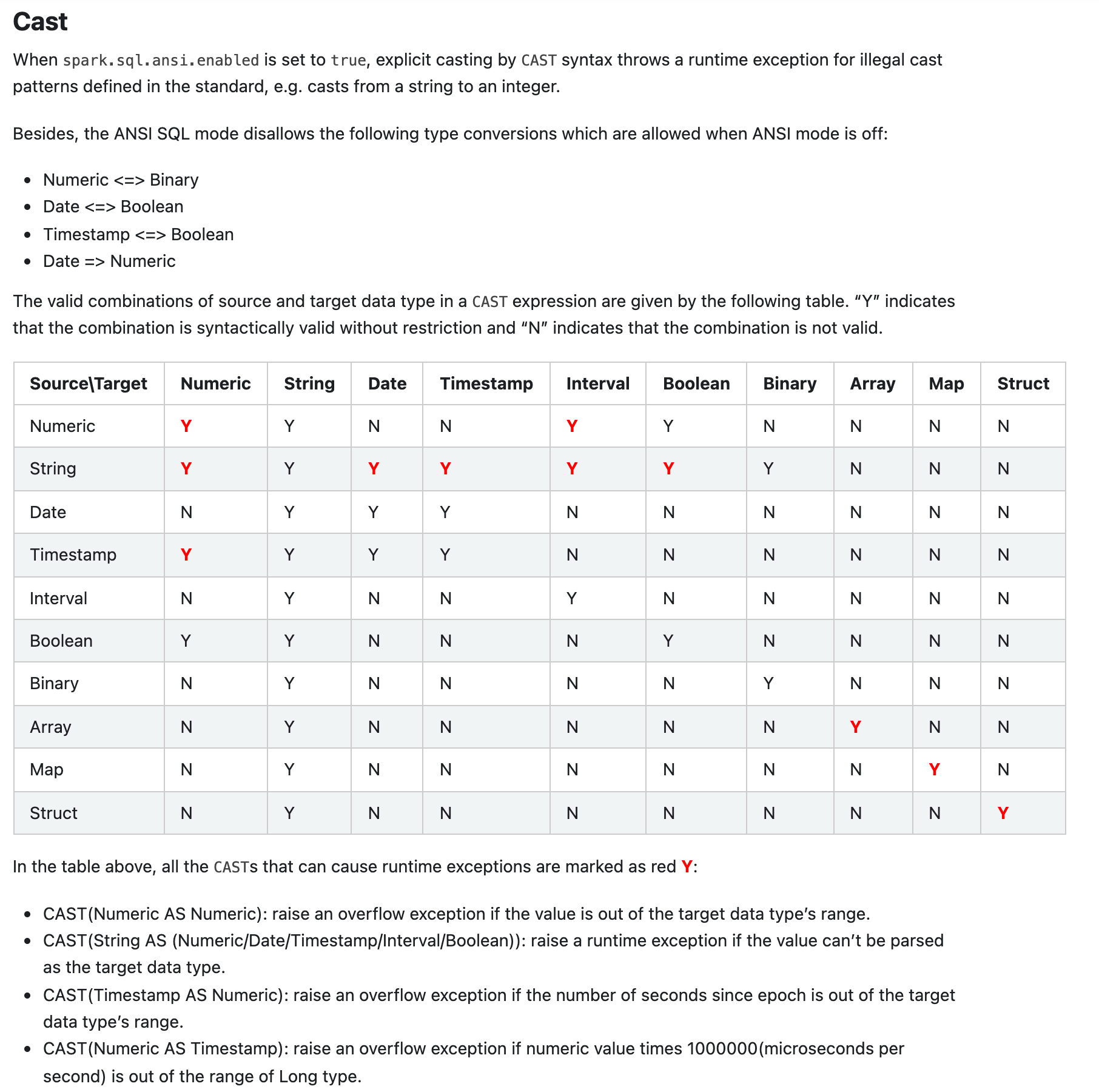
Closes #34985 from gengliangwang/changeSubConf.
Authored-by: Gengliang Wang <[email protected]>
Signed-off-by: Gengliang Wang <[email protected]>
---
docs/sql-ref-ansi-compliance.md | 18 ++--
.../spark/sql/catalyst/expressions/Cast.scala | 5 +-
.../org/apache/spark/sql/internal/SQLConf.scala | 12 ---
.../catalyst/expressions/AnsiCastSuiteBase.scala | 120 +++++----------------
.../spark/sql/catalyst/expressions/CastSuite.scala | 32 +-----
.../sql/catalyst/expressions/CastSuiteBase.scala | 31 ++++++
6 files changed, 67 insertions(+), 151 deletions(-)
diff --git a/docs/sql-ref-ansi-compliance.md b/docs/sql-ref-ansi-compliance.md
index d8d5a24..03b8db1 100644
--- a/docs/sql-ref-ansi-compliance.md
+++ b/docs/sql-ref-ansi-compliance.md
@@ -70,23 +70,21 @@ SELECT abs(-2147483648);
When `spark.sql.ansi.enabled` is set to `true`, explicit casting by `CAST`
syntax throws a runtime exception for illegal cast patterns defined in the
standard, e.g. casts from a string to an integer.
-The `CAST` clause of Spark ANSI mode follows the syntax rules of section 6.13
"cast specification" in [ISO/IEC 9075-2:2011 Information technology — Database
languages - SQL — Part 2: Foundation
(SQL/Foundation)](https://www.iso.org/standard/53682.html), except it specially
allows the following
- straightforward type conversions which are disallowed as per the ANSI
standard:
-* NumericType <=> BooleanType
-* StringType <=> BinaryType
-* ArrayType => String
-* MapType => String
-* StructType => String
+Besides, the ANSI SQL mode disallows the following type conversions which are
allowed when ANSI mode is off:
+* Numeric <=> Binary
+* Date <=> Boolean
+* Timestamp <=> Boolean
+* Date => Numeric
The valid combinations of source and target data type in a `CAST` expression
are given by the following table.
“Y” indicates that the combination is syntactically valid without restriction
and “N” indicates that the combination is not valid.
| Source\Target | Numeric | String | Date | Timestamp | Interval | Boolean |
Binary | Array | Map | Struct |
|-----------|---------|--------|------|-----------|----------|---------|--------|-------|-----|--------|
-| Numeric | <span style="color:red">**Y**</span> | Y | N | N
| N | Y | N | N | N | N |
+| Numeric | <span style="color:red">**Y**</span> | Y | N | N
| <span style="color:red">**Y**</span> | Y | N | N | N | N
|
| String | <span style="color:red">**Y**</span> | Y | <span
style="color:red">**Y**</span> | <span style="color:red">**Y**</span> | <span
style="color:red">**Y**</span> | <span style="color:red">**Y**</span> | Y | N
| N | N |
| Date | N | Y | Y | Y | N | N | N
| N | N | N |
-| Timestamp | N | Y | Y | Y | N | N | N
| N | N | N |
+| Timestamp | <span style="color:red">**Y**</span> | Y | Y | Y
| N | N | N | N | N | N |
| Interval | N | Y | N | N | Y | N | N
| N | N | N |
| Boolean | Y | Y | N | N | N | Y | N
| N | N | N |
| Binary | N | Y | N | N | N | N | Y
| N | N | N |
@@ -97,6 +95,8 @@ The `CAST` clause of Spark ANSI mode follows the syntax rules
of section 6.13 "c
In the table above, all the `CAST`s that can cause runtime exceptions are
marked as red <span style="color:red">**Y**</span>:
* CAST(Numeric AS Numeric): raise an overflow exception if the value is out of
the target data type's range.
* CAST(String AS (Numeric/Date/Timestamp/Interval/Boolean)): raise a runtime
exception if the value can't be parsed as the target data type.
+* CAST(Timestamp AS Numeric): raise an overflow exception if the number of
seconds since epoch is out of the target data type's range.
+* CAST(Numeric AS Timestamp): raise an overflow exception if numeric value
times 1000000(microseconds per second) is out of the range of Long type.
* CAST(Array AS Array): raise an exception if there is any on the conversion
of the elements.
* CAST(Map AS Map): raise an exception if there is any on the conversion of
the keys and the values.
* CAST(Struct AS Struct): raise an exception if there is any on the conversion
of the struct fields.
diff --git
a/sql/catalyst/src/main/scala/org/apache/spark/sql/catalyst/expressions/Cast.scala
b/sql/catalyst/src/main/scala/org/apache/spark/sql/catalyst/expressions/Cast.scala
index 0cf7ffd..8fe7eda 100644
---
a/sql/catalyst/src/main/scala/org/apache/spark/sql/catalyst/expressions/Cast.scala
+++
b/sql/catalyst/src/main/scala/org/apache/spark/sql/catalyst/expressions/Cast.scala
@@ -2202,7 +2202,7 @@ object AnsiCast {
case (StringType, TimestampType) => true
case (DateType, TimestampType) => true
case (TimestampNTZType, TimestampType) => true
- case (_: NumericType, TimestampType) =>
SQLConf.get.allowCastBetweenDatetimeAndNumericInAnsi
+ case (_: NumericType, TimestampType) => true
case (StringType, TimestampNTZType) => true
case (DateType, TimestampNTZType) => true
@@ -2222,8 +2222,7 @@ object AnsiCast {
case (_: NumericType, _: NumericType) => true
case (StringType, _: NumericType) => true
case (BooleanType, _: NumericType) => true
- case (TimestampType, _: NumericType) =>
SQLConf.get.allowCastBetweenDatetimeAndNumericInAnsi
- case (DateType, _: NumericType) =>
SQLConf.get.allowCastBetweenDatetimeAndNumericInAnsi
+ case (TimestampType, _: NumericType) => true
case (ArrayType(fromType, fn), ArrayType(toType, tn)) =>
canCast(fromType, toType) &&
diff --git
a/sql/catalyst/src/main/scala/org/apache/spark/sql/internal/SQLConf.scala
b/sql/catalyst/src/main/scala/org/apache/spark/sql/internal/SQLConf.scala
index 868340b..0859f53 100644
--- a/sql/catalyst/src/main/scala/org/apache/spark/sql/internal/SQLConf.scala
+++ b/sql/catalyst/src/main/scala/org/apache/spark/sql/internal/SQLConf.scala
@@ -2665,15 +2665,6 @@ object SQLConf {
.booleanConf
.createWithDefault(true)
- val ALLOW_CAST_BETWEEN_DATETIME_AND_NUMERIC_IN_ANSI =
- buildConf("spark.sql.ansi.allowCastBetweenDatetimeAndNumeric")
- .doc("When true, the data type conversions between datetime types and
numeric types are " +
- "allowed in ANSI SQL mode. This configuration is only effective when "
+
- s"'${ANSI_ENABLED.key}' is true.")
- .version("3.3.0")
- .booleanConf
- .createWithDefault(false)
-
val SORT_BEFORE_REPARTITION =
buildConf("spark.sql.execution.sortBeforeRepartition")
.internal()
@@ -4139,9 +4130,6 @@ class SQLConf extends Serializable with Logging {
def enforceReservedKeywords: Boolean = ansiEnabled &&
getConf(ENFORCE_RESERVED_KEYWORDS)
- def allowCastBetweenDatetimeAndNumericInAnsi: Boolean =
- getConf(ALLOW_CAST_BETWEEN_DATETIME_AND_NUMERIC_IN_ANSI)
-
def timestampType: AtomicType = getConf(TIMESTAMP_TYPE) match {
case "TIMESTAMP_LTZ" =>
// For historical reason, the TimestampType maps to TIMESTAMP WITH LOCAL
TIME ZONE
diff --git
a/sql/catalyst/src/test/scala/org/apache/spark/sql/catalyst/expressions/AnsiCastSuiteBase.scala
b/sql/catalyst/src/test/scala/org/apache/spark/sql/catalyst/expressions/AnsiCastSuiteBase.scala
index 75dbe18..6338be1 100644
---
a/sql/catalyst/src/test/scala/org/apache/spark/sql/catalyst/expressions/AnsiCastSuiteBase.scala
+++
b/sql/catalyst/src/test/scala/org/apache/spark/sql/catalyst/expressions/AnsiCastSuiteBase.scala
@@ -17,15 +17,14 @@
package org.apache.spark.sql.catalyst.expressions
-import java.sql.{Date, Timestamp}
+import java.sql.Timestamp
import java.time.DateTimeException
import org.apache.spark.SparkArithmeticException
import org.apache.spark.sql.catalyst.InternalRow
import org.apache.spark.sql.catalyst.util.DateTimeConstants.MILLIS_PER_SECOND
import org.apache.spark.sql.catalyst.util.DateTimeTestUtils
-import
org.apache.spark.sql.catalyst.util.DateTimeTestUtils.{withDefaultTimeZone, UTC,
UTC_OPT}
-import org.apache.spark.sql.catalyst.util.DateTimeUtils.fromJavaTimestamp
+import
org.apache.spark.sql.catalyst.util.DateTimeTestUtils.{withDefaultTimeZone, UTC}
import org.apache.spark.sql.internal.SQLConf
import org.apache.spark.sql.types._
import org.apache.spark.unsafe.types.UTF8String
@@ -139,20 +138,6 @@ abstract class AnsiCastSuiteBase extends CastSuiteBase {
cast(Literal(134.12), DecimalType(3, 2)), "cannot be represented")
}
- test("ANSI mode: disallow type conversions between Numeric types and
Timestamp type") {
- import DataTypeTestUtils.numericTypes
- checkInvalidCastFromNumericType(TimestampType)
- var errorMsg =
- "you can use functions
TIMESTAMP_SECONDS/TIMESTAMP_MILLIS/TIMESTAMP_MICROS instead"
- verifyCastFailure(cast(Literal(0L), TimestampType), Some(errorMsg))
-
- val timestampLiteral = Literal(1L, TimestampType)
- errorMsg = "you can use functions UNIX_SECONDS/UNIX_MILLIS/UNIX_MICROS
instead."
- numericTypes.foreach { numericType =>
- verifyCastFailure(cast(timestampLiteral, numericType), Some(errorMsg))
- }
- }
-
test("ANSI mode: disallow type conversions between Numeric types and Date
type") {
import DataTypeTestUtils.numericTypes
checkInvalidCastFromNumericType(DateType)
@@ -276,95 +261,38 @@ abstract class AnsiCastSuiteBase extends CastSuiteBase {
}
test("cast from timestamp II") {
- withSQLConf(SQLConf.ALLOW_CAST_BETWEEN_DATETIME_AND_NUMERIC_IN_ANSI.key ->
"true") {
- checkCastToTimestampError(Literal(Double.NaN), TimestampType)
- checkCastToTimestampError(Literal(1.0 / 0.0), TimestampType)
- checkCastToTimestampError(Literal(Float.NaN), TimestampType)
- checkCastToTimestampError(Literal(1.0f / 0.0f), TimestampType)
- Seq(Long.MinValue.toDouble, Long.MaxValue.toDouble,
Long.MinValue.toFloat,
- Long.MaxValue.toFloat).foreach { v =>
- checkExceptionInExpression[SparkArithmeticException](
- cast(Literal(v), TimestampType), "overflow")
- }
+ checkCastToTimestampError(Literal(Double.NaN), TimestampType)
+ checkCastToTimestampError(Literal(1.0 / 0.0), TimestampType)
+ checkCastToTimestampError(Literal(Float.NaN), TimestampType)
+ checkCastToTimestampError(Literal(1.0f / 0.0f), TimestampType)
+ Seq(Long.MinValue.toDouble, Long.MaxValue.toDouble, Long.MinValue.toFloat,
+ Long.MaxValue.toFloat).foreach { v =>
+ checkExceptionInExpression[SparkArithmeticException](
+ cast(Literal(v), TimestampType), "overflow")
}
}
test("cast a timestamp before the epoch 1970-01-01 00:00:00Z II") {
- withSQLConf(SQLConf.ALLOW_CAST_BETWEEN_DATETIME_AND_NUMERIC_IN_ANSI.key ->
"true") {
- withDefaultTimeZone(UTC) {
- val negativeTs = Timestamp.valueOf("1900-05-05 18:34:56.1")
- assert(negativeTs.getTime < 0)
- Seq(ByteType, ShortType, IntegerType).foreach { dt =>
- checkExceptionInExpression[SparkArithmeticException](
- cast(negativeTs, dt), s"to ${dt.catalogString} causes overflow")
- }
+ withDefaultTimeZone(UTC) {
+ val negativeTs = Timestamp.valueOf("1900-05-05 18:34:56.1")
+ assert(negativeTs.getTime < 0)
+ Seq(ByteType, ShortType, IntegerType).foreach { dt =>
+ checkExceptionInExpression[SparkArithmeticException](
+ cast(negativeTs, dt), s"to ${dt.catalogString} causes overflow")
}
}
}
- test("cast from timestamp") {
- withSQLConf(SQLConf.ALLOW_CAST_BETWEEN_DATETIME_AND_NUMERIC_IN_ANSI.key ->
"true") {
- val millis = 15 * 1000 + 3
- val seconds = millis * 1000 + 3
- val ts = new Timestamp(millis)
- val tss = new Timestamp(seconds)
- checkEvaluation(cast(ts, ShortType), 15.toShort)
- checkEvaluation(cast(ts, IntegerType), 15)
- checkEvaluation(cast(ts, LongType), 15.toLong)
- checkEvaluation(cast(ts, FloatType), 15.003f)
- checkEvaluation(cast(ts, DoubleType), 15.003)
-
- checkEvaluation(cast(cast(tss, ShortType), TimestampType),
- fromJavaTimestamp(ts) * MILLIS_PER_SECOND)
- checkEvaluation(cast(cast(tss, IntegerType), TimestampType),
- fromJavaTimestamp(ts) * MILLIS_PER_SECOND)
- checkEvaluation(cast(cast(tss, LongType), TimestampType),
- fromJavaTimestamp(ts) * MILLIS_PER_SECOND)
- checkEvaluation(
- cast(cast(millis.toFloat / MILLIS_PER_SECOND, TimestampType),
FloatType),
- millis.toFloat / MILLIS_PER_SECOND)
- checkEvaluation(
- cast(cast(millis.toDouble / MILLIS_PER_SECOND, TimestampType),
DoubleType),
- millis.toDouble / MILLIS_PER_SECOND)
- checkEvaluation(
- cast(cast(Decimal(1), TimestampType), DecimalType.SYSTEM_DEFAULT),
- Decimal(1))
-
- // A test for higher precision than millis
- checkEvaluation(cast(cast(0.000001, TimestampType), DoubleType),
0.000001)
- }
- }
-
test("cast a timestamp before the epoch 1970-01-01 00:00:00Z") {
- withSQLConf(SQLConf.ALLOW_CAST_BETWEEN_DATETIME_AND_NUMERIC_IN_ANSI.key ->
"true") {
- withDefaultTimeZone(UTC) {
- val negativeTs = Timestamp.valueOf("1900-05-05 18:34:56.1")
- assert(negativeTs.getTime < 0)
- Seq(ByteType, ShortType, IntegerType).foreach { dt =>
- checkExceptionInExpression[SparkArithmeticException](
- cast(negativeTs, dt), s"to ${dt.catalogString} causes overflow")
- }
- val expectedSecs = Math.floorDiv(negativeTs.getTime, MILLIS_PER_SECOND)
- checkEvaluation(cast(negativeTs, LongType), expectedSecs)
+ withDefaultTimeZone(UTC) {
+ val negativeTs = Timestamp.valueOf("1900-05-05 18:34:56.1")
+ assert(negativeTs.getTime < 0)
+ Seq(ByteType, ShortType, IntegerType).foreach { dt =>
+ checkExceptionInExpression[SparkArithmeticException](
+ cast(negativeTs, dt), s"to ${dt.catalogString} causes overflow")
}
- }
- }
-
- test("cast from date") {
- withSQLConf(SQLConf.ALLOW_CAST_BETWEEN_DATETIME_AND_NUMERIC_IN_ANSI.key ->
"true") {
- val d = Date.valueOf("1970-01-01")
- checkEvaluation(cast(d, ShortType), null)
- checkEvaluation(cast(d, IntegerType), null)
- checkEvaluation(cast(d, LongType), null)
- checkEvaluation(cast(d, FloatType), null)
- checkEvaluation(cast(d, DoubleType), null)
- checkEvaluation(cast(d, DecimalType.SYSTEM_DEFAULT), null)
- checkEvaluation(cast(d, DecimalType(10, 2)), null)
- checkEvaluation(cast(d, StringType), "1970-01-01")
-
- checkEvaluation(
- cast(cast(d, TimestampType, UTC_OPT), StringType, UTC_OPT),
- "1970-01-01 00:00:00")
+ val expectedSecs = Math.floorDiv(negativeTs.getTime, MILLIS_PER_SECOND)
+ checkEvaluation(cast(negativeTs, LongType), expectedSecs)
}
}
diff --git
a/sql/catalyst/src/test/scala/org/apache/spark/sql/catalyst/expressions/CastSuite.scala
b/sql/catalyst/src/test/scala/org/apache/spark/sql/catalyst/expressions/CastSuite.scala
index 9121f2d..ba36fa0 100644
---
a/sql/catalyst/src/test/scala/org/apache/spark/sql/catalyst/expressions/CastSuite.scala
+++
b/sql/catalyst/src/test/scala/org/apache/spark/sql/catalyst/expressions/CastSuite.scala
@@ -27,7 +27,6 @@ import
org.apache.spark.sql.catalyst.analysis.TypeCoercionSuite
import org.apache.spark.sql.catalyst.expressions.aggregate.{CollectList,
CollectSet}
import org.apache.spark.sql.catalyst.util.DateTimeConstants._
import org.apache.spark.sql.catalyst.util.DateTimeTestUtils._
-import org.apache.spark.sql.catalyst.util.DateTimeUtils._
import org.apache.spark.sql.internal.SQLConf
import org.apache.spark.sql.types._
import org.apache.spark.sql.types.DayTimeIntervalType.{DAY, HOUR, MINUTE,
SECOND}
@@ -455,36 +454,7 @@ class CastSuite extends CastSuiteBase {
"1970-01-01 00:00:00")
}
- test("cast from timestamp") {
- val millis = 15 * 1000 + 3
- val seconds = millis * 1000 + 3
- val ts = new Timestamp(millis)
- val tss = new Timestamp(seconds)
- checkEvaluation(cast(ts, ShortType), 15.toShort)
- checkEvaluation(cast(ts, IntegerType), 15)
- checkEvaluation(cast(ts, LongType), 15.toLong)
- checkEvaluation(cast(ts, FloatType), 15.003f)
- checkEvaluation(cast(ts, DoubleType), 15.003)
-
- checkEvaluation(cast(cast(tss, ShortType), TimestampType),
- fromJavaTimestamp(ts) * MILLIS_PER_SECOND)
- checkEvaluation(cast(cast(tss, IntegerType), TimestampType),
- fromJavaTimestamp(ts) * MILLIS_PER_SECOND)
- checkEvaluation(cast(cast(tss, LongType), TimestampType),
- fromJavaTimestamp(ts) * MILLIS_PER_SECOND)
- checkEvaluation(
- cast(cast(millis.toFloat / MILLIS_PER_SECOND, TimestampType), FloatType),
- millis.toFloat / MILLIS_PER_SECOND)
- checkEvaluation(
- cast(cast(millis.toDouble / MILLIS_PER_SECOND, TimestampType),
DoubleType),
- millis.toDouble / MILLIS_PER_SECOND)
- checkEvaluation(
- cast(cast(Decimal(1), TimestampType), DecimalType.SYSTEM_DEFAULT),
- Decimal(1))
-
- // A test for higher precision than millis
- checkEvaluation(cast(cast(0.000001, TimestampType), DoubleType), 0.000001)
-
+ test("cast from timestamp II") {
checkEvaluation(cast(Double.NaN, TimestampType), null)
checkEvaluation(cast(1.0 / 0.0, TimestampType), null)
checkEvaluation(cast(Float.NaN, TimestampType), null)
diff --git
a/sql/catalyst/src/test/scala/org/apache/spark/sql/catalyst/expressions/CastSuiteBase.scala
b/sql/catalyst/src/test/scala/org/apache/spark/sql/catalyst/expressions/CastSuiteBase.scala
index f01fea8..54497f1 100644
---
a/sql/catalyst/src/test/scala/org/apache/spark/sql/catalyst/expressions/CastSuiteBase.scala
+++
b/sql/catalyst/src/test/scala/org/apache/spark/sql/catalyst/expressions/CastSuiteBase.scala
@@ -295,6 +295,37 @@ abstract class CastSuiteBase extends SparkFunSuite with
ExpressionEvalHelper {
assert(cast("abcdef", FloatType).nullable)
}
+ test("cast from timestamp") {
+ val millis = 15 * 1000 + 3
+ val seconds = millis * 1000 + 3
+ val ts = new Timestamp(millis)
+ val tss = new Timestamp(seconds)
+ checkEvaluation(cast(ts, ShortType), 15.toShort)
+ checkEvaluation(cast(ts, IntegerType), 15)
+ checkEvaluation(cast(ts, LongType), 15.toLong)
+ checkEvaluation(cast(ts, FloatType), 15.003f)
+ checkEvaluation(cast(ts, DoubleType), 15.003)
+
+ checkEvaluation(cast(cast(tss, ShortType), TimestampType),
+ fromJavaTimestamp(ts) * MILLIS_PER_SECOND)
+ checkEvaluation(cast(cast(tss, IntegerType), TimestampType),
+ fromJavaTimestamp(ts) * MILLIS_PER_SECOND)
+ checkEvaluation(cast(cast(tss, LongType), TimestampType),
+ fromJavaTimestamp(ts) * MILLIS_PER_SECOND)
+ checkEvaluation(
+ cast(cast(millis.toFloat / MILLIS_PER_SECOND, TimestampType), FloatType),
+ millis.toFloat / MILLIS_PER_SECOND)
+ checkEvaluation(
+ cast(cast(millis.toDouble / MILLIS_PER_SECOND, TimestampType),
DoubleType),
+ millis.toDouble / MILLIS_PER_SECOND)
+ checkEvaluation(
+ cast(cast(Decimal(1), TimestampType), DecimalType.SYSTEM_DEFAULT),
+ Decimal(1))
+
+ // A test for higher precision than millis
+ checkEvaluation(cast(cast(0.000001, TimestampType), DoubleType), 0.000001)
+ }
+
test("data type casting") {
val sd = "1970-01-01"
val d = Date.valueOf(sd)
---------------------------------------------------------------------
To unsubscribe, e-mail: [email protected]
For additional commands, e-mail: [email protected]

