Author: gnaylor
Date: Thu Jul 14 00:23:12 2016
New Revision: 1752572

URL: http://svn.apache.org/viewvc?rev=1752572&view=rev
Log:
Edit and add headings and TOC
Modified:
incubator/taverna/site/trunk/content/documentation/components/index.md
Modified: incubator/taverna/site/trunk/content/documentation/components/index.md
URL:
http://svn.apache.org/viewvc/incubator/taverna/site/trunk/content/documentation/components/index.md?rev=1752572&r1=1752571&r2=1752572&view=diff
==============================================================================
--- incubator/taverna/site/trunk/content/documentation/components/index.md
(original)
+++ incubator/taverna/site/trunk/content/documentation/components/index.md Thu
Jul 14 00:23:12 2016
@@ -16,23 +16,25 @@ Notice: Licensed to the Apache Softwa
specific language governing permissions and limitations
under the License.
+[TOC]
+
+## Overview
Taverna Workflow Components are a system for creating shareable, reusable,
- encapsulated sub-workflows that perform clearly defined tasks while
abstracting away from
+ encapsulated sub-workflows that perform clearly defined tasks while
abstracting
the details of how those tasks are performed.
-They are an integrated feature of Taverna Since Workbench 2.5.0 and Server
2.5.4.
+They are an integrated feature of Taverna since Workbench 2.5.0 and Server
2.5.4.
-As part of the BioVeL and SCAPE projects,
- we have developed a system of service components for Taverna.
-This consists of tools for the creation, management and use of workflow
components,
- and a repository for the storage and sharing of those components.
+Taverna's system of service components was developed as part of the BioVeL and
SCAPE projects. They consist of tools for the creation, management and use of
workflow components,
+ along with a repository for the storage and sharing of those components.
Workflow components within a given component family will work together
cleanly,
- for example by adhering to a tidy type system and being well described.
+ for example, by adhering to a tidy type system and being well described.
+
+## Requirements
-A set of minimal functional requirements for service component management has
been developed
- based upon previous component-related work carried out as part of the
e-Lico project and
- also an examination of the needs of BioVeL and SCAPE.
+A set of minimal functional requirements for service component management has
been developed. These requirements are
+ based upon previous component-related work carried out as part of the
e-Lico project as well as an examination of the needs of BioVeL and SCAPE.
-These requirements include:
+The requirements include:
- The ability to create components
- The specification of the characteristics that are necessary for a set of
components to
@@ -47,7 +49,8 @@ These requirements include:
<img class="aligncenter" title="The Model of Components"
src="/img/registry.png" alt=""
width="433" height="251" />
-##Example
+## Workflows
+### Example workflow with components
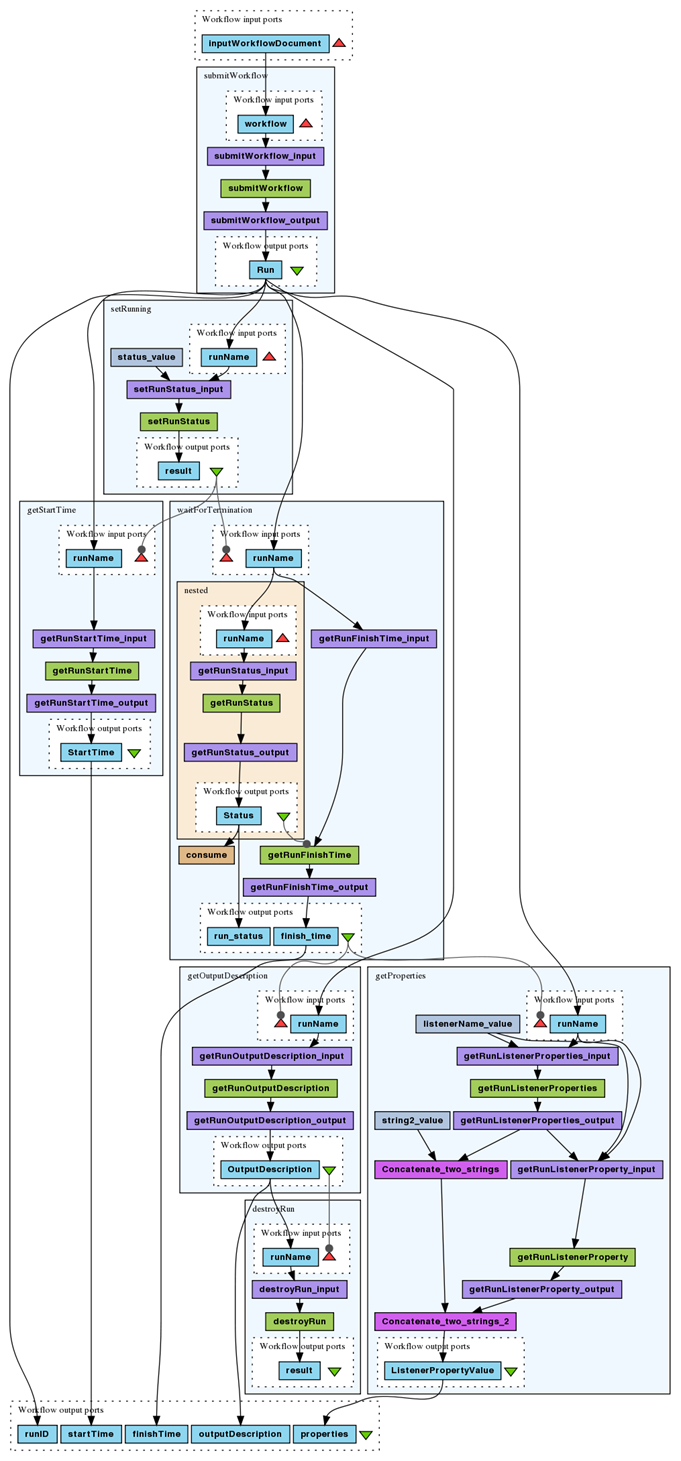
This is an example workflow that includes components, with internal ports
hidden for simplicity:
@@ -58,32 +61,33 @@ Without components, using the same view,
[<img class="aligncenter" title="Un-componentized Workflow"
src="/img/component_c.png" alt="" width="245" height="526"
/>](http://www.taverna.org.uk/pages/wp-content/uploads/2013/05/component_c.png)
-##Including a component in a workflow
+## Including a component in a workflow
-A component can be added into a Taverna workflow in the same way as an
ordinary service,
+A component can be added into a Taverna workflow in the same way as an
ordinary service:
by dragging it from the service panel of the workbench into the workflow
design view.
- Note that although it may be realized internally as a workflow,
- a user sees it as a âblack boxâ and cannot (normally) edit the
componentâs workflow.
+ *Although it may be realized internally as a workflow,
+ a user sees it as a âblack boxâ and cannot (normally) edit the
componentâs workflow.*
<img class="aligncenter" src="/img/arch3.png" alt="" width="500" height="401"
/>
-It is intended that there will be consistency checks to ensure that components
are only plugged
- together in a sensible manner, and for the discovery of and connection to
suitable components
+It is intended that there will be consistency checks to ensure components are
only plugged
+ together in a sensible manner, and for the discovery of (and connection to)
suitable components
based upon existing workflow structure.
-##Executing a component in a workflow run
+## Executing a component in a workflow run
When a component is invoked during a workflow run, the underlying workflow is
called with the
corresponding data.
The results of the workflow are used as the output data for the component
invocation.
-Note that the user sees the component invocation as a âblack boxâ and
cannot see details of
- what happens inside.
+*The user sees the component invocation as a âblack boxâ and cannot see
details of
+ what happens inside.*
-Note that if you publish a workflow containing a component, you *need* to make
sure that the
+>If you publish a workflow containing a component, you *must* make sure the
component is publicly readable in a globally-accessible component registry;
myExperiment is such a suitable registry.
-##Component creation
+## Components
+### Component creation
It was decided that the majority of the information necessary for a component
will be specified
as a Taverna workflow.
@@ -92,7 +96,7 @@ This allows complex internal component f
<img class="aligncenter" src="/img/arch1.png" alt="" width="340" height="433"
/>
-##Component profile
+## Component profile
A specification of the format for the component profile has been agreed.
The format is in XML and an XML schema (xsd) has been created.
@@ -110,7 +114,7 @@ The SCAPE project has an
[extended discussion of component
profiles](https://github.com/openpreserve/scape-component-profiles)
available.
-##Component creation against a profile
+## Component creation against a profile
In order to conform to a component profile, it can be necessary to make
semantic annotations
parts of the corresponding workflow.
@@ -121,7 +125,7 @@ The component profile specifies the onto
family, the correspondence between object classes within a workflow
(input port, service etc.) and the concepts within the ontologies.
-##Checking a component against a profile
+## Checking a component against a profile
Although the components will be modified using a chosen profile,
it is unlikely that the components can be assured as being âcorrect by
constructionâ.
@@ -131,7 +135,7 @@ For this reason, a separate
The component validator is included within
[myExperiment](http://www.myexperiment.org).
-##Publishing a component
+## Publishing a component
Since components are realized as âextensionsâ to Taverna workflows,
it was decided that rather than using a separate component repository,
@@ -146,7 +150,7 @@ To facilitate the development of compone
When a user publishes a component either to myExperiment or to their local
file system,
their service panel is updated to reflect the new component.
-##Discovering a component
+## Discovering a component
Since component families are realized as packs on myExperiment
(or by analogous structures in the userâs file system),