The GitHub Actions job "Required Checks" on
texera.git/gh-readonly-queue/main/pr-8640-f67464940533e38bb68f37303270fc5e544e6bdd
 has failed.
Run started by GitHub user aglinxinyuan (triggered by aglinxinyuan).
Head commit for run: 8687c2a569b1a11d2e8416d72aae7b48a61680f1 / Xinyuan Lin <[email protected]> feat(frontend): accept $variable references in loop blocks (#8640) ### What changes were proposed in this PR? Inside a control block (`Loop Start ... Loop End`), any primitive property of an operator (string, integer, number, boolean) can now hold a loop-variable reference such as `$i`. The frontend sends the literal string `"$i"` unchanged. The backend marks it as a placeholder when it compiles the plan and binds it when the iteration's state message reaches the worker (#8639). Operators outside every block behave as before. ``` Loop Start (i = 0) -> Limit(limit: "$i") -> Loop End ^ panel offers $i; canvas valid; sent as "$i" rename i to j in the Loop Start -> Limit warns "$i is not a variable of an enclosing block; ..."; Run stays enabled delete a link upstream -> Limit outside the block -> "must be integer" disable the Loop End -> the same: the backend compiles and runs only enabled operators ``` | Piece | What it does | |---|---| | Block membership (`enclosingLoopStarts`, `loop-block.util.ts`) | Worked out in the frontend from the graph as it stands: every enabled operator, valid or not, and the links between them, which is the plan the backend compiles and runs (`WorkflowGraph.getSubDAG`). It is a port of the backend's `LogicalPlan.enclosingLoopStarts` (#8639), with the same treatment of a Loop Start that no Loop End closes, nested and sequential blocks, branches, and outermost-first order. `LogicalPlanSpec` and `loop-block.util.spec.ts` both run one shared fixture (`common/workflow-compiler/src/test/resources/loop-blocks.json`: named cases plus random graphs, with the backend's answers), so the two cannot drift apart, and a change to the fixture runs the frontend stack too (`labeler.yml`). An unfinished operator elsewhere on the canvas no longer keeps an operator in a block it has left. | | Loop variables (`extractLoopVariables`, `loopVariablesInScope`) | Reads the variables from each enclosing Loop Start's `initialization` code, following Python's module-level binding: assignments at any depth outside a `def`/`class` body, for-loop targets, one-line compound bodies such as `try: k = 1`, and names an import binds (`from math import pi`, `import numpy as np`, relative modules, parenthesized lists). | | Property panel | Inside a block, each plain primitive field becomes a text box that offers `$name` for every variable in scope. So does a field whose accepted values depend on another field of its row (value rules, as on the sklearn trainers' hyperparameter values): its rules still judge every value that is not a reference, and the text box suggests the values they accept after the variables. Enums, arrays and custom widgets keep their own controls, and so does a property the backend marks `"noLoopVariable": true` (#8750: settings the plan is built from, such as Projection's columns), together with everything nested under it. A `$name` that no enclosing block declares gets a warning under the field; the operator stays valid, and the run itself reports the name if no Loop Start sets it. | | Canvas validation | Inside a block, the schema `type` error is waived exactly where a reference sits in a primitive-typed property. `loopScopeChangeStream` emits on every edit that can change an operator's scope: an operator or link added or deleted, an operator disabled or enabled, or a Loop Start's properties changed. On each one, validation re-validates every operator that holds a reference, so the Run button follows edits two hops away. | | Open panel | Rebuilt on `loopScopeChangeStream` when the operator's scope changed. | | Shared editing (`updateYTypeFromObject`) | A string now replaces a number or boolean instead of throwing, which storing `"$i"` over a number needs. | Panel behavior for a field inside a block: | Field type | Typed text | Stored value | |---|---|---| | integer | `7` | `7` (number) | | integer / number / boolean | `$i` | `"$i"` | | number | `0.5`, typed one key at a time | `0.5`; partial text such as `7.` stays text until complete | | boolean | `true` / `FALSE` | `true` / `false`; other text is flagged | | string | `hello` / `$i` | `"hello"` / `"$i"` | | value rules (e.g. `C`, which must be > 0) | `$i` / `1.0` / `-1` | `"$i"` / `"1.0"` / `"-1"`, flagged by the rules | | any | `$foo` (undeclared) | `"$foo"`, with a warning; the operator stays valid | **Related.** #8639 (on `main`) binds the references and computes the blocks. #8750 (on `main`) adds the `noLoopVariable` marks. **Screenshots.** The Limit outside the loop keeps the number field it has on `main`. The Limit inside the loop gets a text box that suggests the loop's variables and flags a name the loop does not declare. The third shot predates the change of that flag to a warning, which leaves Run enabled. | Before: outside a loop (same as `main`) | After: inside a loop | After: an undeclared name | |---|---|---| | 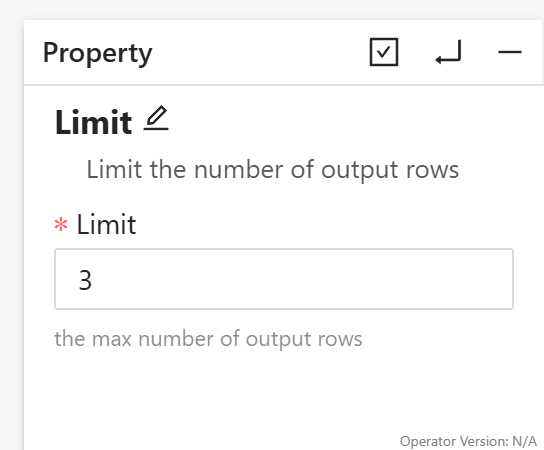 | 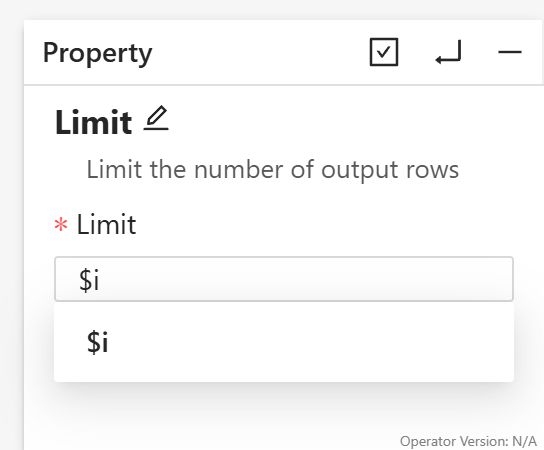 | 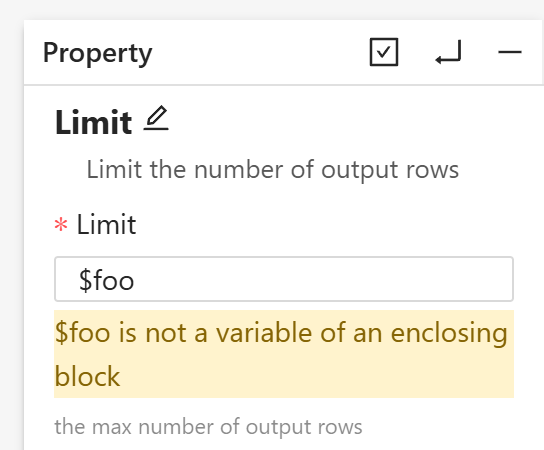 | The workflow in the shots: `Text Input -> Loop Start (i = 0) -> Limit ($i) -> Loop End`, plus a second Limit fed straight from Text Input, outside the loop. 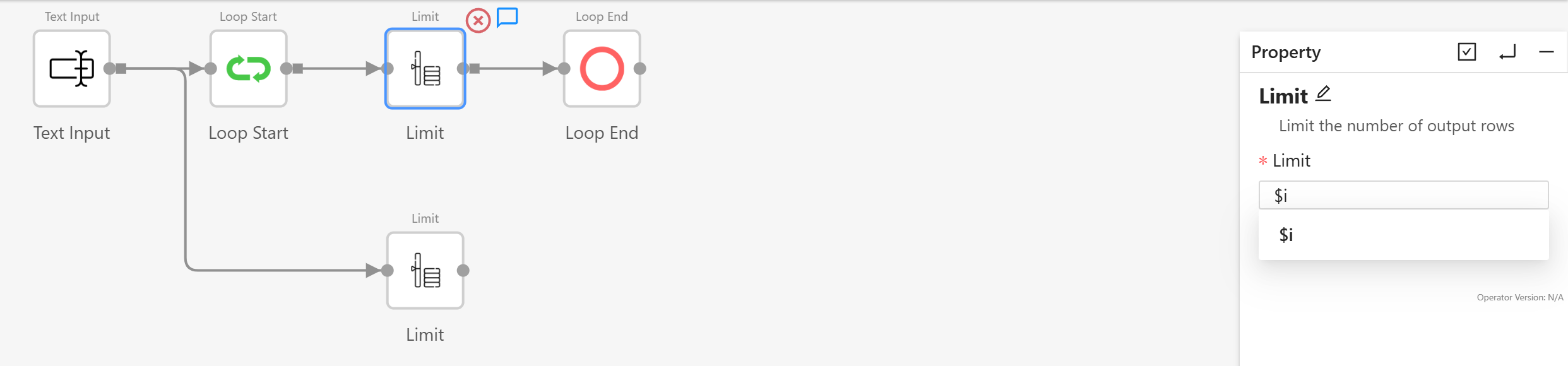 ### Any related issues, documentation, discussions? Closes #8636 ### How was this PR tested? New and updated Vitest specs, run from `frontend/`: | Spec | Covers | |---|---| | `LogicalPlanSpec` (backend) | `enclosingLoopStarts` on every case and random graph of the shared fixture, outermost first. The fixture's Loop Start and Loop End are read by the backend's JSON type names, so a renamed type fails here. The walk-based check on named cases and 400 random DAGs stays. | | `loop-block.util.spec.ts` (new) | The frontend's port on every case and random graph of the same fixture, and on every operator type it names. A graph with a cycle, which the backend rejects but the canvas allows, ends and counts as outside every block. A link to an operator it was not given is ignored. | | `loop-variable.util.spec.ts` | Assignment forms; if/else, try/except, while and for bodies; for targets; one-line compound bodies; import forms (`from ... import`, aliases, relative modules, parenthesized lists, `import a.b`, several on one line; `*` binds nothing); def/class bodies and with/except-as names excluded; Python keywords never taken for names. `loopVariablesInScope`: outermost first without duplicates, undefined outside every block, a disabled operator and its links left out. `loopScopeChangeStream` emits on adds, deletes, disables, enables and Loop Start property changes, and on nothing else. | | `loop-variable-field.util.spec.ts` | Complete vs partial numerals (`7.`, `-0.`, `1e-` kept as text); the parser sets the control without redrawing the box; the string `""` default; the boolean validator rejects `maybe`. On a field with value rules: a reference passes the rules, every other value is still judged by them, the re-validation hook survives, and `props` stays the one object `templateOptions` names. An unknown name gives a warning, not a validation error. `inheritNoLoopVariable` carries a mark to every schema under it, through each keyword that holds a schema and through `$ref`s, without marking a definition an unmarked property shares. | | `loop-variable-input.component.spec.ts` (new) | Rendered through a real formly form: typing `1.05`, `-0.5` and `7.5` one key at a time stores the right number and keeps the box as typed; `$i` and integers; formly attributes reach the input. An unknown name shows the warning. With value rules: the suggestions add the accepted values of the row's parameter (empty box, typed prefix in either case, `$` prefix), and a changed parameter re-judges the value. | | `validation-workflow.service.spec.ts` | The waiver applies only to primitive types. An unknown name leaves the operator valid. Canvas state follows each edit at once: a block opened or closed, and an operator moved out of its block and back while another operator is invalid. Edits two hops away are covered too: an upstream link deleted, a block closed by a link between two other operators, an operator inserted into the body, and a Loop End disabled and enabled again. Each of these four fails if validation stops listening to `loopScopeChangeStream`. | | `operator-property-edit-frame.component.spec.ts` | Primitive fields converted inside a block; file picker, enum and array keep their controls; the form rebuilds when a link, a disabled or enabled operator, or the Loop Start's variables change its scope, and only then. The open operator leaves its block and comes back while another operator on the canvas is invalid. A value-rules field takes `$i` inside a block and keeps its own control outside; with a schema enum or a custom widget it keeps its control inside too. A `noLoopVariable` property, and a field nested under one, keeps its control inside a block. Typing `$` into a number field inside a block keeps the form as it is. | | `shared-editing.interface.spec.ts` | A string replaces a number in a Y.Map instead of throwing. | Each new behavior spec was checked red against the pre-fix code before the final run. ``` yarn ng test --watch=false --include=<the 7 loop and shared-editing specs> # 488 passed, 1 skipped (existing it.skip) yarn ng test --watch=false # 240 files, 6815 passed, 1 skipped (existing it.skip) yarn exec tsc --noEmit -p src/tsconfig.app.json (and src/tsconfig.spec.json) # clean yarn exec ngc -p src/tsconfig.app.json --noEmit # AOT + strictTemplates clean yarn prettier-eslint --list-different <changed files> && yarn eslint <changed files> # clean sbt "WorkflowCompiler/testOnly *LogicalPlanSpec" # 27 passed sbt scalafmtCheckAll "WorkflowCompiler/scalafixAll --check" # clean ``` `yarn ng build` did not complete locally, because the worktree's `node_modules` is a symlink; CI's frontend build passes on macOS, Ubuntu and Windows. An earlier revision was checked by hand on a local deployment with #8639 and #8642 (the test branch in #8645): the loop workflow runs, and the panel behaves as in the screenshots. The changes since (membership from the whole graph, imports, the warning, `noLoopVariable`) are covered by the specs above. Manual steps for the reviewer (Chrome, desktop): link `Loop Start -> Limit -> Loop End` and set the Loop Start initialization to `i = 0`. Open `Limit`: its integer field is a text box, typing `$` offers `$i`, and choosing it keeps the operator valid. Typing `$foo` shows a warning, "$foo is not a variable of an enclosing block; ...", and Run stays enabled. Delete a link so `Limit` leaves the block, or disable the Loop End: the field is a number box again and `$i` is a type error. ### Was this PR authored or co-authored using generative AI tooling? Generated-by: Claude Code (Claude Fable 5.1, Claude Opus 5.5) 🤖 Generated with [Claude Code](https://claude.com/claude-code) Report URL: https://github.com/apache/texera/actions/runs/40065798637 With regards, GitHub Actions via GitBox




