This is an automated email from the ASF dual-hosted git repository.

tqchen pushed a commit to branch main
in repository https://gitbox.apache.org/repos/asf/tvm.git
The following commit(s) were added to refs/heads/main by this push:
     new 1435ddb118 [Doc] Relax Deep Dive (#17380)
1435ddb118 is described below

commit 1435ddb118ce4fc6b87c07804e554c2e945053c9
Author: Siyuan Feng <[email protected]>
AuthorDate: Tue Sep 17 22:06:38 2024 +0800

    [Doc] Relax Deep Dive (#17380)

    * [Doc] Relax Deep Dive

    Similar as TensorIR Deep Dive, we also have Relax Deep Dive.
---
 docs/conf.py                                       |   7 +-
 docs/deep_dive/relax/abstraction.rst               |  73 ++++++
 docs/deep_dive/{tensor_ir => relax}/index.rst      |  17 +-
 docs/deep_dive/relax/learning.rst                  | 272 ++++++++++++++++++++
 docs/deep_dive/relax/tutorials/README.txt          |   2 +
 docs/deep_dive/relax/tutorials/relax_creation.py   | 281 +++++++++++++++++++++
 .../relax/tutorials/relax_transformation.py        | 141 +++++++++++
 docs/deep_dive/tensor_ir/abstraction.rst           |   1 -
 docs/deep_dive/tensor_ir/index.rst                 |   6 +-
 .../tutorials/{creation.py => tir_creation.py}     |   0
 .../{transformation.py => tir_transformation.py}   |   0
 docs/index.rst                                     |   1 +
 12 files changed, 787 insertions(+), 14 deletions(-)

diff --git a/docs/conf.py b/docs/conf.py
index 12039ebb2c..acc03161e5 100644
--- a/docs/conf.py
+++ b/docs/conf.py
@@ -424,6 +424,7 @@ examples_dirs = [
     # New tutorial structure under docs folder
     tvm_path.joinpath("docs", "get_started", "tutorials"),
     tvm_path.joinpath("docs", "how_to", "tutorials"),
+    tvm_path.joinpath("docs", "deep_dive", "relax", "tutorials"),
     tvm_path.joinpath("docs", "deep_dive", "tensor_ir", "tutorials"),
 ]

@@ -443,6 +444,7 @@ gallery_dirs = [
     # New tutorial structure under docs folder
     "get_started/tutorials/",
     "how_to/tutorials/",
+    "deep_dive/relax/tutorials/",
     "deep_dive/tensor_ir/tutorials/",
 ]

@@ -598,10 +600,10 @@ tvm_alias_check_map = {
 ## Setup header and other configs
 import tlcpack_sphinx_addon

-footer_copyright = "© 2023 Apache Software Foundation | All rights reserved"
+footer_copyright = "© 2024 Apache Software Foundation | All rights reserved"
 footer_note = " ".join(
     """
-Copyright © 2023 The Apache Software Foundation. Apache TVM, Apache, the
Apache feather,
+Copyright © 2024 The Apache Software Foundation. Apache TVM, Apache, the
Apache feather,
 and the Apache TVM project logo are either trademarks or registered trademarks
of
 the Apache Software Foundation.""".split(
         "\n"
@@ -614,7 +616,6 @@ header_logo_link = "https://tvm.apache.org/";
 header_links = [
     ("Community", "https://tvm.apache.org/community";),
     ("Download", "https://tvm.apache.org/download";),
-    ("VTA", "https://tvm.apache.org/vta";),
     ("Blog", "https://tvm.apache.org/blog";),
     ("Docs", "https://tvm.apache.org/docs";),
     ("Conference", "https://tvmconf.org";),
diff --git a/docs/deep_dive/relax/abstraction.rst
b/docs/deep_dive/relax/abstraction.rst
new file mode 100644
index 0000000000..2b9ee8b5d7
--- /dev/null
+++ b/docs/deep_dive/relax/abstraction.rst
@@ -0,0 +1,73 @@
+..  Licensed to the Apache Software Foundation (ASF) under one
+    or more contributor license agreements.  See the NOTICE file
+    distributed with this work for additional information
+    regarding copyright ownership.  The ASF licenses this file
+    to you under the Apache License, Version 2.0 (the
+    "License"); you may not use this file except in compliance
+    with the License.  You may obtain a copy of the License at
+
+..    http://www.apache.org/licenses/LICENSE-2.0
+
+..  Unless required by applicable law or agreed to in writing,
+    software distributed under the License is distributed on an
+    "AS IS" BASIS, WITHOUT WARRANTIES OR CONDITIONS OF ANY
+    KIND, either express or implied.  See the License for the
+    specific language governing permissions and limitations
+    under the License.
+
+.. _relax-abstraction:
+
+Graph Abstraction for ML Models
+-------------------------------
+Graph abstraction is a key technique used in machine learning (ML) compilers
+to represent and reason about the structure and data flow of ML models. By
+abstracting the model into a graph representation, the compiler can perform
+various optimizations to improve performance and efficiency. This tutorial will
+cover the basics of graph abstraction, its key elements of Relax IR, and how
it enables optimization in ML compilers.
+
+What is Graph Abstraction?
+~~~~~~~~~~~~~~~~~~~~~~~~~~
+Graph abstraction is the process of representing an ML model as a directed
graph,
+where the nodes represent computational operations (e.g., matrix
multiplication,
+convolution) and the edges represent the flow of data between these operations.
+This abstraction allows the compiler to analyze the dependencies and
+relationships between different parts of the model.
+
+.. code:: python
+
+    from tvm.script import relax as R
+
+    @R.function
+    def main(
+        x: R.Tensor((1, 784), dtype="float32"),
+        weight: R.Tensor((784, 256), dtype="float32"),
+        bias: R.Tensor((256,), dtype="float32"),
+    ) -> R.Tensor((1, 256), dtype="float32"):
+        with R.dataflow():
+            lv0 = R.matmul(x, weight)
+            lv1 = R.add(lv0, bias)
+            gv = R.nn.relu(lv1)
+            R.output(gv)
+        return gv
+
+Key Features of Relax
+~~~~~~~~~~~~~~~~~~~~~
+Relax, the graph representation utilized in Apache TVM's Unity strategy,
+facilitates end-to-end optimization of ML models through several crucial
+features:
+
+- **First-class symbolic shape**: Relax employs symbolic shapes to represent
+  tensor dimensions, enabling global tracking of dynamic shape relationships
+  across tensor operators and function calls.
+
+- **Multi-level abstractions**: Relax supports cross-level abstractions, from
+  high-level neural network layers to low-level tensor operations, enabling
+  optimizations that span different hierarchies within the model.
+
+- **Composable transformations**: Relax offers a framework for composable
+  transformations that can be selectively applied to different model
components.
+  This includes capabilities such as partial lowering and partial
specialization,
+  providing flexible customization and optimization options.
+
+These features collectively empower Relax to offer a powerful and adaptable
approach
+to ML model optimization within the Apache TVM ecosystem.
diff --git a/docs/deep_dive/tensor_ir/index.rst b/docs/deep_dive/relax/index.rst
similarity index 68%
copy from docs/deep_dive/tensor_ir/index.rst
copy to docs/deep_dive/relax/index.rst
index 432d47116a..f891eb2793 100644
--- a/docs/deep_dive/tensor_ir/index.rst
+++ b/docs/deep_dive/relax/index.rst
@@ -15,17 +15,20 @@
     specific language governing permissions and limitations
     under the License.

-.. _tensor-ir:
+.. _relax:
+
+Relax
+=====
+Relax is a high-level abstraction for graph optimization and transformation in
Apache TVM stack.
+Additionally, Apache TVM combine Relax and TensorIR together as a unity
strategy for cross-level
+optimization. Hence, Relax is usually working closely with TensorIR for
representing and optimizing
+the whole IRModule

-TensorIR
-========
-TensorIR is one of the core abstraction in Apache TVM Unity stack, which is
used to
-represent and optimize the primitive tensor functions.

 .. toctree::
     :maxdepth: 2

     abstraction
     learning
-    tutorials/creation
-    tutorials/transformation
+    tutorials/relax_creation
+    tutorials/relax_transformation
diff --git a/docs/deep_dive/relax/learning.rst
b/docs/deep_dive/relax/learning.rst
new file mode 100644
index 0000000000..702b0e0a9f
--- /dev/null
+++ b/docs/deep_dive/relax/learning.rst
@@ -0,0 +1,272 @@
+..  Licensed to the Apache Software Foundation (ASF) under one
+    or more contributor license agreements.  See the NOTICE file
+    distributed with this work for additional information
+    regarding copyright ownership.  The ASF licenses this file
+    to you under the Apache License, Version 2.0 (the
+    "License"); you may not use this file except in compliance
+    with the License.  You may obtain a copy of the License at
+
+..    http://www.apache.org/licenses/LICENSE-2.0
+
+..  Unless required by applicable law or agreed to in writing,
+    software distributed under the License is distributed on an
+    "AS IS" BASIS, WITHOUT WARRANTIES OR CONDITIONS OF ANY
+    KIND, either express or implied.  See the License for the
+    specific language governing permissions and limitations
+    under the License.
+
+.. _relax-learning:
+
+Understand Relax Abstraction
+============================
+Relax is a graph abstraction used in Apache TVM Unity strategy, which
+helps to end-to-end optimize ML models. The principal objective of Relax
+is to depict the structure and data flow of ML models, including the
+dependencies and relationships between different parts of the model, as
+well as how to execute the model on hardware.
+
+End to End Model Execution
+--------------------------
+
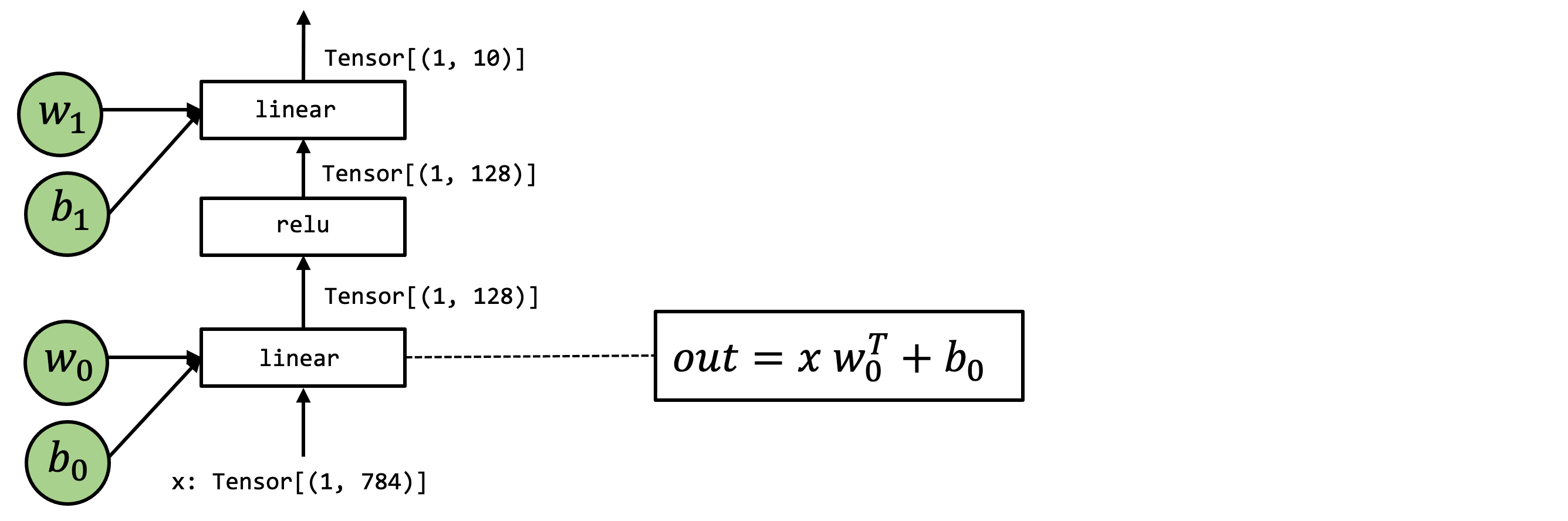
+In this chapter, we will use the following model as an example. This is
+a two-layer neural network that consists of two linear operations with
+relu activation.
+
+.. image:: https://mlc.ai/_images/e2e_fashionmnist_mlp_model.png
+   :width: 85%
+   :align: center
+
+
+High-Level Operations Representation
+~~~~~~~~~~~~~~~~~~~~~~~~~~~~~~~~~~~~
+
+Let us begin by reviewing a Numpy implementation of the model.
+
+.. code:: python
+
+    def numpy_mlp(data, w0, b0, w1, b1):
+        lv0 = data @ w0 + b0
+        lv1 = np.maximum(lv0, 0)
+        lv2 = lv1 @ w1 + b1
+        return lv2
+
+The above example code shows the high-level array operations to perform the
end-to-end model
+execution. Of course, we can rewrite the above code using Relax as follows:
+
+.. code:: python
+
+    from tvm.script import relax as R
+
+    @R.function
+    def relax_mlp(
+        data: R.Tensor(("n", 784), dtype="float32"),
+        w0: R.Tensor((784, 128), dtype="float32"),
+        b0: R.Tensor((128,), dtype="float32"),
+        w1: R.Tensor((128, 10), dtype="float32"),
+        b1: R.Tensor((10,), dtype="float32"),
+    ) -> R.Tensor(("n", 10), dtype="float32"):
+        with R.dataflow():
+            lv0 = R.matmul(data, w0) + b0
+            lv1 = R.nn.relu(lv0)
+            lv2 = R.matmul(lv1, w1) + b1
+            R.output(lv2)
+        return lv2
+
+Low-Level Integration
+~~~~~~~~~~~~~~~~~~~~~
+
+However, again from the pov of machine learning compilation (MLC), we would
like to see
+through the details under the hood of these array computations.
+
+For the purpose of illustrating details under the hood, we will again write
examples in low-level numpy:
+
+We will use a loop instead of array functions when necessary to demonstrate
the possible loop computations.
+When possible, we always explicitly allocate arrays via numpy.empty and pass
them around.
+The code block below shows a low-level numpy implementation of the same model.
+
+.. code:: python
+
+    def lnumpy_linear(X: np.ndarray, W: np.ndarray, B: np.ndarray, Z:
np.ndarray):
+        n, m, K = X.shape[0], W.shape[1], X.shape[1]
+        Y = np.empty((n, m), dtype="float32")
+        for i in range(n):
+            for j in range(m):
+                for k in range(K):
+                    if k == 0:
+                        Y[i, j] = 0
+                    Y[i, j] = Y[i, j] + X[i, k] * W[k, j]
+
+        for i in range(n):
+            for j in range(m):
+                Z[i, j] = Y[i, j] + B[j]
+
+
+    def lnumpy_relu0(X: np.ndarray, Y: np.ndarray):
+        n, m = X.shape
+        for i in range(n):
+            for j in range(m):
+                Y[i, j] = np.maximum(X[i, j], 0)
+
+    def lnumpy_mlp(data, w0, b0, w1, b1):
+        n = data.shape[0]
+        lv0 = np.empty((n, 128), dtype="float32")
+        lnumpy_matmul(data, w0, b0, lv0)
+
+        lv1 = np.empty((n, 128), dtype="float32")
+        lnumpy_relu(lv0, lv1)
+
+        out = np.empty((n, 10), dtype="float32")
+        lnumpy_matmul(lv1, w1, b1, out)
+        return out
+
+With the low-level NumPy example in mind, now we are ready to introduce an
Relax abstraction
+for the end-to-end model execution. The code block below shows a TVMScript
implementation of the model.
+
+.. code:: python
+
+    @I.ir_module
+    class Module:
+        @T.prim_func(private=True)
+        def linear(x: T.handle, w: T.handle, b: T.handle, z: T.handle):
+            M, N, K = T.int64(), T.int64(), T.int64()
+            X = T.match_buffer(x, (M, K), "float32")
+            W = T.match_buffer(w, (K, N), "float32")
+            B = T.match_buffer(b, (N,), "float32")
+            Z = T.match_buffer(z, (M, N), "float32")
+            Y = T.alloc_buffer((M, N), "float32")
+            for i, j, k in T.grid(M, N, K):
+                with T.block("Y"):
+                    v_i, v_j, v_k = T.axis.remap("SSR", [i, j, k])
+                    with T.init():
+                        Y[v_i, v_j] = T.float32(0.0)
+                    Y[v_i, v_j] = Y[v_i, v_j] + X[v_i, v_k] * W[v_k, v_j]
+            for i, j in T.grid(M, N):
+                with T.block("Z"):
+                    v_i, v_j = T.axis.remap("SS", [i, j])
+                    Z[v_i, v_j] = Y[v_i, v_j] + B[v_j]
+
+        @T.prim_func(private=True)
+        def relu(x: T.handle, y: T.handle):
+            M, N = T.int64(), T.int64()
+            X = T.match_buffer(x, (M, N), "float32")
+            Y = T.match_buffer(y, (M, N), "float32")
+            for i, j in T.grid(M, N):
+                with T.block("Y"):
+                    v_i, v_j = T.axis.remap("SS", [i, j])
+                    Y[v_i, v_j] = T.max(X[v_i, v_j], T.float32(0.0))
+
+        @R.function
+        def main(
+            x: R.Tensor(("n", 784), dtype="float32"),
+            w0: R.Tensor((784, 256), dtype="float32"),
+            b0: R.Tensor((256,), dtype="float32"),
+            w1: R.Tensor((256, 10), dtype="float32"),
+            b1: R.Tensor((10,), dtype="float32")
+        ) -> R.Tensor(("n", 10), dtype="float32"):
+            cls = Module
+            n = T.int64()
+            with R.dataflow():
+                lv = R.call_tir(cls.linear, (x, w0, b0),
out_sinfo=R.Tensor((n, 256), dtype="float32"))
+                lv1 = R.call_tir(cls.relu, (lv0,), out_sinfo=R.Tensor((n,
256), dtype="float32"))
+                lv2 = R.call_tir(cls.linear, (lv1, w1, b1),
out_sinfo=R.Tensor((b, 10), dtype="float32"))
+                R.output(lv2)
+            return lv2
+
+The above code contains kinds of functions: the primitive tensor functions
(``T.prim_func``) and a
+``R.function`` (relax function). Relax function is a new type of abstraction
representing
+high-level neural network executions.
+
+Note that the above relax module natively supports symbolic shapes, see the
``"n"`` in the
+tensor shapes in ``main`` function and ``M``, ``N``, ``K`` in the ``linear``
function. This is
+a key feature of Relax abstraction, which enables the compiler to track
dynamic shape relations
+globally across tensor operators and function calls.
+
+Again it is helpful to see the TVMScript code and low-level numpy code
side-by-side and check the
+corresponding elements, and we are going to walk through each of them in
detail. Since we already
+learned about primitive tensor functions, we are going to focus on the
high-level execution part.
+
+Key Elements of Relax
+---------------------
+This section will introduce the key elements of Relax abstraction and how it
enables optimization
+in ML compilers.
+
+Structure Info
+~~~~~~~~~~~~~~
+Structure info is a new concept in Relax that represents the type of relax
expressions. It can
+be ``TensorStructInfo``, ``TupleStructInfo``, etc. In the above example, we
use ``TensorStructInfo``
+(short in ``R.Tensor`` in TVMScript) to represent the shape and dtype of the
tensor of the inputs,
+outputs, and intermediate results.
+
+R.call_tir
+~~~~~~~~~~
+The ``R.call_tir`` function is a new abstraction in Relax that allows calling
primitive tensor
+functions in the same IRModule. This is a key feature of Relax that enables
cross-level
+abstractions, from high-level neural network layers to low-level tensor
operations.
+Taking one line from the above code as an example:
+
+.. code:: python
+
+    lv = R.call_tir(cls.linear, (x, w0, b0), out_sinfo=R.Tensor((n, 256),
dtype="float32"))
+
+To explain what does ``R.call_tir`` work, let us review an equivalent
low-level numpy
+implementation of the operation, as follows:
+
+.. code:: python
+
+    lv0 = np.empty((n, 256), dtype="float32")
+    lnumpy_linear(x, w0, b0, lv0)
+
+Specifically, ``call_tir`` allocates an output tensor res, then pass the
inputs and the output
+to the prim_func. After executing prim_func the result is populated in res,
then we can return
+the result.
+
+This convention is called **destination passing**, The idea is that input and
output are explicitly
+allocated outside and passed to the low-level primitive function. This style
is commonly used
+in low-level library designs, so higher-level frameworks can handle that
memory allocation
+decision. Note that not all tensor operations can be presented in this style
(specifically,
+there are operations whose output shape depends on the input). Nevertheless,
in common practice,
+it is usually helpful to write the low-level function in this style when
possible.
+
+Dataflow Block
+~~~~~~~~~~~~~~
+Another important element in a relax function is the R.dataflow() scope
annotation.
+
+.. code:: python
+
+    with R.dataflow():
+        lv = R.call_tir(cls.linear, (x, w0, b0), out_sinfo=R.Tensor((n, 256),
dtype="float32"))
+        lv1 = R.call_tir(cls.relu, (lv0,), out_sinfo=R.Tensor((n, 256),
dtype="float32"))
+        lv2 = R.call_tir(cls.linear, (lv1, w1, b1), out_sinfo=R.Tensor((b,
10), dtype="float32"))
+        R.output(lv2)
+
+Before we talk about the dataflow block, let us first introduce the concept of
**pure** and
+**side-effect**. A function is **pure** or **side-effect free** if:
+
+- it only reads from its inputs and returns the result via its output
+- it will not change other parts of the program (such as incrementing a global
counter).
+
+For example, all ``R.call_tir`` functions are pure functions, as they only
read from their inputs
+and write the output to another new allocated tensor. However, the **inplace
operations** are not
+pure functions, in other words, they are side-effect functions, because they
will change the existing
+intermediate or input tensors.
+
+A dataflow block is a way for us to mark the computational graph regions of
the program.
+Specifically, within a dataflow block, all the operations need to be
**side-effect free**.
+Outside a dataflow block, the operations can contain side-effect.
+
+.. note::
+
+    A common question that arises is why we need to manually mark dataflow
blocks instead of
+    automatically inferring them. There are two main reasons for this approach:
+
+    - Automatic inference of dataflow blocks can be challenging and imprecise,
particularly
+      when dealing with calls to packed functions (such as cuBLAS
integrations). By manually
+      marking dataflow blocks, we enable the compiler to accurately understand
and optimize
+      the program's dataflow.
+    - Many optimizations can only be applied within dataflow blocks. For
instance, fusion
+      optimization is limited to operations within a single dataflow block. If
the compiler
+      were to incorrectly infer dataflow boundaries, it might miss crucial
optimization
+      opportunities, potentially impacting the program's performance.
+
+By allowing manual marking of dataflow blocks, we ensure that the compiler has
the most
+accurate information to work with, leading to more effective optimizations.
diff --git a/docs/deep_dive/relax/tutorials/README.txt
b/docs/deep_dive/relax/tutorials/README.txt
new file mode 100644
index 0000000000..b532ae9386
--- /dev/null
+++ b/docs/deep_dive/relax/tutorials/README.txt
@@ -0,0 +1,2 @@
+Deep Dive: Relax
+----------------
diff --git a/docs/deep_dive/relax/tutorials/relax_creation.py
b/docs/deep_dive/relax/tutorials/relax_creation.py
new file mode 100644
index 0000000000..f6278e3b65
--- /dev/null
+++ b/docs/deep_dive/relax/tutorials/relax_creation.py
@@ -0,0 +1,281 @@
+# Licensed to the Apache Software Foundation (ASF) under one
+# or more contributor license agreements.  See the NOTICE file
+# distributed with this work for additional information
+# regarding copyright ownership.  The ASF licenses this file
+# to you under the Apache License, Version 2.0 (the
+# "License"); you may not use this file except in compliance
+# with the License.  You may obtain a copy of the License at
+#
+#   http://www.apache.org/licenses/LICENSE-2.0
+#
+# Unless required by applicable law or agreed to in writing,
+# software distributed under the License is distributed on an
+# "AS IS" BASIS, WITHOUT WARRANTIES OR CONDITIONS OF ANY
+# KIND, either express or implied.  See the License for the
+# specific language governing permissions and limitations
+# under the License.
+
+"""
+.. _relax-creation:
+
+Relax Creation
+==============
+This tutorial demonstrates how to create Relax functions and programs.
+We'll cover various ways to define Relax functions, including using TVMScript,
+and relax NNModule API.
+"""
+
+
+######################################################################
+# Create Relax programs using TVMScript
+# -------------------------------------
+# TVMScript is a domain-specific language for representing Apache TVM's
+# intermediate representation (IR). It is a Python dialect that can be used
+# to define an IRModule, which contains both TensorIR and Relax functions.
+#
+# In this section, we will show how to define a simple MLP model with only
+# high-level Relax operators using TVMScript.
+
+from tvm import relax, topi
+from tvm.script import ir as I
+from tvm.script import relax as R
+from tvm.script import tir as T
+
+
[email protected]_module
+class RelaxModule:
+    @R.function
+    def forward(
+        data: R.Tensor(("n", 784), dtype="float32"),
+        w0: R.Tensor((128, 784), dtype="float32"),
+        b0: R.Tensor((128,), dtype="float32"),
+        w1: R.Tensor((10, 128), dtype="float32"),
+        b1: R.Tensor((10,), dtype="float32"),
+    ) -> R.Tensor(("n", 10), dtype="float32"):
+        with R.dataflow():
+            lv0 = R.matmul(data, R.permute_dims(w0)) + b0
+            lv1 = R.nn.relu(lv0)
+            lv2 = R.matmul(lv1, R.permute_dims(w1)) + b1
+            R.output(lv2)
+        return lv2
+
+
+RelaxModule.show()
+
+######################################################################
+# Relax is not only a graph-level IR, but also supports cross-level
+# representation and transformation. To be specific, we can directly call
+# TensorIR functions in Relax function.
+
+
[email protected]_module
+class RelaxModuleWithTIR:
+    @T.prim_func
+    def relu(x: T.handle, y: T.handle):
+        n, m = T.int64(), T.int64()
+        X = T.match_buffer(x, (n, m), "float32")
+        Y = T.match_buffer(y, (n, m), "float32")
+        for i, j in T.grid(n, m):
+            with T.block("relu"):
+                vi, vj = T.axis.remap("SS", [i, j])
+                Y[vi, vj] = T.max(X[vi, vj], T.float32(0))
+
+    @R.function
+    def forward(
+        data: R.Tensor(("n", 784), dtype="float32"),
+        w0: R.Tensor((128, 784), dtype="float32"),
+        b0: R.Tensor((128,), dtype="float32"),
+        w1: R.Tensor((10, 128), dtype="float32"),
+        b1: R.Tensor((10,), dtype="float32"),
+    ) -> R.Tensor(("n", 10), dtype="float32"):
+        n = T.int64()
+        cls = RelaxModuleWithTIR
+        with R.dataflow():
+            lv0 = R.matmul(data, R.permute_dims(w0)) + b0
+            lv1 = R.call_tir(cls.relu, lv0, R.Tensor((n, 128),
dtype="float32"))
+            lv2 = R.matmul(lv1, R.permute_dims(w1)) + b1
+            R.output(lv2)
+        return lv2
+
+
+RelaxModuleWithTIR.show()
+
+######################################################################
+# .. note::
+#
+#   You may notice that the printed output is different from the written
+#   TVMScript code. This is because we print the IRModule in a standard
+#   format, while we support syntax sugar for the input
+#
+#   For example, we can combine multiple operators into a single line, as
+#
+#   .. code-block:: python
+#
+#     lv0 = R.matmul(data, R.permute_dims(w0)) + b0
+#
+#   However, the normalized expression requires only one operation in one
+#   binding. So the printed output is different from the written TVMScript
code,
+#   as
+#
+#   .. code-block:: python
+#
+#     lv: R.Tensor((784, 128), dtype="float32") = R.permute_dims(w0, axes=None)
+#     lv1: R.Tensor((n, 128), dtype="float32") = R.matmul(data, lv,
out_dtype="void")
+#     lv0: R.Tensor((n, 128), dtype="float32") = R.add(lv1, b0)
+#
+
+######################################################################
+# Create Relax programs using NNModule API
+# ----------------------------------------
+# Besides TVMScript, we also provide a PyTorch-like API for defining neural
networks.
+# It is designed to be more intuitive and easier to use than TVMScript.
+#
+# In this section, we will show how to define the same MLP model using
+# Relax NNModule API.
+
+from tvm.relax.frontend import nn
+
+
+class NNModule(nn.Module):
+    def __init__(self):
+        super().__init__()
+        self.fc1 = nn.Linear(784, 128)
+        self.relu1 = nn.ReLU()
+        self.fc2 = nn.Linear(128, 10)
+
+    def forward(self, x):
+        x = self.fc1(x)
+        x = self.relu1(x)
+        x = self.fc2(x)
+        return x
+
+
+######################################################################
+# After we define the NNModule, we can export it to TVM IRModule via
+# ``export_tvm``.
+
+mod, params = NNModule().export_tvm({"forward": {"x": nn.spec.Tensor(("n",
784), "float32")}})
+mod.show()
+
+######################################################################
+# We can also insert customized function calls into the NNModule, such as
+# Tensor Expression(TE), TensorIR functions or other TVM packed functions.
+
+
[email protected]_func
+def tir_linear(x: T.handle, w: T.handle, b: T.handle, z: T.handle):
+    M, N, K = T.int64(), T.int64(), T.int64()
+    X = T.match_buffer(x, (M, K), "float32")
+    W = T.match_buffer(w, (N, K), "float32")
+    B = T.match_buffer(b, (N,), "float32")
+    Z = T.match_buffer(z, (M, N), "float32")
+    for i, j, k in T.grid(M, N, K):
+        with T.block("linear"):
+            vi, vj, vk = T.axis.remap("SSR", [i, j, k])
+            with T.init():
+                Z[vi, vj] = 0
+            Z[vi, vj] = Z[vi, vj] + X[vi, vk] * W[vj, vk]
+    for i, j in T.grid(M, N):
+        with T.block("add"):
+            vi, vj = T.axis.remap("SS", [i, j])
+            Z[vi, vj] = Z[vi, vj] + B[vj]
+
+
+class NNModuleWithTIR(nn.Module):
+    def __init__(self):
+        super().__init__()
+        self.fc1 = nn.Linear(784, 128)
+        self.fc2 = nn.Linear(128, 10)
+
+    def forward(self, x):
+        n = x.shape[0]
+        # We can call external functions using nn.extern
+        x = nn.extern(
+            "env.linear",
+            [x, self.fc1.weight, self.fc1.bias],
+            out=nn.Tensor.placeholder((n, 128), "float32"),
+        )
+        # We can also call TensorIR via Tensor Expression API in TOPI
+        x = nn.tensor_expr_op(topi.nn.relu, "relu", [x])
+        # We can also call other TVM packed functions
+        x = nn.tensor_ir_op(
+            tir_linear,
+            "tir_linear",
+            [x, self.fc2.weight, self.fc2.bias],
+            out=nn.Tensor.placeholder((n, 10), "float32"),
+        )
+        return x
+
+
+mod, params = NNModuleWithTIR().export_tvm(
+    {"forward": {"x": nn.spec.Tensor(("n", 784), "float32")}}
+)
+mod.show()
+
+
+######################################################################
+# Create Relax programs using Block Builder API
+# ---------------------------------------------
+# In addition to the above APIs, we also provide a Block Builder API for
+# creating Relax programs. It is a IR builder API, which is more
+# low-level and widely used in TVM's internal logic, e.g writing a
+# customized pass.
+
+bb = relax.BlockBuilder()
+n = T.int64()
+x = relax.Var("x", R.Tensor((n, 784), "float32"))
+fc1_weight = relax.Var("fc1_weight", R.Tensor((128, 784), "float32"))
+fc1_bias = relax.Var("fc1_bias", R.Tensor((128,), "float32"))
+fc2_weight = relax.Var("fc2_weight", R.Tensor((10, 128), "float32"))
+fc2_bias = relax.Var("fc2_bias", R.Tensor((10,), "float32"))
+with bb.function("forward", [x, fc1_weight, fc1_bias, fc2_weight, fc2_bias]):
+    with bb.dataflow():
+        lv0 = bb.emit(relax.op.matmul(x, relax.op.permute_dims(fc1_weight)) +
fc1_bias)
+        lv1 = bb.emit(relax.op.nn.relu(lv0))
+        gv = bb.emit(relax.op.matmul(lv1, relax.op.permute_dims(fc2_weight)) +
fc2_bias)
+        bb.emit_output(gv)
+    bb.emit_func_output(gv)
+
+mod = bb.get()
+mod.show()
+
+######################################################################
+# Also, Block Builder API supports building cross-level IRModule with both
+# Relax functions, TensorIR functions and other TVM packed functions.
+
+bb = relax.BlockBuilder()
+with bb.function("forward", [x, fc1_weight, fc1_bias, fc2_weight, fc2_bias]):
+    with bb.dataflow():
+        lv0 = bb.emit(
+            relax.call_dps_packed(
+                "env.linear",
+                [x, fc1_weight, fc1_bias],
+                out_sinfo=relax.TensorStructInfo((n, 128), "float32"),
+            )
+        )
+        lv1 = bb.emit_te(topi.nn.relu, lv0)
+        tir_gv = bb.add_func(tir_linear, "tir_linear")
+        gv = bb.emit(
+            relax.call_tir(
+                tir_gv,
+                [lv1, fc2_weight, fc2_bias],
+                out_sinfo=relax.TensorStructInfo((n, 10), "float32"),
+            )
+        )
+        bb.emit_output(gv)
+    bb.emit_func_output(gv)
+mod = bb.get()
+mod.show()
+
+######################################################################
+# Note that the Block Builder API is not as user-friendly as the above APIs,
+# but it is lowest-level API and works closely with the IR definition. We
+# recommend using the above APIs for users who only want to define and
+# transform a ML model. But for those who want to build more complex
+# transformations, the Block Builder API is a more flexible choice.
+
+######################################################################
+# Summary
+# -------
+# This tutorial demonstrates how to create Relax programs using TVMScript,
+# NNModule API, Block Builder API and PackedFunc API for different use cases.
diff --git a/docs/deep_dive/relax/tutorials/relax_transformation.py
b/docs/deep_dive/relax/tutorials/relax_transformation.py
new file mode 100644
index 0000000000..01d8e4e320
--- /dev/null
+++ b/docs/deep_dive/relax/tutorials/relax_transformation.py
@@ -0,0 +1,141 @@
+# Licensed to the Apache Software Foundation (ASF) under one
+# or more contributor license agreements.  See the NOTICE file
+# distributed with this work for additional information
+# regarding copyright ownership.  The ASF licenses this file
+# to you under the Apache License, Version 2.0 (the
+# "License"); you may not use this file except in compliance
+# with the License.  You may obtain a copy of the License at
+#
+#   http://www.apache.org/licenses/LICENSE-2.0
+#
+# Unless required by applicable law or agreed to in writing,
+# software distributed under the License is distributed on an
+# "AS IS" BASIS, WITHOUT WARRANTIES OR CONDITIONS OF ANY
+# KIND, either express or implied.  See the License for the
+# specific language governing permissions and limitations
+# under the License.
+
+"""
+.. _relax-transform:
+
+Transformation
+--------------
+In this section, we will dive into the transformation of Relax programs.
+Transformations is one of the key ingredients of the compilation flows
+for optimizing and integrating with hardware backends.
+"""
+
+######################################################################
+# Let's first create a simple Relax program as what we have done in
+# the :ref:`previous section <relax-creation>`.
+
+import tvm
+from tvm import IRModule, relax
+from tvm.relax.frontend import nn
+
+
+class NNModule(nn.Module):
+    def __init__(self):
+        super().__init__()
+        self.fc1 = nn.Linear(784, 128)
+        self.relu1 = nn.ReLU()
+        self.fc2 = nn.Linear(128, 10)
+
+    def forward(self, x):
+        x = self.fc1(x)
+        x = self.relu1(x)
+        x = self.fc2(x)
+        return x
+
+
+origin_mod, params = NNModule().export_tvm(
+    {"forward": {"x": nn.spec.Tensor(("n", 784), "float32")}}
+)
+origin_mod.show()
+
+######################################################################
+# Apply transformations
+# ~~~~~~~~~~~~~~~~~~~~~
+# Passes are the main way to apply transformations to the program.
+# We can apply passes to the program. As first step, let's apply
+# a built-in pass ``LegalizeOps`` to lower the high-level operators
+# into low-level operators.
+
+mod = tvm.relax.transform.LegalizeOps()(origin_mod)
+mod.show()
+
+######################################################################
+# As we can see from the output, the high-level operators (aka ``relax.op``)
in the program
+# are replaced by their corresponding low-level operators (aka
``relax.call_tir``).
+#
+# Then let's trying to apply the operator fusion, which is a wide-used
optimization technique
+# in ML compilers. Note that in relax, fusion optimizations are done with the
collaboration of
+# a set of passes. We can apply them in a sequence.
+
+mod = tvm.ir.transform.Sequential(
+    [
+        tvm.relax.transform.AnnotateTIROpPattern(),
+        tvm.relax.transform.FuseOps(),
+        tvm.relax.transform.FuseTIR(),
+    ]
+)(mod)
+mod.show()
+
+######################################################################
+# As result, we can see that the ``matmul``, ``add`` and ``relu`` operators
are fused
+# into one kernel (aka one ``call_tir``).
+#
+# For all built-in passes, please refer to :py:class:`relax.transform`.
+#
+# Custom Passes
+# ~~~~~~~~~~~~~
+# We can also define our own passes. Let's taking an example of rewrite the
``relu``
+# operator to ``gelu`` operator.
+#
+# First, we need to write a Relax IR Mutator to do the rewriting.
+
+from tvm.relax.expr_functor import PyExprMutator, mutator
+
+
+@mutator
+class ReluRewriter(PyExprMutator):
+    def __init__(self, mod):
+        super().__init__(mod)
+
+    def visit_call_(self, call: relax.Call) -> relax.Expr:
+        # visit the relax.Call expr, and only handle the case when op is
relax.nn.relu
+        if call.op.name == "relax.nn.relu":
+            return relax.op.nn.gelu(call.args[0])
+
+        return super().visit_call_(call)
+
+
+######################################################################
+# Then we can write a pass to apply the mutator to the whole module.
+
+
[email protected]_pass(opt_level=0, name="ReluToGelu")
+class ReluToGelu:  # pylint: disable=too-few-public-methods
+    def transform_module(self, mod: IRModule, _ctx: tvm.transform.PassContext)
-> IRModule:
+        """IRModule-level transformation"""
+        rewriter = ReluRewriter(mod)
+        for g_var, func in mod.functions_items():
+            if isinstance(func, relax.Function):
+                func = rewriter.visit_expr(func)
+                rewriter.builder_.update_func(g_var, func)
+        return rewriter.builder_.get()
+
+
+mod = ReluToGelu()(origin_mod)
+mod.show()
+
+######################################################################
+# The printed output shows that the ``relax.nn.relu`` operator is
+# rewritten to ``relax.nn.gelu`` operator.
+#
+# For the details of the mutator, please refer to
:py:class:`relax.expr_functor.PyExprMutator`.
+#
+# Summary
+# ~~~~~~~
+# In this section, we have shown how to apply transformations to the Relax
program.
+# We have also shown how to define and apply custom transformations.
diff --git a/docs/deep_dive/tensor_ir/abstraction.rst
b/docs/deep_dive/tensor_ir/abstraction.rst
index fc11d7f391..a832fef995 100644
--- a/docs/deep_dive/tensor_ir/abstraction.rst
+++ b/docs/deep_dive/tensor_ir/abstraction.rst
@@ -44,7 +44,6 @@ the compute statements themselves.

 Key Elements of Tensor Programs
 ~~~~~~~~~~~~~~~~~~~~~~~~~~~~~~~
-
 The demonstrated primitive tensor function calculates the element-wise sum of
two vectors.
 The function:

diff --git a/docs/deep_dive/tensor_ir/index.rst
b/docs/deep_dive/tensor_ir/index.rst
index 432d47116a..46bed7c423 100644
--- a/docs/deep_dive/tensor_ir/index.rst
+++ b/docs/deep_dive/tensor_ir/index.rst
@@ -19,7 +19,7 @@

 TensorIR
 ========
-TensorIR is one of the core abstraction in Apache TVM Unity stack, which is
used to
+TensorIR is one of the core abstraction in Apache TVM stack, which is used to
 represent and optimize the primitive tensor functions.

 .. toctree::
@@ -27,5 +27,5 @@ represent and optimize the primitive tensor functions.

     abstraction
     learning
-    tutorials/creation
-    tutorials/transformation
+    tutorials/tir_creation
+    tutorials/tir_transformation
diff --git a/docs/deep_dive/tensor_ir/tutorials/creation.py
b/docs/deep_dive/tensor_ir/tutorials/tir_creation.py
similarity index 100%
rename from docs/deep_dive/tensor_ir/tutorials/creation.py
rename to docs/deep_dive/tensor_ir/tutorials/tir_creation.py
diff --git a/docs/deep_dive/tensor_ir/tutorials/transformation.py
b/docs/deep_dive/tensor_ir/tutorials/tir_transformation.py
similarity index 100%
rename from docs/deep_dive/tensor_ir/tutorials/transformation.py
rename to docs/deep_dive/tensor_ir/tutorials/tir_transformation.py
diff --git a/docs/index.rst b/docs/index.rst
index 2eec0cb99e..2102bdd33a 100644
--- a/docs/index.rst
+++ b/docs/index.rst
@@ -55,6 +55,7 @@ driving its costs down.
    :caption: Deep Dive

    deep_dive/tensor_ir/index
+   deep_dive/relax/index

 .. toctree::
    :maxdepth: 1