This is an automated email from the ASF dual-hosted git repository.

junrushao pushed a commit to branch main
in repository https://gitbox.apache.org/repos/asf/tvm-ffi.git
The following commit(s) were added to refs/heads/main by this push:
     new 34ad335  doc: Any and AnyView (#382)
34ad335 is described below

commit 34ad335202b27cc802441675571e07ec161556b2
Author: Junru Shao <[email protected]>
AuthorDate: Thu Jan 8 09:33:21 2026 -0800

    doc: Any and AnyView (#382)
---
 docs/concepts/abi_overview.md         |   5 +
 docs/concepts/any.rst                 | 436 ++++++++++++++++++++++++++++++++++
 docs/get_started/stable_c_abi.rst     |   2 +-
 docs/guides/cpp_lang_guide.md         |   5 +
 docs/index.rst                        |   1 +
 python/tvm_ffi/dataclasses/c_class.py |   2 +-
 python/tvm_ffi/dataclasses/field.py   |   2 +-
 7 files changed, 450 insertions(+), 3 deletions(-)

diff --git a/docs/concepts/abi_overview.md b/docs/concepts/abi_overview.md
index 7762ede..573f7e4 100644
--- a/docs/concepts/abi_overview.md
+++ b/docs/concepts/abi_overview.md
@@ -266,6 +266,11 @@ values are unique by appending namespace prefix to the key.

 ## AnyView and Managed Any

+```{seealso}
+For a comprehensive tutorial on Any including ownership semantics, extraction
methods,
+and common patterns, see {doc}`any`.
+```
+
 An `TVMFFIAny` can either be treated as a strongly managed value
(corresponding to `ffi::Any` in C++),
 or an unmanaged value (corresponding to `ffi::AnyView` in C++).

diff --git a/docs/concepts/any.rst b/docs/concepts/any.rst
new file mode 100644
index 0000000..b6e38f1
--- /dev/null
+++ b/docs/concepts/any.rst
@@ -0,0 +1,436 @@
+..  Licensed to the Apache Software Foundation (ASF) under one
+    or more contributor license agreements.  See the NOTICE file
+    distributed with this work for additional information
+    regarding copyright ownership.  The ASF licenses this file
+    to you under the Apache License, Version 2.0 (the
+    "License"); you may not use this file except in compliance
+    with the License.  You may obtain a copy of the License at
+
+..    http://www.apache.org/licenses/LICENSE-2.0
+
+..  Unless required by applicable law or agreed to in writing,
+    software distributed under the License is distributed on an
+    "AS IS" BASIS, WITHOUT WARRANTIES OR CONDITIONS OF ANY
+    KIND, either express or implied.  See the License for the
+    specific language governing permissions and limitations
+    under the License.
+
+Any and AnyView
+===============
+
+TVM-FFI has :cpp:class:`tvm::ffi::Any` and :cpp:class:`tvm::ffi::AnyView`,
+type-erased containers that hold any supported value and transport it across
+C, C++, Python, and Rust boundaries through a stable ABI.
+
+Similar to ``std::any``, :cpp:class:`~tvm::ffi::Any` is a tagged union that
stores
+values of a wide variety of types, including primitives, objects, and strings.
+Unlike ``std::any``, it is designed for zero-copy inter-language exchange
without RTTI,
+featuring a fixed 16-byte layout with built-in reference counting and
ownership semantics.
+
+This tutorial covers everything you need to know about
:cpp:class:`~tvm::ffi::Any` and :cpp:class:`~tvm::ffi::AnyView`:
+common usage patterns, ownership semantics, and memory layout.
+
+
+Common Usage
+------------
+
+Function Signatures
+~~~~~~~~~~~~~~~~~~~
+
+Use :cpp:class:`~tvm::ffi::AnyView` for function parameters
+to avoid reference count overhead and unnecessary copies.
+Use :cpp:class:`~tvm::ffi::Any` for return values to transfer ownership to the
caller.
+
+.. code-block:: cpp
+
+   ffi::Any func_cpp_signature(ffi::AnyView arg0, ffi::AnyView arg1) {
+    ffi::Any result = arg0.cast<int>() + arg1.cast<int>();
+    return result;
+   }
+
+   // Variant: variadic function
+   void func_cpp_variadic(PackedArgs args, Any* ret) {
+     int32_t num_args = args.size();
+     int x0 = args[0].cast<int>();
+     int x1 = args[1].cast<int>();
+     int y = x0 + x1;
+     *ret = y;
+   }
+
+   // Variant: variadic function with C ABI signature
+   int func_c_abi_variadic(void*, const TVMFFIAny* args, int32_t num_args,
TVMFFIAny* ret) {
+     TVM_FFI_SAFE_CALL_BEGIN();
+     int x0 = reinterpret_cast<const AnyView*>(args)[0].cast<int>();
+     int x1 = reinterpret_cast<const AnyView*>(args)[1].cast<int>();
+     int y = x0 + x1;
+     reinterpret_cast<Any*>(ret)[0] = y;
+     TVM_FFI_SAFE_CALL_END();
+   }
+
+
+Container Storage
+~~~~~~~~~~~~~~~~~
+
+:cpp:class:`~tvm::ffi::Any` can be stored in containers like
:cpp:class:`~tvm::ffi::Map` and :cpp:class:`~tvm::ffi::Array`:
+
+.. code-block:: cpp
+
+   ffi::Map<ffi::String, ffi::Any> config;
+   config.Set("learning_rate", 0.001);
+   config.Set("batch_size", 32);
+   config.Set("device", DLDevice{kDLCUDA, 0});
+
+Extracting Values
+~~~~~~~~~~~~~~~~~
+
+Three methods extract values from :cpp:class:`~tvm::ffi::Any`
+and :cpp:class:`~tvm::ffi::AnyView`, each with different levels of strictness:
+
+.. list-table::
+   :header-rows: 1
+   :widths: 20 45 30
+
+   * - Method
+     - Behavior
+     - Use When
+   * - :cpp:func:`cast\<T\>() <tvm::ffi::Any::cast>`
+     - Returns ``T`` or throws :cpp:class:`tvm::ffi::Error`
+     - When you know the expected type and want an exception on mismatch
+   * - :cpp:func:`try_cast\<T\>() <tvm::ffi::Any::try_cast>`
+     - Returns ``std::optional<T>``
+     - When you want graceful failure and allow type conversions (e.g., int to
double)
+   * - :cpp:func:`as\<T\>() <tvm::ffi::Any::as>`
+     - Returns ``std::optional<T>`` or ``const T*`` (for TVM-FFI object types)
+     - When you need an exact type match with no conversions
+
+.. dropdown:: Example of :cpp:func:`cast\<T\>() <tvm::ffi::Any::cast>`
+
+  :cpp:func:`cast\<T\>() <tvm::ffi::Any::cast>` is the workhorse. It returns
the value or throws:
+
+  .. code-block:: cpp
+
+    ffi::Any value = 42;
+    int x = value.cast<int>();       // OK: 42
+    double y = value.cast<double>(); // OK: 42.0 (int → double)
+
+    try {
+      ffi::String s = value.cast<ffi::String>();  // Throws TypeError
+    } catch (const ffi::Error& e) {
+      // "Cannot convert from type `int` to `ffi.Str`"
+    }
+
+.. dropdown:: Example of :cpp:func:`try_cast\<T\>() <tvm::ffi::Any::try_cast>`
+
+  :cpp:func:`try_cast\<T\>() <tvm::ffi::Any::try_cast>` allows type coercion:
+
+  .. code-block:: cpp
+
+    ffi::Any value = 42;
+
+    std::optional<double> opt_float = value.try_cast<double>();
+    // opt_float.has_value() == true, *opt_float == 42.0
+
+    std::optional<bool> opt_bool = value.try_cast<bool>();
+    // opt_bool.has_value() == true, *opt_bool == true
+
+
+.. dropdown:: Example of :cpp:func:`as\<T\>() <tvm::ffi::Any::as>`
+
+  :cpp:func:`as\<T\>() <tvm::ffi::Any::as>` is strict - it succeeds only if
the stored type matches exactly:
+
+  .. code-block:: cpp
+
+    ffi::Any value = 42;
+
+    std::optional<int64_t> opt_int = value.as<int64_t>();
+    // opt_int.has_value() == true
+
+    std::optional<double> opt_float = value.as<double>();
+    // opt_float.has_value() == false (int stored, not float)
+
+    ffi::Any str_value = ffi::String("hello, world!");
+    if (const ffi::Object* obj = str_value.as<ffi::Object>()) {
+      // Use obj without copying
+    }
+
+
+Nullability Checks
+~~~~~~~~~~~~~~~~~~
+
+Compare with ``nullptr`` to check for ``None``:
+
+.. code-block:: cpp
+
+   ffi::Any value = std::nullopt;
+   if (value == nullptr) {
+     // Handle None case
+   } else {
+     // Process value
+   }
+
+
+Ownership
+---------
+
+The core distinction between :cpp:class:`tvm::ffi::Any` and
+:cpp:class:`tvm::ffi::AnyView` is **ownership**:
+
+.. list-table::
+   :header-rows: 1
+   :widths: 25 35 40
+
+   * - Aspect
+     - :cpp:class:`~tvm::ffi::AnyView`
+     - :cpp:class:`~tvm::ffi::Any`
+   * - Ownership
+     - Non-owning (like ``std::string_view``)
+     - Owning (like ``std::string``)
+   * - Reference counting
+     - No reference count changes on copy
+     - Increments reference count on copy; decrements on destroy
+   * - Lifetime
+     - Valid only while source lives
+     - Extends object lifetime
+   * - Primary use
+     - Function inputs
+     - Return values, storage
+
+Code Examples
+~~~~~~~~~~~~~~
+
+:cpp:class:`~tvm::ffi::AnyView` is a lightweight, non-owning view. Copying it
simply
+copies 16 bytes with no reference count updates, making it ideal for passing
arguments without overhead:
+
+.. code-block:: cpp
+
+   void process(ffi::AnyView value) {}
+
+:cpp:class:`~tvm::ffi::Any` is an owning container. Copying an
:cpp:class:`~tvm::ffi::Any` that holds an object
+increments the reference count; destroying it decrements the count:
+
+.. code-block:: cpp
+
+   ffi::Any create_value() {
+     ffi::Any result;
+     {
+       ffi::String str = "hello"; // refcount = 1 (str created)
+       result = str;              // refcount 1 -> 2 (result owns str)
+     }                            // refcount 2 -> 1 (str is destroyed)
+     return result;               // refcount = 1 (result returns to caller)
+   }
+
+
+ABI Boundary
+~~~~~~~~~~~~
+
+TVM-FFI's function calling convention follows two simple rules:
+
+- **Inputs are non-owning**: Arguments are passed as
:cpp:class:`~tvm::ffi::AnyView`. The caller
+  retains ownership, and the callee borrows them for the duration of the call.
+- **Outputs are owning**: Return values are passed as
:cpp:class:`~tvm::ffi::Any`. Ownership transfers
+  to the caller, who becomes responsible for managing the value's lifetime.
+
+.. code-block:: cpp
+
+   // TVM-FFI C ABI
+   int32_t tvm_ffi_c_abi(
+     void* handle,
+     const AnyView* args,   // (Non-owning) args: AnyView[num_args]
+     int32_t num_args,
+     Any* result,           // (Owning) result: Any (caller takes ownership)
+   );
+
+Destruction Semantics in C
+~~~~~~~~~~~~~~~~~~~~~~~~~~
+
+In C, which lacks RAII, you must manually destroy :cpp:class:`~tvm::ffi::Any`
objects
+by calling :cpp:func:`TVMFFIObjectDecRef` for heap-allocated objects.
+
+.. code-block:: cpp
+
+   void destroy_any(TVMFFIAny* any) {
+     if (any->type_index >= kTVMFFIStaticObjectBegin) {
+       // Decrement the reference count of the heap-allocated object
+       TVMFFIObjectDecRef(any->v_obj);
+     }
+     *any = (TVMFFIAny){0};
+   }
+
+In contrast, destroying an :cpp:class:`~tvm::ffi::AnyView` is effectively a
no-op - just clear its contents.
+
+.. code-block:: cpp
+
+   void destroy_any_view(TVMFFIAny* any_view) {
+     *any_view = (TVMFFIAny){0};
+   }
+
+
+Layout
+------
+
+Tagged Union
+~~~~~~~~~~~~
+
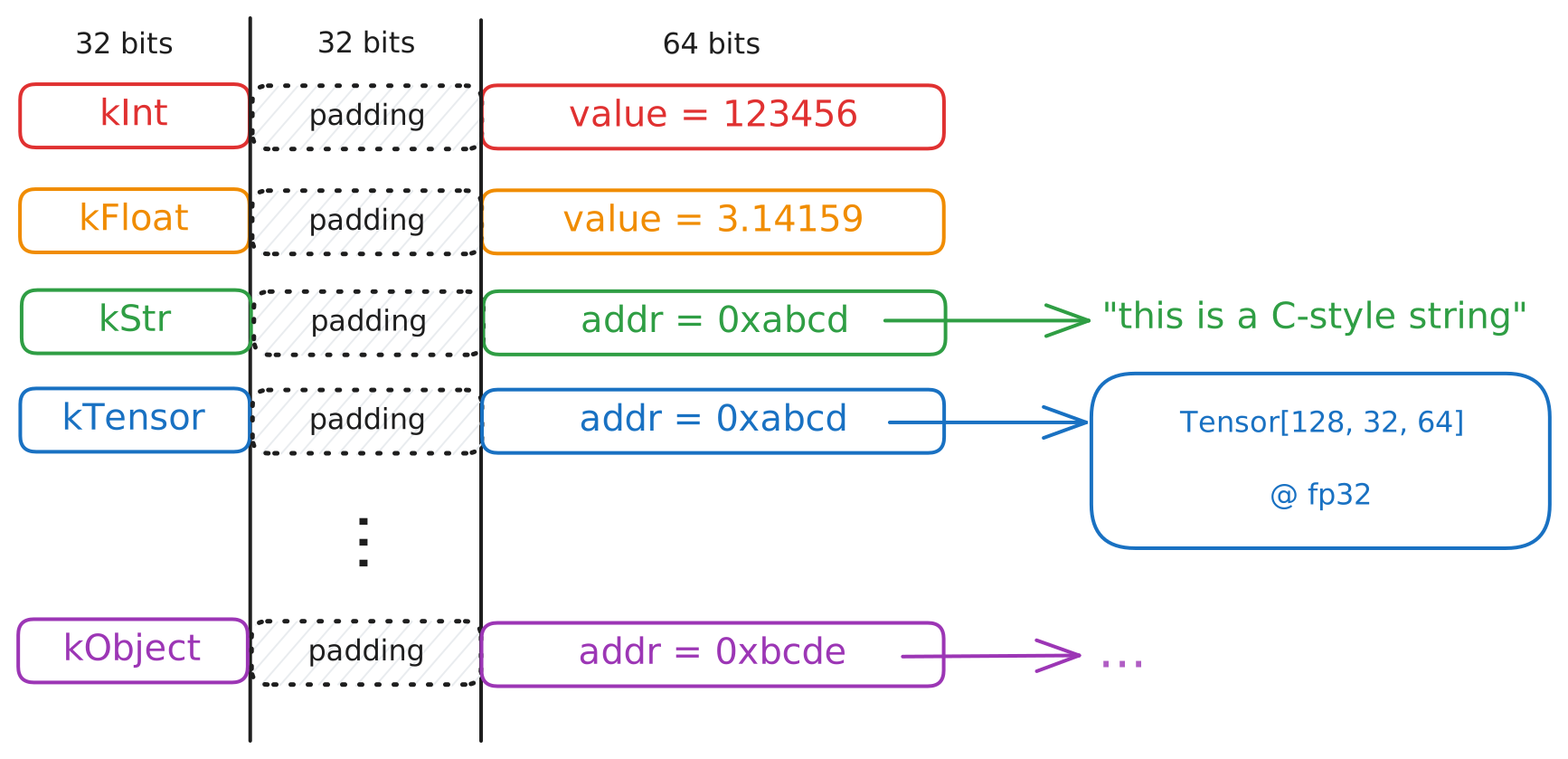
+At C ABI level, every value lives in a :cpp:class:`TVMFFIAny`:
+
+.. code-block:: cpp
+
+   typedef struct TVMFFIAny {
+     int32_t type_index;      // Bytes 0-3: identifies the stored type
+     union {
+       uint32_t zero_padding; // Bytes 4-7: must be zero (or small_str_len)
+       uint32_t small_str_len;
+     };
+     union {                  // Bytes 8-15: the actual value
+       int64_t v_int64;
+       double v_float64;
+       void* v_ptr;
+       DLDataType v_dtype;
+       DLDevice v_device;
+       TVMFFIObject* v_obj;
+       // ... other union members
+     };
+   } TVMFFIAny;
+
+
+.. tip::
+
+   Think of :cpp:class:`TVMFFIAny` as the "layout format", and
:cpp:class:`~tvm::ffi::Any`/:cpp:class:`~tvm::ffi::AnyView`
+   as a thin "application layer" that adds type safety, RAII, and ergonomic
APIs, which has no change to the layout.
+
+.. figure::
https://raw.githubusercontent.com/tlc-pack/web-data/main/images/tvm-ffi/stable-c-abi-layout-any.svg
+   :alt: Layout of the 128-bit Any tagged union
+   :align: center
+
+   Figure 1. Layout of the :cpp:class:`TVMFFIAny` tagged union in C ABI.
:cpp:class:`~tvm::ffi::Any`/:cpp:class:`~tvm::ffi::AnyView`
+   shares the same layout as :cpp:class:`TVMFFIAny`, but adds extra C++ APIs
on top of it for type safety, RAII, and ergonomics.
+
+It is effectively a layout-stable 16-byte tagged union.
+
+* The first 4 bytes (:cpp:member:`TVMFFIAny::type_index`) serve as a tag
identifying the stored type.
+* The last 8 bytes hold the actual value - either stored inline for atomic
types (e.g., ``int64_t``, ``float64``, ``void*``) or as a pointer to a
heap-allocated object.
+
+Atomic Types
+~~~~~~~~~~~~
+
+Primitive values - integers, floats, booleans, devices, and raw pointers - are
stored
+directly in the 8-byte payload with no heap allocation and no reference
counting.
+
+.. list-table:: Figure 2. Common atomic types stored directly in
:cpp:class:`TVMFFIAny`
+   :header-rows: 1
+   :name: atomic-types-table
+   :widths: 40 40 30
+
+   * - Type
+     - type_index
+     - Payload Field
+   * - ``None`` / ``nullptr``
+     - :cpp:enumerator:`kTVMFFINone <TVMFFITypeIndex::kTVMFFINone>` = 0
+     - :cpp:member:`~TVMFFIAny::v_int64` (must be 0)
+   * - ``int64_t``
+     - :cpp:enumerator:`kTVMFFIInt <TVMFFITypeIndex::kTVMFFIInt>` = 1
+     - :cpp:member:`~TVMFFIAny::v_int64`
+   * - ``bool``
+     - :cpp:enumerator:`kTVMFFIBool <TVMFFITypeIndex::kTVMFFIBool>` = 2
+     - :cpp:member:`~TVMFFIAny::v_int64` (0 or 1)
+   * - ``float64_t``
+     - :cpp:enumerator:`kTVMFFIFloat <TVMFFITypeIndex::kTVMFFIFloat>` = 3
+     - :cpp:member:`~TVMFFIAny::v_float64`
+   * - ``void*`` (opaque pointer)
+     - :cpp:enumerator:`kTVMFFIOpaquePtr <TVMFFITypeIndex::kTVMFFIOpaquePtr>`
= 4
+     - :cpp:member:`~TVMFFIAny::v_ptr`
+   * - :c:struct:`DLDataType <DLDataType>`
+     - :cpp:enumerator:`kTVMFFIDataType <TVMFFITypeIndex::kTVMFFIDataType>` = 5
+     - :cpp:member:`~TVMFFIAny::v_dtype`
+   * - :c:struct:`DLDevice <DLDevice>`
+     - :cpp:enumerator:`kTVMFFIDevice <TVMFFITypeIndex::kTVMFFIDevice>` = 6
+     - :cpp:member:`~TVMFFIAny::v_device`
+   * - :c:struct:`DLTensor* <DLTensor>`
+     - :cpp:enumerator:`kTVMFFIDLTensorPtr
<TVMFFITypeIndex::kTVMFFIDLTensorPtr>` = 7
+     - :cpp:member:`~TVMFFIAny::v_ptr`
+   * - ``const char*`` (raw string)
+     - :cpp:enumerator:`kTVMFFIRawStr <TVMFFITypeIndex::kTVMFFIRawStr>` = 8
+     - :cpp:member:`~TVMFFIAny::v_c_str`
+   * - :cpp:class:`TVMFFIByteArray* <TVMFFIByteArray>`
+     - :cpp:enumerator:`kTVMFFIByteArrayPtr
<TVMFFITypeIndex::kTVMFFIByteArrayPtr>` = 9
+     - :cpp:member:`~TVMFFIAny::v_ptr`
+
+:ref:`Figure 2 <atomic-types-table>` shows common atomic types stored in-place
inside the
+:cpp:class:`TVMFFIAny` payload.
+
+.. code-block:: cpp
+
+   AnyView int_val = 42;                   // v_int64 = 42
+   AnyView float_val = 3.14;               // v_float64 = 3.14
+   AnyView bool_val = true;                // v_int64 = 1
+   AnyView device = DLDevice{kDLCUDA, 0};  // v_device
+   DLTensor tensor;
+   AnyView view = &tensor;                 // v_ptr = &tensor
+
+Note that raw pointers like :c:struct:`DLTensor* <DLTensor>` and ``char*``
also fit here.
+These pointers carry no ownership, so the caller must ensure the pointed-to
data outlives
+the :cpp:class:`~tvm::ffi::AnyView` or :cpp:class:`~tvm::ffi::Any`.
+
+Heap-Allocated Objects
+~~~~~~~~~~~~~~~~~~~~~~
+
+.. list-table:: Figure 3. Common TVM-FFI object types stored as pointers in
:cpp:member:`TVMFFIAny::v_obj`.
+   :header-rows: 1
+   :widths: 40 40 30
+
+   * - Type
+     - type_index
+     - Payload Field
+   * - :cpp:class:`ErrorObj* <tvm::ffi::ErrorObj>`
+     - :cpp:enumerator:`kTVMFFIError <TVMFFITypeIndex::kTVMFFIError>` = 67
+     - :cpp:member:`~TVMFFIAny::v_obj`
+   * - :cpp:class:`FunctionObj* <tvm::ffi::FunctionObj>`
+     - :cpp:enumerator:`kTVMFFIFunction <TVMFFITypeIndex::kTVMFFIFunction>` =
68
+     - :cpp:member:`~TVMFFIAny::v_obj`
+   * - :cpp:class:`TensorObj* <tvm::ffi::TensorObj>`
+     - :cpp:enumerator:`kTVMFFITensor <TVMFFITypeIndex::kTVMFFITensor>` = 70
+     - :cpp:member:`~TVMFFIAny::v_obj`
+   * - :cpp:class:`ArrayObj* <tvm::ffi::ArrayObj>`
+     - :cpp:enumerator:`kTVMFFIArray <TVMFFITypeIndex::kTVMFFIArray>` = 71
+     - :cpp:member:`~TVMFFIAny::v_obj`
+   * - :cpp:class:`MapObj* <tvm::ffi::MapObj>`
+     - :cpp:enumerator:`kTVMFFIMap <TVMFFITypeIndex::kTVMFFIMap>` = 72
+     - :cpp:member:`~TVMFFIAny::v_obj`
+   * - :cpp:class:`ModuleObj* <tvm::ffi::ModuleObj>`
+     - :cpp:enumerator:`kTVMFFIModule <TVMFFITypeIndex::kTVMFFIModule>` = 73
+     - :cpp:member:`~TVMFFIAny::v_obj`
+
+
+Heap-allocated objects - :cpp:class:`~tvm::ffi::String`,
:cpp:class:`~tvm::ffi::Function`, :cpp:class:`~tvm::ffi::Tensor`,
:cpp:class:`~tvm::ffi::Array`, :cpp:class:`~tvm::ffi::Map`, and custom types -
are
+stored as pointers to reference-counted :cpp:class:`TVMFFIObject` headers:
+
+.. code-block:: cpp
+
+   ffi::String str = "hello world";
+   ffi::Any any_str = str;  // v_obj points to StringObj
+
+   // Object layout in memory:
+   // [TVMFFIObject header (24 bytes)][object-specific data]
+
+
+Caveats
+-------
+
+Small String Optimization
+~~~~~~~~~~~~~~~~~~~~~~~~~
+
+Strings and byte arrays receive special treatment: values of 7 bytes or fewer
are stored
+inline using **small string optimization**, avoiding heap allocation entirely:
+
+.. code-block:: cpp
+
+   ffi::Any small = "hello";                    // kTVMFFISmallStr, in v_bytes
+   ffi::Any large = "this is a longer string";  // kTVMFFIStr, heap allocated
+
+
+Further Reading
+---------------
+
+- **C examples**: :doc:`../get_started/stable_c_abi` demonstrates working with
:cpp:class:`TVMFFIAny` directly in C
+- **Tensor conversions**: :doc:`tensor` covers how tensors flow through
:cpp:class:`~tvm::ffi::Any` and :cpp:class:`~tvm::ffi::AnyView`
+- **Function calling**: :doc:`../guides/cpp_lang_guide` explains how functions
use :cpp:class:`~tvm::ffi::Any` for arguments and returns
diff --git a/docs/get_started/stable_c_abi.rst
b/docs/get_started/stable_c_abi.rst
index abab5c2..b8d8195 100644
--- a/docs/get_started/stable_c_abi.rst
+++ b/docs/get_started/stable_c_abi.rst
@@ -123,7 +123,7 @@ Stability and Interoperability

 **Stability.** The pure C layout and the calling convention are stable across
compiler versions and independent of host languages or frameworks.

-**Cross-language.** TVM-FFI implements this calling convention in multiple
languages (C, C++, Python, Rust, ...), enabling code written in one language—or
generated by a DSL targeting the ABI—to be called from another language.
+**Cross-language.** TVM-FFI implements this calling convention in multiple
languages (C, C++, Python, Rust, ...), enabling code written in one language -
or generated by a DSL targeting the ABI - to be called from another language.

 **Cross-framework.** TVM-FFI uses standard data structures such as
:external+data-api:doc:`DLPack tensors <design_topics/data_interchange>` to
represent arrays, so compiled functions can be used from any array framework
that implements the DLPack protocol (NumPy, PyTorch, TensorFlow, CuPy, JAX, and
others).

diff --git a/docs/guides/cpp_lang_guide.md b/docs/guides/cpp_lang_guide.md
index e5f09b7..f8ab8e5 100644
--- a/docs/guides/cpp_lang_guide.md
+++ b/docs/guides/cpp_lang_guide.md
@@ -32,6 +32,11 @@ You can find runnable code of the examples under
tests/cpp/test_example.cc.

 ## Any and AnyView

+```{seealso}
+For a deep dive into Any including memory layout, ownership semantics, and the
type conversion
+machinery, see {doc}`../concepts/any`.
+```
+
 `Any` and `AnyView` are the foundation of tvm-ffi, providing
 ways to store values that are compatible with the ffi system.
 The following example shows how we can interact with Any and AnyView.
diff --git a/docs/index.rst b/docs/index.rst
index f6eced7..dc92c98 100644
--- a/docs/index.rst
+++ b/docs/index.rst
@@ -59,6 +59,7 @@ Table of Contents
    :caption: Concepts

    concepts/abi_overview.md
+   concepts/any.rst
    concepts/tensor.rst

 .. toctree::
diff --git a/python/tvm_ffi/dataclasses/c_class.py
b/python/tvm_ffi/dataclasses/c_class.py
index 8c2706b..65d7c73 100644
--- a/python/tvm_ffi/dataclasses/c_class.py
+++ b/python/tvm_ffi/dataclasses/c_class.py
@@ -55,7 +55,7 @@ def c_class(
     The intent is to offer a familiar dataclass authoring experience while
still
     exposing the underlying C++ object.  The ``type_key`` of the C++ class must
     match the string passed to :func:`c_class`, and inheritance relationships
are
-    preserved—subclasses registered in C++ can subclass the Python proxy
defined
+    preserved-subclasses registered in C++ can subclass the Python proxy
defined
     for their parent.

     Parameters
diff --git a/python/tvm_ffi/dataclasses/field.py
b/python/tvm_ffi/dataclasses/field.py
index 95618cd..d10612c 100644
--- a/python/tvm_ffi/dataclasses/field.py
+++ b/python/tvm_ffi/dataclasses/field.py
@@ -32,7 +32,7 @@ class Field:
     the ``Field`` instances, records the ``default_factory`` and later replaces
     the field with a property that forwards to the underlying C++ attribute.

-    Users should not instantiate ``Field`` directly—use :func:`field` instead,
+    Users should not instantiate ``Field`` directly - use :func:`field`
instead,
     which guarantees that ``name`` and ``default_factory`` are populated in a
     way the decorator understands.
     """