hogepodge commented on a change in pull request #7917:
URL: https://github.com/apache/tvm/pull/7917#discussion_r638069401
##########
File path: cmake/libs/Libbacktrace.cmake
##########
@@ -14,14 +14,39 @@
 # KIND, either express or implied.  See the License for the
 # specific language governing permissions and limitations
 # under the License.
+
+# On MacOS, the default C compiler (/usr/bin/cc) is actually a small script
that dispatches to a
+# compiler the default SDK (usually
/Library/Developer/CommandLineTools/usr/bin/ or

Review comment:
       On MacOS, the default C compiler (/usr/bin/cc) is script that dispatches
to the compiler
   provided by the default SDK (usually
/Library/Developer/CommandLineTools/usr/bin/ or

##########
File path: cmake/libs/Libbacktrace.cmake
##########
@@ -14,14 +14,39 @@
 # KIND, either express or implied.  See the License for the
 # specific language governing permissions and limitations
 # under the License.
+
+# On MacOS, the default C compiler (/usr/bin/cc) is actually a small script
that dispatches to a
+# compiler the default SDK (usually
/Library/Developer/CommandLineTools/usr/bin/ or
+#
/Applications/Xcode.app/Contents/Developer/Toolchains/XcodeDefault.xctoolchain/usr/bin/).
 CMake
+# automatically detects what is being dispatched and uses it instead along
with all the flags it
+# needs. CMake makes this second compiler avaliable through the
CMAKE_C_COMPILER variable, but it
+# does not make the necessary flags available. This leads to configuration
errors in libbacktrace
+# because it can't find system libraries. Our solution is to detect if
CMAKE_C_COMPILER lives in
+# /Library or /Applications and switch to the default compiler instead.

Review comment:
       Our solution is to detect if CMAKE_C_COMPILER is installed in

##########
File path: docs/deploy/index.rst
##########
@@ -25,12 +25,20 @@ as well as how to integrate it with your project.

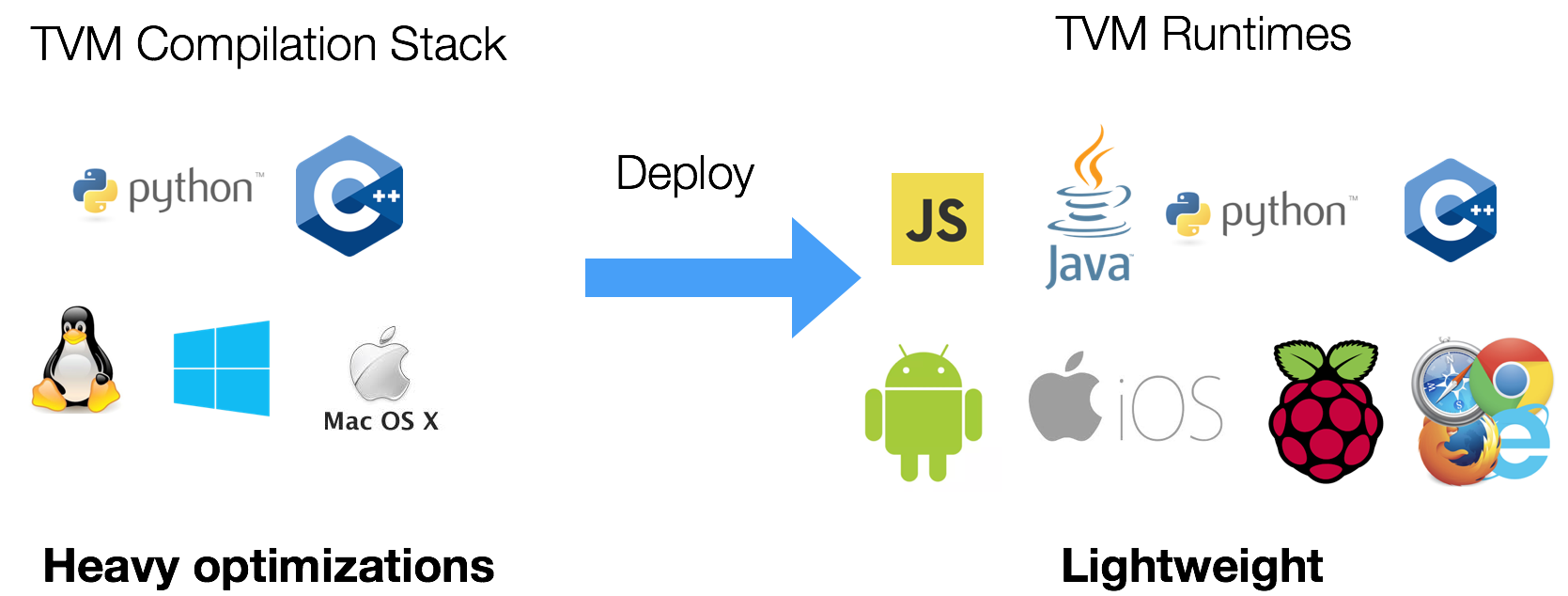
 .. image::  https://tvm.apache.org/images/release/tvm_flexible.png

+Build the TVM runtime library
+-----------------------------
+
+.. _build-tvm-runtime-on-target-device:
+
 Unlike traditional deep learning frameworks. TVM stack is divided into two
major components:

-- TVM compiler, which does all the compilation and optimizations
+- TVM compiler, which does all the compilation and optimizations of the model
 - TVM runtime, which runs on the target devices.

-In order to integrate the compiled module, we **do not** need to build entire
TVM on the target device. You only need to build the TVM compiler stack on your
desktop and use that to cross-compile modules that are deployed on the target
device.
+In order to integrate the compiled module, we **do not** need to build entire
+TVM on the target device. You only need to build the TVM compiler stack on
your

Review comment:
       we **do not** need to build the entire TVM project on the target device.
Rather, we only need to build the TVM compiler stack on a host device and use
that to cross-compile modules that can be deployed to a target device.


--
This is an automated message from the Apache Git Service.
To respond to the message, please log on to GitHub and use the
URL above to go to the specific comment.

For queries about this service, please contact Infrastructure at:
[email protected]