tqchen commented on a change in pull request #9315:
URL: https://github.com/apache/tvm/pull/9315#discussion_r734565993
##########
File path: gallery/tutorial/tensor_ir_blitz_course.py
##########
@@ -0,0 +1,183 @@
+# Licensed to the Apache Software Foundation (ASF) under one
+# or more contributor license agreements.  See the NOTICE file
+# distributed with this work for additional information
+# regarding copyright ownership.  The ASF licenses this file
+# to you under the Apache License, Version 2.0 (the
+# "License"); you may not use this file except in compliance
+# with the License.  You may obtain a copy of the License at
+#
+#   http://www.apache.org/licenses/LICENSE-2.0
+#
+# Unless required by applicable law or agreed to in writing,
+# software distributed under the License is distributed on an
+# "AS IS" BASIS, WITHOUT WARRANTIES OR CONDITIONS OF ANY
+# KIND, either express or implied.  See the License for the
+# specific language governing permissions and limitations
+# under the License.
+"""
+.. _tir_blitz:
+
+Blitz Course to TensorIR
+========================
+**Author**: `Siyuan Feng <https://github.com/Hzfengsy>`_
+
+TensorIR is a domain specific languages for deep learning programs serving two
broad purposes:
+
+- An implementation for transforming and optimizing programs on various
hardware backends.
+
+- An abstraction for automatic tensorized program optimization.
+
+"""
+
+import tvm
+from tvm.ir.module import IRModule
+from tvm.script import tir as T
+import numpy as np
+
+################################################################################################
+# IRModule
+# --------
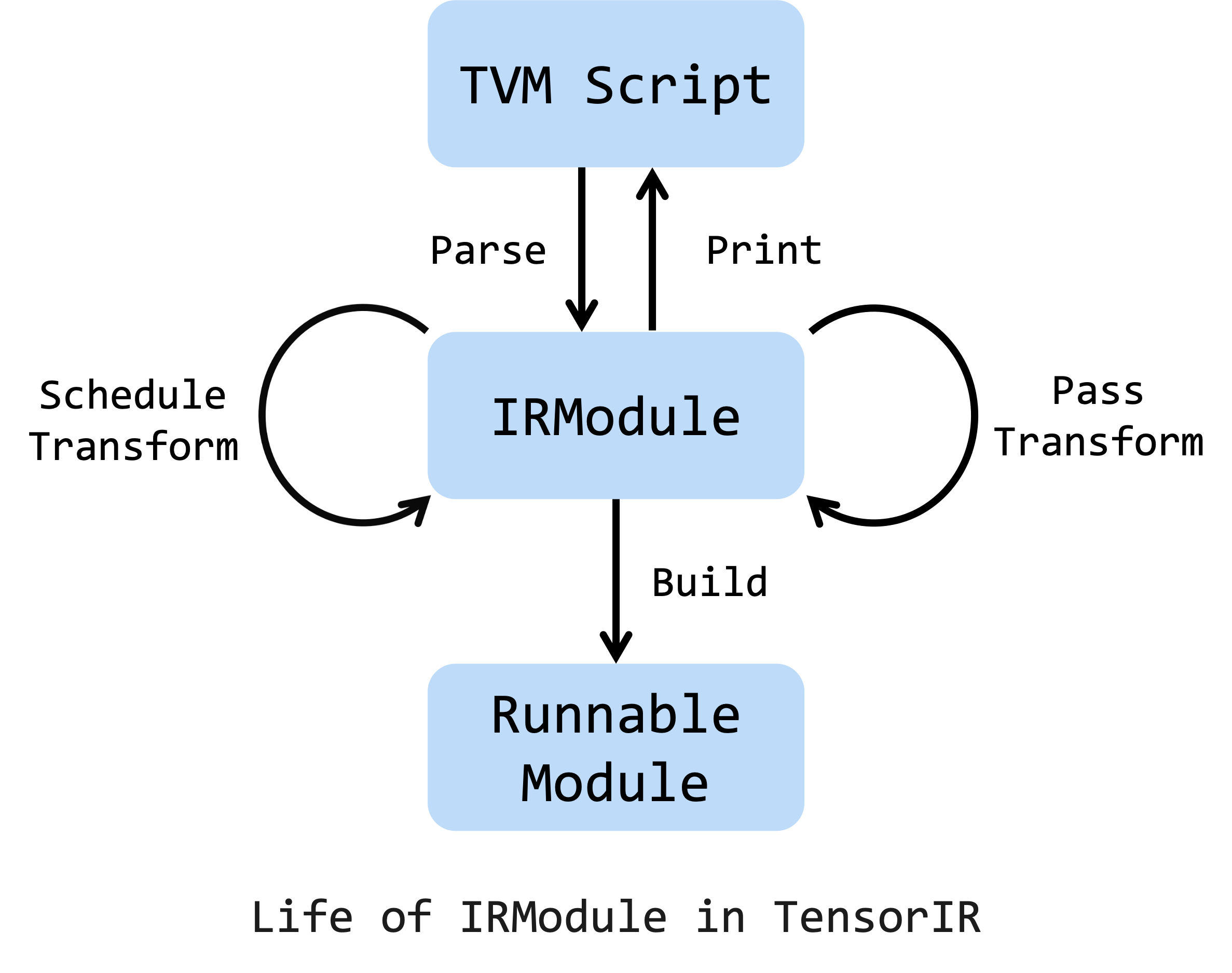
+# An IRModule is the central data structure in TVM, which contains deep
learning programs.
+# It is the basic object of interest of IR transformation and model building.
+#
+# .. image::
https://raw.githubusercontent.com/Hzfengsy/web-data/main/images/design/tvm_life_of_irmodule.png
+#    :align: center
+#    :width: 85%
+#
+# This is the life cycle of an IRModule, which can be created from TVM Script.
TensorIR schedule
+# primitives and passes are two major ways to transform an IRModule. Also, a
sequence of
+# transformations on an IRModule is acceptable. Note that we can print an
IRModule at **ANY** stage
+# to TVMScript. After all transformations and optimizations are complete, we
can build the IRModule
+# to a runnable module to deploy on target devices.
+#
+# Based on the design of TensorIR and IRModule, we are able to create a new
programming method:
+#
+# 1. Write a program by TVMScript (just like write python codes)

Review comment:
       just like python code => in an python-AST based syntax

##########
File path: gallery/tutorial/tensor_ir_blitz_course.py
##########
@@ -0,0 +1,183 @@
+# Licensed to the Apache Software Foundation (ASF) under one
+# or more contributor license agreements.  See the NOTICE file
+# distributed with this work for additional information
+# regarding copyright ownership.  The ASF licenses this file
+# to you under the Apache License, Version 2.0 (the
+# "License"); you may not use this file except in compliance
+# with the License.  You may obtain a copy of the License at
+#
+#   http://www.apache.org/licenses/LICENSE-2.0
+#
+# Unless required by applicable law or agreed to in writing,
+# software distributed under the License is distributed on an
+# "AS IS" BASIS, WITHOUT WARRANTIES OR CONDITIONS OF ANY
+# KIND, either express or implied.  See the License for the
+# specific language governing permissions and limitations
+# under the License.
+"""
+.. _tir_blitz:
+
+Blitz Course to TensorIR
+========================
+**Author**: `Siyuan Feng <https://github.com/Hzfengsy>`_
+
+TensorIR is a domain specific languages for deep learning programs serving two
broad purposes:
+
+- An implementation for transforming and optimizing programs on various
hardware backends.
+
+- An abstraction for automatic tensorized program optimization.
+
+"""
+
+import tvm
+from tvm.ir.module import IRModule
+from tvm.script import tir as T
+import numpy as np
+
+################################################################################################
+# IRModule
+# --------
+# An IRModule is the central data structure in TVM, which contains deep
learning programs.
+# It is the basic object of interest of IR transformation and model building.
+#
+# .. image::
https://raw.githubusercontent.com/Hzfengsy/web-data/main/images/design/tvm_life_of_irmodule.png
+#    :align: center
+#    :width: 85%
+#
+# This is the life cycle of an IRModule, which can be created from TVM Script.
TensorIR schedule
+# primitives and passes are two major ways to transform an IRModule. Also, a
sequence of
+# transformations on an IRModule is acceptable. Note that we can print an
IRModule at **ANY** stage
+# to TVMScript. After all transformations and optimizations are complete, we
can build the IRModule
+# to a runnable module to deploy on target devices.
+#
+# Based on the design of TensorIR and IRModule, we are able to create a new
programming method:
+#
+# 1. Write a program by TVMScript (just like write python codes)
+#
+# 2. Transform and optimize a program with python api (by schedule primitives
and passes)
+#
+# 3. Interactively inspect and try the performance (print or build at any
stage of IRModule)
+
+
+################################################################################################
+# Create an IRModule
+# ------------------
+# IRModule can be created by writing TVMScript, which is a round-trippable
syntax for TVM IR.
+#
+# Different than creating an computational expression by Tensor Expression
+# (:ref:`tutorial-tensor-expr-get-started`). TensorIR allow user to write
native programs, which
+# is similar with writing a Python program with for loops and computational
body. The new method
+# makes it possible to write complex programs and further schedule and
optimize it.
+#
+# Following is an simple example for vector addition.
+#
+
+
[email protected]_module
+class MyModule:
+    @T.prim_func
+    def main(a: T.handle, b: T.handle):
+        # We exchange data between function by handles, which are similar to
pointer.
+        T.func_attr({"global_symbol": "main", "tir.noalias": True})
+        # Create buffer from handles.
+        A = T.match_buffer(a, (8,), dtype="float32")
+        B = T.match_buffer(b, (8,), dtype="float32")
+        for i in range(8):
+            # A block is an abstraction for computation.
+            with T.block("B"):
+                # Define a spatial block iterator and bind it to value i.
+                vi = T.axis.spatial(8, i)
+                B[vi] = A[vi] + 1.0
+
+
+ir_module = MyModule
+print(type(ir_module))
+print(ir_module.script())
+
+################################################################################################
+# Besides, Tensor Expression (TE) is a really good abstraction for simple
operators. TensorIR still
+# allow users to create IRModule from TE.
+#
+
+from tvm import te
+
+A = te.placeholder((8,), dtype="float32", name="A")
+B = te.compute((8,), lambda *i: A(*i) + 1.0, name="B")
+func = te.create_prim_func([A, B])
+ir_module_1 = IRModule({"main": func})
+print(ir_module_1.script())
+
+
+################################################################################################
+# Build and Run an IRModule
+# -------------------------
+# We can build the IRModule into a runnable module with specific target
backends.
+#
+
+mod = tvm.build(ir_module, target="llvm")  # The module for CPU backends.
+print(type(mod))
+
+################################################################################################
+# Prepare the input array and output array, then run the module.
+#
+
+a = tvm.nd.array(np.arange(8).astype("float32"))
+b = tvm.nd.array(np.zeros((8,)).astype("float32"))
+mod(a, b)
+print(a)
+print(b)
+
+
+################################################################################################
+# Transform an IRModule
+# ---------------------
+# The IRModule is the central data structure for program optimization, which
can be transformed
+# by :code:`Schedule`.
+# Schedule consists of primitives. Each primitive does a simple job on IR
transformation,

Review comment:
       A schedule contains multiple primitive methods to interactively
transform the program.  Each primitive transforms the program in certain ways
to bring additional performance optimizations.

##########
File path: gallery/tutorial/tensor_ir_blitz_course.py
##########
@@ -0,0 +1,183 @@
+# Licensed to the Apache Software Foundation (ASF) under one
+# or more contributor license agreements.  See the NOTICE file
+# distributed with this work for additional information
+# regarding copyright ownership.  The ASF licenses this file
+# to you under the Apache License, Version 2.0 (the
+# "License"); you may not use this file except in compliance
+# with the License.  You may obtain a copy of the License at
+#
+#   http://www.apache.org/licenses/LICENSE-2.0
+#
+# Unless required by applicable law or agreed to in writing,
+# software distributed under the License is distributed on an
+# "AS IS" BASIS, WITHOUT WARRANTIES OR CONDITIONS OF ANY
+# KIND, either express or implied.  See the License for the
+# specific language governing permissions and limitations
+# under the License.
+"""
+.. _tir_blitz:
+
+Blitz Course to TensorIR
+========================
+**Author**: `Siyuan Feng <https://github.com/Hzfengsy>`_
+
+TensorIR is a domain specific languages for deep learning programs serving two
broad purposes:
+
+- An implementation for transforming and optimizing programs on various
hardware backends.
+
+- An abstraction for automatic tensorized program optimization.
+
+"""
+
+import tvm
+from tvm.ir.module import IRModule
+from tvm.script import tir as T
+import numpy as np
+
+################################################################################################
+# IRModule
+# --------
+# An IRModule is the central data structure in TVM, which contains deep
learning programs.
+# It is the basic object of interest of IR transformation and model building.
+#
+# .. image::
https://raw.githubusercontent.com/Hzfengsy/web-data/main/images/design/tvm_life_of_irmodule.png
+#    :align: center
+#    :width: 85%
+#
+# This is the life cycle of an IRModule, which can be created from TVM Script.
TensorIR schedule
+# primitives and passes are two major ways to transform an IRModule. Also, a
sequence of
+# transformations on an IRModule is acceptable. Note that we can print an
IRModule at **ANY** stage
+# to TVMScript. After all transformations and optimizations are complete, we
can build the IRModule
+# to a runnable module to deploy on target devices.
+#
+# Based on the design of TensorIR and IRModule, we are able to create a new
programming method:
+#
+# 1. Write a program by TVMScript (just like write python codes)
+#
+# 2. Transform and optimize a program with python api (by schedule primitives
and passes)

Review comment:
       we can safely remove `(by schedule primitives and passes)` as they are
not yet defined here.

##########
File path: gallery/tutorial/tensor_ir_blitz_course.py
##########
@@ -0,0 +1,183 @@
+# Licensed to the Apache Software Foundation (ASF) under one
+# or more contributor license agreements.  See the NOTICE file
+# distributed with this work for additional information
+# regarding copyright ownership.  The ASF licenses this file
+# to you under the Apache License, Version 2.0 (the
+# "License"); you may not use this file except in compliance
+# with the License.  You may obtain a copy of the License at
+#
+#   http://www.apache.org/licenses/LICENSE-2.0
+#
+# Unless required by applicable law or agreed to in writing,
+# software distributed under the License is distributed on an
+# "AS IS" BASIS, WITHOUT WARRANTIES OR CONDITIONS OF ANY
+# KIND, either express or implied.  See the License for the
+# specific language governing permissions and limitations
+# under the License.
+"""
+.. _tir_blitz:
+
+Blitz Course to TensorIR
+========================
+**Author**: `Siyuan Feng <https://github.com/Hzfengsy>`_
+
+TensorIR is a domain specific languages for deep learning programs serving two
broad purposes:
+
+- An implementation for transforming and optimizing programs on various
hardware backends.
+
+- An abstraction for automatic tensorized program optimization.
+
+"""
+
+import tvm
+from tvm.ir.module import IRModule
+from tvm.script import tir as T
+import numpy as np
+
+################################################################################################
+# IRModule
+# --------
+# An IRModule is the central data structure in TVM, which contains deep
learning programs.
+# It is the basic object of interest of IR transformation and model building.
+#
+# .. image::
https://raw.githubusercontent.com/Hzfengsy/web-data/main/images/design/tvm_life_of_irmodule.png
+#    :align: center
+#    :width: 85%
+#
+# This is the life cycle of an IRModule, which can be created from TVM Script.
TensorIR schedule
+# primitives and passes are two major ways to transform an IRModule. Also, a
sequence of
+# transformations on an IRModule is acceptable. Note that we can print an
IRModule at **ANY** stage
+# to TVMScript. After all transformations and optimizations are complete, we
can build the IRModule
+# to a runnable module to deploy on target devices.
+#
+# Based on the design of TensorIR and IRModule, we are able to create a new
programming method:
+#
+# 1. Write a program by TVMScript (just like write python codes)
+#
+# 2. Transform and optimize a program with python api (by schedule primitives
and passes)
+#
+# 3. Interactively inspect and try the performance (print or build at any
stage of IRModule)
+
+
+################################################################################################
+# Create an IRModule
+# ------------------
+# IRModule can be created by writing TVMScript, which is a round-trippable
syntax for TVM IR.
+#
+# Different than creating an computational expression by Tensor Expression
+# (:ref:`tutorial-tensor-expr-get-started`). TensorIR allow user to write
native programs, which
+# is similar with writing a Python program with for loops and computational
body. The new method
+# makes it possible to write complex programs and further schedule and
optimize it.
+#
+# Following is an simple example for vector addition.
+#
+
+
[email protected]_module
+class MyModule:
+    @T.prim_func
+    def main(a: T.handle, b: T.handle):
+        # We exchange data between function by handles, which are similar to
pointer.
+        T.func_attr({"global_symbol": "main", "tir.noalias": True})
+        # Create buffer from handles.
+        A = T.match_buffer(a, (8,), dtype="float32")
+        B = T.match_buffer(b, (8,), dtype="float32")
+        for i in range(8):
+            # A block is an abstraction for computation.
+            with T.block("B"):
+                # Define a spatial block iterator and bind it to value i.
+                vi = T.axis.spatial(8, i)
+                B[vi] = A[vi] + 1.0
+
+
+ir_module = MyModule
+print(type(ir_module))
+print(ir_module.script())
+
+################################################################################################
+# Besides, Tensor Expression (TE) is a really good abstraction for simple
operators. TensorIR still
+# allow users to create IRModule from TE.
+#
+
+from tvm import te
+
+A = te.placeholder((8,), dtype="float32", name="A")
+B = te.compute((8,), lambda *i: A(*i) + 1.0, name="B")
+func = te.create_prim_func([A, B])
+ir_module_1 = IRModule({"main": func})
+print(ir_module_1.script())
+
+
+################################################################################################
+# Build and Run an IRModule
+# -------------------------
+# We can build the IRModule into a runnable module with specific target
backends.
+#
+
+mod = tvm.build(ir_module, target="llvm")  # The module for CPU backends.
+print(type(mod))
+
+################################################################################################
+# Prepare the input array and output array, then run the module.
+#
+
+a = tvm.nd.array(np.arange(8).astype("float32"))
+b = tvm.nd.array(np.zeros((8,)).astype("float32"))
+mod(a, b)
+print(a)
+print(b)
+
+
+################################################################################################
+# Transform an IRModule
+# ---------------------
+# The IRModule is the central data structure for program optimization, which
can be transformed
+# by :code:`Schedule`.
+# Schedule consists of primitives. Each primitive does a simple job on IR
transformation,
+# such as loop tiling or make computation parallel.
+#
+# .. image::
https://raw.githubusercontent.com/Hzfengsy/web-data/main/images/design/tvm_tensor_ir_opt_flow.png
+#    :align: center
+#    :width: 100%
+#
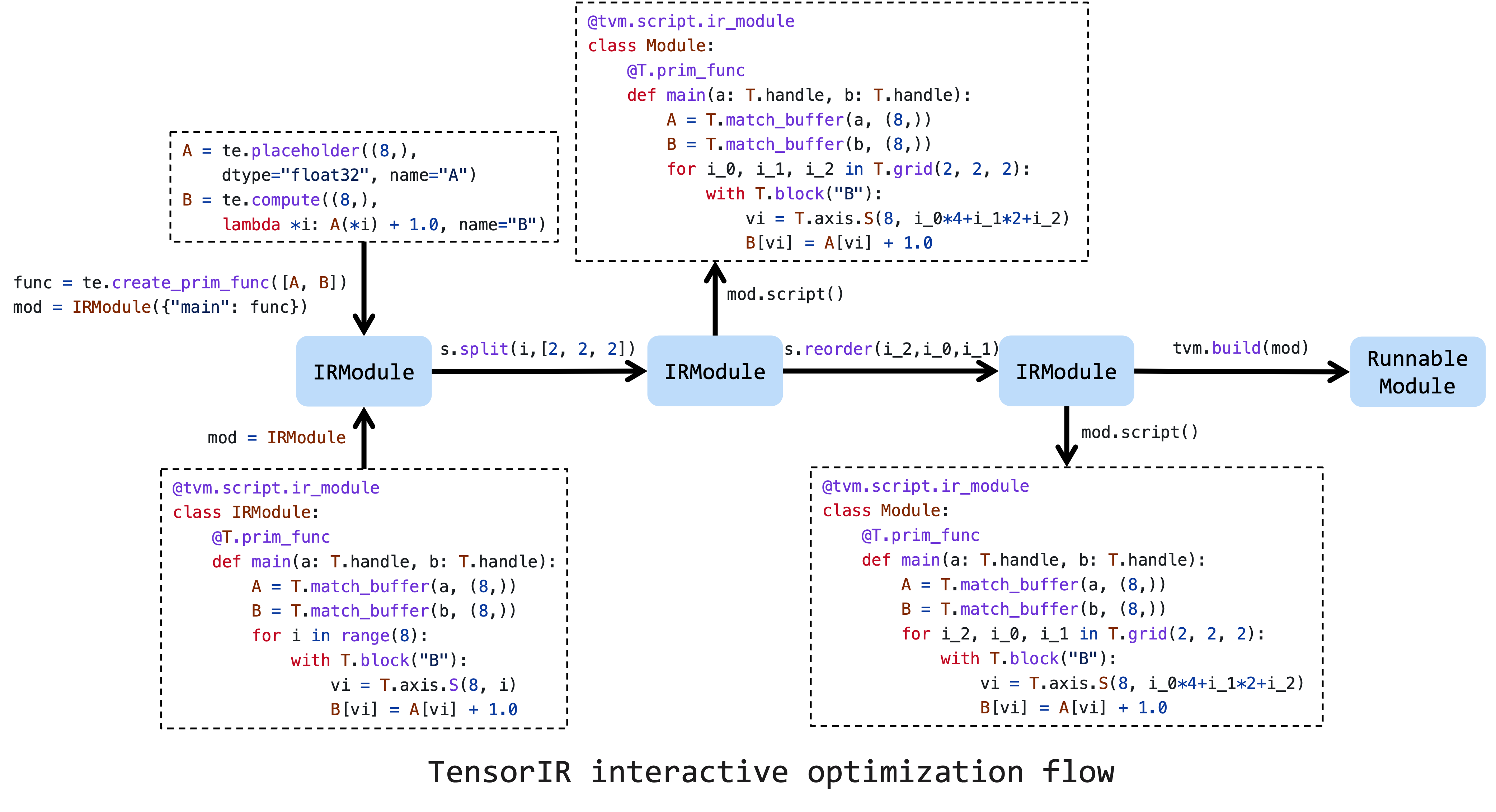
+# The image above is a typical workflow for optimization a tensor program.
First, we need to create
+# schedule on the initial IRModule created from either TVMScript or Tensor
Expression. Then, a
+# sequence of schedule primitives will help to improve the performance. And at
last, we can lower
+# and build it into a runnable module.
+#
+# Here we just demostrate a very simple tranformation. First we create
schedule on the input ir_module.
+
+sch = tvm.tir.Schedule(ir_module)
+print(type(sch))
+
+################################################################################################
+# Tile the loops 8 into 3 loops and print the result.
+
+# Get block by its name
+block_b = sch.get_block("B")
+# Get loops surronding the block
+(i,) = sch.get_loops(block_b)
+# Tile the loop nesting.
+i_0, i_1, i_2 = sch.split(i, factors=[2, 2, 2])

Review comment:
       consider also show reorder

##########
File path: gallery/tutorial/tensor_ir_blitz_course.py
##########
@@ -0,0 +1,183 @@
+# Licensed to the Apache Software Foundation (ASF) under one
+# or more contributor license agreements.  See the NOTICE file
+# distributed with this work for additional information
+# regarding copyright ownership.  The ASF licenses this file
+# to you under the Apache License, Version 2.0 (the
+# "License"); you may not use this file except in compliance
+# with the License.  You may obtain a copy of the License at
+#
+#   http://www.apache.org/licenses/LICENSE-2.0
+#
+# Unless required by applicable law or agreed to in writing,
+# software distributed under the License is distributed on an
+# "AS IS" BASIS, WITHOUT WARRANTIES OR CONDITIONS OF ANY
+# KIND, either express or implied.  See the License for the
+# specific language governing permissions and limitations
+# under the License.
+"""
+.. _tir_blitz:
+
+Blitz Course to TensorIR
+========================
+**Author**: `Siyuan Feng <https://github.com/Hzfengsy>`_
+
+TensorIR is a domain specific languages for deep learning programs serving two
broad purposes:
+
+- An implementation for transforming and optimizing programs on various
hardware backends.
+
+- An abstraction for automatic tensorized program optimization.
+
+"""
+
+import tvm
+from tvm.ir.module import IRModule
+from tvm.script import tir as T
+import numpy as np
+
+################################################################################################
+# IRModule
+# --------
+# An IRModule is the central data structure in TVM, which contains deep
learning programs.
+# It is the basic object of interest of IR transformation and model building.
+#
+# .. image::
https://raw.githubusercontent.com/Hzfengsy/web-data/main/images/design/tvm_life_of_irmodule.png
+#    :align: center
+#    :width: 85%
+#
+# This is the life cycle of an IRModule, which can be created from TVM Script.
TensorIR schedule
+# primitives and passes are two major ways to transform an IRModule. Also, a
sequence of
+# transformations on an IRModule is acceptable. Note that we can print an
IRModule at **ANY** stage
+# to TVMScript. After all transformations and optimizations are complete, we
can build the IRModule
+# to a runnable module to deploy on target devices.
+#
+# Based on the design of TensorIR and IRModule, we are able to create a new
programming method:
+#
+# 1. Write a program by TVMScript (just like write python codes)
+#
+# 2. Transform and optimize a program with python api (by schedule primitives
and passes)
+#
+# 3. Interactively inspect and try the performance (print or build at any
stage of IRModule)

Review comment:
       Interactively inspect and try the performance with an imperative style
transformation API.


--
This is an automated message from the Apache Git Service.
To respond to the message, please log on to GitHub and use the
URL above to go to the specific comment.

To unsubscribe, e-mail: [email protected]

For queries about this service, please contact Infrastructure at:
[email protected]