This is an automated email from the ASF dual-hosted git repository.

junrushao pushed a commit to branch main
in repository https://gitbox.apache.org/repos/asf/tvm-rfcs.git
The following commit(s) were added to refs/heads/main by this push:
new 87fe5f0 [RFC] SparseTIR Dialect (#100)
87fe5f0 is described below
commit 87fe5f0021d50187daa365cd048ac7f0c29e95a6
Author: Zihao Ye <[email protected]>
AuthorDate: Wed Apr 19 13:50:18 2023 -0700
[RFC] SparseTIR Dialect (#100)
This RFC proposes a plan for integrating SparseTIR as a new dialect into
TVM.
Discussion thread:
https://discuss.tvm.apache.org/t/rfc-sparsetir-as-a-new-dialect-in-tvm/14645
---
rfcs/0100-sparestir-dialect.md | 809 +++++++++++++++++++++++++++++++++++++++++
1 file changed, 809 insertions(+)
diff --git a/rfcs/0100-sparestir-dialect.md b/rfcs/0100-sparestir-dialect.md
new file mode 100644
index 0000000..0cfdeb5
--- /dev/null
+++ b/rfcs/0100-sparestir-dialect.md
@@ -0,0 +1,809 @@
+- Feature Name: SparseTIR Dialect
+- Start Date: 2023-03-31
+- RFC PR: [apache/tvm-rfcs#0100](https://github.com/apache/tvm-rfcs/pull/0100)
+- Discussion forum:
[#14645](https://discuss.tvm.apache.org/t/rfc-sparsetir-as-a-new-dialect-in-tvm/14645)
+
+# Summary
+[summary]: #summary
+
+This RFC proposes a plan for integrating SparseTIR as a new dialect into TVM.
+
+# Motivation
+[motivation]: #motivation
+
+## N0: No Sparse Support in TVM
+Many Deep Learning workloads involve sparse/varied components, e.g. Mixture of
Experts, Network Pruning, GNNs, and Sparse Conv. Currently, if users want to
write these operators in TVM, they need to compose them with IRBuilder, which
is not scalable and cannot be specified schedules.
+
+[SparseTIR](https://dl.acm.org/doi/10.1145/3582016.3582047) is our attempt at
bringing sparsity to TVM, the basic idea is to build a dialect on top of TVM's
TensorIR, and adding sparse annotations (inspired by TACO and other pioneering
works in sparse compilers) as first-class members to describe formats for
sparse tensors and sparse iterations. SparseTIR designs a multi-stage
compilation process whose frontend IR is TACO-like sparse computation
description and target IR is TensorIR:
+
+
+
+## N1: Sparsity-Aware Optimizations and Hardware-Aware Optimizations for
Sparse Operators
+A lot of optimizations and generalizations can be done under this framework.
Notably composable formats and composable transformations: we can decompose the
computation into several different formats where each one of them in different
formats (usually more hardware friendly), and optimize computation on each one
of these formats. The multi-stage design enables us to apply schedule
primitives in different stages, at both high-level (stage-I) for sparsity-aware
transformations and lower-l [...]
+
+# Guide-level Explanation
+[guide-level-explaination]: #guide-level-explaination
+
+We have the following design goals of SparseTIR:
+
+- G0: SparseTIR is consistent with TVM's ecosystem, which means other
components of TVM stack (Relax/Relay/TOPI)
+can interact with SparseTIR smoothly, and enjoy of the benefits of SparseTIR.
+- G1: SparseTIR is expressive, which means we can express most sparse
operators in Deep Learning with SparseTIR.
+- G2: SparseTIR is performant, which means we can cover optimizations used in
Sparse CPU/GPU libraries.
+
+We will outline the detailed design in the next section.
+
+# Reference-level explanation
+[reference-level-explanation]: #reference-level-explanation
+
+This section outlines the design of SparseTIR, and its interaction with
existing components in TVM.
+
+## D0: Programming Interface
+
+A generic SparseTIR program looks like the following, the workload is
Sampled-Dense-Dense-Matrix-Multiplication (SDDMM):
+
+```python
[email protected]_func
+def sddmm(
+ a: T.handle,
+ b: T.handle,
+ x: T.handle,
+ y: T.handle,
+ indptr: T.handle,
+ indices: T.handle,
+ m: T.int32,
+ n: T.int32,
+ feat_size: T.int32,
+ nnz: T.int32,
+) -> None:
+ T.func_attr({"global_symbol": "main", "tir.noalias": True,
"sparse_tir_level": 2})
+ # sparse iterators
+ I = T.sp.dense_fixed(m)
+ J = T.sp.compressed_varied(I, (n, nnz), (indptr, indices), "int32")
+ J_detach = T.sp.dense_fixed(n)
+ K = T.sp.dense_fixed(feat_size)
+ # sparse buffers
+ A = T.sp.match_buffer(a, (I, K), "float32")
+ B = T.sp.match_buffer(b, (J_detach, K), "float32")
+ X = T.sp.match_buffer(x, (I, J), "float32")
+ Y = T.sp.match_buffer(y, (I, J), "float32")
+ # sparse iterations
+ with T.sp.iteration([I, J, K], "SSR", "sddmm") as [i, j, k]:
+ with T.init():
+ Y[i, j] = 0.0
+ Y[i, j] = Y[i, j] + A[i, k] * B[j, k] * X[i, j]
+```
+
+where we have constructs like **sparse iterators**, **sparse buffers** and
**sparse iterations**.
+
+### Sparse Iterators
+Sparse iterators is a generation of per-dimensional level formats in TACO
where we annotate each dimension of a format as **dense**/**compressed** (this
dimension is stored in dense or compressed storage) and **fixed**/**varied**
(this dimension's extent is fixed or varied). For **compressed**/**varied**
iterators, we need to specify its dependent iterator.
+
+- For iterators that are **compressed**, we need to specify a `indices` array
to store the non-zero indices.
+- For iterators that are **varied**, we need to specify an `indptr` (short for
indices pointer) array to store the start offset of each fiber (a
generalization of row in multi-dimensional
[CSF](http://shaden.io/pub-files/smith2017knl.pdf) format) because the fiber
length is varied and we cannot simply compute element offset with an affine map
of indices.
+- An iterator that is both **compressed** and **varied** need to be specified
with both **indices** and **indptr** array.
+
+```python
+I = T.sp.dense_fixed(m)
+# J1 is a compressed fixed iterator, whose dependent iterator is I
+# it has maximum length n and number of non-zero elements per row: c,
+# the indices data are stored in the region started from indices_1 handle,
+# and the index data type (in indices array) is int32.
+J1 = T.sp.compressed_fixed(I, (n, c), indices_1, idtype="int32")
+# J2 is a dense varied iterator, whose dependent iterator is I,
+# it has a maximum length of n,
+# the indptr data are stored in the region started from indptr_2 handle,
+# and the index data type (in indptr array) is int32.
+J2 = T.sp.dense_varied(I, n, indptr_2, idtype="int32")
+# J3 is a compressed varied iterator, whose dependent iterator is J1,
+# it has maximum length of n1, number of elements nnz in the space composed of
(I, J1, J3),
+# the indptr data are stored in the region started from indptr_3 handle,
+# and the indices data are stored in the region started from indices_3 handle,
+# the index data type (of indptr and indices array) is "int64")
+J3 = T.sp.compressed_varied(J1, (n1, nnz), (indptr_3, indices_3),
idtype="int64")
+```
+
+### Sparse Buffer
+
+User can create sparse buffers with following APIs in SparseTIR:
+```
+A = T.sp.match_buffer(a, (I, J1), dtype="float32", scope="global")
+B = T.sp.alloc_buffer((I, j2), dtype="float32", scope="shared")
+```
+Their semantics are very similar to the existing `match_buffer` and
`alloc_buffer` constructs in TensorIR, with the exception that we accept an
array of sparse iterators as shape.
+- The `T.sp.match_buffer` binds a sparse format with a handle(pointer) `a` to
the start of a user-specified input/output array that stores the value inside
the sparse buffer.
+- The `T.sp.alloc_buffer` create a sparse buffer without binding to input or
output and always acts as an intermediate buffer.
+
+The storage of sparse tensors in SparseTIR follows the design of [Compressed
Sparse Fiber](http://shaden.io/pub-files/smith2017knl.pdf) which is a natural
extension of CSR format to high dimensional. Note that SparseTIR decouples the
storage of `value` with auxiliary structure information such as `indptr` and
`indices`: the `value` array is bonded with sparse buffers and the `indptr` and
`indices` array is bonded to sparse iterators. Such design enables us to share
structure information [...]
+
+We can express sparse tensors stored in various formats using the **sparse
iterator** and **sparse buffer** construct:
+```python
+# ELLPack format, with number of columns per row 4
+I = T.sp.dense_fixed(m)
+J = T.sp.compressed_fixed(I, (n, 4), indices, idtype="int32")
+A = T.sp.match_buffer(a, (I, J), dtype="float32")
+```
+```python
+# 2D Ragged Tensor
+I = T.sp.dense_fixed(m)
+J = T.sp.dense_varied(I, n, indptr, idtype="int32")
+A = T.sp.match_buffer(a, (I, J), dtype="float32")
+```
+```python
+# Doubly Compressed Sparse Row (DCSR)
+O = T.sp.dense_fixed(1) # A placeholder iterator as parent of iterator I.
+I = T.sp.compressed_varied(O, (m, nnz1), (indptr_i, indices_i), idtype="int32")
+J = T.sp.compressed_varied(I, (n, nnz2), (indptr_j, indices_j), idtype="int32")
+A = T.sp.match_buffer(a, (O, I, J), dtype="float32")
+```
+```python
+# Block Compressed Sparse Row (BCSR)
+IO = T.sp.dense_fixed(mb)
+JO = T.sp.compressed_varied(IO, (nb, nnzb), (indptr, indices), idtype="int32")
+II = T.sp.dense_fixed(block_size)
+JI = T.sp.dense_fixed(block_size)
+A = T.sp.match_buffer(a, (IO, JO, II, JI), dtype="float32")
+```
+
+### Sparse Iteration
+
+To create an iteration space, SparseTIR provides a structure called **sparse
iteration**, which accepts an array of sparse iterators as input and construct
correspondingly iteration space on the product of these iterators, user can
write computations inside the body of sparse iterations:
+```python
+with T.sp.iteration([I, J, K], "SSR", "sddmm") as [i, j, k]:
+ with T.init():
+ Y[i, j] = 0.0
+ Y[i, j] = Y[i, j] + A[i, k] * B[j, k] * X[i, j]
+```
+here the `SSR` means the three iterators are `spatial` or `reduction`, which
follows the design of TensorIR. `sddmm` is the name of the sparse iteration for
reference when applying schedule primitives.
+
+## D1: Compiler Passes
+
+SparseTIR has three major compiler passes: `DecomposeFormat`,
`LowerSparseIter` and `LowerSparseBuffer`.
+
+### (Optional) Decompose Format
+
+As mentioned above, SparseTIR supports composable formats for efficiency on
heterogeneous hardware, this is achieved by an optional compiler pass called
`DecomposeFormat`.
+
+We provide a class called `FormatRewriteRule` which is a specification of a
format rewrite rule, and the pass would accept an array of `FormatRewriteRules`
and rewrites the given SparseTIR script by :
+
+```python
+# original sparsetir script before rewrite
[email protected]_func
+def csrmm(
+ a: T.handle,
+ b: T.handle,
+ c: T.handle,
+ indptr: T.handle,
+ indices: T.handle,
+ m: T.int32,
+ n: T.int32,
+ feat_size: T.int32,
+ nnz: T.int32,
+) -> None:
+ T.func_attr({"global_symbol": "main", "tir.noalias": True,
"sparse_tir_level": 2})
+ I = T.sp.dense_fixed(m)
+ J = T.sp.compressed_varied(I, (n, nnz), (indptr, indices), "int32")
+ J_detach = T.sp.dense_fixed(n)
+ K = T.sp.dense_fixed(feat_size)
+ A = T.sp.match_buffer(a, (I, J), "float32")
+ B = T.sp.match_buffer(b, (J_detach, K), "float32")
+ C = T.sp.match_buffer(c, (I, K), "float32")
+ with T.sp.iteration([I, J, K], "SRS", "csrmm") as [i, j, k]:
+ with T.init():
+ C[i, k] = 0.0
+ C[i, k] = C[i, k] + A[i, j] * B[j, k]
+
+mod = tvm.IRModule.from_expr(csrmm)
+
+# bsr format description
+def bsr(block_size: int):
+ @T.prim_func
+ def func(
+ a: T.handle,
+ indptr: T.handle,
+ indices: T.handle,
+ m: T.int32,
+ n: T.int32,
+ nnz: T.int32
+ ) -> None:
+ IO = T.sp.dense_fixed(m)
+ JO = T.sp.compressed_varied(IO, (n, nnz), (indptr, indices), "int32")
+ II = T.sp.dense_fixed(block_size)
+ JI = T.sp.dense_fixed(block_size)
+ A = T.sp.match_buffer(a, (IO, JO, II, JI), "float32")
+ pass # placeholder, indicates it's the end of the script.
+ return func
+
+# inverse index map
+def csr2bsr_inv_index_map(block_size):
+ def func(io, jo, ii, ji):
+ return io * block_size + ii, jo * block_size + ji
+
+ return func
+
+# index map
+def csr2bsr_index_map(block_size):
+ def func(i, j):
+ return i // block_size, j // block_size, i % block_size, j % block_size
+
+ return func
+
+rewrites = [] # array of format rewrite rules
+for block_size in [4, 16, 32]:
+ rewrites.append(
+ FormatRewriteRule(
+ str(block_size), # name of generated buffer.
+ bsr(block_size), # the format specification
+ ["A"], # name of the original buffer to rewrite
+ {"I": ["IO", "II"], "J": ["JO", "JI"]}, # the correspondence
between original sparse iterators and new iterators
+ csr2bsr_index_map(block_size), # the index map from the original
buffer access index to the new
+ buffer access index.
+ csr2bsr_inv_index_map(block_size), # the inverse index map from
new buffer access index to original buffer access index.
+ )
+ )
+
+# format decomposition pass
+mod = tvm.sparse.format_decompose(mod, rewrites)
+```
+
+and below is the IR script after transformation, which generates three 3
sparse iterations for data movement that copies data from the original format
to composable formats, and another 3 sparse iterations that compute on the
composable formats:
+```python
[email protected]_func
+def bsr_rewrite_with_preprocess(
+ a: T.handle,
+ b: T.handle,
+ c: T.handle,
+ indptr: T.handle,
+ indices: T.handle,
+ m: T.int32,
+ n: T.int32,
+ feat_size: T.int32,
+ nnz: T.int32,
+ a_4: T.handle,
+ indptr_4: T.handle,
+ indices_4: T.handle,
+ m_4: T.int32,
+ n_4: T.int32,
+ nnz_4: T.int32,
+ a_16: T.handle,
+ indptr_16: T.handle,
+ indices_16: T.handle,
+ m_16: T.int32,
+ n_16: T.int32,
+ nnz_16: T.int32,
+ a_32: T.handle,
+ indptr_32: T.handle,
+ indices_32: T.handle,
+ m_32: T.int32,
+ n_32: T.int32,
+ nnz_32: T.int32,
+) -> None:
+ # function attr dict
+ T.func_attr(
+ {"global_symbol": "main", "tir.noalias": True, "sparse_tir_level": 2,
"composable": 1}
+ )
+ I = T.sp.dense_fixed(m, "int32")
+ J = T.sp.compressed_varied(I, (n, nnz), (indptr, indices), "int32")
+ J_detach = T.sp.dense_fixed(n, "int32")
+ K = T.sp.dense_fixed(feat_size, "int32")
+ IO_4 = T.sp.dense_fixed(m_4, "int32")
+ JO_4 = T.sp.compressed_varied(IO_4, (n_4, nnz_4), (indptr_4, indices_4),
"int32")
+ II_4 = T.sp.dense_fixed(4, "int32")
+ JI_4 = T.sp.dense_fixed(4, "int32")
+ IO_16 = T.sp.dense_fixed(m_16, "int32")
+ JO_16 = T.sp.compressed_varied(IO_16, (n_16, nnz_16), (indptr_16,
indices_16), "int32")
+ II_16 = T.sp.dense_fixed(16, "int32")
+ JI_16 = T.sp.dense_fixed(16, "int32")
+ IO_32 = T.sp.dense_fixed(m_32, "int32")
+ JO_32 = T.sp.compressed_varied(IO_32, (n_32, nnz_32), (indptr_32,
indices_32), "int32")
+ II_32 = T.sp.dense_fixed(32, "int32")
+ JI_32 = T.sp.dense_fixed(32, "int32")
+ A = T.sp.match_buffer(a, [I, J], dtype="float32")
+ B = T.sp.match_buffer(b, [J_detach, K], dtype="float32")
+ C = T.sp.match_buffer(c, [I, K], dtype="float32")
+ A_4 = T.sp.match_buffer(a_4, [IO_4, JO_4, II_4, JI_4], dtype="float32")
+ A_16 = T.sp.match_buffer(a_16, [IO_16, JO_16, II_16, JI_16],
dtype="float32")
+ A_32 = T.sp.match_buffer(a_32, [IO_32, JO_32, II_32, JI_32],
dtype="float32")
+ # body
+ # with T.block("root")
+ with T.sp.iteration([IO_4, JO_4, II_4, JI_4], "SSSS", "rewrite_A_4") as
[io_4, jo_4, ii_4, ji_4]:
+ T.sp.iteration_attr({"preprocess": True})
+ A_4[io_4, jo_4, ii_4, ji_4] = A[io_4 * 4 + ii_4, jo_4 * 4 + ji_4]
+ with T.sp.iteration([IO_16, JO_16, II_16, JI_16], "SSSS", "rewrite_A_16")
as [
+ io_16,
+ jo_16,
+ ii_16,
+ ji_16,
+ ]:
+ T.sp.iteration_attr({"preprocess": True})
+ A_16[io_16, jo_16, ii_16, ji_16] = A[io_16 * 16 + ii_16, jo_16 * 16 +
ji_16]
+ with T.sp.iteration([IO_32, JO_32, II_32, JI_32], "SSSS", "rewrite_A_32")
as [
+ io_32,
+ jo_32,
+ ii_32,
+ ji_32,
+ ]:
+ T.sp.iteration_attr({"preprocess": True})
+ A_32[io_32, jo_32, ii_32, ji_32] = A[io_32 * 32 + ii_32, jo_32 * 32 +
ji_32]
+ with T.sp.iteration([IO_4, II_4, JO_4, JI_4, K], "SSRRS", "csrmm_4") as
[io_4, ii_4, jo_4, ji_4, k]:
+ with T.init():
+ C[io_4 * 4 + ii_4, k] = T.float32(0)
+ C[io_4 * 4 + ii_4, k] = (
+ C[io_4 * 4 + ii_4, k] + A_4[io_4, jo_4, ii_4, ji_4] * B[jo_4 * 4 +
ji_4, k]
+ )
+ with T.sp.iteration([IO_16, II_16, JO_16, JI_16, K], "SSRRS", "csrmm_16")
as [
+ io_16,
+ ii_16,
+ jo_16,
+ ji_16,
+ k,
+ ]:
+ with T.init():
+ C[io_16 * 16 + ii_16, k] = T.float32(0)
+ C[io_16 * 16 + ii_16, k] = (
+ C[io_16 * 16 + ii_16, k] + A_16[io_16, jo_16, ii_16, ji_16] *
B[jo_16 * 16 + ji_16, k]
+ )
+ with T.sp.iteration([IO_32, II_32, JO_32, JI_32, K], "SSRRS", "csrmm_32")
as [
+ io_32,
+ ii_32,
+ jo_32,
+ ji_32,
+ k,
+ ]:
+ with T.init():
+ C[io_32 * 32 + ii_32, k] = T.float32(0)
+ C[io_32 * 32 + ii_32, k] = (
+ C[io_32 * 32 + ii_32, k] + A_32[io_32, jo_32, ii_32, ji_32] *
B[jo_32 * 32 + ji_32, k]
+ )
+```
+
+This pass can help generate code with better performance if we use the "right"
composable formats. However, it introduces external data movement overhead from
the buffer in the original format to the buffer in composable formats. In most
settings where the sparse structure is stationary, we can lift the data
movement parts outside the kernel and reuse them during training/serving thus
amortizing such overhead. But there are some cases that sparse structure is
dynamic and decompose format [...]
+
+As the TVMScript in becoming more powerful, we might embed all information
required by `FormatRewriteRule` in a single
+TVMScript, and in this way we can support `FormatRewriteRule` with symbolic
shapes:
+
+```python
[email protected]_func
+def bsr(
+ a: T.handle,
+ indptr: T.handle,
+ indices: T.handle,
+ m: T.int32,
+ n: T.int32,
+ nnz: T.int32,
+ block_size: T.var("int32")
+) -> None:
+ IO = T.sp.dense_fixed(m)
+ JO = T.sp.compressed_varied(IO, (n, nnz), (indptr, indices), "int32")
+ II = T.sp.dense_fixed(block_size)
+ JI = T.sp.dense_fixed(block_size)
+ A = T.sp.match_buffer(a, (IO, JO, II, JI), "float32")
+ T.func_attr({
+ "buffer_to_rewrite": "A",
+ "iterator_map": {"I": ["IO", "II"], "J": ["JO", "JI"]}
+ "idx_map": (lambda i, j: i // block_size, j // block_size, i %
block_size, j % block_size),
+ "inv_idx_map": (lambda io, jo, ii, ji: io * block_size + ii, jo *
block_size + ji)
+ })
+ pass
+```
+
+### Sparse Iteration Lowering
+
+The transition from stage-I to stage-II is called **Sparse Iteration
Lowering** where we restructure **Sparse Iterations** in stage-I to nested
loops in stage-II (in the future we will support co-iterations generation like
in TACO), and we also change the buffer access semantics from coordinate space
in stage-I (which is data structure agnostic) to position space in stage-II
(which is aware of data structures).
+
+Below is an example of sparse iteration lowering:
+```python
+# before lowering
[email protected]_func
+def bsrmm_stage_i(
+ a: T.handle,
+ b: T.handle,
+ c: T.handle,
+ indptr: T.handle,
+ indices: T.handle,
+ nb: T.int32,
+ mb: T.int32,
+ nnzb: T.int32,
+ blk: T.int32,
+ feat_size: T.int32,
+) -> None:
+ T.func_attr({"global_symbol": "main", "tir.noalias": True,
"sparse_tir_level": 2})
+ I = T.sp.dense_fixed(nb)
+ J = T.sp.compressed_varied(I, (mb, nnzb), (indptr, indices), "int32")
+ J_detach = T.sp.dense_fixed(mb)
+ BI = T.sp.dense_fixed(blk)
+ BJ = T.sp.dense_fixed(blk)
+ F = T.sp.dense_fixed(feat_size)
+ A = T.sp.match_buffer(a, (I, J, BI, BJ), "float32")
+ B = T.sp.match_buffer(b, (J_detach, BJ, F), "float32")
+ C = T.sp.match_buffer(c, (I, BI, F), "float32")
+
+ with T.sp.iteration([I, BI, BJ, F, J], "SSRSR", "bsrmm") as [
+ i,
+ bi,
+ bj,
+ f,
+ j,
+ ]:
+ with T.init():
+ C[i, bi, f] = 0.0
+ C[i, bi, f] = C[i, bi, f] + A[i, j, bi, bj] * B[j, bj, f]
+
+# after lowering
[email protected]_func
+def bsrmm_stage_ii(
+ a: T.handle,
+ b: T.handle,
+ c: T.handle,
+ indptr: T.handle,
+ indices: T.handle,
+ nb: T.int32,
+ mb: T.int32,
+ nnzb: T.int32,
+ blk: T.int32,
+ feat_size: T.int32,
+) -> None:
+ # function attr dict
+ T.func_attr({"global_symbol": "main", "tir.noalias": True,
"sparse_tir_level": 1})
+ I = T.sp.dense_fixed(nb, idtype="int32")
+ J = T.sp.compressed_varied(I, (mb, nnzb), (indptr, indices),
idtype="int32", sorted=True)
+ J_dense = T.sp.dense_varied(I, (mb, nnzb), indptr, idtype="int32")
+ J_detach = T.sp.dense_fixed(mb, idtype="int32")
+ BI = T.sp.dense_fixed(blk, idtype="int32")
+ BJ = T.sp.dense_fixed(blk, idtype="int32")
+ F = T.sp.dense_fixed(feat_size, idtype="int32")
+ A = T.sp.match_buffer(a, [I, J, BI, BJ], dtype="float32")
+ B = T.sp.match_buffer(b, [J_detach, BJ, F], dtype="float32")
+ C = T.sp.match_buffer(c, [I, BI, F], dtype="float32")
+ J_indptr = T.sp.match_buffer(indptr, [I], dtype="int32", extra_storage=1)
+ J_indices = T.sp.match_buffer(indices, [I, J_dense], dtype="int32")
+ # body
+ # with T.block("root")
+ T.assume_buffer_domain(J_indptr, [0, nnzb])
+ T.assume_buffer_domain(J_indices, [0, mb])
+ for i, bi, bj, f in T.grid(nb, blk, blk, feat_size):
+ with T.block("bsrmm0"):
+ vi, vbi, vbj, vf = T.axis.remap("SSRS", [i, bi, bj, f])
+ T.reads(
+ J_indptr[vi : vi + 2], A[vi, 0:mb, vbi, vbj], B[0:mb, vbj,
vf], J_indices[vi, 0:mb]
+ )
+ T.writes(C[vi, vbi, vf])
+ T.block_attr({"sparse": True})
+ with T.init():
+ C[vi, vbi, vf] = T.float32(0)
+ for j in T.serial(J_indptr[vi + 1] - J_indptr[vi]):
+ with T.block("bsrmm1"):
+ vj = T.axis.reduce(mb, j)
+ T.reads(A[vi, vj, vbi, vbj], B[J_indices[vi, vj], vbj,
vf], J_indices[vi, vj])
+ T.writes(C[vi, vbi, vf])
+ T.block_attr({"sparse": True})
+ C[vi, vbi, vf] = (
+ C[vi, vbi, vf] + A[vi, vj, vbi, vbj] * B[J_indices[vi,
vj], vbj, vf]
+ )
+```
+
+Please check section 3.3 of the
[paper](https://dl.acm.org/doi/10.1145/3582016.3582047) and
[code](https://github.com/uwsampl/SparseTIR/blob/9c26e843a42700e1f236b8937fa8d2068f027004/src/tir/transforms/lower_sparse_iter.cc)
for the details of this pass.
+
+### Sparse Buffer Lowering
+
+This pass transforms stage-II IR to stage-III IR (TVM TensorIR), by removing
sparse structures (**sparse iterators** and **sparse buffers**), and flattens
varied dimensions in sparse buffers, and transforms sparse buffer access to
corresponding access to flattened dense buffer.
+
+Note that in SparseTIR [paper](https://dl.acm.org/doi/10.1145/3582016.3582047)
(see section 3.4) and [original
implementation](https://github.com/uwsampl/SparseTIR/blob/9c26e843a42700e1f236b8937fa8d2068f027004/src/tir/transforms/lower_sparse_buffer.cc),
+we flattens all dimensions thus all sparse buffers are rewritten to
1-dimensional buffer, however, this is not desirable if we still want to
+keep the high-dimensionality of buffers. So we design to flatten only the
varied dimensions in sparse buffers, and keep the fixed dimensions in their
original form.
+This change would not change the semantics of the pass, but makes stage-III
more powerful, for example we can perform `sparse_tensorize` in stage-III if
the dense dimensions are preserved.
+
+Below is the code of BSRMM function in stage-III after sparse buffer lowering:
+```python
[email protected]_func
+def bsrmm(
+ a: T.handle,
+ b: T.handle,
+ c: T.handle,
+ indptr: T.handle,
+ indices: T.handle,
+ nb: T.int32,
+ mb: T.int32,
+ nnzb: T.int32,
+ blk: T.int32,
+ feat_size: T.int32,
+) -> None:
+ # function attr dict
+ T.func_attr({"global_symbol": "main", "tir.noalias": True,
"sparse_tir_level": 0})
+ A_data = T.match_buffer(a, [nnzb, blk, blk], dtype="float32", strides=[1])
+ B_data = T.match_buffer(b, [mb, blk, feat_size], dtype="float32",
strides=[1])
+ C_data = T.match_buffer(c, [nb, blk, feat_size], dtype="float32",
strides=[1])
+ J_indptr_data = T.match_buffer(indptr, [nb + 1], dtype="int32",
strides=[1])
+ J_indices_data = T.match_buffer(indices, [nnzb], dtype="int32",
strides=[1])
+ # body
+ # with T.block("root")
+ for i, bi, bj, f in T.grid(nb, blk, blk, feat_size):
+ with T.block("bsrmm0"):
+ vi, vbi, vbj, vf = T.axis.remap("SSRS", [i, bi, bj, f])
+ T.reads(
+ J_indptr_data[0 : nb + 1],
+ A_data[0 : nnzb, 0 : blk, 0 : blk],
+ B_data[0 : mb, 0 : blk, 0 : feat_size],
+ J_indices_data[0:nnzb],
+ )
+ T.writes(C_data[vi, vbi, vf])
+ T.block_attr({"sparse": True})
+ with T.init():
+ C_data[vi, vbi, vf] = T.float32(0)
+ for j in T.serial(J_indptr_data[vi + 1] - J_indptr_data[vi]):
+ with T.block("bsrmm1"):
+ vj = T.axis.reduce(mb, j)
+ T.reads(
+ A_data[(vj + J_indptr_data[vi]), vbi, vbj],
+ B_data[J_indices_data[vj + J_indptr_data[vi]], vbj,
vf],
+ J_indices_data[vj + J_indptr_data[vi]],
+ )
+ T.writes(C_data[vi, vbi, vf])
+ T.block_attr({"sparse": True})
+ C_data[vi, vbi, vf] = (
+ C_data[vi, vbi, vf]
+ + A_data[(vj + J_indptr_data[vi]), vbi, vbj]
+ * B_data[J_indices_data[vj + J_indptr_data[vi]], vbj,
vf])
+```
+
+## D2: Schedules
+
+We allow users to apply schedule primitives at all stages (I, II, III) to
transform programs.
+
+### Stage-I Schedules
+The schedules applied at stage-I are new to TVM, we require schedule
primitives at this stage to only manipulates the 3 structures **Sparse
Iterators**, **Sparse Iterations**, and **Sparse Buffers**, and cannot generate
loops/blocks because these structures do not appear in stage-I. We currently
have the following schedules at stage-I:
+- **sparse_reorder** : reorder the iterators in sparse iterations.
+- **sparse_fuse** : fuse multiple iterators into a single one, so that we only
emit a single loop for the multi-dimensional iteration space in stage-II (this
is the same as `collapse` schedule primitive in TACO).
+- **annotate_sparse_iter** : annotate sparse iterations.
+
+We can create more schedule primitives such as `sparse_compute_at` as long as
they are dealing with stage-I structures.
+
+### Stage-II Schedules
+Stage-II IR is very similar to TensorIR except for **Sparse Iterators** and
**Sparse Buffers**, we re-use all TensorIR's schedule primitives to enable
transforming stage-II IR in SparseTIR.
+
+Slight code changes are required to make some schedule primitives recognize
sparse buffers, but in general, these changes would not break any existing
behavior.
+
+### Stage-III Schedules
+We introduce a new schedule primitive `sparse_tensorize` at stage-III to use
sparse tensor cores in NVIDIA's Ampere or later architectures.
+
+```python
+def get_mma_sp_m16n8k32_intrin(in_dtype: str, out_dtype: str):
+ def maybe_cast(v):
+ if out_dtype in ["float32", "int32"]:
+ return Cast(out_dtype, v)
+ return v
+
+ def index_map_A(i, j):
+ ...
+
+ def index_map_B(i, j):
+ ...
+
+ def index_map_C(i, j):
+ ...
+
+ @T.prim_func
+ def desc(a: T.handle, b: T.handle, c: T.handle, meta: T.handle):
+ A = T.match_buffer(
+ a,
+ (WARP_SIZE, 8),
+ in_dtype,
+ scope="warp",
+ )
+ B = T.match_buffer(
+ b,
+ (WARP_SIZE, 8),
+ in_dtype,
+ scope="warp",
+ )
+ C = T.match_buffer(
+ c,
+ (WARP_SIZE, 4),
+ out_dtype,
+ scope="warp",
+ )
+ M = T.match_buffer(
+ meta,
+ (WARP_SIZE, 8),
+ "int2",
+ scope="warp",
+ )
+ with T.block("root"):
+ T.reads(
+ C[0:WARP_SIZE, 0:4],
+ A[0:WARP_SIZE, 0:8],
+ B[0:WARP_SIZE, 0:8],
+ M[0:WARP_SIZE, 0:8]
+ )
+ T.writes(C[0:WARP_SIZE, 0:4])
+
+ for i, j, ko, ki in T.grid(16, 8, 16):
+ with T.block("C"):
+ i, j, k = T.axis.remap("SSR", [i, j, k])
+ thread_id_C, local_id_C = T.meta_var(index_map_C(i, j))
+ thread_id_A, local_id_A = T.meta_var(index_map_A(i, k))
+ thread_id_B, local_id_B = T.meta_var(index_map_B((k // 8)
* 4 + M[thread_id_A, local_id_A], j))
+
+ T.reads(
+ C[thread_id_C, local_id_C],
+ A[thread_id_A, local_id_A],
+ M[thread_id_A, local_id_A]
+ B[thread_id_B, local_id_B],
+ )
+ T.writes(C[thread_id_C, local_id_C])
+
+ C[thread_id_C, local_id_C] += maybe_cast(
+ A[thread_id_A, local_id_A]
+ ) * maybe_cast(B[thread_id_B, local_id_B])
+
+ @T.prim_func
+ def impl(a: T.handle, b: T.handle, c: T.handle, meta: T.handle):
+ A = T.match_buffer(
+ a,
+ (WARP_SIZE, 8),
+ in_dtype,
+ scope="warp",
+ )
+ B = T.match_buffer(
+ b,
+ (WARP_SIZE, 8),
+ in_dtype,
+ scope="warp",
+ )
+ C = T.match_buffer(
+ c,
+ (WARP_SIZE, 4),
+ out_dtype,
+ scope="warp",
+ )
+ M = T.match_buffer(
+ meta,
+ (WARP_SIZE, 8),
+ "int2",
+ scope="warp",
+ )
+ with T.block("root"):
+ T.reads(
+ C[0:WARP_SIZE, 0:4],
+ A[0:WARP_SIZE, 0:8],
+ B[0:WARP_SIZE, 0:8],
+ M[0:WARP_SIZE, 0:8]
+ )
+ T.writes(C[0:WARP_SIZE, 0:4])
+ tx = T.env_thread("threadIdx.x")
+ T.launch_thread(tx, WARP_SIZE)
+
+ T.evaluate(
+ T.ptx_mma_sp(
+ "m16n8k32",
+ "row",
+ "col",
+ in_dtype,
+ in_dtype,
+ out_dtype,
+ A.data,
+ A.elem_offset + tx * 8,
+ B.data,
+ B.elem_offset + tx * 8,
+ C.data,
+ C.elem_offset + tx * 4,
+ M.data,
+ M.elem_offset + tx * 8,
+ 0,
+ False,
+ )
+ )
+
+ return desc, impl
+
+# Define the tensor intrin
+TensorIntrin.register("mma_sp_m16n8k32_f16f16f32",
*get_mma_sp_m16n8k32_intrin("float16", "float32"))
+
+# Use the intrin during scheduling, sparse_tensorize will replace the blocks
that matches with the
+# sparse tensor cores descriptions with their corresponding implemenations.
+# This schedule primitive should be applied at stage-III IR (pure TensorIR),
which do not have sparse tensor constructs.
+sch.sparse_tensorize(blk, "mma_sp_m16n8k32_f16f16f32") # suppose sch is the
schedule corresponding to stage-III IR.
+```
+
+## D3: Post-Processing Passes
+
+### Horizontal Fusion
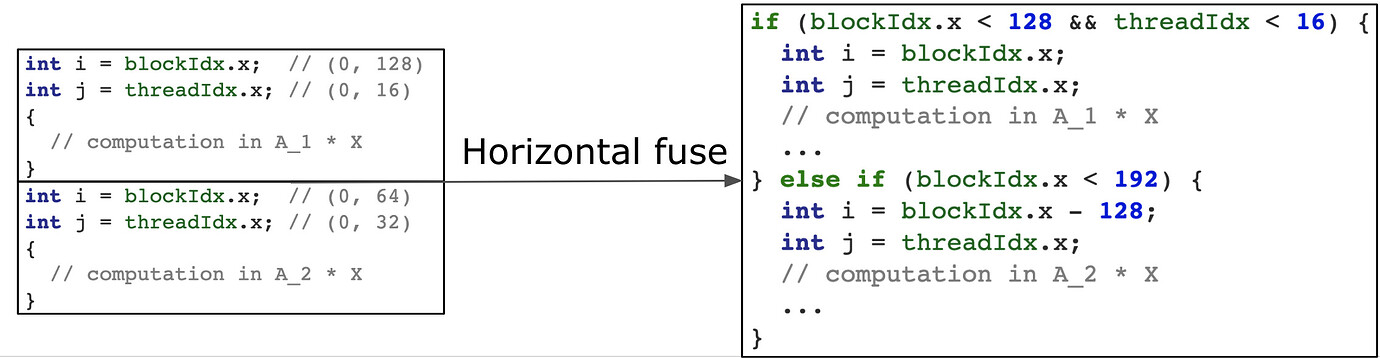
+We need a `HorizontalFusion` pass which enables us to fuse multiple CUDA
kernels horizontally (to reduce kernel launching overhead for composable
formats, on CUDA):
+
+
+
+The pass itself is not hard to implement in TVM, reference implementation can
be found
[here](https://github.com/uwsampl/SparseTIR/blob/9c26e843a42700e1f236b8937fa8d2068f027004/src/tir/transforms/horizontal_fusion.cc).
+
+### Lowering Atomic Intrinsics
+Several CTA might write into the same position because of composable formats,
and this pass would rewrite assignments to atomic add (and more general atomic
aggregation, in the future) intrinsics.
+
+## D4: Runtime classes
+
+The **Decompose Format** pass is only responsible for rewriting the IR, and we
need corresponding functions to transform the sparse matrix, currently,
SparseTIR is not capable of generating these format conversion routines
automatically, but we provide APIs for some frequently used conversions.
+
+# Drawbacks
+[drawbacks]: #drawbacks
+
+- The co-iteration of SparseTIR is not ready, and the performance of SpGEMM
kernel is not as good as other sparse compilers. Currently we are still
focusing on Sparse Workloads in Deep Learning where co-iteration is not
required,
+and supporting co-iteration is in our future plan with medium-to-high
priority.
+
+# Rationale and alternatives
+[rationale-and-alternatives]: #rationale-and-alternatives
+
+SparseTIR can help TVM support sparse workloads in Deep Learning, currently,
TVM has some sparse workloads written in `IRBuilder` and we can replace them
with SparseTIR scripts, which also enables larger schedule space as `IRBuilder`
is hard to schedule. We have evaluated many sparse Deep Learning applications
in SparseTIR and the performance is promising (see our
[examples](https://github.com/uwsampl/SparseTIR/tree/main/examples) and
[artifact evaluations](https://github.com/uwsampl/spa [...]
+
+SparseTIR's design is consistent with the spirit of [TVM
Unity](https://github.com/tqchen/tvm-rfcs/blob/main/rfcs/0091-establish-tvm-unity-connection.md),
the sparse annotations could not only exist in tensor level IR but also
computational-graph level IR (e.g. relax), where we can describe variable
lengths inputs in LLMs, mixture-of-experts and more.
+
+# Prior art
+[prior-art]: #prior-art
+
+The design of SparseTIR was inspired by
[TACO](https://github.com/tensor-compiler/taco), TACO's [format
abstraction](https://dl.acm.org/doi/pdf/10.1145/3276493)
+and TACO's [sparse iteration transformation
framework](https://dl.acm.org/doi/pdf/10.1145/3428226). However, it's not
+trivial to lower TACO's IR to TVM's IR, an alternative is to design a IR that
adopts programming interface similar to
+TACO, and lowers the IR in a more composable and progressive manner.
+
+We design a multiple-stage IR on top of TensorIR, so that we can use
high-level sparse tensor programming interface
+like TACO, while reusing the existing schedule primitives and post-processing
passes.
+
+# Unresolved questions
+[unresolved-questions]: #unresolved-questions
+
+- Currently, IntSet analysis for symbolic shapes is still weak. This
limitation is hindering the ability to compile general kernels with symbolic
shapes in SparseTIR.
+
+# Future possibilities
+[future-possibilities]: #future-possibilities
+
+- Tensor Expression(TE) and TVM Operator Inventory (TOPI) for sparse operators.
+- Exploring the potential for MetaSchedule and default schedule support for
SparseTIR.
+- Investigating the integration of sparse annotations with Relax, and the
possibility of supporting dynamic compilation of variable length kernels.
+- Designing automatic decomposing algorithms of sparse matrices into
composable formats for stationary sparse matrices.
+- Considering the feasibility of supporting lowering to co-iterations for
sparse vector union/intersection.
+- Researching ways to efficiently compile kernels for dynamic sparsity, where
the sparse structure and shape may not be known at compile time.
+
+# Phasing
+
+All of the functionalities described in this RFC has already been implemented
in [SparseTIR](https://github.com/uwsampl/sparsetir), which is a fork of TVM
from v0.9. The changes to the TVM codebase are incremental and modular. We plan
to
+integrate the proposal into TVM in the following phases:
+
+- M0: Sparse Data Structures
+ - Implement **Sparse Iterators**, **Sparse Buffers**, **Sparse Iterations**.
+ - Change the implementation of **PrimFunc** to accept **Sparse Iterators**
as its member.
+- M1: SparseTIR TVMScript Parser and Printer
+ - Implement TVMScript parser and printer for SparseTIR.
+- M2: SparseTIR schedule primitives
+ - Implement `sparse_reorder`, `sparse_fuse`, `annotate_sparse_iter`.
+- M3: Lowering passes and unit tests
+ - Implement `format_decomposition` pass, and corresponding runtime classes.
+ - Implement the `lower_sparse_iteration` pass.
+ - Implement the `lower_sparse_buffer` pass.
+- M4: Post-Processing passes
+ - Implement the `Horizontal Fusion` pass.
+ - Slight change on lowering passes orders, to enable storage rewrite after
split host/device.
+ - Implement the `Atomic Lowering` pass.
+- M5: Format conversion routine of native format decomposition rules.
+ - Implement the format conversion routine for common format decomposition
patterns.
+- M6: Sparse Tensor Cores support
+ - Implement the `sparse_tensorize` schedule primitive.
+
+
+# Differences with SparseTIR original paper
+
+Below is checklist of differences between [SparseTIR
paper](https://dl.acm.org/doi/10.1145/3582016.3582047) and this RFC.
+- Naming issue
+ - To avoid confusion with existing concepts in TensorIR and TVM, we rename
the following concepts:
+ - axis(axes) are renamed to sparse iterator(s) to avoid confusion with
TensorIR's block axis.
+ - The per-dimensional attribute "sparse" is renamed to "compressed" which
is a more precise description of underlying layout, and consistent with other
sparse compilers.
+ - The per-dimensional attribute "variable" is renamed to "varied" to avoid
confusion with TVM's variable.
+- Semantics
+ - The buffers in stage-III are not necessary 1-dimensional.
+ - The `lower_sparse_buffer` pass will only flatten the varied dimensions
instead of all dimensions.
+
+
+# Reference
+
+- [SparseTIR paper](https://dl.acm.org/doi/10.1145/3582016.3582047): the paper
describes the design of SparseTIR and performance analysis.
+- [SparseTIR repository](https://github.com/uwsampl/sparsetir): the prototype
implementation of SparseTIR.
+- [SparseTIR artifacts](https://github.com/uwsampl/sparsetir-artifact):
detailed evaluation with other compilers/libraries.
+- [Stage-I
scripts](https://gist.github.com/yzh119/a7154e2f04aae4ea77c514aa2fc891b5):
examples of SparseTIR script at stage-I.
+- [Stage-II
scripts](https://gist.github.com/yzh119/a15db56ac4bde53ac40e169f0658b46c):
examples of SparseTIR script at stage-II.
+- [Stage-III
scripts](https://gist.github.com/yzh119/eb5baacdb7b346e272cc82c043e95b16):
examples of SparseTIR script at stage-III.


