Dear Wiki user,

You have subscribed to a wiki page or wiki category on "Hadoop Wiki" for change
notification.
The "dineshs/DockerNetworkingForYarnApps" page has been changed by dineshs:
https://wiki.apache.org/hadoop/dineshs/DockerNetworkingForYarnApps

New page:
##master-page:HomepageReadPageTemplate
##master-date:Unknown-Date
#format wiki
#language en

= Docker Networking for Hadoop/YARN Applications =

This page summarizes the issues involved and possible approaches for the
networking portion of Hadoop-Docker interface.  Advantages of integrating
Docker into YARN and the general issues are outlined
[[dineshs/IsolatingYarnAppsInDockerContainers|here]].

In the way of some quick background (for the benefit of Docker guys who may be
unfamiliar), YARN applications consist of a set of Docker containers with one
of them running the Application Master (AM) and the rest running its tasks.
YARN resource manager (RM) launches AM which acts as the focal point for the
application.  Typically, AM starts listening on a dynamic port, launches the
task containers and passes them application configuration.  In particular, the
configuration includes the IP address and port where AM listens.  The AM
container and its task containers could be scheduled on different hosts in the
cluster based on data locality, resource availability etc.

In a multitenant cluster, applications belonging to different tenants should be
securely isolated such that tenants would not be able to snoop each others
traffic.

== Possible approaches ==

=== Expose ports (on the fly) ===

Default Docker networking based on NAT'ed interfaces doesn't work well for
inter-host container networking.  One possibility, based on mechanisms
currently supported by Docker, is to expose inbound container ports to the host
and have application components talk to one another through their respective
hosts.  The problem though is that the port on which the application master
listens on is not known when its container is created.  Since Docker only
supports exposing ports at the time of container creation, this option won't
work.  Conceivably, exposing ports on the fly can be implemented.  It requires
an API between the application and YARN/Docker to communicate the ports to be
exposed.  Even that won't help with existing YARN applications in the wild that
expect seamless connectivity among their components.

=== Connect application containers across hosts into an L2 subnet ===

[[https://raw.githubusercontent.com/dineshs-altiscale/yarn-apps-in-docker/master/pictures/net-1.png|This
 figure]] shows the network topology.  The IP address space of
[[https://github.com/dotcloud/docker/pull/6101|Docker subnet is partitioned]]
among the hosts and containers on a particular host are assigned IP address
from their partition.  The host level bridges can then be weaved together into
an L2-over-L3 Open vSwitch subnet through point-to-point GRE tunnels.

Once Docker bridges, IP ranges and the OVS layer are configured correctly, no
other coupling between YARN and Docker is necessary.  Existing and future YARN
applications would work seamlessly.

==== Isolation ====

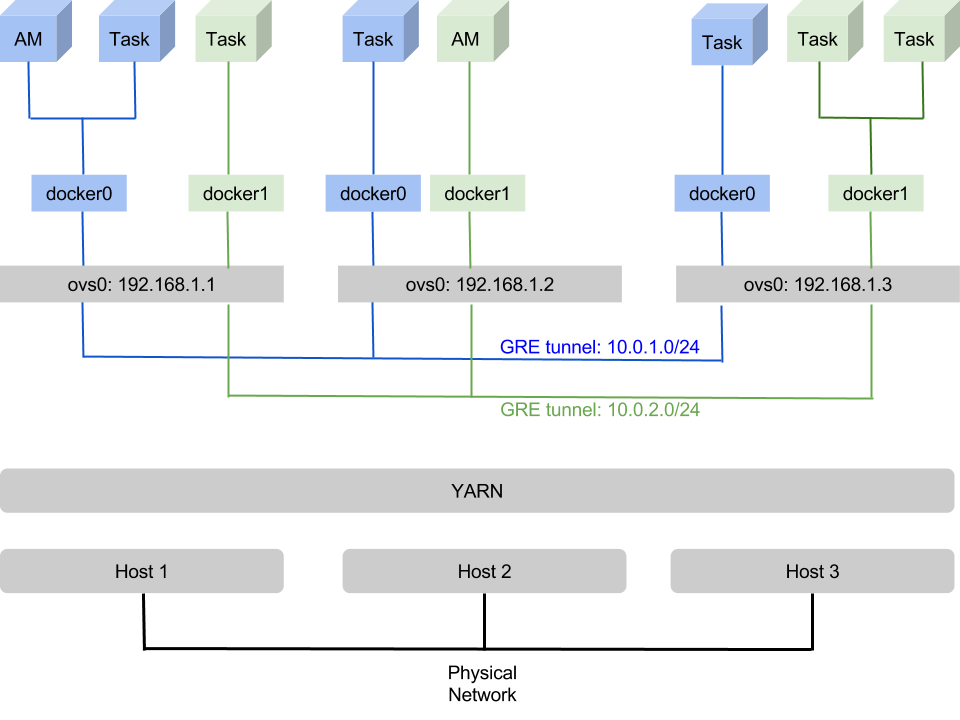
[[https://raw.githubusercontent.com/dineshs-altiscale/yarn-apps-in-docker/master/pictures/net-2.png|This
 figure]] shows how a multitenant YARN cluster might look.  Containers of each
tenant are added to a separate Docker bridge, which is connected to its peers
on other hosts through OVS tunneling to form an isolated L2 subnet.  It
requires Docker support to
[[https://github.com/dotcloud/docker/issues/6155|specify the bridge]] to which
a container should be connected.  The subrange of IP addresses used for each
bridge should be specifiable as well.

If Docker natively supports OVS bridging, that would avoid an additional hop
between the Linux bridges and the OVS bridge.