On Sat, 2008-11-22 at 17:54 +0100, "Ingo Althöfer" wrote:
> Hello Don,
>
> thx for all your answers.
> I think, I found a website where old programs
> (from the 19_80s and early 90's) are listed:
>
> http://www.septober.de/chess/index.htm#
>
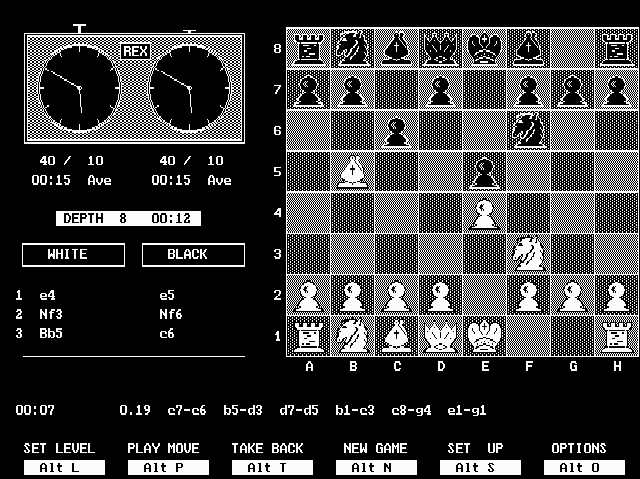
> There are also screenshots of RexChess
> http://www.septober.de/chess/pics/9102.gif
>
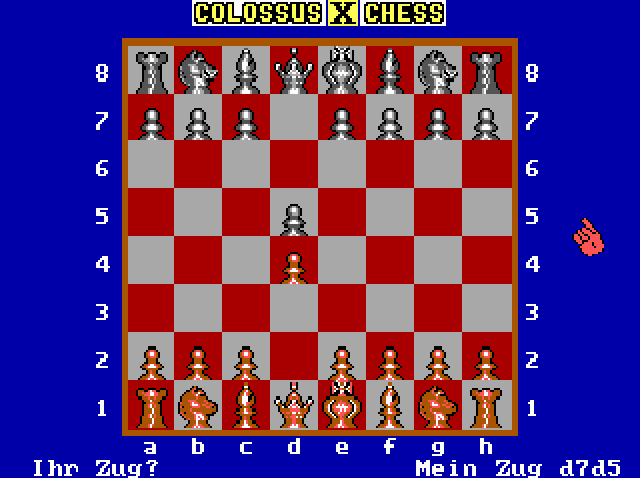
> and "Colossus X" (by Martin Bryant)
> http://www.septober.de/chess/pics/9001.gif
>
> I think, in those days Martin's programs were the
> best-sold chess software in Europe. I heard, he even
> bought a Ferrari from the money he earned with
> Colossus.
>
> **************************
> Again my wish: When you speak or write about
> software piracy in Europe (which really exists): Please,
> do not throw all regions or countries or people in one
> big pot. I have many friends in Europe who are
> honestly paying for their "games software". And some
> of them (including me) are sensible when someone writes
> (openly or between the lines) that software piracy is
> a standard in Europe.
That was not my intent.  I think software piracy is a standard in all
countries.   It's pretty much accepted practice everywhere.

I booby trapped one palm program I wrote (not Ogo).  Sure enough, within
a day or two of me putting it up on palmgear someone I know discovered a
site where you could get it for free.   Someone thought they had broken
the copy protection.   The easy way to copy protect a palm program is to
associate the palm users name (which you identify your palm with) with a
hash key.    The secret key you send them much match the hash of their
user name.

I did that, but it was a decoy.   I arranged so that there were routines
which checksumed the entire executable for a somewhat more sophisticated
test.   I did other things to obfuscate things including making the
obvious hacks look like they had succeeded and putting the test in
several places, but with different looking code.   The obvious hack
would work for a while,  long enough for the hacker to think he had
succeeded.   In short I wanted the hacker to get frustrated, thinking he
had succeeded at first, but eventually wondering if he had really found
all the traps.  He would never be 100% sure even if he got past the
first one, or second one.

I didn't do anything malicious, but if the program wasn't hacked
correctly it would crash the machine with a message proclaiming that
this was a hacked copy.   The message of course was encrypted and
hopefully difficult to find.   When the machine crashed, it would
require a reset of the machine.  Not just a reboot.

I took the hacked version and tested it to see if the hacker had
actually succeeded.   It looked like he had succeeded, but after getting
in and out of the program the required number of times, I got the
message!   Yeah!   I had embarrassed the hacker!

It's not possible of course to fool a determined hacker, no matter what
you do there is a way around it but my goal was to try to make it not
worth the hackers trouble.

- Don


>
> Best regards, Ingo
 signature.asc
Description: This is a digitally signed message part
_______________________________________________
computer-go mailing list
[email protected]
http://www.computer-go.org/mailman/listinfo/computer-go/