------------------------ Yahoo! Groups Sponsor --------------------~-->
Make a clean sweep of pop-up ads. Yahoo! Companion Toolbar.
Now with Pop-Up Blocker. Get it for free!
http://us.click.yahoo.com/L5YrjA/eSIIAA/yQLSAA/GSaulB/TM
--------------------------------------------------------------------~->
There are 24 messages in this issue.

Topics in this digest:

      1. Re: Fw: Need some help with terms: was "rhotic miscellany"
           From: "Mark J. Reed" <[EMAIL PROTECTED]>
      2. Re: Need some help with terms: was "rhotic miscellany"
           From: Sally Caves <[EMAIL PROTECTED]>
      3. Re: kinaa umtui ymi - New conlang
           From: Yann Kiraly <[EMAIL PROTECTED]>
      4. Re: Fw: Need some help with terms: was "rhotic miscellany"
           From: Sally Caves <[EMAIL PROTECTED]>
      5. Re: ANADEWISM: Natlangs that do comparison with true verbs?
           From: Philippe Caquant <[EMAIL PROTECTED]>
      6. Re: Japanese Long Consonants
           From: Chris Bates <[EMAIL PROTECTED]>
      7. LLL Weekly Update #18/2004
           From: J�rg Rhiemeier <[EMAIL PROTECTED]>
      8. Re: Need some help with terms: was "rhotic miscellany"
           From: Ray Brown <[EMAIL PROTECTED]>
      9. Re: Spelling pronunciations (was: rhotic miscellany)
           From: Ray Brown <[EMAIL PROTECTED]>
     10. Question about historical Japanese kana usage.
           From: Steven Williams <[EMAIL PROTECTED]>
     11. Re: back to "rhotic miscellany" (was:  Need some help with terms: was
"rhotic miscellany")
           From: Roger Mills <[EMAIL PROTECTED]>
     12. Re: Spelling pronunciations (was: rhotic miscellany)
           From: Steg Belsky <[EMAIL PROTECTED]>
     13. Re: Japanese Long Consonants
           From: Roger Mills <[EMAIL PROTECTED]>
     14. Re: rhotic miscellany, and a usage note
           From: "Thomas R. Wier" <[EMAIL PROTECTED]>
     15. Re: back to "rhotic miscellany" (was:  Need some help with terms: was
"rhotic miscellany")
           From: caeruleancentaur <[EMAIL PROTECTED]>
     16. Re: Need some help with terms: was "rhotic miscellany"
           From: Andreas Johansson <[EMAIL PROTECTED]>
     17. Re: ANADEWISM: Natlangs that do comparison with true verbs?
           From: Rene Uittenbogaard <[EMAIL PROTECTED]>
     18. Re: Question about historical Japanese kana usage.
           From: Muke Tever <[EMAIL PROTECTED]>
     19. Japanese question - Ii ?
           From: Rodlox <[EMAIL PROTECTED]>
     20. Re: Question about historical Japanese kana usage.
           From: Steven Williams <[EMAIL PROTECTED]>
     21. Re: Question about historical Japanese kana usage.
           From: Phil <[EMAIL PROTECTED]>
     22. Re: Japanese question - Ii ?
           From: Steven Williams <[EMAIL PROTECTED]>
     23. Re: back to "rhotic miscellany" (was:  Need some help with terms: was
"rhotic miscellany")
           From: Sally Caves <[EMAIL PROTECTED]>
     24. CXS changes
           From: Tristan Mc Leay <[EMAIL PROTECTED]>


________________________________________________________________________
________________________________________________________________________

Message: 1
   Date: Sun, 7 Nov 2004 09:32:01 -0500
   From: "Mark J. Reed" <[EMAIL PROTECTED]>
Subject: Re: Fw: Need some help with terms: was "rhotic miscellany"

Okay, it seems what Sally and I had heah was a failyuh to comyoonicate,
coupled with my personal ignorance of a once-common characterization of the
American /r/ as retroflex.  Also, there's the fact that I don't have a
convenient X-ray machine to see what the heck my own tongue is doing
when I pronounce one.

So I apologize again to Sally for the confusion and misinterpretation of
her tone, and readily accept her apologies in turn.

I think we all now understand and agree upon what the IPA means by
"retroflex", and that it is a manner of articulation masquerading as a
point of articulation because that's how it patterns (a useful
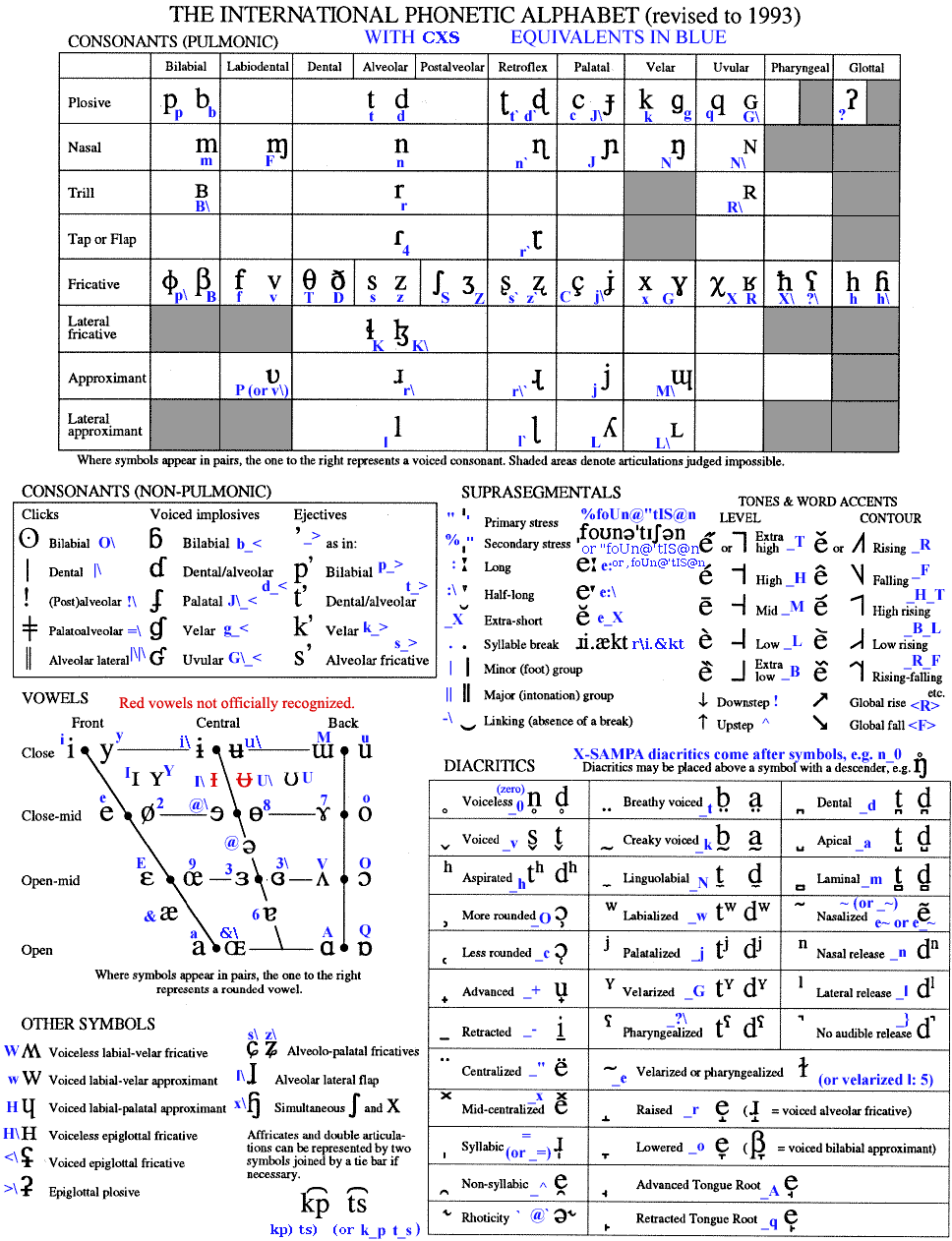
clarification; thank you).  The CXS symbol for the retroflex
approximant is [r\`], which is a direct mapping of the components of the
IPA symbol: the symbol for the dental/alveolar/postalveoloar approximant
[r\] plus the rhotic hook [`].

But AFAICT we still haven't established what the realization of /r/ in
General American English actually is, much less whether my /r/ and
Sally's /r/ differ from that or from each other.

All I can say about GAE is that I have never noticed any difference
between its /r/ and mine.  So I hereby resolve to avoid any
generalizations for the balance of this message. :)

Having now spent a frankly disturbing amount of time pronouncing /r/
with my fingers in my mouth and/or in front of a mirror with a
flashlight, I am going to do a complete 180-degree turn, withdraw my
objection, and agree that my /r/ is in fact retroflex - now that I
realize that "retroflex" is not the same as "sublaminal".  The tip of my
tongue definitely curls up.  I note that it also seems to have something
of a lateral component, in that the sides of my tongue touch the insides
of my upper teeth.

So at my /r/, and based on earlier messages in this thread,
Sally's /r/, are both apparently [r\`].  So it would not be much of a
stretch to assume that the GAE /r/ is also [r\`].  But I'm not going to
make that assumption, because I resolved above not to. :)

-Marcos


________________________________________________________________________
________________________________________________________________________

Message: 2
   Date: Sun, 7 Nov 2004 09:59:07 -0500
   From: Sally Caves <[EMAIL PROTECTED]>
Subject: Re: Need some help with terms: was "rhotic miscellany"

----- Original Message -----
From: "caeruleancentaur" <[EMAIL PROTECTED]>

Sally Caves wrote:
> >
> > Retroflectere: "to bend back."  The tongue pulls back and the tip curls
> > up
> > towards the roof of the mouth.  If we stick strictly to the meaning of
> > the
> > term itself, then I indeed do pronounce my "r"s in English
> > retroflexively,
> > and so, I imagine, do millions of other Americans.

> --- In [EMAIL PROTECTED], John Cowan <[EMAIL PROTECTED]> wrote:
>
> >But others don't.  I, for example, pronounce "r" with alveolopalatal
> >articulation: the tip of my tongue is behind but not touching my
> >lower teeth, while the blade of the tongue approximates my hard
> >palate.
>
> Finally!  A description of my "r."  I've been sitting here these past
> few days saying, "rrrrrrrrrr," & trying to figure out where my tongue
> is.  This is the description that works, only to add that the sides
> of the blade are in contact with the inside of my upper teeth.  I
> don't think I've every heard an American use a retroflex "r."
>
> Charlie

I just can't duplicate what John is describing and still pronounce "car" the
way I do it.  So there's no curling up of your tongue tip towards the roof
of your mouth?  It stays behind your lower teeth?  Is there any curling at
all, John?  When I try to duplicate that, without the curl, I get not only a
sound that changes the quality of my "a," but an "r" that sounds like "caw"
with "r-coloring,"  If I curl it, with the tongue still behind the lower
teeth, I get a deeper sounding r, but in order to make it sound right, it
still points up at the roof of my mouth.  You and I have met at Tim's house
(that was a wonderful party!).  I don't think I noticed that your "r" was
different from mine.  Maybe these distinctions are so subtle that it's hard
for others to hear it when they aren't listening for it.

I'm saying "car" now and holding it.  The back of my tongue drops down (for
the back vowel).  The sides of my tongue are half way between my upper and
lower back teeth, and the tip is turned up behind the alveolar ridge and
pointing towards the hard palate. Let's try it with a front vowel, "ear":
tongue rises in the mouth to accommodate the front vowel.  Back and sides of
the tongue are touching the back teeth.  To get the "r" ("ear" is definitely
a kind of diphthong for me), the whole tongue drops slightly, but not as far
as in "car," and tip of tongue curls up behind the alveolarpalatal region to
point at the palate.  If I raise the tip of the tongue, it touches that
tickly part of my hard palate that arches up and away from the post
alveolar.

But everybody's mouth is different.  Mine is long and narrow (which is why I
had to have such extensive orthodonture: lots of teeth yanked because of
over crowding) and the roof of my mouth  is high domed and arches up
suddenly.  Nothing gradual about it!

Maybe that's the problem. We're assigning parts to the mouth, but every
mouth is different.  I wish I could provide a diagram, but my scanner is
broken. (I used to have the plaster cast they took of my mouth to fit me
with a "retainer."  YUCK!

I do not have an unusually pronounced "r"; my accent is "generally" Eastern
seaboard, so what I think is happening here is that I don't know where the
so-called "retroflex region" is IN MY MOUTH.  I've been entrenched in
thinking that "retroflex" describes the backward tilting of the tip of the
tongue, and the direction of the point. Given that definition, what you
would hear from me, Charlie, is a retroflex "r."

I guess I'm frustrated that I don't completely grasp where these areas in my
mouth are: "post alveolar, alveolar palatal, and retroflex region.  I have
been entrenched in thinking that retroflex means the curling of the tongue
UP.  Those Americans who bend it up and back, which is what I think some of
you are describing in using the term retroflex approximant, do exist, but we
associate that "r" with certain parts of the south, or parts of the midwest.

What we need in CXS is a better representation of the variations in the
American "r."  Judging from what I've heard, these sounds have been
neglected.

amities,
Sally


________________________________________________________________________
________________________________________________________________________

Message: 3
   Date: Sun, 7 Nov 2004 09:58:15 -0500
   From: Yann Kiraly <[EMAIL PROTECTED]>
Subject: Re: kinaa umtui ymi - New conlang

Before I put my conlang online, I changed the phonology one more time, to
produce:
p b t d k g f s j m n a i o y e. The transition works like this:
t,k,s,h->f,l->g,j,m,n,ks->p,ts->b,r->d,i,a,y->o,e,u->y
This produces:

jene-a gifa-i ymty-a ag-e jene-a gifa-i-fo kya jene-a sy-e jene-a gifa-i-fy
abot-a

I-NB be-SB human-NB and-DB I-NB be-SB-FUTURE bird/angel/soul-NB but-DB I-
NB be-SB-PAST dirt-NB
I am a human and I will be a bird/angel/soul but I was dirt.

Now we also have a bigger difference between fy and fo than hy and hu.


________________________________________________________________________
________________________________________________________________________

Message: 4
   Date: Sun, 7 Nov 2004 10:07:34 -0500
   From: Sally Caves <[EMAIL PROTECTED]>
Subject: Re: Fw: Need some help with terms: was "rhotic miscellany"

LOL!!  Ha ha ha!  What a heartwarming message, Marcos, and I thank you
heartily for it!  The things this list makes us do!  (Because I too spent a
disturbing amount of time in front of the mirror, with my fingers in my
gurgling mouth, much to the annoyance of my husband.)  Apologies accepted,
and please accept mine.  I'm in the midst of a migraine.  I promise
everybody that if I do find my retainer, or the plaster cast of my mouth, I
won't take a picture of it and post it on the web.

----- Original Message -----
From: "Mark J. Reed" <[EMAIL PROTECTED]>
To: <[EMAIL PROTECTED]>
Sent: Sunday, November 07, 2004 9:32 AM
Subject: Re: Fw: Need some help with terms: was "rhotic miscellany"


> Okay, it seems what Sally and I had heah was a failyuh to comyoonicate,
> coupled with my personal ignorance of a once-common characterization of
> the
> American /r/ as retroflex.  Also, there's the fact that I don't have a
> convenient X-ray machine to see what the heck my own tongue is doing
> when I pronounce one.
>
> So I apologize again to Sally for the confusion and misinterpretation of
> her tone, and readily accept her apologies in turn.
>
> I think we all now understand and agree upon what the IPA means by
> "retroflex", and that it is a manner of articulation masquerading as a
> point of articulation because that's how it patterns (a useful
> clarification; thank you).  The CXS symbol for the retroflex
> approximant is [r\`], which is a direct mapping of the components of the
> IPA symbol: the symbol for the dental/alveolar/postalveoloar approximant
> [r\] plus the rhotic hook [`].
>
> But AFAICT we still haven't established what the realization of /r/ in
> General American English actually is, much less whether my /r/ and
> Sally's /r/ differ from that or from each other.
>
> All I can say about GAE is that I have never noticed any difference
> between its /r/ and mine.  So I hereby resolve to avoid any
> generalizations for the balance of this message. :)
>
> Having now spent a frankly disturbing amount of time pronouncing /r/
> with my fingers in my mouth and/or in front of a mirror with a
> flashlight, I am going to do a complete 180-degree turn, withdraw my
> objection, and agree that my /r/ is in fact retroflex - now that I
> realize that "retroflex" is not the same as "sublaminal".  The tip of my
> tongue definitely curls up.  I note that it also seems to have something
> of a lateral component, in that the sides of my tongue touch the insides
> of my upper teeth.
>
> So at my /r/, and based on earlier messages in this thread,
> Sally's /r/, are both apparently [r\`].  So it would not be much of a
> stretch to assume that the GAE /r/ is also [r\`].  But I'm not going to
> make that assumption, because I resolved above not to. :)
>
> -Marcos
>


________________________________________________________________________
________________________________________________________________________

Message: 5
   Date: Sun, 7 Nov 2004 16:24:56 +0100
   From: Philippe Caquant <[EMAIL PROTECTED]>
Subject: Re: ANADEWISM: Natlangs that do comparison with true verbs?

 --- Carsten Becker <[EMAIL PROTECTED]>
skrev:
> Hello!
>
> I have a problem with Ayeri in that it uses true
> verbs for the
> comparison of adjectives: "to be as ... as", "to be
> more ... as", "to be
> less ... as" etc.
> Are there any natlangs that do comparison the same
> way, where I can
> ste... get ideas from?
>
L'homme �gale le loup en f�rocit� (Man equals wolf as
far is ferocity is concerned)

L'homme l'emporte sur le loup en f�rocit� (Man is
superior to wolf as far as ferocity is concerned).
L'homme d�passe (surpasse) le loup en f�rocit� (id)

Le loup n'arrive pas � la cheville de l'homme pour la
f�rocit� (Wolf doesn't get to the level of man's
ankles for ferocity). Le loup n'atteint pas le niveau
de l'homme... etc.


=====
Philippe Caquant


Ceterum censeo *vi* esse oblitterandum (Me).


________________________________________________________________________
________________________________________________________________________

Message: 6
   Date: Sun, 7 Nov 2004 16:57:03 +0000
   From: Chris Bates <[EMAIL PROTECTED]>
Subject: Re: Japanese Long Consonants

Okay. At the moment.... the structure of each syllable is:

(C)V(C)

So a word is like:

(C)V(C)(C)V(C).....

Sorry... I'm not sure how to write it, but I was using brackets to show
that something is optional. So basically each syllable has to contain a
vowel, but both initial and coda consonants are optional. :) The
consonants that can occur in coda position are limited though: mostly
fricatives, nasals, l, r and (under the current system) the glottal
stop. I'm not sure how realistic it is allow a glottal stop as a coda
consonant but not any other stops, especially since the glottal stop
can't occur as an initial consonant (it's always coda).... I suppose I
might be able to come up with an explanation if I thought hard enough.
:)  So for instance:

d�nen
/du?nen/

is possible, but

d�snen
/du?snen/

isn't, since each syllable can have only one coda and one initial
consonant. Initially I was thinking about not counting the glottal stop
(so syllables could have a coda consonant and a glottal stop), so
"d�snen" would be legal, but so far I've decided against having any
words like that. I could change it though, since adding flexibility
doesn't make any of the words I've come up with so far illegal.
 As for sound changes involving the glottal stop... I haven't really
finished designing the proto-language, but I've already sketched some of
the glottal stop influenced sound changes that take place in the
daughter languages (again, subject to change):

Language One: Intervocalic softening (like lenition) happens, blocked by
the glottal stop. The glottal stops then disappear (I haven't decided if
this causes vowel lengthening, but I don't want it to lengthen the
consonants), giving rise to a system where the accents on the vowels
actually indicate whether the following consonant is softened or not, eg:

d�den
/duden/
duden
/duDen/

note the dental fricative in the second. Such a system could also give
rise to welsh style initial consonant mutations, although I'm still
working on arranging it properly so that I can work my way to the
changes being essentially grammatically determined. :)

Language Two: Softening doesn't occur. Glottal stops merge with
following consonants to produce long consonants. Where a glottal stop
occurs between vowels, it vanishes but the two vowels remain separate
rather than becoming a diphthong. I'm then planning a series of vowel
demolishing sound changes to produce more interesting consonant clusters
(I haven't decided what changes yet though.... possibly something along
the lines of vowel centralization similar to english followed by
dropping of @ in certain circumstances). The vowel demolishing and
consonant assimilation afterwards in this language will probably destroy
the distinctiveness of a lot of the grammatical (especially verbal)
endings, thus leading to more pronoun use and the end of the language
being pro-drop.

This is all still being planned, or subject to revision... after the
glottal stops intervocally vanish, I may then merge consecutive vowels
to give new vowel sounds like /y/ as you suggest (I think /y/ is the
right letter for the sound � isn't it?)
 BTW, so far the long and short vowels have the same quality, unlike in
English. :)

Chris.

>What actually is the syllable structure of your language? (sorry if I've
>missed a previous discussion).  Let's say:
>
>.VCV..  and ...V:Cv..
>.VCCV... (? and ..V:CCV.. -- that might sort-of violate a sort-of
>universal, but IIRC Latin, Greek and Sanskrit allowed long V before 2
>consonants, but universals are there to be violated :-) )
>
>Now, if one of the C's is /?/, there's no intrinsic reason you couldn't have
>V?V and V:?V
>V?CV and V:?CV
>
>Possible sound changes:
>
>1. Loss of /?/ after short V--
>V?V > new single V combining features of both, e.g. a?i > e, u?i > y; (in my
>Gwr, any sequence of i/u > 1) Like V would presumably > long, e.g. a?a > a:
> Many possibilities, including diphthongs.
>
>V?CV > compensatory length of V1: V:CV OR of the C: VC:V
>
>2. Loss of /?/ after long V:--
>V:?V > distinct V in separate syllables, a:?i > a(:).i etc. (If your
>language doesn't allow vowels in hiatus, then introduce a glide of some
>sort.)
>V:?CV > V:CV  or perhaps V:C:V ???
>
>Another question/possibility:  are the long V different in quality, or
>simply lengthened versions of the short V?  Perhaps /a/ = [6], /a:/ = A, /e/
>= [E], /e:/ = [e]???
>
>
>
>


________________________________________________________________________
________________________________________________________________________

Message: 7
   Date: Sun, 7 Nov 2004 18:40:59 +0100
   From: J�rg Rhiemeier <[EMAIL PROTECTED]>
Subject: LLL Weekly Update #18/2004

Hallo!

It's the first week of November, and traffic in the lostlangs mailing
list has been rather low.  Bob posted a list of Hifahoshach clothing
terms borrowed from Spanish, and Anton picked up an old thread about
closed-vocabulary schemes (and their misguidedness) again.

Greetings,

J�rg.


________________________________________________________________________
________________________________________________________________________

Message: 8
   Date: Sun, 7 Nov 2004 18:02:11 +0000
   From: Ray Brown <[EMAIL PROTECTED]>
Subject: Re: Need some help with terms: was "rhotic miscellany"

On Sunday, November 7, 2004, at 03:51 , Mark J. Reed wrote:

> On Sat, Nov 06, 2004 at 09:51:30PM -0500, Sally Caves wrote:
[snip]
>> If by a "retroflex POA" linguists mean the
>> post-alveolar-palatal, then I would prefer that term.
>
> As I understand it, "retroflex" as a POA refers to a point in between
> "postalveolar" (touched or approached by the tip of the tongue with no
> retroflexion) and "palatal" (touched or approached by the blade of the
> tongue, not the tip).

Yes, I am not sure what postalveolar-palatal would actually mean. Would it
be concerned with the tip of the tongue or the front part of the blade? I
don't know.

But whatever one likes, the IPA usage of 'retroflex' does refer to a point
of articulation with retroflex sounds produced in several different
manners of articulation, namely: plosive, nasal, fricative, flap or tap
(but not trill), approximant, lateral approximant, ejective stop.

That last one sounds interesting. I wonder what language has it?

Thinks: if there's a retroflex lateral approximant - and there is in some
Indic languages - why ain't there any retroflex lateral fricatives? (Umm -
a bit difficult to pronounce).

>  But as Ray pointed out, it is also possible to
> use "retroflex" as a modifier on sounds made with the tip of the tongue
> at other locations, although doing so can be a bit confusing.

It can indeed; and IMO it would be preferable not to use 'retroflex' this
way for that very reason. As these sounds are said to be 'rhotic' it would
be better IMO to use the term 'rhoticized'. But I suspect it is too much
to expect people to distinguish between 'rhotacized' and 'rhoticized'   :)

> [snip]
>> I find the term "retroflex r" or "retroflex approximant" to be a
>> convenient
>> and perfectly logical description of the American "r" that distinguishes
>> it
>> from other forms of "r." Since many other languages, as announced on this
>> list, have a retroflex tap, then I prefer "retroflex approximant."
>
> The American R is quite clearly an approximant of some sort; of that
> there is no question.  I don't know if it differs in POA from the
> British approximant

My British R has always been a approximant - so was the R of those I grew
up with. It's an alveolar approximant. I must say, I've never noticed any
great difference between my R and that of Americans I've met (quite a few
of them).

> (of course, British also has an allophone that is a
> tap rather than an approximant).

So texts books say - but I have rarely met people with that allophone.
=====================================================

On Sunday, November 7, 2004, at 05:50 , Steg Belsky wrote:

> On Nov 7, 2004, at 5:51 AM, Mark J. Reed wrote:
[snip]
>> Well, I don't know and can't speak to what "most people" understand in
>> this regard.  All I know is that we have historically used [r\] for the
>> American R on this list, and [r\] can in CXS refer to either a dental,
>> alveolar, or postalveolar approximant, but not a retroflex one.

It is true that [r\] is the dental/alveolar/postalveolar approximant, that
the RP Brit /r/.

[snip]

>
> I remember when it was commonly [r\`].

Yep - that's certainly the CXS for the retroflex approximant.

> I'm pretty sure that [r\] is
> just being used as a shorter, easier-to-type abbreviation.

Maybe, but.....................
============================================
On Sunday, November 7, 2004, at 06:24 , John Cowan wrote:

> Sally Caves scripsit:
[snip]
>> Retroflectere: "to bend back."  The tongue pulls back and the tip curls
>> up
>> towards the roof of the mouth.  If we stick strictly to the meaning of
>> the
>> term itself, then I indeed do pronounce my "r"s in English
>> retroflexively,
>> and so, I imagine, do millions of other Americans.
>
> But others don't.  I, for example, pronounce "r" with alveolopalatal
> articulation:

.....which I guess will not sound so very different fom my alveolar
approximant  :)

In any case, I find it difficult to believe that there would no variation
at all over such a vast area as the USA. I know dialect variation, for
various historic reasons, on our little island is higher than in the 50
states. In Britain itself, there is considerable variety in the
pronunciation of /r/ (I think examples of all rhotic approximants, taps
and trills can be found somewhere or other); I would not expect such great
variety in the US, but there must surely be some variation, as John is
pointing out.

Ray
===============================================
http://home.freeuk.com/ray.brown
[EMAIL PROTECTED]
===============================================
Anything is possible in the fabulous Celtic twilight,
which is not so much a twilight of the gods
as of the reason."      [JRRT, "English and Welsh" ]


________________________________________________________________________
________________________________________________________________________

Message: 9
   Date: Sun, 7 Nov 2004 18:02:06 +0000
   From: Ray Brown <[EMAIL PROTECTED]>
Subject: Re: Spelling pronunciations (was: rhotic miscellany)

[WAISTCOAT aka VEST]
On Sunday, November 7, 2004, at 12:56 , Paul Bennett wrote:

> On Sat, 06 Nov 2004 19:04:12 +0000, Ray Brown <[EMAIL PROTECTED]>
> wrote:
>
>> My dictionary says of the pronunciation /'wEskIt/
>
> Really with an /E/?

Yes, definitely - I've checked the dictionary. Besides JRRT spelling
hardly leaves any doubt:

Gaffer Gamgee (Sam's father) says "What's become of his weskit [sic]?
I don't hold with wearing ironmongery, whether it wears well or no."

Also, it is the dialect pronunciation I knew as a youngster. There is a
tendency in rural dialects of southern england for RP [ej] to become just
[E]. Occasionally it gets into the standard language, for example:
again /@'gejn/ or /@'gEn/ (so also with _against_)
ate /ejt/ or /Et/

Of course there's the well known _ain't_ /Ent/ (which I was certainly
familiar with) that JRRT puns with _Ent_ in LotR.

> I'd've said /'wes:k1t/ (with an ambisyllabic /s/ --

I've no doubt that there are other dialect variants. But the point I was
making is that IME the most common pronunciation now in the UK is
'waist-coat' /'[EMAIL PROTECTED]/.

===============================================

On Sunday, November 7, 2004, at 05:57 , John Cowan wrote:

> Ray Brown scripsit:
[snip]

>> Not the side of the Pond, it ain't. They are still often worn -
>> especially
>> if colorful   :)
>
> Hmm, there seems to be a semantic issue here.  MWC10 (www.m-w.com),
> which is an American dictionary, defines "waistcoat" as "1. An ornamental
> garment worn under a doublet.  2. *chiefly British* A vest."  Vests are
> certainly not obsolete.

We've given up wearing doublets long ago   :)

I've been talking all the time about 'British waistcoats', which you
LeftPondians quaintly call 'vests'. The were once (and hopefully still are)
  called 'weskits'. Over here, as I guess you know, 'vest' always means
what you call an 'undervest'
=================================================
[TORTOISE]

On Sunday, November 7, 2004, at 05:57 , John Cowan wrote:

> Ray Brown scripsit:
[snip]
>> It wasn't the first syllable I was commenting on. I imagine all dialects
>> (and ideolects) of English pronounce the syllable with or withour
>> 'rhoticity' according its normal practice. It's the second syllable I was
>> commenting on. When I was a youngster AFAIK practically everyone
>> pronounce
>> it [EMAIL PROTECTED], as they did also with 'porpoise'. But now I too often
>> hear both
>> these words pronounced as tho they rhymed with 'toys' - ach!!
>
> I've also heard a Frenchified [-wAz] in British English.

Ach!!!! How pretentious & ignorant can a person get?!

The French for _tortoise_ is in fact _tortue_ <-- late Latin _tortu:ca_

If the word have stayed as borrowed, we would still be using the French
spelling (tho not pronunciation). I think the second syllable got changed
through the influence of _porpoise_.

_porpoise_ is from Old French _porpeis_ or _porpois_ (and |oi| was *not*
pronounced [wa] then!) for earlier *porcpeis <-- Latin _porcu(m) + pisce(m)
, i.e. "hog-fish"   :)

> But my point
> was that in North America the traditional [EMAIL PROTECTED] pronuncation
> prevails.

Glad to know it. I hope the pretentious [-Ojz] does not cross the Atlantic,
  still less the ignorant pseudo-French [-wAz]!

Ray
===============================================
http://home.freeuk.com/ray.brown
[EMAIL PROTECTED]
===============================================
Anything is possible in the fabulous Celtic twilight,
which is not so much a twilight of the gods
as of the reason."      [JRRT, "English and Welsh" ]


________________________________________________________________________
________________________________________________________________________

Message: 10
   Date: Sun, 7 Nov 2004 19:31:07 +0100
   From: Steven Williams <[EMAIL PROTECTED]>
Subject: Question about historical Japanese kana usage.

In the process of learning the hira- and katakana, I
hit upon something that made me very curious indeed.
There were kana for the syllables 'we', 'wi' and 'wo'
(pronounced these days as 'o'; the other two have
simply been replaced by 'e' and 'i'), but there's no
kana for 'ye'. 'Ye' as a syllable existed in Japanese,
as in the obsolete names 'Yedo' (now 'Edo') and 'yen'
(now 'en').

How did the Japanese express the syllable 'ye'? Or did
they at all?


________________________________________________________________________
________________________________________________________________________

Message: 11
   Date: Sun, 7 Nov 2004 13:38:26 -0500
   From: Roger Mills <[EMAIL PROTECTED]>
Subject: Re: back to "rhotic miscellany" (was:  Need some help with terms: was
"rhotic miscellany")

<mounts pulpit-- it's Sunday after all>

Charlie wrote:
> > --- In [EMAIL PROTECTED], John Cowan <[EMAIL PROTECTED]> wrote:
> >
> > >But others don't.  I, for example, pronounce "r" with alveolopalatal
> > >articulation: the tip of my tongue is behind but not touching my
> > >lower teeth, while the blade of the tongue approximates my hard
> > >palate.
> >
> > Finally!  A description of my "r."  I've been sitting here these past
> > few days saying, "rrrrrrrrrr," & trying to figure out where my tongue
> > is.  This is the description that works, only to add that the sides
> > of the blade are in contact with the inside of my upper teeth.  I
> > don't think I've every heard an American use a retroflex "r."
> >
Well, close inspection and introspection are the only ways, sometimes, to
figure out what's going on in our mouths :-)) My only revision to the above
(pl.) would be to add: the tip of the tongue is in mid-air and is probably
curled up/back _to some degree_.

Is our /r/ retroflexed? Try these experiments (valid at least for Murkins):

Say "cod" or "hod"-- notice where the tongue tip ends up. Now say "card" or
"hard". Unless I miss my guess, you will see that the "d" is now articulated
noticeably further back. You will also feel, I think, that the d of cod etc.
involves more of the tongue blade, whereas the d of card is more apical
Same with "lodge" vs. "large", no? (And needless to say, same with final -t
and [-tS] words.)

Or contrast "cotter" and "Carter" or "lodger/larger"-- 2-syl. words work
better, since we tend to drawl monosyllables, leading to an intrusive [EMAIL
PROTECTED]
IMO the experiment should show that our /r/ is indeed retroflexed, in that
it shifts the POA from alveolar to post-alveolar, even if not to the hard
palate where true retroflexes are articulated.

Just for fun, if you can isolate those apical post-alv. t's and d's, try
using them in words where no r is involved. I guarawntee, it won't sound
right-- almost Indian. (One of the characteristics of Indian Engl., as Prof.
Catford liked to point out-- with a killer imitation(1)-- is their use of
retroflexed t/d in place of our alveolar ones.)
-------------------
[k&l`'k6t`6 'k4IkIt` kl6b]
--------------------------------

Not to confuse the issue, but note that [r\] (IPA inverted r) is not
precisely specified as to dental/alv/post-alv. in the chart at
http://cassowary.free.fr/Linguistics/cxschart.png -- note too that it's the
symbol used for "consonantal" (pre-vocalic) r, as in the ex. [r\i.&kt]
"react" under "Suprasegmentals". No argument there, I think.

It's post-vocalic, semi-vocalic r that's the problem.  In close phonetic
transcriptions, it is often indicated as a _modification_ of the vowel, esp.
of [EMAIL PROTECTED]/[3] (stressed/unstr. resp.), so ['[EMAIL PROTECTED],
[b3^d] "killer, bird".
Since [EMAIL PROTECTED], 3^] are unitary vowel sounds (no transitional movement
of the
tongue as in "are, ear"), it suggests that in other post-voc. environments
they're functioning as glides and producing a sort of diphthong-- just like
superscript _U and _I in e.g. [a_U, a_I]. Thus in a close phonetic
transcription of "card", perhaps we should write [EMAIL PROTECTED];  if we drawl
the word, we get almost 2-syl ['[EMAIL PROTECTED], just as drawled "cloud" will
come
out [kla.ud].  Obviously, to an audience of Engl. speakers it isn't
necessary to be that precise-- consequently the various shorthand ("broad
phonetic") variants [br\=d] (or even [br=d] though that's bad phonetics, OK
as phonemic), [kIlr\=], [kar\d].

Note that in non-rhotic dialects, [EMAIL PROTECTED] simply loses its
retroflexion but
survives as an [EMAIL PROTECTED] offglide, as in "beer" [EMAIL PROTECTED],
NYC-ese "sure, shore"
[EMAIL PROTECTED] (the vowel is actually somewhere between [U] and [o]) or
compensatory
length (Tristan's Australian [bI:], RP "court" [k_hO:t]-- quite on a par
with the dropping of the glide-[j] is Southern US, "I" [A:], "fire" [fAr\].
=======================================
Sally Caves wrote:
>
> I just can't duplicate what John is describing and still pronounce "car"
> the
> way I do it.  So there's no curling up of your tongue tip towards the roof
> of your mouth?  It stays behind your lower teeth?  Is there any curling at
> all, John?  When I try to duplicate that, without the curl, I get not only
> a
> sound that changes the quality of my "a," but an "r" that sounds like
> "caw"
> with "r-coloring,"  ...(snip) Maybe these distinctions are so subtle that
> it's hard
> for others to hear it when they aren't listening for it.

Your last sentence is the operative one :-))))
>
> I'm saying "car" now and holding it.  The back of my tongue drops down
> (for
> the back vowel).  The sides of my tongue are half way between my upper and
> lower back teeth, and the tip is turned up behind the alveolar ridge and
> pointing towards the hard palate. Let's try it with a front vowel, "ear":
> tongue rises in the mouth to accommodate the front vowel.  Back and sides
> of
> the tongue are touching the back teeth.  To get the "r" ("ear" is
> definitely
> a kind of diphthong for me), the whole tongue drops slightly, but not as
> far
> as in "car," and tip of tongue curls up behind the alveolarpalatal region
> to
> point at the palate.  If I raise the tip of the tongue, it touches that
> tickly part of my hard palate that arches up and away from the post
> alveolar.

This IMO is an entirely accurate description, and matches my own.
>
> But everybody's mouth is different.  Mine is long and narrow (which is why
> I
> had to have such extensive orthodonture: lots of teeth yanked because of
> over crowding)

Ho ho, you too, eh?

> Maybe that's the problem. We're assigning parts to the mouth, but every
> mouth is different.....(snip) > I guess I'm frustrated that I don't
> completely grasp where these areas in my
> mouth are: "post alveolar, alveolar palatal, and retroflex region.

True; from teeth to velum is a continuum; and the tongue is infinitely
mobile. Everyone's mileage differs.

>I have
> been entrenched in thinking that retroflex means the curling of the tongue
> UP.

True; but that entails some slight backing too. Cf. ____ vs. ____/

>Those Americans who bend it up and back, which is what I think some of
> you are describing in using the term retroflex approximant, do exist, but
> we
> associate that "r" with certain parts of the south, or parts of the
> midwest.

"Stage" or parodied Irish too, now that I think of it. Yes, some retroflex
more than others..........

>
> What we need in CXS is a better representation of the variations in the
> American "r."  Judging from what I've heard, these sounds have been
> neglected.
>
Sometimes I wonder if those 19th C. French/German/British phoneticians
weren't just a bit flummoxed by Engl./Amer. "r" when it came to devising the
IPA :-))))

<dismounts pulpit>


________________________________________________________________________
________________________________________________________________________

Message: 12
   Date: Sun, 7 Nov 2004 21:05:46 +0200
   From: Steg Belsky <[EMAIL PROTECTED]>
Subject: Re: Spelling pronunciations (was: rhotic miscellany)

On Nov 7, 2004, at 8:02 PM, Ray Brown wrote:
> I've been talking all the time about 'British waistcoats', which you
> LeftPondians quaintly call 'vests'. The were once (and hopefully still
> are)
>  called 'weskits'. Over here, as I guess you know, 'vest' always means
> what you call an 'undervest'
>

Undershirt. :-)


-Stephen (Steg)
  "Enthrone your pasts:
    this done, fire and old blood
    will find you again:
   better hearts' breaking
   than worlds'."
  "Dethrone the past:
    this done, day comes up new
    though empty-hearted:
   O the long silence,
   my son!"
      ~ from _the romulan way_ by diane duane & peter morwood


________________________________________________________________________
________________________________________________________________________

Message: 13
   Date: Sun, 7 Nov 2004 15:06:24 -0500
   From: Roger Mills <[EMAIL PROTECTED]>
Subject: Re: Japanese Long Consonants

Chris Bates wrote:


> Okay. At the moment.... the structure of each syllable is:
>
> (C)V(C)
>
> So a word is like:
>
> (C)V(C)(C)V(C).....
>
> Sorry... I'm not sure how to write it, but I was using brackets to show
> that something is optional.

The parens are correct.

The
> consonants that can occur in coda position are limited though: mostly
> fricatives, nasals, l, r and (under the current system) the glottal
> stop. I'm not sure how realistic it is allow a glottal stop as a coda
> consonant but not any other stops, especially since the glottal stop
> can't occur as an initial consonant (it's always coda)....

Quite reasonable and realistic IMO. The Indo. langs. I worked with allow
only nasal and /?/ as codas. (But a word like **du?en is not possible, I
assume.)  Medial clusters of ?+C could arise from earlier C1+C2, which is
indeed one of the sources of the clusters in Bugis/Makassarese et al.

(snip remaining details-- very well done, and entirely possible)


________________________________________________________________________
________________________________________________________________________

Message: 14
   Date: Sun, 7 Nov 2004 14:11:42 -0600
   From: "Thomas R. Wier" <[EMAIL PROTECTED]>
Subject: Re: rhotic miscellany, and a usage note

From:    "J. 'Mach' Wust" <[EMAIL PROTECTED]>
> On Fri, 5 Nov 2004 23:50:33 -0600, Thomas R. Wier <[EMAIL PROTECTED]> wrote:
> > From:    "J. 'Mach' Wust" <[EMAIL PROTECTED]>
> > > I don't know how the /r/ is realized in Bavarian dialects. Hitler,
> > > however, didn't have no Bavarian in his speech. He spoke just the
> > > standard media accent of his time.
> >
> > Really? I could swear I've heard recordings of him where he used
> > the alveolar tap or trill rather than the uvular trill for <r> --
> > especially in "das deutsche [rrrr]eich".
>
> So you're affirming that the alveolar tap-trill is a feature of
> Bavarian-Austrian.

Ah, I seem to have misread your original comment.  Sorry for the confusion.

==========================================================================
Thomas Wier            "I find it useful to meet my subjects personally,
Dept. of Linguistics    because our secret police don't get it right
University of Chicago   half the time." -- octogenarian Sheikh Zayed of
1010 E. 59th Street     Abu Dhabi, to a French reporter.
Chicago, IL 60637


________________________________________________________________________
________________________________________________________________________

Message: 15
   Date: Sun, 7 Nov 2004 20:52:01 -0000
   From: caeruleancentaur <[EMAIL PROTECTED]>
Subject: Re: back to "rhotic miscellany" (was:  Need some help with terms: was
"rhotic miscellany")

--- In [EMAIL PROTECTED], Roger Mills <[EMAIL PROTECTED]> wrote:

>Is our /r/ retroflexed? Try these experiments (valid at least for
>Murkins):

>Say "cod" or "hod"-- notice where the tongue tip ends up. Now
>say "card" or "hard". Unless I miss my guess, you will see that
>the "d" is now articulated noticeably further back. You will also
>feel, I think, that the d of cod etc. involves more of the tongue
>blade, whereas the d of card is more apical Same with "lodge"
>vs. "large", no? (And needless to say, same with final -t and [-tS]
>words.)

Quite right to a point.  But this time I stuck my finger in my mouth
to find the tip of my tongue.  It is definitely not retroflexed but
points straight ahead.  Yes, the "d" of "cod" is articulated a
bit "post-tip."  But the reason my "d" of "card" is articulated
farther back on the alveolus is that the "r" pulls the whole tongue
back toward my palate.  But it doesn't make make the tongue tip
retroflex.

This is fascinating!

Charlie


________________________________________________________________________
________________________________________________________________________

Message: 16
   Date: Sun, 7 Nov 2004 21:50:19 +0100
   From: Andreas Johansson <[EMAIL PROTECTED]>
Subject: Re: Need some help with terms: was "rhotic miscellany"

Quoting Ray Brown <[EMAIL PROTECTED]>:

> Thinks: if there's a retroflex lateral approximant - and there is in some
> Indic languages - why ain't there any retroflex lateral fricatives? (Umm -
> a bit difficult to pronounce).

ObMyWeirdSwedish: Certain varieties of Swedish, mine included, has a sublaminal
retroflex lateral approximant as realization of /rl/. Now, this isn't very
strange in itself, but what _is_ weird is that until a few years ago, I did not
have it, but realized /rl/ as simply [l_d]. The distinction entered my usage
quite unconsciously, and I do not know from where I acquired it, altho the
written form of these words must've helped.

I can produce sublaminal lateral fricative too, and I do not find it any harder
than your run-of-the-mill apico-alveolar lateral fric, so I would not be
surprised if it's used somewhere. The lack of an IPA sign need only mean that
no language distinguishes phonologically from apico-alveolars, and since, I
believe, both retroflex-alveolar distinctions and lateral fricatives are
relatively rare typologically, the lack of such languages might simply be due
to combinatorics.

                                                 Andreas


________________________________________________________________________
________________________________________________________________________

Message: 17
   Date: Sun, 7 Nov 2004 22:39:13 +0100
   From: Rene Uittenbogaard <[EMAIL PROTECTED]>
Subject: Re: ANADEWISM: Natlangs that do comparison with true verbs?

Philippe Caquant wrote:

 >  --- Carsten Becker skrev:
 >
 > > Hello!
 > >
 > > I have a problem with Ayeri in that it uses true
 > > verbs for the comparison of adjectives: "to be as
 > > ... as", "to be more ... as", "to be less ... as" etc.
 > > Are there any natlangs that do comparison the same
 > > way, where I can ste... get ideas from?
 > >
 >
 > L'homme �gale le loup en f�rocit� (Man equals wolf as
 > far is ferocity is concerned)
 >
 > L'homme l'emporte sur le loup en f�rocit� (Man is
 > superior to wolf as far as ferocity is concerned).
 > L'homme d�passe (surpasse) le loup en f�rocit� (id)
 >
 > Le loup n'arrive pas � la cheville de l'homme pour la
 > f�rocit� (Wolf doesn't get to the level of man's
 > ankles for ferocity). Le loup n'atteint pas le niveau
 > de l'homme... etc.

It seems there are more languages with verbs like these.
To stick with the same examples, here are the same
comparisons in Dutch:

De mens evenaart de wolf in wildheid.
Man equals wolf in ferocity. (evenaren = to equal)

De wolf overtreft de mens in wildheid.
Wolf surpasses man in ferocity. (overtreffen = to surpass)
(Deu. �bertreffen)

De mens doet onder voor de wolf in wildheid.
Man is inferior to wolf in ferocity. (onderdoen voor = to be
inferior to)

(I'm not sure about the choice of the preposition "in" in that
last English sentence; is that correct?)

And even though it's not a natlang, I really like the way in
which Lojban handles this (but I don't know it well enough to
translate "wolf" and "ferocity"):

ti barda zmadu do
this big-exceeds you
This is bigger than you.

ti barda mleca do
this big-is_less you
This is less big than you.

This is one of a few types of tanru that I find especially
appealing. :)

�ylo,

Ren�


________________________________________________________________________
________________________________________________________________________

Message: 18
   Date: Sun, 7 Nov 2004 15:12:41 -0700
   From: Muke Tever <[EMAIL PROTECTED]>
Subject: Re: Question about historical Japanese kana usage.

On Sun, 7 Nov 2004 19:31:07 +0100, Steven Williams <[EMAIL PROTECTED]> wrote:
> In the process of learning the hira- and katakana, I
> hit upon something that made me very curious indeed.
> There were kana for the syllables 'we', 'wi' and 'wo'
> (pronounced these days as 'o'; the other two have
> simply been replaced by 'e' and 'i'), but there's no
> kana for 'ye'. 'Ye' as a syllable existed in Japanese,
> as in the obsolete names 'Yedo' (now 'Edo') and 'yen'
> (now 'en').
>
> How did the Japanese express the syllable 'ye'? Or did
> they at all?

Not in kana, as "ye" disappeared from the language before hiragana and
katakana evolved:
http://www.csse.monash.edu.au/~jwb/afaq/yeyi.html

"en" apparently used to be "wen", not "yen".  "Yen" is an artifact of
an old system of Romanization that spelled "e" initially as "ye" (and,
I suspect after vowels as well, as in the surname "Inouye").
http://www.csse.monash.edu.au/~jwb/afaq/yen.html


        *Muke!
--
website:     http://frath.net/
LiveJournal: http://kohath.livejournal.com/
deviantArt:  http://kohath.deviantart.com/

FrathWiki, a conlang and conculture wiki:
http://wiki.frath.net/


________________________________________________________________________
________________________________________________________________________

Message: 19
   Date: Mon, 8 Nov 2004 00:22:37 +0200
   From: Rodlox <[EMAIL PROTECTED]>
Subject: Japanese question - Ii ?

 a while back, in a book about Japanese history, I found an unusual (well,
to me) name -

 Ii

 in Japanese, is that one sylable or two?


________________________________________________________________________
________________________________________________________________________

Message: 20
   Date: Sun, 7 Nov 2004 23:39:02 +0100
   From: Steven Williams <[EMAIL PROTECTED]>
Subject: Re: Question about historical Japanese kana usage.

 --- Muke Tever <[EMAIL PROTECTED]> skrev:
> "en" apparently used to be "wen", not "yen".  "Yen"
> is an artifact of an old system of Romanization that
> spelled "e" initially as "ye" (and, I suspect after
> vowels as well, as in the surname "Inouye").

Makes sense. Sort of like Pinyin and many other
transliteration systems for Mandarin requiring 'yi'
and 'wu' for initial [i] and [u] (according to
Omniglot). So, I suspect 'yen' is somehow
etymologically equivalent to Mandarin 'yuan' [HEn_R].
Am I right?


________________________________________________________________________
________________________________________________________________________

Message: 21
   Date: Mon, 8 Nov 2004 07:34:24 +0900
   From: Phil <[EMAIL PROTECTED]>
Subject: Re: Question about historical Japanese kana usage.

<delurk>

   I've been lurking for a while, but with no current active project,
haven't really had anything to contribute. I can field this one, though.

Steven Williams wrote:

> kana for 'ye'. 'Ye' as a syllable existed in Japanese,
> as in the obsolete names 'Yedo' (now 'Edo') and 'yen'
> (now 'en').
>
> How did the Japanese express the syllable 'ye'? Or did
> they at all?

   Actually, AFAIK, "ye" never did exist as a syllable, "yedo" was
always "edo" and "yen" was always "en".

   The "ye" bit in romanised texts is due to a misperception of the
sounds by foreigners who heard "e" as "ye" -- in actual conversation,
the transition from the preceding word to the word beginning with "e"
can make it sound, to non-Japanese ears, as though there is a "y" (is
that /j/ in CXS?) sound there.

<relurk>

Phil


________________________________________________________________________
________________________________________________________________________

Message: 22
   Date: Sun, 7 Nov 2004 23:50:42 +0100
   From: Steven Williams <[EMAIL PROTECTED]>
Subject: Re: Japanese question - Ii ?

 --- Rodlox <[EMAIL PROTECTED]> skrev:
>  a while back, in a book about Japanese history, I
> found an unusual (well, to me) name -
>
>  Ii
>
>  in Japanese, is that one sylable or two?

Japanese is not measured in syllables, but rather,
'morae' (singular, 'mora', comes from Latin, which
also worked in morae). From a syllabic perspective,
'Ii' is one syllable, but from a moraic standpoint,
it's two morae. In Japanese, a mora is composed of one
of these four things:

1. a short vowel ('a' is one mora)
2. a consonant plus a short vowel ('wa' is one mora)
3. the syllabic [n] (the word 'hanbun' has four morae,
divided as 'ha-n-bu-n')
4. the first element of a geminated consonant (the
word 'Nippon' is four morae, divided as 'Ni-p-po-n')

A consonant and long vowel takes up two morae: nyaa
is divided as 'nya-a'. Vowel clusters are counted
seperately; 'aoi' is three morae, divided as 'a-o-i'.


________________________________________________________________________
________________________________________________________________________

Message: 23
   Date: Sun, 7 Nov 2004 20:25:48 -0500
   From: Sally Caves <[EMAIL PROTECTED]>
Subject: Re: back to "rhotic miscellany" (was:  Need some help with terms: was
"rhotic miscellany")

----- Original Message -----
From: "caeruleancentaur" <[EMAIL PROTECTED]>
To: <[EMAIL PROTECTED]>
Sent: Sunday, November 07, 2004 3:52 PM
Subject: Re: back to "rhotic miscellany" (was: Need some help with terms:
was "rhotic miscellany")


> --- In [EMAIL PROTECTED], Roger Mills <[EMAIL PROTECTED]> wrote:
>
>>Is our /r/ retroflexed? Try these experiments (valid at least for
>>Murkins):
>
>>Say "cod" or "hod"-- notice where the tongue tip ends up. Now
>>say "card" or "hard". Unless I miss my guess, you will see that
>>the "d" is now articulated noticeably further back. You will also
>>feel, I think, that the d of cod etc. involves more of the tongue
>>blade, whereas the d of card is more apical Same with "lodge"
>>vs. "large", no? (And needless to say, same with final -t and [-tS]
>>words.)
>
> Quite right to a point.  But this time I stuck my finger in my mouth
> to find the tip of my tongue.  It is definitely not retroflexed but
> points straight ahead.  Yes, the "d" of "cod" is articulated a
> bit "post-tip."  But the reason my "d" of "card" is articulated
> farther back on the alveolus is that the "r" pulls the whole tongue
> back toward my palate.  But it doesn't make make the tongue tip
> retroflex.
>
> This is fascinating!
>
> Charlie

Yes it is!  If you don't mind my asking, I wonder where you're from in the
States (are you from the States?).  I was born in the midwest, was moved to
southern California when I was five, came to Upstate New York nineteen years
ago.  My maternal grandparents are southern: South Carolina and Alabama.  My
paternal grandparents were the children of German immigrants who settled in
Michigan.  My pronunciation may be more Californian than Eastern Seaboard
but my mother, who was teased mercilously for her accent when she moved to
Chicago, adopted a kind of "American radio announcer diction."  Your
description suggests to me that you pronounce your "r" ever so much more
"softly" than I do (by "soft" I mean with not so much tongue curling.  Is
there a new term we can invent for "retroflex"? :) apical flexion? so that
we can speak of various Americans [and Brits] as having more or less apical
flexion in the pronunciation of "r"?)  I'm beginning to wonder if a true
Eastern Seaboard accent includes the kind of "r" you and John describe: not
so relaxed that others hear it as an absence of "r" but not so curled as a
Chicagoan "r."

S.

Sally


________________________________________________________________________
________________________________________________________________________

Message: 24
   Date: Mon, 8 Nov 2004 12:44:40 +1100
   From: Tristan Mc Leay <[EMAIL PROTECTED]>
Subject: CXS changes

I'm back! (With a new email address---I got a domain name for my
birthday as part of my plot to take over the world; see my new webpage
at <http://thecartographers.net/>.) Have given maybe twenty minutes
total thought to conlanging, so no big news from that front. God this
has been a horrible semester. Five subjects (I'm doing a double degree).
Won't be doing that again...

Thankyou very muchly Yitzik for filling me in on the details.

My view is this:
In general, I don't like swapping things around, and I'm particularly
unhappy with two sounds so close as <j\> and <J\>. On the other hand,
<j\> and <J\> are a bit stupid as it stands... (CXS did move <&> from OE
to ae because we thought it made sense, but it was already a standard
part of CXS when I standardised it; and anyway, <}> or <{>, whichever it
was, left the scene so it wasn't a swap anyway...)

Now, codifying CXS was meant to provide a nice way for newbies to learn
what we meant and be understood, it wasn't meant to stop it evolving. Of
course, I realise now---and should've then---that
documenting something automatically makes it an unchangeable standard,
hence prescriptivist grammar. It would also be somewhat difficult to say
'Yeah, we have CXS, but we use it with the following changes'... that'd
sound silly. So I will accept changes to CXS.

However: For those people who care:

    - If there is an essentially unanamous decision to swap <J\> and
      <j\>, I will do it.
    - If however anyone provides a reasonable argument against it, I
      would prefer considerable use (by posts, not by people). I will
      ignore any arguments like 'I would prefer we changed <!> into
      <~>'; to me that means you don't care about the issue at hand (try
      and get others to your cause). Of course I've been offlist for a
      while so I don't know what the current situation is but when I get
      back to having a bit of time, I'll look into it...
    - If anyone can think of a replacement symbol for one of them, and
      then have <J\> and <j\> as synonyms, that's my preferred choice in
      my role as maintainer of CXS. This would probably be the same idea
      as how <t_s> and <ts)> are synonyms, but no-one ever uses <t_s>
      anymore and I might as well remove it from my chart now that <ts)>
      has been so successful. (Unless I've forgotten anyone?)

Email me, either onlist or privately at [EMAIL PROTECTED],
with your opinion if you have one. So far I assume that Jan, Yitzik and
Philip Newton are all in favor of the swap, and that J. 'Mach' Wust
isn't for it---but can I point out that although CXS is based on X-Sampa
which is based on the IPA, CXS is motivated more by
ease-of-use-and-memorisation, independent of the IPA. Does that affect
your objection, Mach?

My personal opinion is that the current situation is a bit shitty so I'm
probably biased towards changing them. On the other hand, I think I'm
getting conservative in my old age...

(BTW And, the reason CXS is so good isn't because I did a really good
job, it's because it's what we wanted to use---what we were
using---anyway. All I did was modify an image and told everyone about
it, started calling it CXS instead of X-Sampa-but-with-these-changes,
and refused to accept every change thrown at me.* I certainly had no
intention to snub anyone, I just wanted to stop calling something that
wasn't X-Sampa 'X-Sampa' and make it easier for newbies. And make myself
a little bit famous :)

My brief history of CXS as I recall it is: People here mostly used
X-Sampa, except with a few changes. I made the CXS chart with those
changes I could remember, and created the digraph <&\> to replace
X-Sampa <&>, usurped for the ae ligature. I forgot a couple of things
and was quickly reminded of them and added them to the image. The close
bracket-for-tiebar was suggested by Yitzik, didn't cause any major
upsets to the standard (an addition rather than a replacement), and was
well-received, so it got added to the image and very quickly became the
primary method. I think a couple of other things have been suggested but
I never added them and they didn't get major use...)

* If CXS is good, it's all of our fault. If CXS is bad, it's my fault
   for not accepting the changes sooner.

--
Tristan

http://thecartographers.net/


________________________________________________________________________
________________________________________________________________________


------------------------------------------------------------------------
Yahoo! Groups Links

<*> To visit your group on the web, go to:
    http://groups.yahoo.com/group/conlang/

<*> To unsubscribe from this group, send an email to:
    [EMAIL PROTECTED]

<*> Your use of Yahoo! Groups is subject to:
    http://docs.yahoo.com/info/terms/

------------------------------------------------------------------------