We are proud to announce the release of a new version of BabelNet
<https://babelnet.org/> and its APIs, *both Java and the brand-new Python
version*, developed jointly by the Sapienza NLP Group
<http://nlp.uniroma1.it> of the *Sapienza University of Rome* under the
supervision of prof. Roberto Navigli <https://www.diag.uniroma1.it/navigli/>
and Babelscape <http://babelscape.com/>, *a successful deep-tech
multilingual NLP Company* providing innovative solutions for multilingual
NLP.
BabelNet -- winner of the *prominent paper award 2017* from the Artificial
Intelligence Journal and the META prize 2015, and covered in media such as The
Guardian
<https://www.theguardian.com/news/2018/feb/23/oxford-english-dictionary-can-worlds-biggest-dictionary-survive-internet>
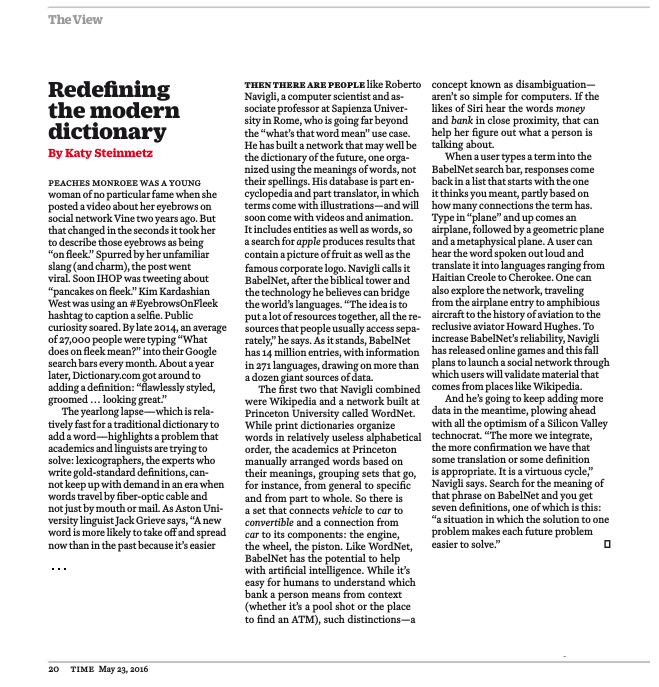
and Time magazine
<http://wwwusers.di.uniroma1.it/~navigli/img/Redefining_the_modern_dictionary.png>
-- is today’s *most far-reaching multilingual resource* which, according to
need, can be used as an *encyclopedic dictionary*, or a *semantic network*
or a huge *knowledge base/ontology*. It has been used by more than *1000
universities and research institutions*, enabling multilinguality in
several fields of AI and NLP, such as semantic search, Word Sense
Disambiguation, Semantic Role Labeling and image tagging.

BabelNet was created by means of the seamless integration and interlinking
of the largest multilingual Web encyclopedia - i.e., Wikipedia - with the
most popular computational lexicon of English - i.e., WordNet, and other
lexical resources such as Wiktionary, OmegaWiki, Wikidata, dozens of
wordnets, Wikiquote, GeoNames, and ImageNet. BabelNet provides *multilingual
synsets*, i.e., concepts and named entities lexicalized in many languages,
and connected with large amounts of semantic relations.

*Version 5.1* comes with the following features:

   - *500 languages* and *22 million synsets* covered;
   - *53 resources *linked and integrated;
   - *Wikipedia* and *Wikidata* updated thanks to *BabelNet live*;
   - *Open English WordNet* has been updated to version 2021;
   - Added *Q-codes* identifiers (e.g.
   https://www.hetop.eu/hetop/3CGP/?la=en&rr=CGP_QC_QD8);
   - Added *string tags *from *Wikipedia labels*;
   - *French wordnets cleaned up* by removing most potentially incorrect
   translations;
   - *Italian wordnet definitions *cleaned up;
   - *General data cleanup* (glosses, senses, Named Entity vs. concept
   labels);
   - *Lemma casing corrected in 24 languages* (English, Italian, Spanish,
   German, French, Dutch, Polish, Portuguese, Russian, Bulgarian, Czech,
   Danish, Greek, Estonian, Finnish, Croatian, Hungarian, Lithuanian, Latvian,
   Maltese, Romanian, Slovak, Slovenian, Swedish).

More statistics are available at: babelnet.org/statistics.

Kind regards,
The BabelNet team
--
==============================================
Roberto Navigli* - Professor*
Department of Computer, Control and Management Engineering
Sapienza University of Rome
Via Ariosto, 25
00185 Roma Italy
Phone: +39 06 77274109
Home Page: https://www.diag.uniroma1.it/navigli/
Sapienza NLP Group: http://nlp.uniroma1.it
Co-founder of Babelscape <https://babelscape.com>
==============================================
_______________________________________________
Corpora mailing list -- [email protected]
https://list.elra.info/mailman3/postorius/lists/corpora.list.elra.info/
To unsubscribe send an email to [email protected]