Dear all,

We (Achille, Francesca, Martin, Pavlos, Eleni) are preparing the new stable
version of CRMtex, following the discussion and decisions during the last
SIG meeting in Belval (see Issue 549
<https://cidoc-crm.org/Issue/ID-549-revise-tx5-reading-versus-tx6-transcription>
).
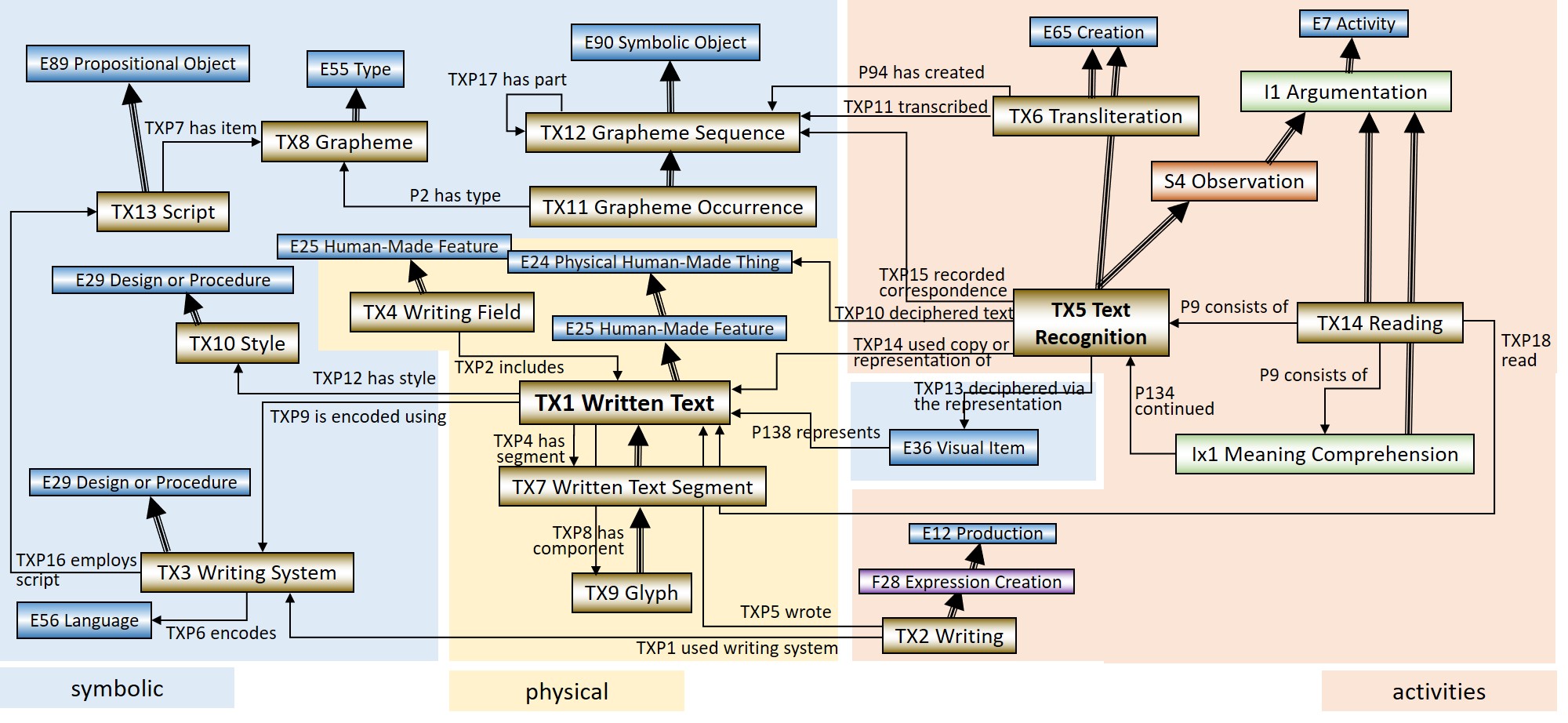
For those interested, a depiction of the new full model is available here
<https://reknow.ics.forth.gr/files/CRMtex_Revision.jpg>, and the full draft
document of the new version is available here
<https://docs.google.com/document/d/1FfnB3dN_0IkokwRLjbuJeeIdcZKz1Uyb/edit?usp=share_link&ouid=101337094540163420519&rtpof=true&sd=true>
.
*Please consider the following latest (minor) changes for an e-vote*.
Please vote YES if you are happy with the changes/inclusions, or vote NO
and explain which ones are not good enough. For minor issues, please vote
YES with a note for the correction.

============================
*(A) Revision of scope note of 'TXP7 has item' *
Domain: TX13 Script
Range: TX8 Grapheme

*Revised scope note*: This property associates an instance of TX13 Script
with an instance of TX8 Grapheme employed by this script. Different
instances of TX13 Script may have some graphemes in common, but not all.


*(B) Revision of scope note AND new example of 'TXP17 has part' *
Domain: TX12 Grapheme Sequence
Range: TX12 Grapheme Sequence

*Revised scope note*: This property associates an instance of TX12 Grapheme
Sequence with another instance of TX12 Grapheme Sequence appearing at a
particular position of the sequence. The property can be also used by an
instance of TX11 Grapheme Occurrence (subclass of TX12 Grapheme Sequence)
for denoting that a grapheme occurrence has part another grapheme
occurrence. Note that a grapheme occurrence may be a symbolic composite
containing another grapheme occurrence, such as the minute character “e” on
top of the character “u” in former German writing systems denoting the
symbol for “ü”.

*New example*:
- The recognition of the “DIVINITATIS” grapheme sequence (TX12),
corresponding to the glyphs sequence of the inscription (TX1) on the Arch
of Constantine, TXP17 has part the recognition of the “AT” grapheme
sequence (TX12) which appears to be damaged.


*(C) Revision of scope note of 'TXP18 read' *
Domain: TX14 Reading
Range: TX1 Written Text

*Revised scope note*:This property associates an instance of TX14 Reading
with an instance of TX1 Written Text whose linguistic meaning was
interpreted/understood through the reading process. It is a shortcut of the
fully developed path from TX14 Reading through P9 consists of, TX5 Text
Recognition, TXP10 deciphered text, to TX1 Written Text.


*(D) New FOL statement of 'TXP13 deciphered via the representation'*

TXP13(x, y) ⇒ (∃z) [TXP14(x, z) ∧ P138(y, z) ^ ¬TXP10(x, z)]
*// FOL explanation*:
If the text recognition process deciphered via a representation of the
original text (a visual item), then:
- there is a written text ‘z’ whose copy or representation was used in the
text recognition process (TXP14),
- the visual item represents the written text (P138), and
- the text recognition process did not decipher the written text through an
autoptic investigation.

*Why to include this statement (text by Martin)*:
It says that the specific original has not been used in this process. The
Closed World is limited to this particular activity, which is reasonable to
be completely observed. The FOL is important because it clarifies the
provenance of knowledge. Whatever was recognized in this particular process
is to be found on this specific copy. We have added "if this particular
process" in the scope note, to make clear that it is not a global negation.


*(E) Revised scope note AND new example of TX3 Writing System*

*Revised scope note*: This class represents a conventional symbolic system
designed to represent units of a natural language with the purpose of
recording and transmitting information. A writing system consists of a set
of symbols (graphemes, TX8), instantiated through physical signs of a
visual or tactile nature (TX8 Glyphs) representing linguistic units of any
kind and the related syntactic (graphotactic) rules.
It is used to produce a TX1 Written Text during a TX2 Writing event.

*New example*: The Latin alphabet using the glyph “E” to encode the mid
front unrounded vowel /e/.


*(F) New version number*

Based on the 3-tier numbering of versions that we had accepted in issue 310
and revised in Rome in the context of Issue 599, the numbering should
reflect how drastic are the changes that have been implemented from the
last release of the model.

The new version will be *2.0* because it implements major changes in the
model.
===========================================

Thank you!

Best regards,
Pavlos


--
Pavlos Fafalios

Postdoctoral researcher
Centre for Cultural Informatics & Information Systems Laboratory
Institute of Computer Science - FORTH

Visiting Lecturer
Department of Management Science & Technology
Hellenic Mediterranean University

Web: http://users.ics.forth.gr/~fafalios/
Email: [email protected]
Address: N. Plastira 100, Vassilika Vouton, 70013 Heraklion, Greece
Tel: +30-2810-391619
_______________________________________________
Crm-sig mailing list
[email protected]
http://lists.ics.forth.gr/mailman/listinfo/crm-sig