Cryptography-Digest Digest #155, Volume #10       Wed, 1 Sep 99 16:13:03 EDT

Contents:
  Re: Members Only Key Exchange (Medical Electronics Lab)
  Re: Protecting license information (Medical Electronics Lab)
  Re: Unpatented Public/private key system (Medical Electronics Lab)
  Re: Ratio plain/ciphertext (Medical Electronics Lab)
  Re: What if RSA / factoring really breaks? ("Tony T. Warnock")
  -=-=-= A challenge, a prize and a good cause =-=-=- (Robert Harley)
  Re: How does RC4 work ? (fungus)
  Re: Pincodes (Walter Hofmann)
  Web encryption, some references please.. ("Sta")
  Re: What if RSA / factoring really breaks? (Anton Stiglic)
  Re: THINK PEOPLE (Greg)
  SQ Announcement ("Kostadin Bajalcaliev")
  SQ Announcement ("Kostadin Bajalcaliev")
  Re: Standaarden in =?iso-8859-1?Q?Belgi=EB?= (Jean-Jacques Quisquater)
  Re: Home Invasion Bill Drives U.S. Computer Users across border (Greg)
  Re: Please help a HS student with an independent study in crypto (Arthur Dardia)
  Re: How does RC4 work ? (Frampton Blampton)
  Re: LFSRs in a5 (Ian Goldberg)
  Re: Exponents in public key algorithms ([EMAIL PROTECTED])
  Re: Ciphertext disguised as plaintext? (newbie question) (James Muir)

----------------------------------------------------------------------------

From: Medical Electronics Lab <[EMAIL PROTECTED]>
Subject: Re: Members Only Key Exchange
Date: Wed, 01 Sep 1999 12:25:46 -0500

Gary wrote:
>
> A chair(wo)man of an Internet club wishes to issue members with keys that
> can
> be used in a key exchange system so that they can all communicate securely
> with each other.
>
> The chair(wo)man wants to have a secret primitive such that only (s)he can
> register new members.
>
> The only ways I could think of doing this was
>
> i)RSA like variant of Diffie Hellman.
> The modulus must be composite (like RSA).
> The chair(wo)man uses a secret primitive s and assigns the pair s^k (mod pq)
> and k to each member. The members can communicate in a DH manner without
> discovering the primitive.

How about 2 levels of PK, with the outer level really public and
the inner level secret to the club.  Sign the inner level keys with
the chair's key and disallow use of keys that don't have the proper
signature.

If you don't use key signature with the chair's key, anybody who's
already a member can give anyone else the inner level PK data.

I think a better idea would be to use standard authentication methods.
Then you only need one level of PK and the "head dude" can allow
or disallow anyone they want by including or revoking the authorization
code.

Patience, persistence, truth,
Dr. mike

------------------------------

From: Medical Electronics Lab <[EMAIL PROTECTED]>
Subject: Re: Protecting license information
Date: Wed, 01 Sep 1999 12:57:39 -0500

Ranche wrote:
>
> I'd like to provide different versions of my application using some sort of licenses.
> I want to make sure that nobody except me can create valid licenses.
> What is the best way to achieve this?

It depends on how you generate the license.  If you use a secret that
only you have to create it, and a PK system to verify it (like a
digital signature for example), then only you can create the license.
If you are selling something in a box, and all boxes are the same,
then life if far more difficult.  If you can put the license on each
CD so every CD is different, then you have a pretty secure situation.

However, while only you can create valid licenses, people can still
cut out the code that checks for it.

Patience, persistence, truth,
Dr. mike

------------------------------

From: Medical Electronics Lab <[EMAIL PROTECTED]>
Subject: Re: Unpatented Public/private key system
Date: Wed, 01 Sep 1999 12:43:49 -0500

Micha�l Chass� wrote:
>
> Hi,
>
>     I'd like to know some Public/Private key system that aren't patented
> (that I can use on the public domain) and, if possible, references to have
> informations about them.

Check out Blowfish or CAST or Twofish for private key systems.
You can find the *fish at www.counterpane.com and the CAST
variations are at www.entrust.com or try this:
http://info.internet.isi.edu/in-notes/rfc/files/rfc2144.txt

Unpatented PK systems can be found here:
http://ds.dial.pipex.com/george.barwood/index.htm
or here:
http://www.terracom.net/~eresrch

Documentation for the private key systems is at those web sites,
you can find docs for the PK systems in book form here:
http://www.manning.com/Rosing

Patience, persistence, truth,
Dr. mike

------------------------------

From: Medical Electronics Lab <[EMAIL PROTECTED]>
Subject: Re: Ratio plain/ciphertext
Date: Wed, 01 Sep 1999 12:50:59 -0500

Ranche wrote:
>
> Does anybody have an overview of the expansion ratio's when using
> asymmetric ciphers?
> Is there a minimum for small plain-text (i.e. what happens to short
> messages)?
> Could anyone point me to references that would allow me to deduct
> this?

Most asymmetric ciphers are public key.  The cipher text size is fixed.
The message can be anything smaller so it fits.  The amount of
expansion depends on the cipher used.  If the message is too small,
an opponent can simply guess it until they get a match with the
cipher text.  You can get around this by adding random garbage to
fill up the rest of the message.

Patience, persistence, truth,
Dr. mike

------------------------------

From: "Tony T. Warnock" <[EMAIL PROTECTED]>
Subject: Re: What if RSA / factoring really breaks?
Date: Wed, 01 Sep 1999 11:27:05 -0600
Reply-To: [EMAIL PROTECTED]

"SCOTT19U.ZIP_GUY" wrote:

>But this requires a very special type of communications channel so it not
available to the averge users.

Not long ago, the average user couldn't afford a 500mhz computer. If there is
demand, supply will follow.


------------------------------

From: Robert Harley <[EMAIL PROTECTED]>
Subject: -=-=-= A challenge, a prize and a good cause =-=-=-
Date: 01 Sep 1999 19:49:33 +0200


Readers of sci.crypt might like to participate in the following
project.  It was developed entirely on Alpha Linux but all
participants are welcome!

There is 32-bit and 64-bit source code that can be compiled on just
about any Unix-like O.S.  There are also binary executables for
Windows 98, Windows NT and Solaris 7.

Bye,
  Rob.

==============================================================================

Further details at the Web site:

  http://pauillac.inria.fr/~harley/ecdl6/readMe.html

==============================================================================

* Calling all users of free and open-source software! *


The challenge: Certicom ECC challenge (see http://www.certicom.com/chal/).

The prize: $5000.

The good cause: Free Software Foundation (see http://www.fsf.org/).


We've got some awesome machines and are capable of solving big
problems if a large enough percentage of us are mobilised.  The first
six problems in the Certicom ECC challenge have been already been
solved (see http://www.certicom.com/chal/ch_6.htm).  This next problem,
called ECC2-97, is the hardest yet.

For comparison with the just-completed factorisation of RSA-155: this
is harder!  Compared with an exhaustive search of DES: this is a bit
easier, but uses an interesting algorithm rather than searching
blindly for a needle in a haystack.

We need to find *distinguished points* on a certain elliptic curve
until the same point is found in two different ways and then the
solution can be computed easily.  Each point takes about a billion
elliptic curve operations and it is estimated that a matching pair
will be found after about 400000 points.

The prize for the first correct solution is $5000.  If we win it, $500
will go to each of the two people who find the match and we will
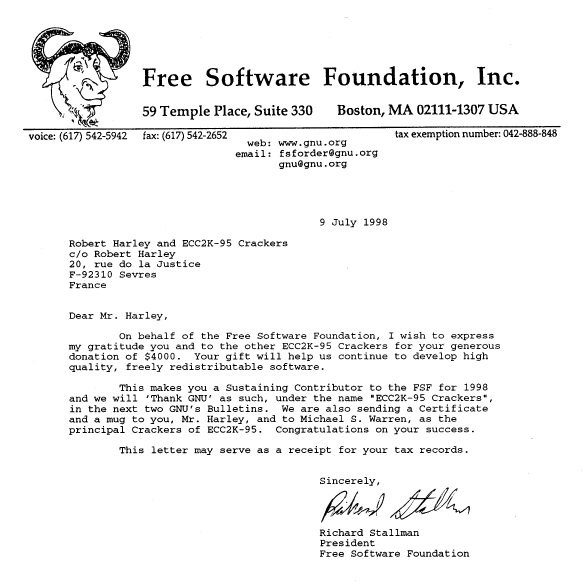
donate the remaining $4000 to the F.S.F. (same as last time, see
http://pauillac.inria.fr/~harley/ecdl5/fsf.gif).

==============================================================================

* So why not participate in the project? *

Just grab the source code, compile it, and leave it running in the
background.  The program uses CPU time but almost no other resources,
so by running it with 'nice' you'll hardly notice.  Source code for
Unix-like operating systems and detailed info are available at:

  http://pauillac.inria.fr/~harley/ecdl6/source/


There are also binary executables for Windows 98, Windows NT and
Solaris 7 in:

  http://pauillac.inria.fr/~harley/ecdl6/binaries/


Good luck!
  Rob.

PS: Constructive comments are very welcome.

==============================================================================

------------------------------

From: fungus <[EMAIL PROTECTED]>
Subject: Re: How does RC4 work ?
Date: Wed, 01 Sep 1999 20:59:44 +0200


Georg Zetzsche wrote:
>
> Hi all!
> Does anybody know, how the RC4 - encryption algorithm works ?
> I watched the source code and it looked like a simple XOR

Yes, but what does it XOR with, exactly?


Figure it out, and you'll find the secret.


--
<\___/>
/ O O \
\_____/  FTB.

------------------------------

From: Walter Hofmann <[EMAIL PROTECTED]>
Subject: Re: Pincodes
Date: Wed, 1 Sep 1999 01:37:13 +0200

John Savard <[EMAIL PROTECTED]> wrote:
>
> b) what makes you think there is a code to break: surely it would be
> safer to store a hash of the PIN number at a central site than on the
> magnetic stripe of the card.

Hashing a PIN is useless as the number of possible PINs is small.

> Of course, if the bank absolutely insists on letting people withdraw
> some small sum of money when the lines are down, they could still
> protect against hackers as follows:
>
> 1) Record only a hash of the PIN on the card, not the PIN itself.
>
> 2) Encrypt that hash - with one of a thousand or more keys, stored on
> a hard disk at each bank machine - with an indication of which key to
> use placed on the card.

Why bother with hashes and multiple keys? Add a random salt and
encrypt it with a fixed key.

Even better: Don't store the PIN anywhere, not even encrypted. Make
the PIN a function of the card data:

PIN = Crypt(Key, Hash(Account-No, Expiry-Date, ...))  (mod 10**n)

This would also prevent the user from changing the expiry date on
the magnetic stripe.

Walter Hofmann

------------------------------

From: "Sta" <nospam@nomail>
Subject: Web encryption, some references please..
Date: Tue, 31 Aug 1999 19:57:57 +0200

Hello,

I'd like to learn about the encryption protocols used on the www.
Please, could you give me some starting references?

maybe some links, books, articles...

Thank you

PD: No mail to avoid spam, please post to the group.


------------------------------

From: Anton Stiglic <[EMAIL PROTECTED]>
Subject: Re: What if RSA / factoring really breaks?
Date: Wed, 01 Sep 1999 14:50:03 -0400

>

Do not mistake quantum factorization algo with quantum crypto.,
does are both two seperat issues.  Quantum crypto has been implemented
(see refs bellow), whereas quantum factorization is still far from
beeing
reality.
So even do I agree with your reply, It doesn't fit in the context with
my reply
since I was simply argumenting about the comment:
  "...and there is no known one-way functions in the quantum setting
(remember
    that factoring is easy for quantum computers)" that someone poste.


Townsend, P. D., Rarity, J. G. and Tapster, P. R., "Single photon
interference in a 10 km long optical fibre interferometer", Electronics
Letters, vol. 29, no. 7, April 1993, pp. 634 - 635.
Townsend, P. D., Rarity, J. G. and Tapster, P. R., "Enhanced single
photon fringe visibility in a 10 km-long prototype quantum cryptography
channel", Electronics Letters, vol. 29, no. 14, 8 July 1993, pp.
      1291 - 1293.
 Muller, A., Breguet, J. and Gisin, N., "Experimental demonstration of
quantum cryptography using polarized photons in optical fibre over more
than 1 km" Europhysics Letters, vol. 23, no. 6, 20 August
      1993, pp. 383 - 388.
 Rarity, J. G., Owens, P. C. M. and Tapster, P. R., "Quantum random
number generation and key sharing", Journal of Modern Optics, vol. 41,
no. 12, December 1994, pp. 2435 - 2444.


------------------------------

From: Greg <[EMAIL PROTECTED]>
Subject: Re: THINK PEOPLE
Date: Wed, 01 Sep 1999 19:04:57 GMT

I think you got a point.

--
Truth is first ridiculed, then violently opposed, and then it is
accepted as self evident ("obvious").

I love my president... I love my president... I love my president...


Sent via Deja.com http://www.deja.com/
Share what you know. Learn what you don't.

------------------------------

From: "Kostadin Bajalcaliev" <[EMAIL PROTECTED]>
Subject: SQ Announcement
Date: Wed, 1 Sep 1999 20:29:37 +0200

WHY YOU RECIVE THIS E-MAIL
Your e-mail is extracted from a Your home page, from some internet list of
cryptographers or from Your postings to sci.crypt. You are not going to be
bother with e-mails every day, if the content of this message is irrelevant
to you please discard it. You have decided to publish your e-mail do not get
angry because I use it.

Dear Cryptographers

I am proud to announce my work about Stream Ciphers design. In the past 2
years the theory explained in this thesis was developed in order to answer a
simple question: What make a certain Stream cipher secure? Cryptography is
one of the strangest sciences ever founded. In any textbook you can find
that there is no way to prove that a certain crypto system is secure, all my
effort is concentrate to define the rules of the game and show that there is
a way to design provably secure crypto system.
 Two basic requirements are defined in my thesis in order a certain Stream
Cipher to be secure: it must have a strong statistical behavior, and the
information carried by the output sequence must be not enough to reconstruct
the inner state of the generator. This two requirements are not so new, they
are logical consequences from the definition of randomness and random
sequences. The new thing is that I am defining a theory how to design a
Cipher so this requirements to be satisfied.
 SQ1 is stream cipher designed using the theory described in the thesis, it
is both statistically strong and cryptographycally secure. There is still a
lot of work needed to be done in order to refine SQ1, the version included
in the thesis is the best construction I have made. In order to measure the
goodness of a certain ciphers a simple strategy is used:  FIPS 140-1
statistical test is run over 4GB long bit sequences (divided into
subsequential blocks of appropriate length according to FIPS 140-1) and the
FAILS are counted. SQ1 produce only 10 fails in 4GB=1717987*20000bits
sequence when it is run with 9bit internal word and 8bit output, and only 3
fails when both internal word and output are of length 8 bits. Further
improvements are possible, just to compare RC4 produce 6 fails in the same
circumstances (8bit inner and output range).
 I need help in order to continue my research, more than everything I need a
cooperation. Even my theory is not fully defined I decide to announce it
because I believe that wide discussion is better that any individual effort
alone. I need cryptoanalisys textbooks (somehow I collect all the major
cryptography books, most by donations), if you can help me please contact
me.
This is the firs part of my efforts to revise my inventions, in next couple
of mounts I am going to announce the Poly-Morphing-Encryption theory
concerning block ciphers design. As an intro the idea behind Polumorphyng
encryption is design of undetermined algorithms. The starting point is: If
the algorithm used to encrypt the data is unknown there is not way to break
the secret. (Of course I suppose that a strong algorithm was used).

The full text of the thesis and the source codes are published on the
following sites:

http://eon.pmf.ukim.edu.mk/kbajalc
http://members.tripod.com/kbajalc
http://kbajalc.8m.com

Follow the link    News from my researches (NEW: SQ)

Kostadin Bajalcaliev, [Sep 1, 1999]
[EMAIL PROTECTED]


------------------------------

From: "Kostadin Bajalcaliev" <[EMAIL PROTECTED]>
Subject: SQ Announcement
Date: Wed, 1 Sep 1999 20:25:50 +0200

WHY YOU RECIVE THIS E-MAIL
Your e-mail is extracted from a Your home page, from some internet list of
cryptographers or from Your postings to sci.crypt. You are not going to be
bother with e-mails every day, if the content of this message is irrelevant
to you please discard it. You have decided to publish your e-mail do not get
angry because I use it.

Dear Cryptographers

I am proud to announce my work about Stream Ciphers design. In the past 2
years the theory explained in this thesis was developed in order to answer a
simple question: What make a certain Stream cipher secure? Cryptography is
one of the strangest sciences ever founded. In any textbook you can find
that there is no way to prove that a certain crypto system is secure, all my
effort is concentrate to define the rules of the game and show that there is
a way to design provably secure crypto system.
 Two basic requirements are defined in my thesis in order a certain Stream
Cipher to be secure: it must have a strong statistical behavior, and the
information carried by the output sequence must be not enough to reconstruct
the inner state of the generator. This two requirements are not so new, they
are logical consequences from the definition of randomness and random
sequences. The new thing is that I am defining a theory how to design a
Cipher so this requirements to be satisfied.
 SQ1 is stream cipher designed using the theory described in the thesis, it
is both statistically strong and cryptographycally secure. There is still a
lot of work needed to be done in order to refine SQ1, the version included
in the thesis is the best construction I have made. In order to measure the
goodness of a certain ciphers a simple strategy is used:  FIPS 140-1
statistical test is run over 4GB long bit sequences (divided into
subsequential blocks of appropriate length according to FIPS 140-1) and the
FAILS are counted. SQ1 produce only 10 fails in 4GB=1717987*20000bits
sequence when it is run with 9bit internal word and 8bit output, and only 3
fails when both internal word and output are of length 8 bits. Further
improvements are possible, just to compare RC4 produce 6 fails in the same
circumstances (8bit inner and output range).
 I need help in order to continue my research, more than everything I need a
cooperation. Even my theory is not fully defined I decide to announce it
because I believe that wide discussion is better that any individual effort
alone. I need cryptoanalisys textbooks (somehow I collect all the major
cryptography books, most by donations), if you can help me please contact
me.
This is the firs part of my efforts to revise my inventions, in next couple
of mounts I am going to announce the Poly-Morphing-Encryption theory
concerning block ciphers design. As an intro the idea behind Polumorphyng
encryption is design of undetermined algorithms. The starting point is: If
the algorithm used to encrypt the data is unknown there is not way to break
the secret. (Of course I suppose that a strong algorithm was used).

The full text of the thesis and the source codes are published on the
following sites:

http://eon.pmf.ukim.edu.mk/kbajalc
http://members.tripod.com/kbajalc
http://kbajalc.8m.com

Follow the link    News from my researches (NEW: SQ)

Kostadin Bajalcaliev, [Sep 1, 1999]
[EMAIL PROTECTED]


------------------------------

From: Jean-Jacques Quisquater <[EMAIL PROTECTED]>
Subject: Re: Standaarden in =?iso-8859-1?Q?Belgi=EB?=
Date: Wed, 01 Sep 1999 14:34:55 +0200

For the answer see the very good page:

http://cwis.kub.nl/~frw/people/koops/cls2.htm#be

In one sentence: cryptography is free in Belgium.

------------------------------

From: Greg <[EMAIL PROTECTED]>
Crossposted-To: alt.privacy.anon-server
Subject: Re: Home Invasion Bill Drives U.S. Computer Users across border
Date: Wed, 01 Sep 1999 19:08:31 GMT


> It's ironic that a Canadian company is being flooded by
> requests to protect American citizens from their own government.

Or naive to think otherwise, perhaps?


--
Truth is first ridiculed, then violently opposed, and then it is
accepted as self evident ("obvious").

I love my president... I love my president... I love my president...


Sent via Deja.com http://www.deja.com/
Share what you know. Learn what you don't.

------------------------------

From: Arthur Dardia <[EMAIL PROTECTED]>
Subject: Re: Please help a HS student with an independent study in crypto
Date: Wed, 01 Sep 1999 15:12:59 -0400
Reply-To: [EMAIL PROTECTED]

David A Molnar wrote:
>
> Jeff Moser <[EMAIL PROTECTED]> wrote:
>
> > ElGammal, DH, etc] works, How [DES, RCx, AES submissions, etc] works, How
> > signatures work, MAC/Hash, etc). What I want to focus on in the course is
> > "Why" it works. I'd like to be able to write out proofs for why the methods
>
> Try to get your hands on Neal Koblitz' book _A Course in Number Theory and
> Cryptography_. It focuses on the number theoretic/algebraic aspects of the
> field, and avoids bringing in much computational complexity, which you
> probably don't have yet. As a bonus, it has a great introduction to modern
> factoring methods and some elliptic curve crypto stuff.
>
> > work. I'd like to be able to, for example, show the mathematics of why the
> > public key systems work [in depth of Euler Totient/Phi, Galois fields, other
> > fields, etc].
>
> It covers all of this. maybe not in incredible depth, but certainly enough
> to prove why RSA works.
>
> You might also check out the thread on "online tutorials" -- Helger Lipmaa
> posted a URL to a site with lots of interesting stuff, including three
> crypto tutorials (one in Polish, though). Of those, I like Oded
> Goldreich's "Foundations of Modern Cryptography -- fragments of a book."
>
> If you think of Koblitz as giving you the primitives and showing how they
> work, then you can think of Goldreich as the owner's manual -- showing you
> what to do with them once you've got 'em. but bad analogies aside, it
> covers things like what "secure" really means, zero-knowledge proofs, and
> what "pseudo-randomness" means.
>
> -David Molnar

I too am going into my senior year in HS.  I've been very interested in
crytography for a while; however, I have never been able to totally understand
it.  I'm scouring libraries for a copy of Applied Crytography, because at the
moment I have absolutely no money.  I wanted to take Vector/Matrix Algebra;
however, I was the only person in the school who signed up for the class.  What
else can I do to study crytography?  I plan on majoring in computer engineering,
maybe a double major in computer science or electronics engineering.  However,
I'd love to take crytography classes in college.  I figure now is the time to
get a head start.  I'm especially interested in hardware encryption/decryption
machines.

I've recently come across many 5,000 gate FPGA's from a friend.  He worked at
National Semiconductor.  From the little of what I know about FPGAs, I
understand that they are reprogrammable.  Would an FPGA be a lot quicker than an
Intel/AMD chip?  I don't know the clock speed of the FPGA; however, can't you
program your own instructions?  Wouldn't this be a lot quicker?  Let me know.  I
might plug that FPGA onto a PCI card and slap it into my computer and write an
interface for it.

                                        Art Dardia

------------------------------

From: [EMAIL PROTECTED] (Frampton Blampton)
Subject: Re: How does RC4 work ?
Date: Wed, 01 Sep 1999 19:46:00 GMT


>Georg Zetzsche wrote:
>
> Hi all!
> Does anybody know, how the RC4 - encryption algorithm works ?
> I watched the source code and it looked like a simple XOR
>

See:

http://www.cs.uwf.edu/~wilde/CEN6990/papers/boone/RC4.htm


You'll find an explanation of the algorithm. Using this as a guideline, I was
able to write an RC4 key-generator in C and even in Quick Basic...

J. Barrett

------------------------------

From: [EMAIL PROTECTED] (Ian Goldberg)
Subject: Re: LFSRs in a5
Date: 1 Sep 1999 19:37:57 GMT

In article <[EMAIL PROTECTED]>,
Maciej Maciejonek  <[EMAIL PROTECTED]> wrote:
>I understand that primitive polynomial:
>for LFSR1  x^19 + x^5 + x^2 + x + 1  (18,17,16,13)
>for LFSR2  x^22 + x + 1,                    (21,20)
>for LFSR3 x^23 + x^15 + x^2 + x + 1.(22,21,20,7)
>What about clock control taps in these registers?
>Bit 8 in first ( 0x100) , bit 10 ( 0x400) in second and third?

That's correct in A5/1.

>What about A5/2? When will You be publishing source?

You're not asking for us to violate export laws by posting crypto source
online, are you? :-)

That having been said, the source for A5/1 and A5/2 was published and
distributed (on paper) at the Usenix Security '99 conference.

   - Ian

------------------------------

From: [EMAIL PROTECTED]
Subject: Re: Exponents in public key algorithms
Date: Wed, 01 Sep 1999 19:43:01 GMT

Gaston Gloesener wrote:
[...]
> the El-Gamal Algorithm.
>
> In this example a number (N) has to be choosen which should be quite
> large. My book speaks about 1024 bits minumum. Later on other numbers
> (g,x) have to be choosen which should be smaller than the first one
(N)
> but I believe they should still be very large. Especially the on which
> is used as secret key (x).

The method has been refined since ElGamal published
it.  Choose an N such that N-1 has a large prime
factor q, and use a g which generates a sub-group
of order q.  The size of g is unimportant.  Choose
x uniformly from the integers in (1, q-1).


> Now later in the calculation you come to soming like g^x mod p.

I think you switched notation.  Is p the same as N?

> My problem is understanding how this works in reality. Since x is the
> secret key it should be very large (1024 bits?).
>
> Suposing that g has n bits, the result of g^x will have at maximum
> n*2^1024 bits which is a dramatic high value and cannot be handled
> during the encryption.

Note that
    a * b  mod N  =  (a mod N) * (b mod N)  mod N

So you can reduce all your partial results mod N.  You
never have to work with anything more than twice the
length of N (less if you really want).  Also, the
conventional modular exponentiation algorithm runs in
time cubic in the length of the parameters.

--Bryan


Sent via Deja.com http://www.deja.com/
Share what you know. Learn what you don't.

------------------------------

From: James Muir <[EMAIL PROTECTED]>
Subject: Re: Ciphertext disguised as plaintext? (newbie question)
Date: Wed, 01 Sep 1999 19:53:22 GMT

In article <[EMAIL PROTECTED]>,
<snip>
> Are there any automatic encryption systems which produce a ciphertext
> which appears, at least to a casual glance, to be a plaintext?  Is
there
> a word for a system like this?

"Steganography" or "watermarking".

-James


Sent via Deja.com http://www.deja.com/
Share what you know. Learn what you don't.

------------------------------


** FOR YOUR REFERENCE **

The service address, to which questions about the list itself and requests
to be added to or deleted from it should be directed, is:

    Internet: [EMAIL PROTECTED]

You can send mail to the entire list (and sci.crypt) via:

    Internet: [EMAIL PROTECTED]

End of Cryptography-Digest Digest
******************************