Let us please be civil and as always, Caveat Lector. ======================================================================== Archives Available at:
http://www.mail-archive.com/[EMAIL PROTECTED]/ <A HREF="">ctrl</A> ======================================================================== To subscribe to Conspiracy Theory Research List[CTRL] send email: SUBSCRIBE CTRL [to:] [EMAIL PROTECTED]
To UNsubscribe to Conspiracy Theory Research List[CTRL] send email: SIGNOFF CTRL [to:] [EMAIL PROTECTED]
Om
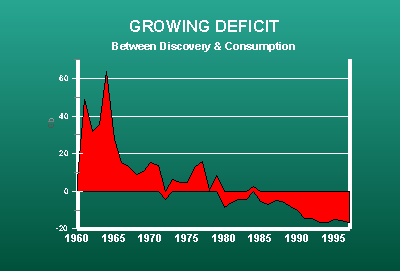
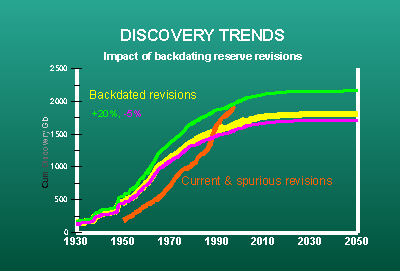
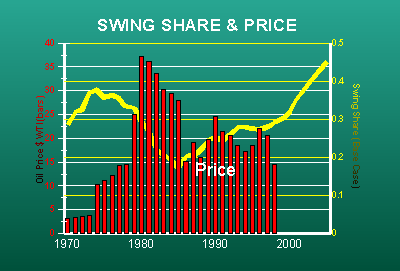
--- Begin Message ----Caveat Lector- Gary North's REALITY CHECKIssue 355 June 25, 2004 WHEN OIL PRODUCTION FALTERS AND THEN FALLS Back in 1973, in the midst of the first OPEC price hike, a little-known professor of economics at Texas A&M University, Phil Gramm, wrote a short essay, which appeared on the editorial page of the "Wall Street Journal." In it, he recounted the story of the rising price of whale oil in the mid-19th century. The demand for whale oil as a means of lighting lamps was increasing, but the supply of whales was decreasing. There would soon be a whale oil crisis, some believed. Then an engineer discovered that black oil in the western part of Pennsylvania could be converted into a newly marketed fuel, kerosene. The rising price of whale oil had created an incentive to find an alternative. That alternative became the basis of the modern, energy-intensive economy. In 1973, there were price controls on oil and gasoline. Gramm argued that a similar situation in the 1850s would have reduced the incentive to find an alternative. It would also have created shortages of whale oil in the marketplace. As Gramm told a group of students in August of 1974, that article had made him famous. He had worked for years publishing unread academic articles in scholarly journals, yet that whale oil article had taken him less than a day to write. He admitted that this told something about his previous allocation of time. Four years later, Gramm was elected to Congress. Eight years later, he was elected to the U.S. Senate. His political career's skids were greased with whale oil. A SHORTAGE OF WHALES There is no doubt that the cost of locating and killing suitable whales was rising in the 1850s. An objective oil shortage was taking place. There was no way that homes in the world could continue to be lighted by lamps using whale oil. Coal oil was a promising alternative after 1856, but in 1859, Pennsylvania's petroleum oil appeared on the scene. There was no way that the rising price of whale oil would have led to a sufficient increase in the supply of whales. The primary economic function of price -- to allocate supplies -- was a demand-side phenomenon in the whale oil market. But the secondary function of price -- to encourage the development of alternatives -- led to the technological breakthrough on which modern society rests. The fact that there was a shortage of whales was not crucial for the future of the world economy, but this fact was not clear in 1855. What was clear was that there was a rising price for whale oil. The success of the free market in developing suitable alternatives has persuaded many economists that there are always alternatives "at some price." This faith has been confirmed time after time. The success of the free market in developing alternatives prior to a major downturn, let alone a collapse, caused by the looming shortage has persuaded economists that the free market can solve all problems of supply and demand "at some price." This raises three crucial questions: 1. How high will the price get? 2. What if politicians cap the legal price? 3. What if politicians outlaw the alternatives? A SHORTAGE OF PETROLEUM Every day, the world consumes about 80 million barrels of oil. This means that every 12 days, it consumes a billion barrels. Kinetic energy becomes entropic energy, no longer fit for service. This process is a one-way street. Four years ago, I wrote an issue of this newsletter on the topic of the oil shortage. Because most of my readers today were not subscribers then, I have decided to reprint some of that newsletter here. I sent it out on February 7, 2000, six weeks before the NASDAQ peaked at 5040. It was issue #46. *************** OIL, GOLD, AND THE ILLUSION OF PAPER WEALTH Digits are the basis of the modern economy. Digits represent wealth, but they also represent debt. Today's prices are based on expected future returns, discounted by the interest rate. They are also based on men's belief that a greater fool will buy an asset that cannot rationally be priced as high as it is priced today. Numbers represent the real world. They also shape the real world. There is feedback back and forth. But when numbers in free markets depart from what appear to be the objective facts of the real world, then there has to be an explanation. Maybe the facts are wrong. Maybe the buyers and sellers are caught up in a mania. Maybe the market is rigged. --- Advertisement --- Seven Predictions That Could Help Make You Rich One conservative formula could help you see 79%, 93% and 145% gains while keeping your portfolio free of ENRON-type stocks. Learn how a 67-year old investment formula filters out risk, helps you avoid disaster and could help you see triple-digit gains in as few as three days. Learn more about seven stock market predictions for 2004 that could help you know what to buy and what to avoid... http://www.agora-inc.com/reports/FST/predict503/ ----------------------- OIL PRODUCTION The world, we are told, runs on information. So it is. But information doesn't warm the house or power the car. Energy does. The increase in the price of oil in the second half of 1999 was spectacular. Yet an increase to about $30 was predicted in a July report by Dr. Colin Campbell, who spoke to an All-Party Committee of Britain's House of Commons. He said it would take place in 2001 or earlier. Much earlier, as it turned out. This report appears, appropriately, on www.hubbertpeak.com. http://www.hubbertpeak.com/campbell/commons.htm Hubbert is not a familiar name to most people. M. King Hubbert was a man who believed in charts. He once produced a chart on the increase in the number of professional journals over the last two centuries. The curve in 1960 was becoming exponential. I cited that chart decades ago, although I can't recall where. But his more intriguing charts had to do with oil depletion. In 1956, he predicted that oil production in the U.S. would peak sometime around 1970. He was not taken seriously in 1956 or even 1970. I recall an economist's book on oil production issued by a university press in 1970 or 1971 that forecast $1 oil. This forecast sank into the academic tar pit in 1973. The OPEC price hike buried it. In 1974, he predicted that world petroleum output would peak around 1995. His forecast here was not quite so accurate, although it has been reasonably close. I am no fan of his monetary theory, interest rate theory, and his theory of the ever-declining work week. But I do not argue with his forecasts on oil production. Neither does Dr. Campbell. In his presentation to the Commons committee, he outlined a theory of oil reserves. He thinks that they are basically fixed -- a matter of geology. Oil fields were produced under rare circumstances. Modern technology has advance considerably, letting us identify these fields. "The world has now been very thoroughly explored with the benefits of this new understanding and the high resolution seismic surveys. About 90% of the world's oil endowment lies in just 30 major petroleum systems. . . . All the promising areas have been thoroughly explored." He argues that when an oil discovery curve for an oil field region becomes flat, the exploration will end. The same is true for oil companies. He provides charts for Shell and Amoco. "The point is that all discovery curves are flattening. . . . Discovery peaked in the 1960s with a 60 G [giga = billion] b[arrel] surplus. But that has given was to a deficit of almost 20 Gb. We now find one barrel for every four we consume." http://www.hubbertpeak.com/campbell/images/com10.gif Yet the public is unconcerned. "The general situation seems so obvious. Surely everyone can see it staring them in the face. How can any thinking person not be aware of it? How can governments be oblivious of the realities of discovery and their implications?" But aren't there stable or increasing oil reserves today? No. There is statistical deception going on. Companies usually under-report reserves when a new field is discovered. So do OPEC countries, whose quotas are tied to oil reserves. These reserve figures should be backdated. If they were, this would have major implications on the discovery charts. They would be flattening. http://www.hubbertpeak.com/campbell/images/com14.gif Prudhoe Bay's depletion curve has been flat since 1991. It will barely make the original 1977 estimate of 12.5 Gb, which was downgraded officially to 9 Gb. What we have experienced is a growth of reporting, not a growth in oil reserves. Today, half of the world's known oil reserves are in five Middle East countries. They hold the hammer. He thinks they will be using it soon. There is a discovery/production relationship for newly discovered fields. Production peaks at the halfway point. In the U.S.A.'s lower 48 states, discovery peaked in the 1930s and production peaked in 1971. In the North Sea, discovery peaked in 1980 and peak production seems to have been reached. The Middle East will have to make up any deficit: the hammer. Campbell calls this "swing share." Swing share rose to 38% in 1973, just before the OPEC oil embargo. It fell to 18% in 1985 as a result of North Sea oil. Oil prices fell. As of mid- 1999, the Middle East's swing share was back to 30%. http://www.hubbertpeak.com/campbell/images/com20.gif "This time it is set to continue to rise because there are no new provinces ready to deliver fresh production, save perhaps the Caspian and that seems to be turning sour." He thinks the swing share will hit 35% in 2001. "The Middle East countries will then have the confidence to impose much higher prices, realising that they have no competition. They may even get such confidence sooner." Norway's production is set to halve by 2006. Norway is the world's second largest exporter. "I think prices might briefly soar to very high levels... ." Also, "I think demand does become elastic above about $30/b, reacting to normal market forces, so higher prices may curb demand." The price reached $29/b before 2000 rolled over. "But I expect that somehow a plateau of production, however volatile, will unfold around $30 a barrel. But the end of this plateau will soon come into sight." He thinks it will hit in 2008, when swing share is 50% and Middle East countries will be approaching their depletion midpoint. Production will then drop by 3% per year. An additional 500 Gb of reserves would delay this by only a decade. "One indisputable fact stands out. Discovery peaked 30 years ago. It takes no feat of intellect to conclude that we now face the corresponding peak of production." The balance of power will shift to the Middle East. Western monetary authorities will not be able to halt this shift. Maybe military forces will, but I doubt it. Paper assets are fine if all you want in exchange is another paper asset. The profitable exchange of paper -- digits -- is the basis of the financial euphoria today. But digits that do not represent underlying productivity are illusionary. This is Warren Buffet's message, and it is also Colin Campbell's. Look deeper to discover reality, says Campbell: about 10,000 feet or so. ************** On June 21, 2004, Michael Ruppert published a report on the May 24-26 Berlin conference of the Association for the Study of Peak Oil and Gas (ASPO). This was its third annual convention. No longer is peak oil production a topic of obscure fanatics and oddballs. Ruppert listed 32 recent articles in mainstream magazines and newspapers on the topic. He wrote of the conference: The big three of ASPO, Colin Campbell, Kjell Aleklett, and Jean Laherrere -- accompanied by the de facto star of the event -- investment banker Matthew Simmons -- had their work cut out for them; not with the audience but with those who had come to deny. Natural gas issues facing Europe took up most of the first day. Two things quickly became clear on that account. First, almost all of Europe, soon even perhaps Ireland, was going to become dependent upon Russian natural gas to stay warm (Britain has just become a net gas importer in the face of North Sea decline). Second, Russia had much less natural gas than the economists and bookkeepers had predicted. Simmons asked rhetorically why anyone would stake their future on four large Russian fields that had been shown to be in permanent decline. . . . Simmons pointed out that North America hit its natural gas peak in 1973 and is now falling off the production cliff. Presentations exploring Liquefied Natural Gas (LNG) imports to the US concluded what FTW [Ruppert's website] already knew. The cost is too expensive, the lead time too long, and the capital investment too great to make much of a difference here. Then what of oil production, which is the mainstay of the modern economy? Saudi Arabia's promise to increase production to meet US and world economic needs was the hot topic. Much discussion and hard data was devoted to the fact that Ghawar, the largest field in the world, along with all of Saudi Arabia's other large fields, was old and tired. In recent years both water injection and so-called "bottle-brush" drilling have been employed to maintain production and both of these techniques tend to accelerate decline and damage the reservoirs. They are desperate measures. With bottle brush drilling, a shaft is drilled horizontally over long distances with a number of brush-like openings. As water is forced under pressure into the reservoir, the oil is forced upwards toward the well heads and extraction is thereby increased. However, when the water table hits the horizontal shaft, often without warning, the whole field is virtually dead and production immediately drops off to almost nothing. This comes as surprise in most cases. As several at the conference noted, this is exactly what had already happened in Oman, Syria and Yemen. As William Kennedy, a UK observer at the conference noted afterwards, "For the record, Ghawar's ultimate recoverable reserves in 1975 were estimated at 60 billion barrels -- by Exxon, Mobil, Texaco and Chevron. It had produced 55 billion barrels up to the end of 2003 and is still producing at 1.8 billion per annum. That shows you how close it might be to the end. When Ghawar dies, the world is officially in decline." Some of you may have read about the scandal at Royal Dutch Shell. The company had deliberately overstated its oil reserves for years. Reality finally caught up with the senior managers last January, and again in late May, when official reserves were lowered again. British Petroleum and Exxon Mobil also stepped through the looking glass. After presenting a series of slides which almost everyone in the audience was quite capable of reading, BP spokesman Francis Harper, addressing the issue of "reserve growth" refused to answer two direct questions about how his charts had just absolutely confirmed an imminent peak and decline. He just didn't answer. He did say that "Reserve estimates are uncertain and can vary widely throughout field life." . . . . Exxon Mobil's G. Jeffrey Johnson, while saying that supply was sufficient to satisfy growth until 2020, also admitted that current decline was at 4-6% per year. Economic growth is not possible without increased energy production. When asked by me where Exxon Mobil was working feverishly to find new reserves, Johnson rattled off a list of countries and regions already well familiar to FTW readers: West Africa, the Middle East and South America. Not one of those well-explored regions has anything near the two or three Ghawar fields we need to find immediately to avert a crisis. Assuming that sufficient oil was found, how much money would be needed to develop it and bring it to market? Exxon Mobil's spokesman indicated that a global annual investment of $530 billion would be required. The IEA's Faith Birol stated that a total of $16 trillion would have to be invested before 2030 to develop oil and gas reserves that -- even he admitted -- no one was sure existed. Now, that's a number that catches anyone's eye: $16 trillion. That is over $600 billion a year -- more than the U.S. government's annual deficit -- for 26 consecutive years. Who is going to put up that kind of money? Ruppert then discussed the disagreement he has with Simmons. Simmons thinks oil at over $180 a barrel will be beneficial economically. Ruppert does not. But he and I part company on the price of oil; not only does he see it rising to $182 a barrel, he thinks that it might be beneficial, especially when it comes to generating some of that $16 trillion that needs to be invested in new oil and gas infrastructure. At $182 a barrel Simmons predicts the pump price will be $7 a gallon. "But", he added cautiously, "we're not going there overnight." The APSO outlook is now getting a wider press. This should be understood as an echo that has taken since 1956 to reach the public. That was when M. King Hubbert made his initial prediction, fulfilled, that the U.S. would reach peak oil sometime around 1970. This is beginning to look like whale oil revisited. Ruppert quoted Campbell. On the question of Saudi Arabia he was unequivocal. "The Saudis are out of capacity. That's my opinion... They have no infrastructure or extra pipes or gas, oil, and water separators (very expensive large globes used to separate what comes out of a water injection well). They have very heavy oil which, through a conventional refinery, produces asphalt. We don't need asphalt. We need gasoline. It takes a complex refinery to make gasoline and it only takes 7-10 years to build one." After two years of study and two days at the conference, it was obvious that a crash building program begun today by Saudi Arabia would make no difference if most of the Saudi fields (especially the biggest ones) had already gone into, or were near, decline. As we have already seen in FTW, the uncertainty of return on investment was the principal reason why more power generating stations weren't built in the US in the last five years. There wasn't enough natural gas to run them and pay off the debt. The same cost-benefit issue arises in Saudi Arabia. For Ruppert's full report, click here: tinyurl.com/2fmck OIL AND GOLD As I wrote on February, 6, 2000, six weeks before the NASDAQ collapsed, this development in oil was positive for gold. Gold shares are cheap today. The market capitalization (shares times price) of the entire gold mining industry is $50 billion. By comparison, the CHANGE in market capitalization of just one company, Qualcomm, gained and then lost $50 billion in late 1999 and early 2000. Mining companies have sold short by promising to deliver gold in the future. This has depressed gold's price. These firms are now trapped: if they bid against each other to restructure their hedge books -- the source of their profits -- the front-runners will bid up prices, and the late-comers will be hit with massive losses. But if they stop hedging -- if they come to their senses -- this will drive up prices in the futures markets by lowering gold supplies (paper promises to deliver). I quoted John Hathaway: Vast quantities of present-day paper wealth, held in the form of inflated stock equities, will never be converted into lasting wealth. For most, this imaginary wealth will die along with the prevailing market mania. Only a few high tech millionaires will transform their dot.com and similar paper into lasting wealth. As in all major market turns, surprise will be a major factor. He was correct, as we saw by the end of 2000. CONCLUSION There is no doubt that new discoveries of oil fields are not keeping pace with oil depletion today. Western Canada's tar sands may finally prove to be an interim alternative, but this has not happened yet. The existence of those tar sands has been known for many decades. Because of political impediments, power companies in the United States do not build nuclear power plants. Hydroelectric power is limited geographically. The drought in the southwest is now calling into question the ability of Hoover Dam to continue to generate power on today's level over the next decade. It depends on the weather. Also, there are environmental restrictions on the construction of new dams that could generate power. At some price, alternatives will become economically feasible. But we must ask, "At what price?" We must also ask: "How long will development of these alternatives take?" Finally, this question: "How long can environmentalists delay the beginning of construction of such new facilities?" With oil at $40/barrel, nothing has changed on the supply side of American politics. With respect to gold, oil, and Hubbert's peak, I have not changed my mind. The bad news on the energy front has only just begun. The good news -- energy alternatives -- are either not viable as society-wide replacements for oil (solar, geothermal) or are politically unacceptable to environmentalists and will face well-organized opposition until the price of energy is far higher. And so, I leave you with these three words: at what price? ------------- -- Been to the Daily Reckoning Marketplace Yet? -- If not, you ought to see what you've been missing. Want to read more from our regular contributors? This is the place to find it. We've collected some of the best financial advice and commentary available anywhere and presented it to you all in one place. Take a look: http://www.dailyreckoning.com/marketplace.cfm ------------- To subscribe to Reality Check go to: http://www.dailyreckoning.com/sub/GetReality.cfm ------------- If you enjoy Reality Check and would like to read more of Gary's writing please visit his website: http://www.freebooks.com ------------- If you'd like to suggest Reality Check to a friend, please forward this letter to them or point them to: http://www.dailyreckoning.com/sub/GetReality.cfm ------------- E-mail Address Change? Just go to Subscriber Services: http://www.dailyreckoning.com/RC/services.cfm and give us your new address. ******* Please note: We sent this e-mail to: <[EMAIL PROTECTED]> because you or someone using your e-mail address subscribed to this service. ******* To manage your e-mail subscription, use our web interface at: http://www.agoramail.net/Home.cfm?List=RealityC To cancel or for any other subscription issues, write us at: Order Processing Center Attn: Customer Service P.O. Box 925 Frederick, MD 21705 USA www.ctrl.org DECLARATION & DISCLAIMER ========== CTRL is a discussion & informational exchange list. Proselytizing propagandic screeds are unwelcomed. Substance—not soap-boxing—please! These are sordid matters and 'conspiracy theory'—with its many half-truths, mis- directions and outright frauds—is used politically by different groups with major and minor effects spread throughout the spectrum of time and thought. That being said, CTRLgives no endorsement to the validity of posts, and always suggests to readers; be wary of what you read. CTRL gives no credence to Holocaust denial and nazi's need not apply. Let us please be civil and as always, Caveat Lector. ======================================================================== Archives Available at: http://www.mail-archive.com/[EMAIL PROTECTED]/ <A HREF="http://www.mail-archive.com/[EMAIL PROTECTED]/">ctrl</A> ======================================================================== To subscribe to Conspiracy Theory Research List[CTRL] send email: SUBSCRIBE CTRL [to:] [EMAIL PROTECTED] To UNsubscribe to Conspiracy Theory Research List[CTRL] send email: SIGNOFF CTRL [to:] [EMAIL PROTECTED] Om
--- End Message ---