https://github.com/maqp/tfc
Tinfoil Chat (TFC) is a
[FOSS](https://www.gnu.org/philosophy/free-sw.html)+[FHD](https://www.gnu.org/philosophy/free-hardware-designs.en.html)
 [peer-to-peer](https://en.wikipedia.org/wiki/Peer-to-peer) messaging system
that relies on high assurance hardware architecture to protect users from
[passive collection](https://en.wikipedia.org/wiki/Upstream_collection), [MITM
attacks](https://en.wikipedia.org/wiki/Man-in-the-middle_attack) and most
importantly, [remote key
exfiltration](https://www.youtube.com/watch?v=3euYBPlX9LM). TFC is designed for
people with one of the most complex threat models: organized crime groups and
nation state hackers who bypass end-to-end encryption of traditional secure
messaging apps by hacking the endpoint.

State-of-the-art cryptography

TFC uses
[XChaCha20](https://cr.yp.to/chacha/chacha-20080128.pdf)-[Poly1305](https://cr.yp.to/mac/poly1305-20050329.pdf)
 [end-to-end encryption](https://en.wikipedia.org/wiki/End-to-end_encryption)
with [deniable
authentication](https://en.wikipedia.org/wiki/Deniable_encryption#Deniable_authentication)
 to protect all messages and files sent to individual recipients and groups.
The symmetric keys are either
[pre-shared](https://en.wikipedia.org/wiki/Pre-shared_key), or exchanged using
[X448](https://eprint.iacr.org/2015/625.pdf), the base-10
[fingerprints](https://en.wikipedia.org/wiki/Public_key_fingerprint) of which
are verified via an out-of-band channel. TFC provides per-message [forward
secrecy](https://en.wikipedia.org/wiki/Forward_secrecy) with
[BLAKE2b](https://blake2.net/blake2.pdf) based [hash
ratchet](https://www.youtube.com/watch?v=9sO2qdTci-s#t=1m34s). All persistent
user data is encrypted locally using XChaCha20-Poly1305, the key of which is
derived from password and salt using
[Argon2id](https://github.com/P-H-C/phc-winner-argon2/blob/master/argon2-specs.pdf),
 the parameters of which are automatically tuned according to best practices.
Key generation of TFC relies on Linux kernel's
[getrandom()](https://manpages.debian.org/testing/manpages-dev/getrandom.2.en.html),
 a syscall for its ChaCha20 based
[CSPRNG](https://en.wikipedia.org/wiki/Cryptographically_secure_pseudorandom_number_generator).

Anonymous by design

TFC routes all communication exclusively through the
[Tor](https://2019.www.torproject.org/about/overview.html.en) anonymity
network. It uses the next generation
([v3](https://trac.torproject.org/projects/tor/wiki/doc/NextGenOnions)) [Tor
Onion Services](https://2019.www.torproject.org/docs/onion-services) to enable
P2P communication that never exits the Tor network. This makes it hard for the
users to accidentally deanonymize themselves. It also means that unlike
(de)centralized messengers, there's no third party server with access to user
metadata such as who is talking to whom, when, and how much. The network
architecture means TFC runs exclusively on the user's devices. There are no ads
or tracking, and it collects no data whatsoever about the user. All data is
always encrypted with keys the user controls, and the databases never leave the
user's device.

Using Onion Services also means no account registration is needed. During the
first launch TFC generates a random TFC account (an Onion Service address) for
the user, e.g. 4sci35xrhp2d45gbm3qpta7ogfedonuw2mucmc36jxemucd7fmgzj3ad. By
knowing this TFC account, anyone can send the user a contact request and talk
to them without ever learning their real life identity, IP-address, or
geolocation. Protected geolocation makes physical attacks very difficult
because the attacker doesn't know where the device is located on the planet. At
the same time it makes the communication censorship resistant: Blocking TFC
requires blocking Tor categorically, nation-wide.

TFC also features a traffic masking mode that hides the type, quantity, and
schedule of communication, even if the network facing device of the user is
hacked. To provide even further metadata protection from hackers, the
Internet-facing part of TFC can be run on [Tails](https://tails.boum.org/), a
privacy and anonymity focused operating system that contains no personal files
of the user (which makes it hard to deduce to whom the endpoint belongs to),
and that provides [additional layers of
protection](https://github.com/Whonix/onion-grater) for their anonymity.

First messaging system with endpoint security

TFC is designed to be used in hardware configuration that provides strong
[endpoint security](https://en.wikipedia.org/wiki/Endpoint_security). This
configuration uses three computers per endpoint: Encryption and decryption
processes are separated from each other onto two isolated computers, the Source
Computer, and the Destination Computer. These two devices are are dedicated for
TFC. This split [TCB](https://en.wikipedia.org/wiki/Trusted_computing_base)
interacts with the network via the user's daily computer, called the Networked
Computer.

In TFC data moves from the Source Computer to the Networked Computer, and from
the Networked Computer to the Destination Computer, unidirectionally. The
unidirectionality of data flow is enforced, as the data is passed from one
device to another only through a free hardware design [data
diode](https://en.wikipedia.org/wiki/Unidirectional_network), that is connected
to the three computers using one USB-cable per device. The Source and
Destination Computers are not connected to the Internet, or to any device other
than the data diode.

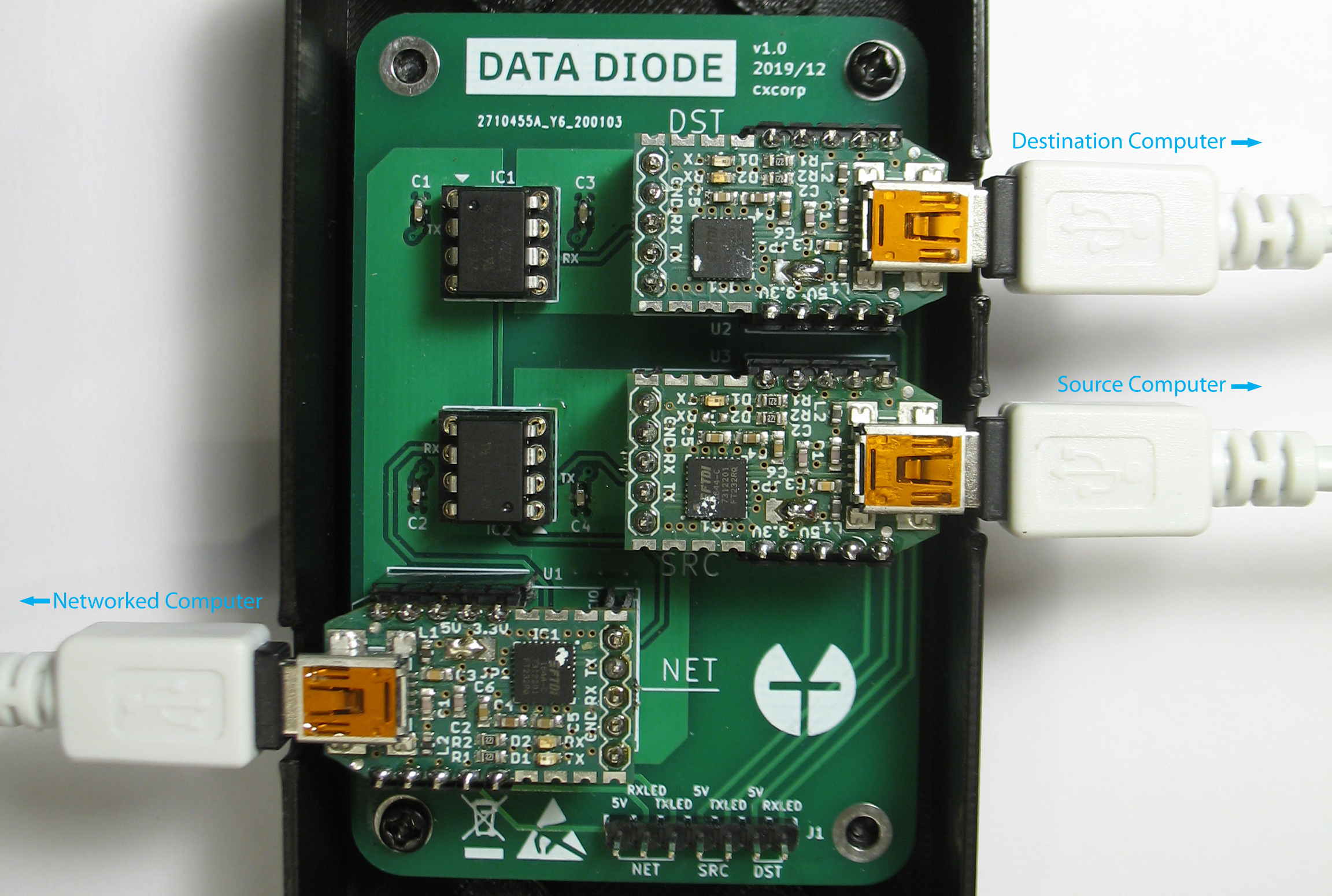
https://camo.githubusercontent.com/be91382229596f4ae22250ed86091265e80ff6d7/68747470733a2f2f7777772e63732e68656c73696e6b692e66692f752f6f6f7474656c612f77696b692f726561646d652f646174615f64696f64652e6a7067
 [TFC data
diode](https://www.cs.helsinki.fi/u/oottela/wiki/readme/data_diode.jpg)

Optical repeater inside the
[optocouplers](https://en.wikipedia.org/wiki/Opto-isolator) of the data diode
enforce direction of data transmission with the fundamental laws of physics.
This protection is so strong, the certified implementations of data diodes are
typically found in critical infrastructure protection and government networks
where the classification level of data varies between systems. A data diode
might e.g. allow access to a nuclear power plant's safety system readings,
while at the same time preventing attackers from exploiting these critical
systems. An alternative use case is to allow importing data from less secure
systems to ones that contain classified documents that must be protected from
exfiltration.

In TFC the hardware data diode ensures that neither of the TCB-halves can be
accessed bidirectionally. Since the protection relies on physical limitations
of the hardware's capabilities, no piece of malware, not even a [zero-day
exploit](https://en.wikipedia.org/wiki/Zero-day_(computing)) can bypass the
security provided by the data diode.

How it works

With the hardware in place, all that's left for the users to do is launch the
device specific TFC program on each computer.

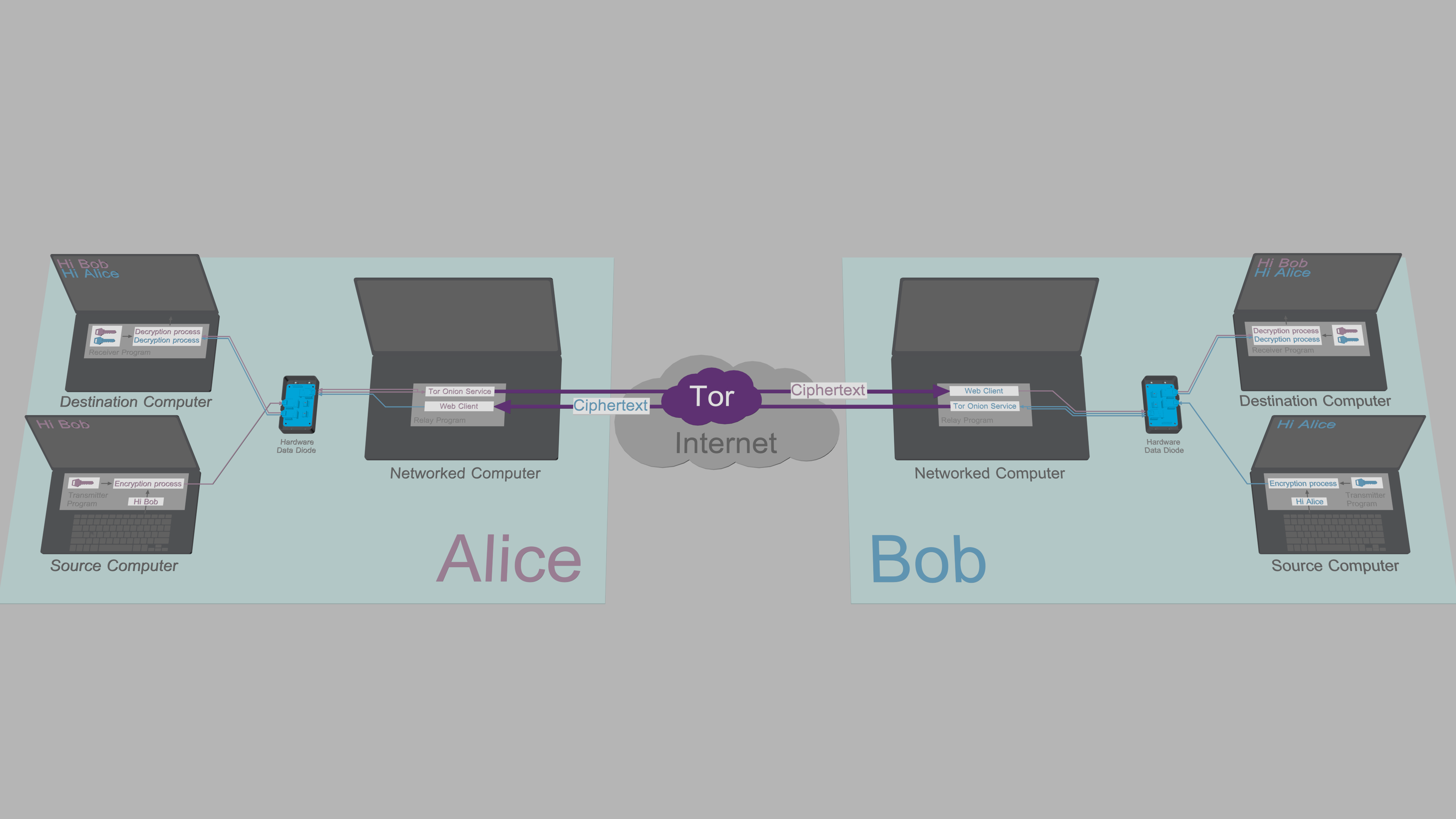
https://camo.githubusercontent.com/fc12f37e9af2ef375c0c55ddf739e8900de383e2/68747470733a2f2f7777772e63732e68656c73696e6b692e66692f752f6f6f7474656c612f77696b692f726561646d652f6f766572766965772e706e67
 [System
overview](https://www.cs.helsinki.fi/u/oottela/wiki/readme/overview.png)

In the illustration above, Alice enters messages and commands to Transmitter
Program running on her Source Computer. The Transmitter Program encrypts and
signs plaintext data and relays the ciphertexts from Source Computer to her
Networked Computer through the data diode.

Relay Program on Alice's Networked Computer relays commands and copies of
outgoing messages to her Destination Computer via the data diode. Receiver
Program on Alice's Destination Computer authenticates, decrypts and processes
the received message/command.

Alice's Relay Program shares messages and files to Bob over a Tor Onion
Service. The web client of Bob's Relay Program fetches the ciphertext from
Alice's Onion Service and forwards it to his Destination Computer through his
data diode. Bob's Receiver Program then authenticates, decrypts and processes
the received message/file.

When Bob responds, he will type his message to the Transmitter Program on his
Source Computer, and after a mirrored process, Alice reads the message from the
Receiver Program on her Destination Computer.

Why keys and plaintexts cannot be exfiltrated

The architecture described above simultaneously utilizes both [the classical
and the alternative data diode
models](https://en.wikipedia.org/wiki/Unidirectional_network#Applications) to
enable bidirectional communication between two users, while at the same time
providing hardware enforced endpoint security:

-

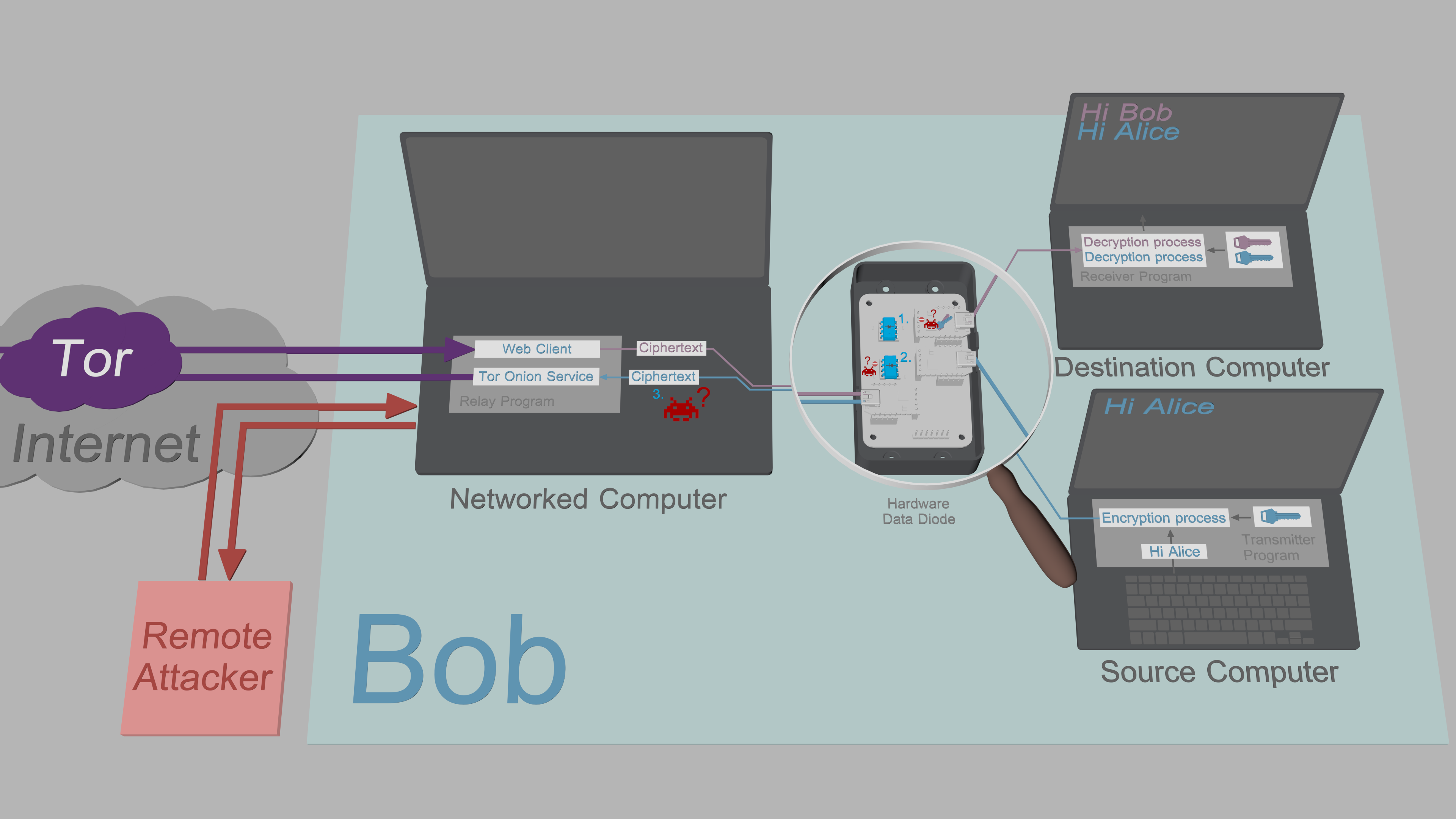
The Destination Computer uses the classical data diode model. This means it can
receive data from the insecure Networked Computer, but is unable to send data
back to the Networked Computer. The Receiver Program is designed to function
under these constraints. However, even though the program authenticates and
validates all incoming data, it is not ruled out malware couldn't still
infiltrate the Destination Computer. However, in the event that would happen,
the malware would be unable to exfiltrate sensitive keys or plaintexts back to
the Networked Computer, as the data diode prevents all outbound traffic.

-

The Source Computer uses the alternative data diode model. This means it can
output encrypted data to the insecure Networked Computer without having to
worry about being compromised: The data diode protects the Source Computer from
all attacks by physically preventing all inbound traffic. The Transmitter
Program is also designed to work under the data flow constraints introduced by
the data diode; To allow key exchanges, the short elliptic-curve public keys
are input manually by the user.

-

The Networked Computer is designed under the assumption it can be compromised
by a remote attacker: All sensitive data that passes through the Relay Program
is encrypted and signed with no exceptions. Since the attacker is unable to
exfiltrate decryption keys from the Source or Destination Computer, the
ciphertexts are of no value to the attacker.

https://camo.githubusercontent.com/ae719d8f7c576a880b4d16607608780e2d1eceba/68747470733a2f2f7777772e63732e68656c73696e6b692e66692f752f6f6f7474656c612f77696b692f726561646d652f61747461636b732e706e67
 [Exfiltration
security](https://www.cs.helsinki.fi/u/oottela/wiki/readme/attacks.png)

Qubes-isolated intermediate solution

For some users the
[APTs](https://en.wikipedia.org/wiki/Advanced_persistent_threat) of the modern
world are not part of the threat model, and for others, the requirement of
having to build the data diode by themselves is a deal breaker. Yet, for all of
them, storing private keys on a networked device is still a security risk.

To meet these users' needs, TFC can also be run in three dedicated
[Qubes](https://www.qubes-os.org/) virtual machines. With the Qubes
configuration, the isolation is provided by the [Xen
hypervisor](https://xenproject.org/users/security/), and the unidirectionality
of data flow between the VMs is enforced with strict firewall rules. This
intermediate isolation mechanism runs on a single computer which means no
hardware data diode is needed.

Supported Operating Systems

Source/Destination Computer

- Debian 10
- PureOS 9.0
- *buntu 19.10
- LMDE 4
- Qubes 4 (Debian 10 VM)

Networked Computer

- Tails 4.0
- Debian 10
- PureOS 9.0
- *buntu 19.10
- LMDE 4
- Qubes 4 (Debian 10 VM)

More information

[Threat model](https://github.com/maqp/tfc/wiki/Threat-model)
[FAQ](https://github.com/maqp/tfc/wiki/FAQ)
[Security design](https://github.com/maqp/tfc/wiki/Security-design)

Hardware Data Diode
    [Breadboard
version](https://github.com/maqp/tfc/wiki/TTL-Data-Diode-(breadboard)) (Easy)
    [Perfboard
version](https://github.com/maqp/tfc/wiki/TTL-Data-Diode-(perfboard))
(Intermediate)
    [PCB version](https://github.com/maqp/tfc/wiki/TTL-Data-Diode-(PCB))
(Advanced)

How to use
    [Installation](https://github.com/maqp/tfc/wiki/Installation)
    [Master password setup](https://github.com/maqp/tfc/wiki/Master-Password)
    [Local key setup](https://github.com/maqp/tfc/wiki/Local-Key-Setup)
    [Onion Service setup](https://github.com/maqp/tfc/wiki/Onion-Service-Setup)
    [X448 key exchange](https://github.com/maqp/tfc/wiki/X448)
    [Pre-shared keys](https://github.com/maqp/tfc/wiki/PSK)
    [Commands](https://github.com/maqp/tfc/wiki/Commands)

[Update log](https://github.com/maqp/tfc/wiki/Update-Log)