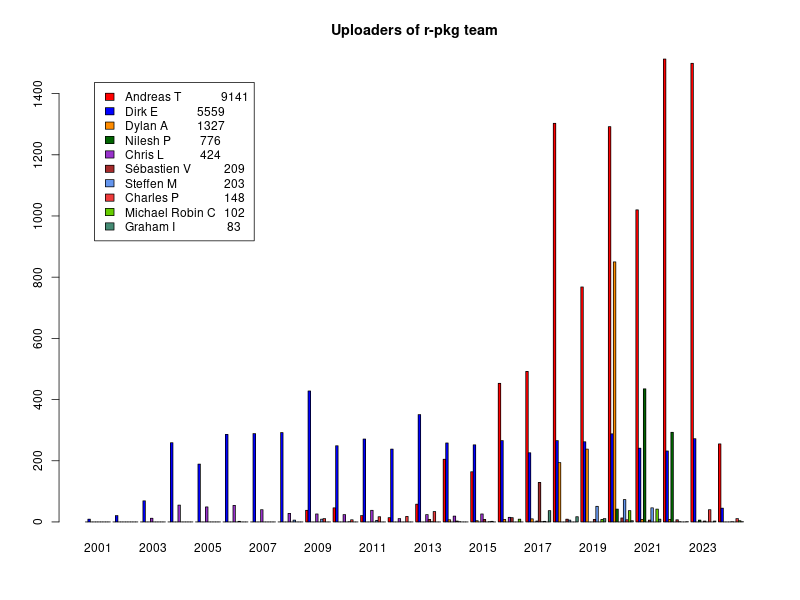
Hi Andreas,

On 2021-11-03 17:55, Andreas Tille wrote:
> Am Wed, Nov 03, 2021 at 01:26:34PM +0200 schrieb Andrius Merkys:
>>> No notes, Andreas came up with this idea in debconf, you could find it on
>>> videos.debian.net.
>>> But anyways, I have the following point to make:
>>>
>>> 1. Separate team will help keep track of math-specific software, making it
>>> easy for
>>> interested folks to work on them. Currently there is no specific team, and
>>> packages
>>> are scattered across several teams which is (in my eyes) a bit haphazard
>>
>> I find it hard to believe that all (most?) of math software in Debian will
>> be brought under this team.
>
> First let those maintainers move their packages to that team who like it.
> Once this has proven to work nicely others will follow.
>
>> Then there is the categorization problem: How
>> would we define what is math software? What would be done with
>> interdisciplinary software?
>
> Blends categorisation is *not* exclusive.  One package can be in two or
> more Blends (and we have lots of examples for this).
ACK. However, team categorization is exclusive.

>> For example, I maintain two packages, spglib and
>> voronota, which deal with crystallography (chemistry?), but employ heavy
>> math. Should I put them in debichem or debian-math?
>
> Leaving it where it is would be a first approach.
>
>> I believe the
>> classification problem cannot be solved in general way, leading to looking
>> for more "pragmatic" classification.
>
> I consider it pragmatic to simply not change anything that works for
> you.  Nobody will force you to move your packages.

OK.

>>> 2. debian-math meta-package (with a separate team) -- this will help
>>> researchers to get
>>> math related software and tooling in one go (exactly like the debian-med
>>> metapackage)
>>
>> I would extend Stuart's argument [4] by saying that meta-packages should be
>> independent from teams. As said, I find it hard to believe that all math
>> software will end up in debian-math.
>
> I try to reword what I thought I would have explained several times (in
> this thread and always when similar discussion was done):  Metapackages
> are *designed* to be independent from teams.  The idea was to build
> sensible sets of user oriented packages and users usually do not ask who
> is maintaining a package (as long as it is maintained at all).  The
> impossibility to put all packages under one team actually created the
> need to find other ways to build those sets of packages.

OK, I got this impression from Nilesh's comment "debian-math
meta-package (with a separate team)". I stand corrected.

> Well, it turns out that maintainers of somehow related software find
> together in one team to enhance cooperation and team maintenance.  But
> this has nothing to do with the metapackage approach per se.

Understood. I think I expressed my doubts about this already.

>>> 3. Easier to find and contribute for people -- I am sure there are a lot of
>>> people on this list,
>>> and even DDs who are interested in math, having such a team helps them
>>> approach and contribute well.
>>
>> I am still not entirely sure this will improve the bus factor. Nevertheless
>> please add me to debian-math.
>
> We can never be sure - but I'm personally extremely optimistic
> considering the amount of positive responses which I'd consider
> overwhelming compared to similar attempts I've seen in the past.

Great - let's see how it goes!

>>> 4. Better maintainance - Lots of math softwares which are still lying
>>> un-updated, or broken in some ways.
>>> So it helps improve the overall quality
>>
>> This greatly depends on the enthusiasm on the members of the new team (as
>> everywhere in Debian).
>
> This is correct.  However, the existence of a team is lowering the
> barrier to touch those packages.  I have quite some experience with
> this.

Unless everyone in debian-science (and other teams from where math
packages originate from) are given permissions to push to debiam-math,
barrier is actually raised for them - now they have to apply for
permissions in debian-math. As for the newcomers, fragmentation isolates
them inside these smaller teams, which is probably good.

>>> 5. We have debichem team for chemistry packages, astro team for astronomy
>>> ones, and now even a new robotics team
>>> We had a new AI team made a few months back. These would also come under
>>> science earlier, so if we could
>>> make teams for specific domains, *and* they are doing well, why not do so
>>> for math?
>>> I mean this comes as a very natural choice to me, considering other blends.
>>
>> Indeed, precedents for debian-math exist. I do not want to block launching
>> debian-math, I am just questioning whether fragmentation by domain will
>> result in significant increase of net attention for packages.
>
> Only time can prove whether your doubts are right or wrong.

Right.

>>> I'm sorry, but I have to admit this argument of yours is sloppy, Andrius.
>>> By this logic, we could push entire debian-med python packages into
>>> python-team,
>>> java packages into java-team and so on... >
>>> You also mentioned debian-med above, so if you think everything would be
>>> per-language
>>> organised, why do you think separate teams (like -med, or -astro) should
>>> even exist?
>>
>> Sure, feel free to disagree. I however cannot solve the package
>> categorization even for myself - almost every time I package stuff I have to
>> deliberate on where to push it. I see per-language teams employing
>> semi-automated means to update packages/fix common issues, therefore I
>> believe my packages would stay in good shape there even without my input.
>
> If you see this kind of advantage for your package by all means use
> these advantages.

OK.

>>> The whole point of blends is to help people with "specific" needs, right.
>>> and such teams help organize that in a reliable way.
>>
>> In real life I personally do not meet Debian/Ubuntu users who know what a
>> "blend" or "team" in Debian is. Most users I meet use apt to search for
>> particular packages they need, that's all.
>
> So it is our task to run around and tell users.  I'm doing so for many
> years[5].  You should point users to relevant tasks pages.  Why do you
> think I started writing that code (luckily I've got help by several
> others) and was keen on adding things like citations etc.?  It is to
> make users aware that there is extra value.

>From my experience users usually know which packages they want to
install. The fact that a certain piece of software is not packaged for
Debian rarely instigates them to search for Debian-provided
alternatives. Thus they turn to snap/conda/deb-from-web. Task pages are
really nice and they help a lot when one looks for Debian-provided
package for a task they want to achieve. But from my experience users
most of the time know exactly (= software name) what they want.

But I am afraid I am derailing the main conversation. I acknowledge the
great work you do with maintaining tasks. They surely deserve more
attention from the general users, though.

> Debian has no advertising department as other distributions.  So it is
> part of our job to explain users the advantages we have.  IMHO some
> dedicated team can do this better - thus I applause the Debian Math
> team creation.

I hope so.

>> If not found, they turn to snap
>> or conda or just .deb lying around on the Web. Of course this is just my
>> experience.
>
> I think you are describing the "typical user these days".  But users
> might grow up when educated.  So lets educate them.  Always when I told
> them about the Blends idea users liked it.  They liked it even more if
> the software ended up as a package in the tasks list (sometimes very
> quickly).

ACK.

>>> And Fwiw, people do
>>> ask sometimes about software in debian-med (check element), people do file
>>> bug reports there, et. al.
>>> Many upstreams are tied to -med team, and that could've never happened
>>> without domain-specific knowledge.
>>
>> These are all great achievements of debian-med and other teams. I am not
>> trying to null them, sorry it looks like that.
>
> At least I did not misunderstood you that way.  I just want to stress
> that I expect that a Debian Math team can do similar positive things
> than other teams ... and they can do this better if not hidden inside
> Debian Science IMHO.

I do not think that anything in debian-science is hidden :)

>>> The number of pure math software in R package team is in no way
>>> overflowing, so I really think this should
>>> be manageable. The probability of it having a bit-rot will be less --
>>> atleast not high with me, Andreas, Doug et. al.
>>> being around.
>>
>> I am really impressed by the work you all do. I have no doubt teams having
>> you all will take good care of their packages. Thus if you are fine with
>> further subdivisions of debian-science, I think I should not have any
>> concerns either.
>
> I was one of the initiators of Debian Science and I was suggesting right
> from the beginning that this project should help subdivisions to grow.
> Beeing a physicist by profession I should start a Debian Physics myself -
> but well, one pet project is enough for me. ;-)
>
>>> Should you want more explanation, do let me know and I'll be happy to
>>> discuss.
>>
>> Sure. Thanks for finding time to discuss it with me.
>
> BTW, I consider discussing your doubts very important and I'm happy you
> raised these.  This gives better options to explain main ideas.  BTW, even
> the Blends doc says[6]:
>
>   While there are Debian Pure Blends that care for certain sciences
>   (Debian Med deals in a main part with Biology, DebiChem for Chemistry
>   and Debian GIS for geography) not all sciences are covered by a specific
>   Blend. The main reason is that at the moment not enough people support
>   such an effort for every science. The temporary solution was to build a
>   general Debian Science Blend that makes use of the work of other Blends
>   in case it exists.
>
>
> Looking at that page I see its again outdated (Debian Astro is missing and
> Ezgo is dead) and should be overworked.  Its a good sign that nobody is
> reading those docs and thus its not very motivating to keep it updated.

Thanks for providing this historical background to me. It helps me
understand the further fragmentation of debian-science has been foreseen
at its creation. I however see some disadvantages of such fragmentation
(and seemingly I am not alone), but surely I do not want to block the
progress. Maybe just instigate a discussion about how certain aspects
could be done even better.

>>> [1]: http://blends.debian.net/liststats/
>>> [2]: http://blends.debian.net/liststats/uploaders_r-pkg.png
>>> [3]: http://blends.debian.net/liststats/commitstat_pkg-r.png
>>
>> [4] https://lists.debian.org/debian-science/2021/11/msg00016.html
>
> [5] https://people.debian.org/~tille/talks/
> [6] https://blends.debian.org/blends/ch04.html#debian-science

Best,
Andrius