Are you sure you can't use trunk?  Swapping in PForDelta as a codec is
much easier and we are wanting to do that, anyway (as a hybrid codec
w/ Pulsing as well), before releasing 4.0 :)
Partial decode of PForDelta is challenging I think... because the
exceptions are a linked list, you have to walk the exceptions up
front?

That's a nice idea to interleave the encoding of 128 docDeltas then
128 docFreqs... in trunk's Sep codec we currently put them in separate
files.

Mike

On Wed, Nov 24, 2010 at 5:16 AM, Li Li <[email protected]> wrote:
> hi all
>    I want to improve our search engine throughput without any help of
> hardward improvement. My task now is optimizing index format. And we
> have some experience on modifying index format by reading codes of
> lucene and write a little codes such as implementing bitmap for high
> frequent terms, top positions infos with frq files and modifiable fdt
> style fields to meet our need.
>   I want to integrate PForDelta into index but can't waiting for
> lucene4's release date and we can not migrate lucene 2.9/solr 1.4 to
> new version in svn trunk .
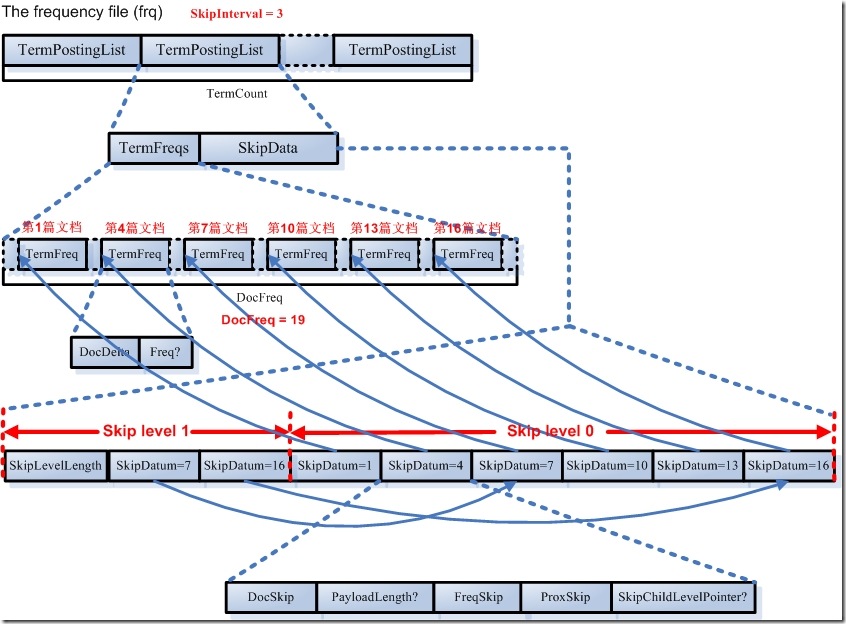
>   the index format in lucene 2.9.3 is
> http://lucene.apache.org/java/2_9_3/fileformats.html#Frequencies
>
>  FreqFile (.frq) --> <TermFreqs, SkipData> TermCount
>  TermFreqs --> <TermFreq> DocFreq
>  TermFreq --> DocDelta[, Freq?]
>  SkipData --> <<SkipLevelLength, SkipLevel> NumSkipLevels-1,
> SkipLevel> <SkipDatum>
>  SkipLevel --> <SkipDatum> DocFreq/(SkipInterval^(Level + 1))
>  SkipDatum --> DocSkip,PayloadLength?,FreqSkip,ProxSkip,SkipChildLevelPointer?
>  DocDelta,Freq,DocSkip,PayloadLength,FreqSkip,ProxSkip --> VInt
>  SkipChildLevelPointer --> VLong
>
>  which can be summarized in this image
> http://hi.csdn.net/attachment/201002/2/3634917_1265115903L6FU.jpg
>
>  I just want to modify compression algorithm from VInt to PForDelta.
>  But PForDelta is batching method that compress/decompress an integer
> array while VInt decode/encode one by one.
>  The main implementation of TermDocs is SegmentTermDocs.
>  And some important methods are
>  void seek(TermInfo ti, Term term)
>  public int read(final int[] docs, final int[] freqs)
>  public boolean next()
>  public boolean skipTo(int target)
>
>  There are 2 major type of search: disjunction and conjuction
>  for conjuction, we decode all the docList and frequency so public
> int read(final int[] docs, final int[] freqs) is needed
>  for disjuction, in ConjunctionScorer doNext function does the major job
>  private int doNext() throws IOException {
>    int first = 0;
>    int doc = scorers[scorers.length - 1].docID();
>    Scorer firstScorer;
>    while ((firstScorer = scorers[first]).docID() < doc) {
>      doc = firstScorer.advance(doc);
>      first = first == scorers.length - 1 ? 0 : first + 1;
>    }
>    return doc;
>  }
>  which finally call TermScorer.advance() which call
>  boolean result = termDocs.skipTo(target);
>  e.g. term1's docList 1 10 100
>        term2's docList 1 2 3 .. 100
>  then with skipList, we don't need decode all the docIds of term2
>
>  That's my understanding of lucene 2.9.3's implementation
>
>  Now I need integrating PForDelta
>  My plan is as follows:
>  1 if df<128 stay VINT not changed return
>  2 compress 128 ints into groups. docList and tf are stored separately
>         e.g.    docList 1--128, tf 1--128  |  docList 129-256,tf 129-256 | ...
>  3 skipList's leaf point to group start position (in 2.9.3 leaf of
> skipList point to the position of exact position of this document)
>  4 for disjunction query, we decode the whole group for docID and tf
> and cache the int array of this group
>     for conjuction query, we also decode the whole group and cache
> the group result of docID and tf(maybe tf is not needed because it
> don't occur in other terms, but for now we don't  want to modify score
> algorithm)
>
>  Comparision with VINT
>  for disjunction query, both need decode all the docIDs and tfs. So
> PForDelta will be faster.
>  for conjunction query,it's hard to analyze
>  e.g. skipInterval is 1024 if we skipTo 10 and then 1100 then VINT
> only need decode 10 docIDs while PForDelta need decode the 128 docIDs
>  e.g. skipInteval is 1024 if we skipTo 10 and then 100. VINT need
> decode 100 docIDs while PForDelta need also decode 128 docIDs
>  I think PForDelta also support parial decode but don't know it's
> speed is fast or slow comparing with VINT.
>
>  So the group size is critical,if it's too large, conjuction query
> may become slow. if it's too small, disjuction query may become slow.
>  I found 128 in paper Performance of Compressed Inverted List Caching
> in Search Engines
>   any other good method to improve both disjunction and conjuction
> query? Or any suggestion for me ?
>  Thank you !
>
> ---------------------------------------------------------------------
> To unsubscribe, e-mail: [email protected]
> For additional commands, e-mail: [email protected]
>
>

---------------------------------------------------------------------
To unsubscribe, e-mail: [email protected]
For additional commands, e-mail: [email protected]