XiaoyiPeng opened a new issue #3528:
URL: https://github.com/apache/rocketmq/issues/3528
**BUG REPORT**
1. Please describe the issue you observed:
Connections to RocketMQ brokers are often refused in high-load production
environments !
On the server, the number of sockets in the ESTABLISHED state is less
than one thousand.
2. Please tell us about your environment:
CentOS Linux release 7.6.1810
3. Other information (e.g. detailed explanation, logs, related issues,
suggestions how to fix, etc):
Connections to RocketMQ brokers are often refused in high-load production
environments, and on the server, the number of sockets in the ESTABLISHED
state is less than one thousand.
We debug the code, find `ChannelOption.SO_BACKLOG` is hard coded with
value 1024 in class org.apache.rocketmq.remoting.netty.NettyRemotingServer, as
shown below :
```
ServerBootstrap childHandler =
this.serverBootstrap.group(this.eventLoopGroupBoss,
this.eventLoopGroupSelector)
.channel(useEpoll() ? EpollServerSocketChannel.class :
NioServerSocketChannel.class)
.option(ChannelOption.SO_BACKLOG, 1024)
.option(ChannelOption.SO_REUSEADDR, true)
.option(ChannelOption.SO_KEEPALIVE, false)
.childOption(ChannelOption.TCP_NODELAY, true)
.childOption(ChannelOption.SO_SNDBUF,
nettyServerConfig.getServerSocketSndBufSize())
.childOption(ChannelOption.SO_RCVBUF,
nettyServerConfig.getServerSocketRcvBufSize())
.localAddress(new
InetSocketAddress(this.nettyServerConfig.getListenPort())
```
But according to the JDK documentation in
**`java.nio.channels.ServerSocketChannel`**, this value **`backlog`** means
**maximum number of pending connections** instead of completely established
connection, as shown below :
```
* @param local
* The address to bind the socket, or {@code null} to bind to an
* automatically assigned socket address
* @param backlog
* The maximum number of **pending connections**
*
* @return This channel
*/
public abstract ServerSocketChannel bind(SocketAddress local, int
backlog)
throws IOException;
```
I looked at the implementation of this method
`sun.nio.ch.ServerSocketChannelImpl#bind` in the OpenJDK ,as show below :
```
private SocketAddress netBind(SocketAddress local, int backlog) throws
IOException {
InetSocketAddress isa;
if (local == null) {
isa = new InetSocketAddress(Net.anyLocalAddress(family), 0);
} else {
isa = Net.checkAddress(local, family);
}
@SuppressWarnings("removal")
SecurityManager sm = System.getSecurityManager();
if (sm != null)
sm.checkListen(isa.getPort());
NetHooks.beforeTcpBind(fd, isa.getAddress(), isa.getPort());
Net.bind(family, fd, isa.getAddress(), isa.getPort());
Net.listen(fd, backlog < 1 ? 50 : backlog);
return Net.localAddress(fd);
}
```
in class `sun.nio.ch.Net`, it calls the native method as shown below:
```static native void listen(FileDescriptor fd, int backlog) throws
IOException;```
And I guess it invoke linux system call `int listen(int sockfd, int
backlog);` , In the official documentation, the following explanation is found:
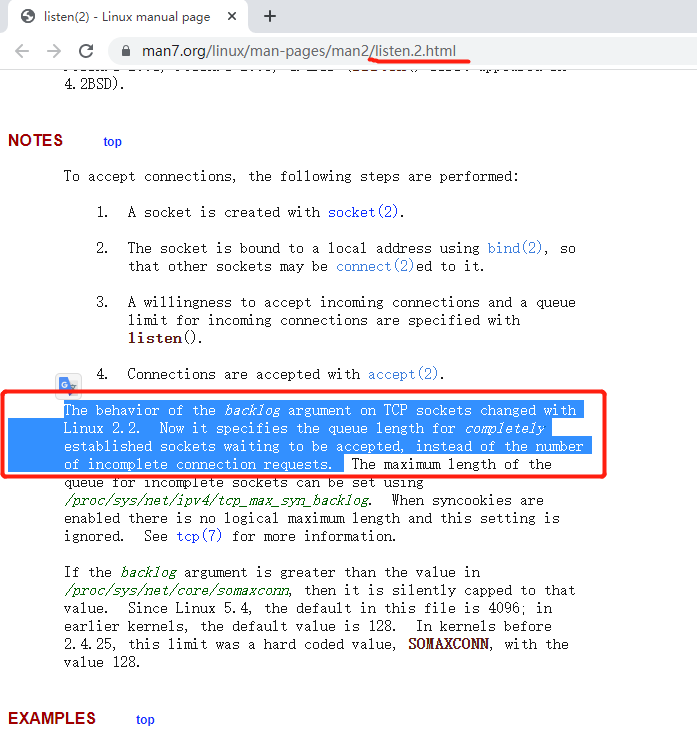
**Attention :**
**The behavior of the `**backlog** `argument on TCP sockets changed with
Linux 2.2. Now it specifies the queue length for completely established
sockets waiting to be accepted, instead of the number of incomplete connection
requests.**
To summarize, everything can be explained.
--
This is an automated message from the Apache Git Service.
To respond to the message, please log on to GitHub and use the
URL above to go to the specific comment.
To unsubscribe, e-mail: [email protected]
For queries about this service, please contact Infrastructure at:
[email protected]

