>
> Send Discuss-gnuradio mailing list submissions to
>     [email protected]
>
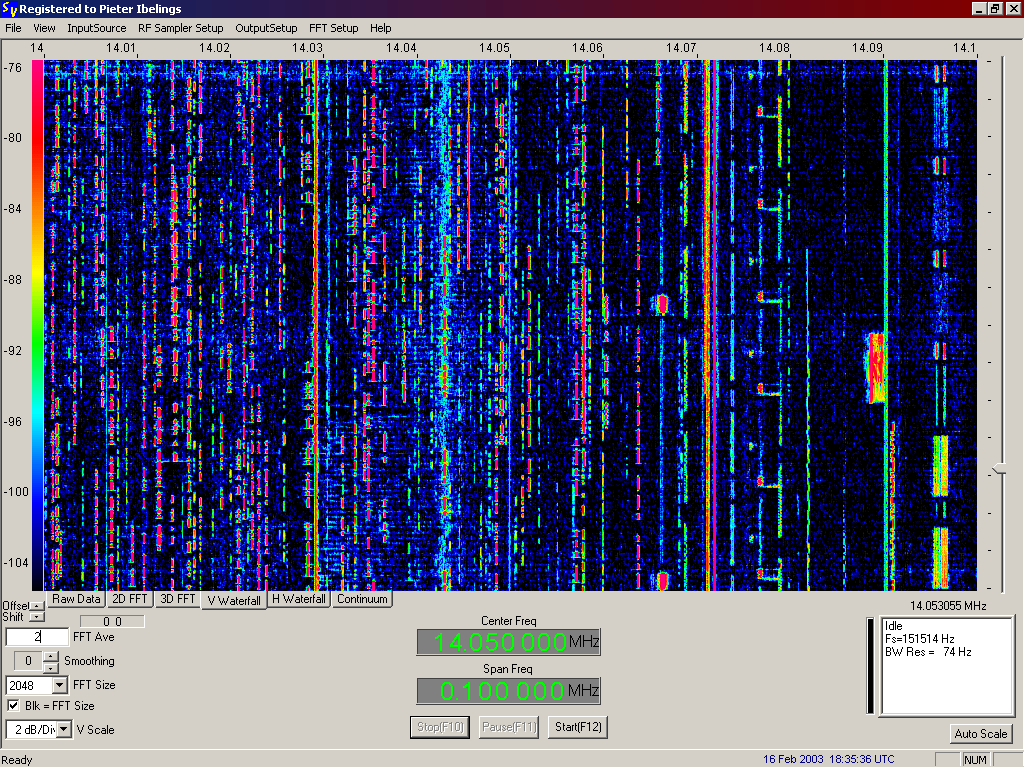
> To subscribe or unsubscribe via the World Wide Web, visit
>     http://lists.gnu.org/mailman/listinfo/discuss-gnuradio
> or, via email, send a message with subject or body 'help'
> to
>     [EMAIL PROTECTED]
>
> You can reach the person managing the list at
>     [EMAIL PROTECTED]
>
> When replying, please edit your Subject line so it is more
> specific than "Re: Contents of Discuss-gnuradio digest..."
>
>
> Today's Topics:
>
>    1. Re: interpolation and output level (Eric Blossom)
>    2. Re: html formatted emails (Eric Blossom)
>    3. Re: interpolation and output level (Javs)
>    4. Re: Looking for signals (Dan Gisselquist)
>    5. An question on wfm_rcv_gui.py (Dawei Shen)
>    6. Re: Query on GPS (David Bengtson)
>    7. Re: Query on GPS (Krzysztof Kamieniecki)
>    8. Re: Query on GPS (Eric Blossom)
>    9. RE: Query on GPS (Robert McGwier)
>
>
> ----------------------------------------------------------
> ------------
>
> Message: 1
> Date: Fri, 18 Mar 2005 15:05:26 -0800
> From: Eric Blossom <[EMAIL PROTECTED]>
> Subject: Re: [Discuss-gnuradio] interpolation and output
> level To: Javs <[EMAIL PROTECTED]>
> Cc: [email protected]
> Message-ID: <[EMAIL PROTECTED]>
> Content-Type: text/plain; charset=us-ascii
>
> On Fri, Mar 18, 2005 at 02:05:24PM -0800, Javs wrote:
> >
> > Hello ppl,
> >
>
> > I understand that the interpolation factor changes the
> > amplitudes of the signals. The default usrp_siggen.py
> > works fine and I can admire 16mV and 100 K on the scope.
> > But if I use the default intrp of 64 in the example
> > usrp_siggen.py and try to change the amplitude levels
> using -a option, the signals still come down. Any guesses
> why ?
>
> What value's are you trying with the -a option?
> Keep them <= 16000.
>
> > Also, When I first boot my USRP and try an example, it
> > fails for the first time. For instance, I tried
> > tx_check.py and i had a runtime error. However, it works
> > fine the second time. Is this because, it takes its time
> > to load firmware into the FX2 and the FPGA or am I
> missing something here ?
>
> What's the error?
>
> Eric
>
>
>
>
> ------------------------------
>
> Message: 2
> Date: Fri, 18 Mar 2005 16:04:09 -0800
> From: Eric Blossom <[EMAIL PROTECTED]>
> Subject: Re: [Discuss-gnuradio] html formatted emails
> To: Berndt Josef Wulf <[EMAIL PROTECTED]>
> Cc: [email protected]
> Message-ID: <[EMAIL PROTECTED]>
> Content-Type: text/plain; charset=us-ascii
>
> On Sat, Mar 19, 2005 at 10:08:27AM +1030, Berndt Josef
> > Wulf wrote: G'day,
> >
> > I've just received a message that my subscription was
> > disabled due to  excessive bounces. Further
> > investigations revealed that this is due to the
> mailserver rejecting HTML formatted emails.  This type of
> > email accounts for  80% of spam received here and hence
> > this rule is of great relief.
> > Is there an option to select "prefer text format" on
> this list?
>
> As far as I can tell, the only way it comes is non-HTML.
>
> I deliberately don't use an html capable mail reader, and
> very rarely see HTML on the list.
>
> FYI, your mail was bouncing because your mailbox was full.
>
> Eric
>
>
>
>
> ------------------------------
>
> Message: 3
> Date: Fri, 18 Mar 2005 16:52:34 -0800 (PST)
> From: Javs <[EMAIL PROTECTED]>
> Subject: Re: [Discuss-gnuradio] interpolation and output
> level To: Eric Blossom <[EMAIL PROTECTED]>
> Cc: [email protected]
> Message-ID:
> <[EMAIL PROTECTED]>
> Content-Type: text/plain; charset=us-ascii
>
> Hey Eric,
>
> I tried various values for the amplitude and looks
> like  it works fine anywhere between 10000 and 35000,
> giving me ~= 10mV and 35mV respectively. But anywhere
> below or beyond its behaving erratic. Is this the
> boundary ?
>
> And here is what I get when I boot my usrp and run the
> tx_check.py the first time.
>
> [EMAIL PROTECTED] usrp]$ ./tx_check.py usrp: found usrp rev2
> usrp_open_interface: usb_claim_interface: failed conf
> 0
> could not set config 1: Operation not permitted
> open_nth_cmd_interface: open_cmd_interface failed
> Traceback (most recent call last):
>   File "./tx_check.py", line 78, in ?
>     main ()
>   File "./tx_check.py", line 70, in main
>     sg = siggen ()
>   File "./tx_check.py", line 17, in __init__
>     self._instantiate_blocks ()
>   File "./tx_check.py", line 53, in
> _instantiate_blocks
>     self.usrp = usrp.sink_c (0, self.interp)
>   File
> "/usr/local/lib/python2.3/site-packages/gnuradio/usrp1.py"
> , line 692, in sink_c
>     return _usrp1.sink_c(*args)
> RuntimeError: std::runtime_error
>
> ---------
>
> Thanks for looking into it.
>
> Javs
>
> --- Eric Blossom <[EMAIL PROTECTED]> wrote:
> > On Fri, Mar 18, 2005 at 02:05:24PM -0800, Javs
> > wrote:
> > >
> > > Hello ppl,
> > >
> >
> > > I understand that the interpolation factor changes
> > the amplitudes of
> > > the signals. The default usrp_siggen.py works fine
> > and I can admire
> > > 16mV and 100 K on the scope. But if I use the
> > default intrp of 64 in
> > > the example usrp_siggen.py and try to change the
> > amplitude levels
> > > using -a option, the signals still come down. Any
> > guesses why ?
> >
> > What value's are you trying with the -a option?
> > Keep them <= 16000.
> >
> > > Also, When I first boot my USRP and try an
> > example, it fails for the
> > > first time. For instance, I tried tx_check.py and
> > i had a runtime
> > > error. However, it works fine the second time. Is
> > this because, it
> > > takes its time to load firmware into the FX2 and
> > the FPGA or am I
> > > missing something here ?
> >
> > What's the error?
> >
> > Eric
> >
>
> __________________________________________________
> Do You Yahoo!?
> Tired of spam?  Yahoo! Mail has the best spam protection
> around  http://mail.yahoo.com
>
>
>
>
> ------------------------------
>
> Message: 4
> Date: Sat, 19 Mar 2005 05:55:56 +0000
> From: Dan Gisselquist <[EMAIL PROTECTED]>
> Subject: Re: [Discuss-gnuradio] Looking for signals
> To: [EMAIL PROTECTED]
> Cc: [email protected]
> Message-ID: <[EMAIL PROTECTED]>
> Content-Type: text/plain; charset=us-ascii; DelSp=Yes;
> Format=Flowed
>
> I'd like a time of day that's busy.  What I'm looking for
> is an image, for   demonstration purposes, showing several
> different types of signals which are   easily recognizable
> by eye.  So, I figure in the evening (or weekend) US time
> should be perfect.
>
> As for other HF bands ... anything you think that might
> show morse and voice   in the same cut at two separate
> frequencies.  Even better, something that   shows lots of
> morse and more than one channel of voice.  That would be
> perfect.
>
> Thanks, and I really appreciate it!
>
> Dan
>
> On 03/18/2005 09:39:00 AM, [EMAIL PROTECTED] wrote:
> > Dan,
> >
> > I can snap that for you.  What time of day do you want?
> > I'm in the SW US.
> > Any other HF bands?
> >
> > On Fri, 18 Mar 2005, Dan Gisselquist wrote:
> >
> > > Hello all,
> > >
> > > I'm looking for someone who could get me a 30 second
> > cut of the 14 MHz   band
> >
> > > from 14.0 MHz to 14.1 Mhz.  I'm hoping for roughly 30
> > seconds or so.  I figure
> > > 8 bit samples, at 250 ksps, for 30 secs -> about 7.5
> > Mbytes. >
> > > What I'd like is a cut, very similar to the one
> > RFSpace shows at, >
> > > http://www.rfspace.com/images/20_meter_cw.gif
> > >
> > > This is a great demo picture, given that it shows a
> > diverse set of signals all
> > > at the same time.  My only problem is, I'd like to
> > > tinker with how it was generated, the spectral
> > analysis method, the colors in the display, etc. and
> > > to do that I need a real signal.
> > >
> > > Any takers?
> > >
> > > Thanks!
> > >
> > > Dan
> > >
> > >
> > >
> > > _______________________________________________
> > > Discuss-gnuradio mailing list
> > > [email protected]
> > > http://lists.gnu.org/mailman/listinfo/discuss-gnuradio
> > >
> >
> >
>
>
>
>
>
>
> ------------------------------
>
> Message: 5
> Date: Fri, 18 Mar 2005 22:55:49 -0800 (PST)
> From: Dawei Shen <[EMAIL PROTECTED]>
> Subject: [Discuss-gnuradio] An question on wfm_rcv_gui.py
> To: [email protected]
> Message-ID:
> <[EMAIL PROTECTED]>
> Content-Type: text/plain; charset=us-ascii
>
> Hi guys
>
> I got a bit confused by the code for FM demodulator.
> In function parseargs(), why we return freq1 - 128e6
> instead of freq1 itself? What does 128M stand for?
>
> Thanks
>
> Sachi
>
>
>
> __________________________________
> Do you Yahoo!?
> Yahoo! Small Business - Try our new resources site!
> http://smallbusiness.yahoo.com/resources/
>
>
>
>
> ------------------------------
>
> Message: 6
> Date: Sun, 20 Mar 2005 09:21:08 -0500
> From: David Bengtson <[EMAIL PROTECTED]>
> Subject: Re: [Discuss-gnuradio] Query on GPS
> To: Krzysztof Kamieniecki <[EMAIL PROTECTED]>
> Cc: [email protected]
> Message-ID: <[EMAIL PROTECTED]>
> Content-Type: text/plain; charset=ISO-8859-1;
> format=flowed
>
> Hi:
>
> I'm still working on this slowly. I've selected the Maxim
> 2745 as the  best part available that is reasonably
> accessible. I've ordered and  received samples of the part
> from Maxim, and am starting to work on a  block diagram,
> followed by a schematic. This is looking like a RX module
> to plug into the USRP board, and feed data into the FPGA
> for down  sampling and filtering.
>
> Question for folks on the mailing list. I'm a hardware
> engineer, and am  more adept in programming in Matlab and
> solder than Python. Are there  enough folks out there that
> would be interested in helping with the  software to make
> this feasible, as I'm certainly not the guy to write  the
> code. I do feel competent to do the block diagram for the
> software,  although Krys is probably more up to speed on
> that. My guess is that we  would need ~ 2 to 3 folks
> writing code to demodulate the GPS signal and  turn it
> into a location. We can talk about generating hardware, as
> it  looks like the GPS board by itself will be pretty
> cheap, although costs  will have to wait until I have  BOM
>
>
> Dave
>
>
>
> Krzysztof Kamieniecki wrote:
>
> > I love replying to myself.
> >
> > I updated my website with a plot showing the results of
> > a correlator  doing a brute force search thru frequency
> and delay on the real raw data. >
> > Krzysztof Kamieniecki wrote:
> >
> >> I am, slowly but surely. I plan on using the USRP.
> >> I recently got some raw data from a person associated
> with GPStk if  >> you are interested.
> >>
> >> Right now David Bengtson is working on a daughter card.
> >> http://www.keystoneradio.com/GnuGPS.html
> >>
> >> Other links of interest
> >> My page: http://www.kamieniecki.com/krys/gps/
> >> GnuRadio GPS page:
> http://comsec.com/wiki?GlobalPositioningSystem >>
> >> Robert McGwier wrote:
> >>
> >>> Who is working on a GPS receiver for the USRP or other
> hardware >>> in this project?  I would like not to do
> duplication of effort. >>>
> >>> Bob
> >>>
> >>>
> >>>
> >>>
> >>> _______________________________________________
> >>> Discuss-gnuradio mailing list
> >>> [email protected]
> >>> http://lists.gnu.org/mailman/listinfo/discuss-gnuradio
> >>>
> >>
> >
>
>
>
>
>
> ------------------------------
>
> Message: 7
> Date: Sun, 20 Mar 2005 12:55:51 -0500
> From: Krzysztof Kamieniecki <[EMAIL PROTECTED]>
> Subject: Re: [Discuss-gnuradio] Query on GPS
> To: [email protected]
> Cc: [EMAIL PROTECTED]
> Message-ID:
> <[EMAIL PROTECTED]>
> Content-Type: text/plain; charset=ISO-8859-1
>
> Please excuse the spelling errors, I'm using webmail
> today.
>
> Right now it looks like my software does to the
> demodulation and calculation of position into xyz
> coordinates, I'm still looking for enough raw data to be
> able to test the full position calculation.
>
> Major todos:
> -Integration with GNURadio, I think most of the low level
> portions of the GPS reciever will have to be one block,
> because all of the correlators have to be syncronized.
> There is a question as to what this section should output.
> The major problem is that GNURadio blocks can only output
> at one data rate and the correlator outputs are not
> syncronized. So there will need to be a stream of two
> types of packets: unsyncronized C/A symbols from each
> correlator and syncronized snapshots of correlator
> counters to calculate pseudo ranges.
>
> -Integration with GPStk, I think my code is good enough
> for basic testing, but there is so much effort that has
> been put into the GPStk that it doesn't make sense to
> duplicate it.
>
> -Threshold calculation to speedup search.
>
> -Selection of PLL and DLL loop filters,
>
> -High level receiver functionality, including tracking
> only satellites that are in view, almanac managment (ie.
> cold start vs. warm start), ...
>
> Quoting David Bengtson <[EMAIL PROTECTED]>:
> > Hi:
> >
> > I'm still working on this slowly. I've selected the
> > Maxim 2745 as the  best part available that is
> > reasonably accessible. I've ordered and  received
> samples of the part from Maxim, and am starting to work on
> > a  block diagram, followed by a schematic. This is
> > looking like a RX module  to plug into the USRP board,
> > and feed data into the FPGA for down  sampling and
> > filtering.
> > Question for folks on the mailing list. I'm a hardware
> > engineer, and am  more adept in programming in Matlab
> > and solder than Python. Are there  enough folks out
> > there that would be interested in helping with the
> software to make this feasible, as I'm certainly not the
> > guy to write  the code. I do feel competent to do the
> > block diagram for the software,  although Krys is
> > probably more up to speed on that. My guess is that we
> would need ~ 2 to 3 folks writing code to demodulate the
> > GPS signal and  turn it into a location. We can talk
> > about generating hardware, as it  looks like the GPS
> > board by itself will be pretty cheap, although costs
> > will have to wait until I have  BOM
> >
> > Dave
> >
> >
> >
> > Krzysztof Kamieniecki wrote:
> >
> > > I love replying to myself.
> > >
> > > I updated my website with a plot showing the results
> > > of a correlator  doing a brute force search thru
> > frequency and delay on the real raw data. >
> > > Krzysztof Kamieniecki wrote:
> > >
> > >> I am, slowly but surely. I plan on using the USRP.
> > >> I recently got some raw data from a person associated
> > with GPStk if  >> you are interested.
> > >>
> > >> Right now David Bengtson is working on a daughter
> > card. >> http://www.keystoneradio.com/GnuGPS.html
> > >>
> > >> Other links of interest
> > >> My page: http://www.kamieniecki.com/krys/gps/
> > >> GnuRadio GPS page:
> > http://comsec.com/wiki?GlobalPositioningSystem >>
> > >> Robert McGwier wrote:
> > >>
> > >>> Who is working on a GPS receiver for the USRP or
> > other hardware >>> in this project?  I would like not to
> > do duplication of effort. >>>
> > >>> Bob
> > >>>
> > >>>
> > >>>
> > >>>
> > >>> _______________________________________________
> > >>> Discuss-gnuradio mailing list
> > >>> [email protected]
> > >>>
> > http://lists.gnu.org/mailman/listinfo/discuss-gnuradio
> > >>> >>
> > >
> >
> >
> >
> > _______________________________________________
> > Discuss-gnuradio mailing list
> > [email protected]
> > http://lists.gnu.org/mailman/listinfo/discuss-gnuradio
> >
>
>
>
>
> ------------------------------
>
> Message: 8
> Date: Sun, 20 Mar 2005 10:33:53 -0800
> From: Eric Blossom <[EMAIL PROTECTED]>
> Subject: Re: [Discuss-gnuradio] Query on GPS
> To: [EMAIL PROTECTED]
> Cc: Krzysztof Kamieniecki <[EMAIL PROTECTED]>,
>     [email protected]
> Message-ID: <[EMAIL PROTECTED]>
> Content-Type: text/plain; charset=us-ascii
>
> On Sun, Mar 20, 2005 at 09:21:08AM -0500, David Bengtson
> > wrote: Hi:
> >
> > I'm still working on this slowly. I've selected the
> > Maxim 2745 as the  best part available that is
> > reasonably accessible. I've ordered and  received
> samples of the part from Maxim, and am starting to work on
> > a  block diagram, followed by a schematic. This is
> > looking like a RX module  to plug into the USRP board,
> > and feed data into the FPGA for down  sampling and
> > filtering.
> > Question for folks on the mailing list. I'm a hardware
> > engineer, and am  more adept in programming in Matlab
> > and solder than Python. Are there  enough folks out
> > there that would be interested in helping with the
> software to make this feasible, as I'm certainly not the
> > guy to write  the code. I do feel competent to do the
> > block diagram for the software,  although Krys is
> > probably more up to speed on that. My guess is that we
> would need ~ 2 to 3 folks writing code to demodulate the
> > GPS signal and  turn it into a location. We can talk
> > about generating hardware, as it  looks like the GPS
> > board by itself will be pretty cheap, although costs
> > will have to wait until I have  BOM
> >
> > Dave
>
> I'll make sure (probably with some help from Matt) that we
> get the daughterboard glued into the GNU Radio framework.
>
> Between Krys, Bob and others, I'm sure we've got plenty of
> folks willing to work on the actual GPS signal processing.
>
> If you build it, they will come ;-)
>
> Eric
>
>
>
>
> ------------------------------
>
> Message: 9
> Date: Sun, 20 Mar 2005 21:33:21 -0000
> From: "Robert McGwier" <[EMAIL PROTECTED]>
> Subject: RE: [Discuss-gnuradio] Query on GPS
> To: <[email protected]>
> Message-ID:
> <[EMAIL PROTECTED]>
> Content-Type: text/plain;    charset="US-ASCII"
>
> We can do this I am sure.  I thank Dave and Krys for the
> advance work they have been doing when not many (any?)
> were "listening". If we allow the FPGA to do (carrier
> phase/code) (acquisition/tracking ) in a joint-detection
> process run on the FPGA, I believe we can do a 12 channel
> receiver.
>
> In addition to this,  Brickle and I have specific
> interests in Cognitive Radio usage of the USRP as a
> wideband front end and likely hooking this in to a system
> with a narrow band SDR to prosecute the signal in a higher
> dynamic range regime.  We are extremely interested in
> active antenna work as well.  I would like to be doing
> four channel beam steering by the time of AMSAT-NA
> symposium this fall.
>
> Bob
>
>
> -----Original Message-----
> From:
> [EMAIL PROTECTED]
> [mailto:[EMAIL PROTECTED]
> org]On Behalf Of Eric Blossom
> Sent: Sunday, March 20, 2005 6:34 PM
> To: [EMAIL PROTECTED]
> Cc: Krzysztof Kamieniecki; [email protected]
> Subject: Re: [Discuss-gnuradio] Query on GPS
>
>
> On Sun, Mar 20, 2005 at 09:21:08AM -0500, David Bengtson
> > wrote: Hi:
> >
> > I'm still working on this slowly. I've selected the
> > Maxim 2745 as the  best part available that is
> > reasonably accessible. I've ordered and  received
> samples of the part from Maxim, and am starting to work on
> > a  block diagram, followed by a schematic. This is
> > looking like a RX module  to plug into the USRP board,
> > and feed data into the FPGA for down  sampling and
> > filtering.
> > Question for folks on the mailing list. I'm a hardware
> > engineer, and am  more adept in programming in Matlab
> > and solder than Python. Are there  enough folks out
> > there that would be interested in helping with the
> software to make this feasible, as I'm certainly not the
> > guy to write  the code. I do feel competent to do the
> > block diagram for the software,  although Krys is
> > probably more up to speed on that. My guess is that we
> would need ~ 2 to 3 folks writing code to demodulate the
> > GPS signal and  turn it into a location. We can talk
> > about generating hardware, as it  looks like the GPS
> > board by itself will be pretty cheap, although costs
> > will have to wait until I have  BOM
> >
> > Dave
>
> I'll make sure (probably with some help from Matt) that we
> get the daughterboard glued into the GNU Radio framework.
>
> Between Krys, Bob and others, I'm sure we've got plenty of
> folks willing to work on the actual GPS signal processing.
>
> If you build it, they will come ;-)
>
> Eric
Hye all

Iam also a hardware engineer and work on FPGA and design
with Digital fundamentals and code on verilog , can u all
tell me where can i fit into this discussion and how can i
help.

Regards

Sarvamiti
>
>
> _______________________________________________
> Discuss-gnuradio mailing list
> [email protected]
> http://lists.gnu.org/mailman/listinfo/discuss-gnuradio
>
>
>
>
>
>
> ------------------------------
>
> _______________________________________________
> Discuss-gnuradio mailing list
> [email protected]
> http://lists.gnu.org/mailman/listinfo/discuss-gnuradio
>
>
> End of Discuss-gnuradio Digest, Vol 28, Issue 18
> ************************************************


_______________________________________________
Discuss-gnuradio mailing list
[email protected]
http://lists.gnu.org/mailman/listinfo/discuss-gnuradio