On Thu, 2006-06-15 at 02:12 +0200, Martin Dvh wrote:
> Eric Blossom wrote:
> > On Wed, Jun 14, 2006 at 02:00:27PM -0400, Lee Patton wrote:
> >
> >>Hi, folks -
> >>
> >>I'm trying to build an active pulsed radar using GR/USRP. Right now I am
> >>only concerned with the transmission and reception of pulses.  All radar
> >>signal processing will happen offline.  I know Eric is working on
> >>passive radar. Has anyone tried active yet?
> I am also working on passive radar at the moment, not active (yet).
> I would suggest using a chirp signal instead of a pulse.
> It is much more accurate and power efficient.
Thanks a lot Martin.  We are actually hoping to use the returns for SAR.
For that we need a lot of bandwidth on scene -- like 100+ MHz.
Obviously, this can't be done instantaneously, but it can be achieved
via a stepped-frequency waveform.  To that end I am using a 13-bit
barker coded baseband sequence modulated on a (hopefully) stepped
frequency pulse train.  I didn't mention this in my email because the
stepped frequency adds another layer of complexity that I don't know how
to handle right now.  I actually pinged the list about this a while ago
with no response.

http://lists.gnu.org/archive/html/discuss-gnuradio/2006-05/msg00296.html

Basically, I need to step the VCO by (hopefully) 10 MHz between each
pulse.  Since I need this to be correlated with a baseband pulse train
provided by another block, I need to do this in C++ (I think) and not
Python.  It would be very easy to implement in Python, but I never seem
to find the easy way :)  I'll investigate this once I am transmitting
and receiving a pulse train.

>
> > On TX, the idea is to have a timestamp in the header that says "do not
> > transmit before time t".  There will be some way to map "frames"
> > (variable length things possibly bigger or smaller than a USB packet),
> > into something we keep track of across the USB.
> It would also be handy to have a feedback-path for TX.
> The fpga could report back:
> TX packet AAA was transmitted on timestamp XXXX
> Then you can also send continuous streams (of packets) and still have exact
> synchronisation with RX.
> (RX packet BBB was received on timestamp YYYY)
>
>
> On my passive radar experiments.
> After doing a lot of simulation I am now trying to do real-world
> passive-radar using the usrp and just basic RX-boards with simple standard
> cheap FM/TV antenna-amplifiers in front of them.
> (I still need better filtering of the FM band)
>
> I do get signals, but it is probably not an accurate radar image.
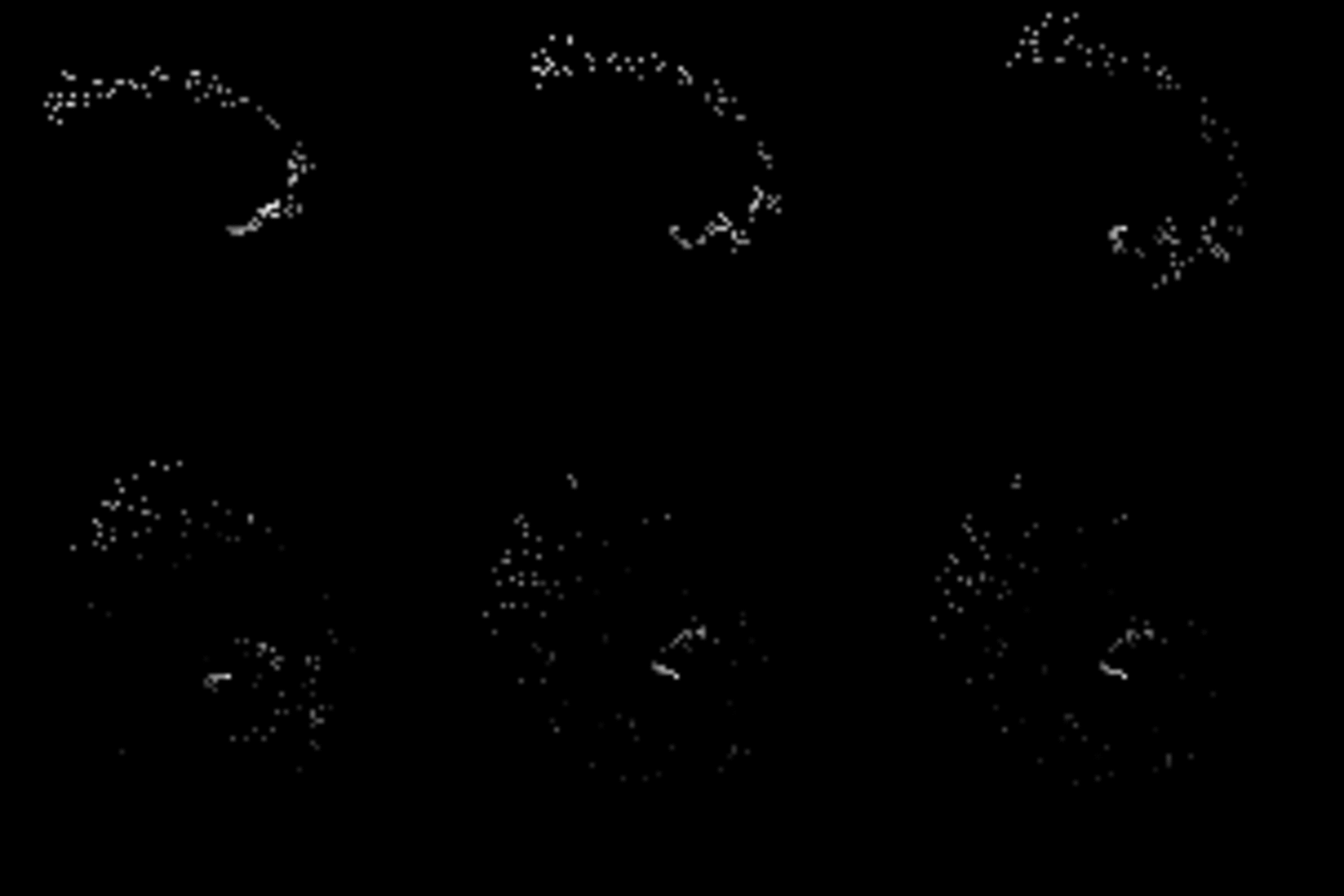
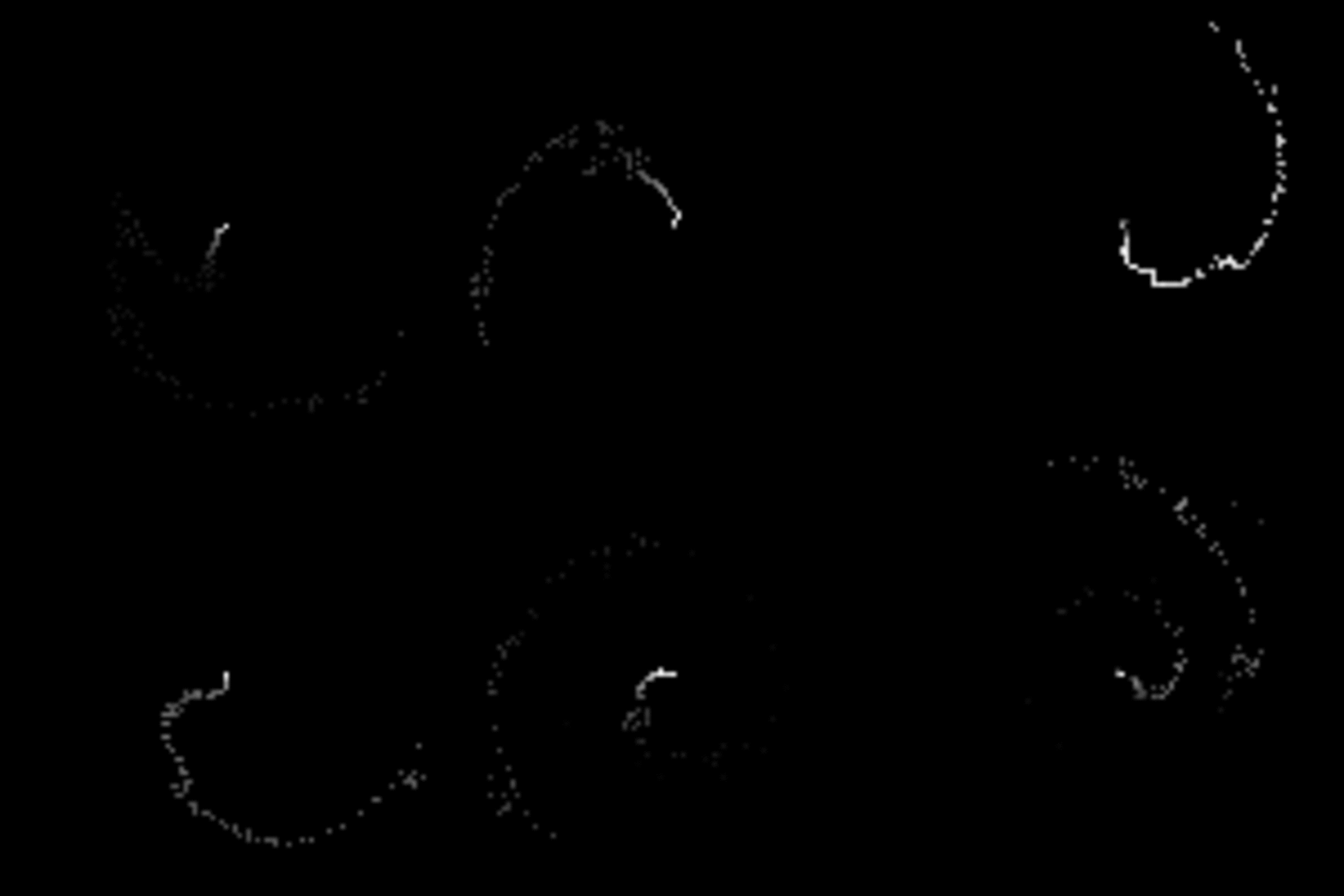
> If I plot slant-range (the total distance transmitter-object-receiver)
> against received phasediff between my two antenna's I get allways spirals.
> This would suggest I have a doppler-shift which allways increases with
> objects further away which is not very logical.

I'm not familiar with this method of slant range vs. phase difference.
Usually, I plot range vs. Doppler.  I would like to learn more, do you
have a reference you can point me to?  Do you have range-Doppler images
of this data?

> If I correlate with different doppler shifts my spirals turn around but they
> keep being spirals.
> In this image I change the doppler shift in every frame
> http://www.olifantasia.com/projects/gnuradio/mdvh/passive_radar/passive_radar_time_is_time_x_arc_is_phasediff_length_is_slantrange.gif
> In this image every frame is from samples further in time.
> http://www.olifantasia.com/projects/gnuradio/mdvh/passive_radar/passive_radar_time_is_doppler_x_arc_is_phasediff_length_is_slantrange.gif
>
> Greetings,
> Martin


_______________________________________________
Discuss-gnuradio mailing list
[email protected]
http://lists.gnu.org/mailman/listinfo/discuss-gnuradio