Ruoyu,
First off, Singapore is a very noisy place (From a radio perspective), so you
are going to have to pair any external low noise amplifiers with appropriate
filters for your signals of interest. It is vital that none of the components
in the radio signal chain receivers too much power which can lead to
non-linearity and ultimately to damage to the radio. Placing a very high gain
amplifier such as you have, in conjunction with a wide band antenna is not a
safe proposition with a USRP daughter board, other loud and local signals will
overwhelm the initial analog stages of the radio. I find even when using a dish
pointed skywards in an urban area that introducing a wideband LNA without a
filter causes other local cellular (etc) signals to saturate my USRP frontend.
When I'm working with satellite signals close in frequency the Iridium signals
you are interested in (~1.6GHz)  I use a combination of a Minicircuits
ZX60-242GLN-S+ LNA and a NBP-1560+ bandpass filter with good results with a
variety of USRP's/daughter boards. For weather satellites in the 137MHz band
(which is the same band as the Orbcomm downlink) I use a custom LNA+filter from
SSB in Germany. In both cases gain is approximately 30dB and the noise figures
very low, typical numbers for LNA's ideal for satellite use are 0.4-0.8dB NF.

You should rethink your antenna(s) completely, Orbcomm use a right hand
circular polarized signal for their downlink and you could thus use any antenna
design that was intended for use to receive NOAA's APT weather satellite signal
…you will find many references on how to build these if you google "APT
antenna"….here's one incredibly simple example of a less than ideal, but simple
solution that worked fine: http://websterling.com/tsro/apt/. In fact listening
to the APT signal from NOAA-16, NOAA-18 and NOAA-19 may be a good starting
point for you to develop your skills.

Iridium is also a RHCP signal, and in those bands people typically use a patch
or helix antenna for these types of signal, both can be built quite easily and
at low cost.

You should also familiarize your self with the open source software, "predict"
and "gpredict"  (There are others but these are recommended), as it is
important to know when (and where with a directional antenna) your signal of
interest is actually visible in the sky.

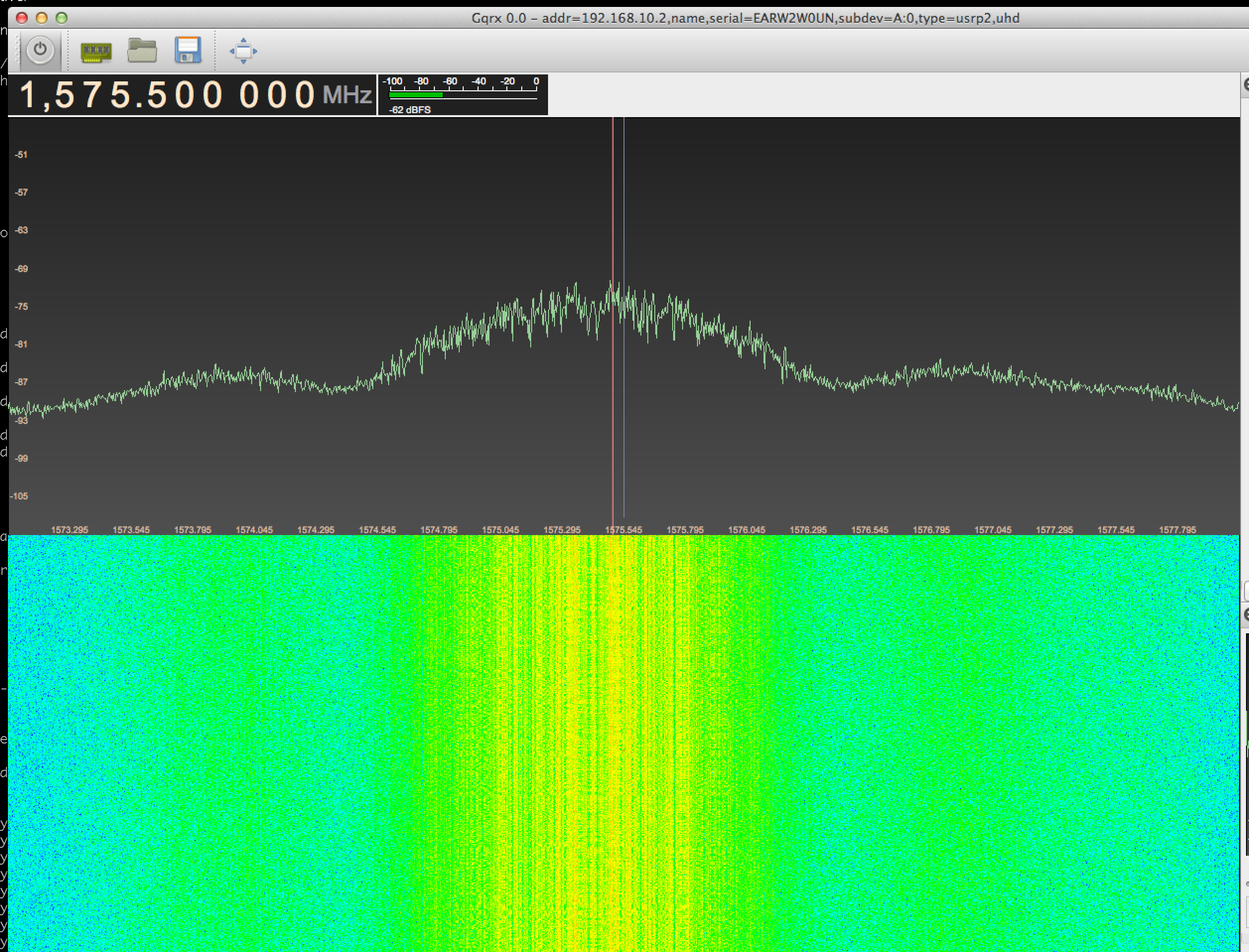
And lastly GPS L1…..in the last few weeks I happen to have been listing to this
with Balint from Ettus whilst we have been testing some antennas and other
hardware. A USRP nor any other radio is going to see the raw signal above the
noise floor with an omnidirectional antenna, the magic of GPS is all down to
spread-specturm processing gain and is an interesting study if you have the
time. One quick trick is to use autocorrelation to look for the signals, since
the L1 C/A spreading code repeats every 1mS, it's relatively easy to prove it's
there even though you can not see it in the FFT. And if your curious about what
it looks like when you work a little harder to listen to it, then a USRP (SBX
in this case) and a 1 meter dish prove more than sufficient:
http://ionconcepts.com/ionconcepts/signals/L1-signal.png

-Ian


On Sep 4, 2013, at 1:12 AM, Chi <[email protected]> wrote:

> Hi, All
>
>
> I am working on a project which requires to receive signals from LEO
> satellites like orbcomm and iridium.
> I tried to use USRP N210 to collect the data, but I found the signal may be
> too weak to be observed.
>
> Stuffs I used:
> 1. USRP N210, DBSRX2 800-2400MHz
> 2. Minicircuit cable amplifier, provides 37 dB gain at 15V/0.68A supply
> input. To ensure signal is enough enhanced, I used two of them in recent
> experiments.
> 3. Horn antenna with frequency range from 0.8 - 18 GHz. beamwidth 60 degree.
>
> After connected all things and warming up, I run "uhd_fft" to check if
> signals can be seen in frequency domain. I expected a peak around the center
> frequency. However, it is just noise. But if I turned center frequency to GSM
> band, it showed signal clearly. And then I turned it to 1.57542 GHz, which is
> the L1 band of GPS, it also shows nothing but noise.
>
> So, I am wondering if it is because the signal it too weak to be detected in
> that way.
> Have anyone ever done weak signal detection and collection before with USRP ?
> not only satellite, any weak signals is fine.
>
> If you have done similar project before, could you please tell me how you
> know signal is there if it cannot be seen by FFT. Any other function can help
> ?
>
> Many thanks ahead.
>
>
> Best regards,
>
> Ruoyu
> _______________________________________________
> Discuss-gnuradio mailing list
> [email protected]
> https://lists.gnu.org/mailman/listinfo/discuss-gnuradio
_______________________________________________
Discuss-gnuradio mailing list
[email protected]
https://lists.gnu.org/mailman/listinfo/discuss-gnuradio