Lou, thanks for your interest.  Yes the entire thing was made purely with
GRC and there was no modification to the generated Python.  All that is
required to run the scanoo_rx GRC file unmodified is a UHD compatible
device and an installation done with "./pybombs install uhd gnuradio".
Johnathan's GNURadio Live DVD should work too -
http://gnuradio.org/redmine/projects/gnuradio/wiki/GNURadioLiveDVD .
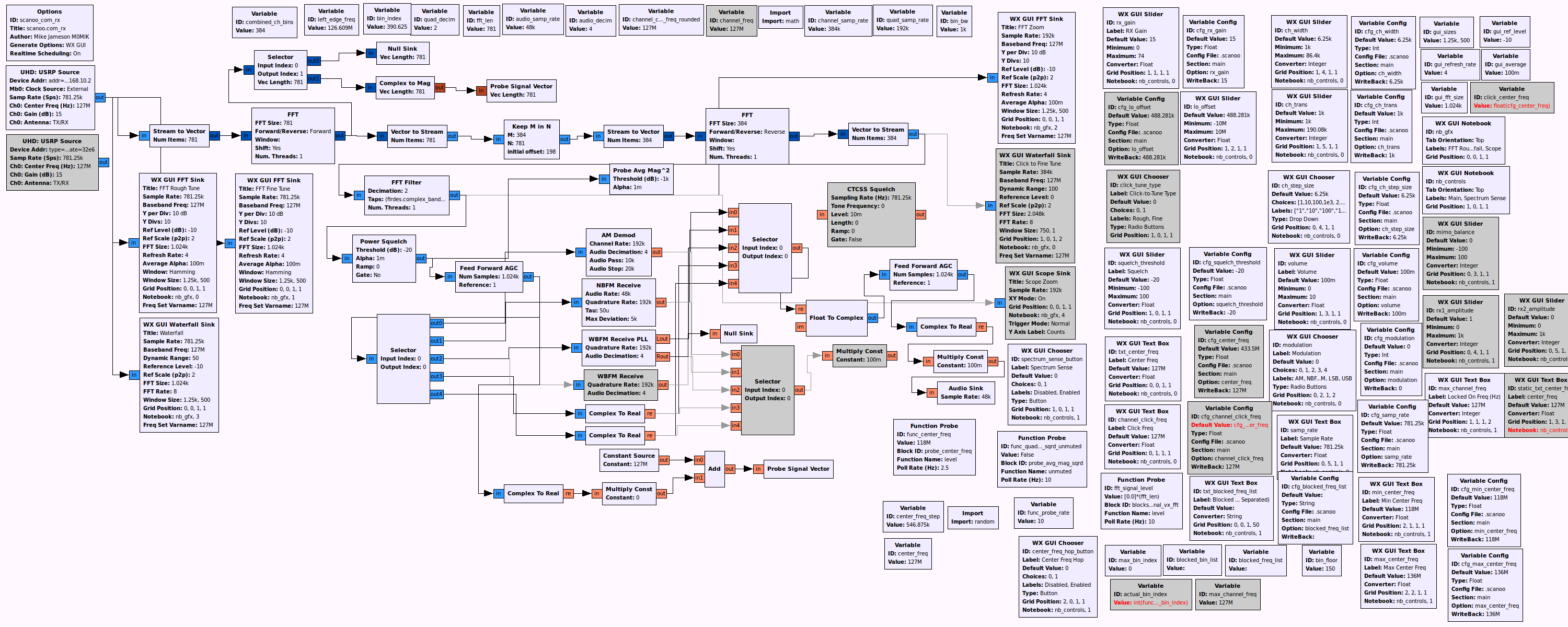
For reference, here is a screenshot of the scanoo_rx GRC flowgraph -
https://raw.githubusercontent.com/m0mik/scanoo/master/apps/scanoo.com_rx.grc.png

Starting at the top left, the 'UHD USRP Source' block receives complex time
domain samples from your UHD compatible SDR hardware and sends these
complex time domain samples to the 'Stream to Vector' block and the three
'WX GUI' display blocks.

The 'Stream to Vector' block sends the complex time domain samples in
vector chunks of size 'fft_len' to the 'FFT' block which outputs the vector
chunks of complex samples in frequency domain format. FYI, the 'WX GUI FFT
Sink' blocks (aka 'FFT Rough Tune'/'FFT Fine Tune') do this internally in
order to display the signals in the frequency domain.

The output of the 'FFT' block is sent to a 'Selector' block which is the
pathway to the 'Probe Signal Vector' block used for spectrum sensing.  The
'FFT' block also sends samples to a 'Vector to Stream' block which puts the
vector chunks back into a single stream of samples in frequency domain
format.

The 'Vector to Stream' block sends the stream of frequency domain samples
to the 'Keep M in N' block which is responsible for picking out the channel
we want and at the same time it decimates the signal to 'channel_samp_rate'
in order to reduce the amount of data processing required for blocks
further down the chain.  The channel is chosen by either a mouse click on
the 'FFT Fine Tune' / 'FFT Zoom' displays or by enabling 'Spectrum Sense'
mode.  When 'Spectrum Sense' mode is enabled, the maximum signal found is
selected as determined by the 'Probe Signal Vector' block.

The 'Keep M in N' block sends the selected complex frequency domain samples
to the 'Stream to Vector' block in order for the samples to be converted
back into complex time domain format by the 'FFT' block which is set to
'Reverse' (IFFT).

The 'FFT' block outputs a vector of complex time domain samples of the
chosen channel and sends these via a 'Vector to Stream' block to an 'FFT
Filter' block. The 'FFT Filter' block is responsible for decimating and
filtering the time domain sample stream.  The bandwidth of the filter is
adjustable in the 'Main' section of the GUI controls and can be seen when
viewing with the 'FFT Zoom' display.  In the 'FFT Filter' block there is
logic to change the filter automatically when the modulation is changed.
AM/NBFM/WBFM use a lowpass filter and LSB/USB use a complex bandpass filter.

>From the 'FFT Filter' block the sample stream is sent at a rate of
'quad_samp_rate' to the 'Power Squelch' block.  This squelch block is
responsible for determining whether the chosen signal is powerful enough to
lock on to.  If so, the samples are passed through a 'Feed Forward AGC' for
signal level normalisation and then on to the audio demodulation blocks via
the modulation 'Selector' block. The 'Probe Avg Mag^2' block after the
'Power Squelch' block is used to halt the spectrum sensing and center
frequency hopping in order to lock onto the selected channel.  This 'Probe
Avg Mag^2' block is also the reason for the signal holding on channel for a
few seconds after the squelch cuts out. This delay is adjustable with the
block's alpha setting.

If there are any queries as to the use of raw FFT bin indexes then I'll be
happy to explain that too, such as in the frequency lockout feature.

Mike

--
Mike Jameson M0MIK BSc MIET
Email: [email protected]
Web: http://scanoo.com


On Tue, Jun 10, 2014 at 5:49 PM, madengr <[email protected]> wrote:

> Mike,
>
> Can you give a general overview of how the program works, and maybe what
> you
> are doing with the FFT and IFFT, and how you accomplish the tuning via
> mouse
> click in GRC?  I assume this is entirely done in GRC and there was no
> modification of the generated Python?
>
> Thanks,
> Lou
> KD4HSO
>
>
>
> Mike Jameson-2 wrote
> > Hi all,
> >
> > The latest version of my scanoo_rx GRC SDR scanning application is now
> > available via GitHub.  Please star the project if you like it and report
> > bugs by creating an issue on the GitHub page.
> >
> >
> > https://github.com/m0mik/scanoo
> >
> > Mike
> >
> > --
> > Mike Jameson M0MIK BSc MIET
> > Email:
>
> > mike@
>
> > Web: http://scanoo.com
>
>
>
>
>
> --
> View this message in context:
> http://gnuradio.4.n7.nabble.com/Scanoo-rx-New-GUI-Center-Freq-Hopping-SSB-Modulation-tp48866p48882.html
> Sent from the GnuRadio mailing list archive at Nabble.com.
>
> _______________________________________________
> Discuss-gnuradio mailing list
> [email protected]
> https://lists.gnu.org/mailman/listinfo/discuss-gnuradio
>
_______________________________________________
Discuss-gnuradio mailing list
[email protected]
https://lists.gnu.org/mailman/listinfo/discuss-gnuradio