Hi,

I would wholly agree with the methods and procedures that you prescribe
throughout this mail and think that there are some very strong points for
those in the start up / design stages to follow.
Yet point 5 flies in the face of so much established knowledge it seems as
though its been thrown in to check if people read that far.

With out the need to list the backdrop of various papers that show the
strength in getting the views of more than just the design team. You seem to
have put a glib statement in and offered weak rational as to why you view it
as the case.

Regards,

B Hendy

 -----Original Message-----
From: [email protected] [mailto:[email protected]] On Behalf Of Thomas
Petersen
Sent: 14 September 2009 22:46
To: [email protected]
Subject: [IxDA Discuss] What are your principles for making
digitalproducts/services

I would like to hear what principles different people use when making
digital products.

Here is a the most fundamental of mine:

1. Start simple, stay simple.

It cannot be said enough. Less is more - much more, and there is a
very good explanation that it pays to understand.

If you do less you can measure more. If you can measure more you can
better experiment with what works.

Most products are simple, based on simple insights. Make sure that
you stay true to that idea as you develop until you know you have
done everything possible to test it. Don't add new features and think
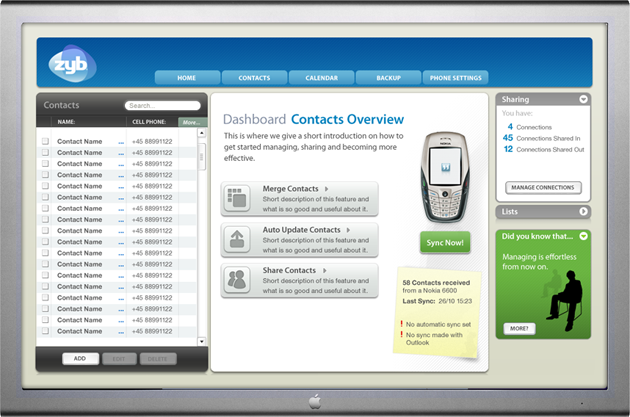
that it will help, it wont, not yet. When Zyb was designed in 2005
they made sure to make their product as focused around the
administration of mobile data. They didn't change until they had
tried out different possibilities to see what worked.

http://000fff.org/wp-content/uploads/2009/03/021.png

2. Build to integrate.

Think about whether your product could be a good extension to already
existing products/services. That way you are tapping into the already
existing digital ecosystems out there. This will make it easier for
people to adopt your product and provide you with a trust factor that
you have a very hard time obtaining on your own.

3. Don't confuse change with improvement.

One of the biggest challenges when record artist produce their albums
is the fatigue from listening to the same riffs over and over. It's
one of the reasons why many of them have a problem listening to the
album when it's finally out. Startups as intense and time consuming
as they often are can be similar. It's very tempting after a couple
of months of looking at the same interface over and over to want to
change it.  Don't submit to this whether you are a manager, designer,
& developer. stay on target.

You are making this for your customers not yourself and they, unlike
you haven't seen anything before.

4. Don't do everything that is possible only what is necessary.

Constrain yourself. A good product has limitations. It doesn't just
succumb to every temptation that comes along. Focus on what makes the
product the product and only add features if you get clear signs that
it is needed. Most users will have to learn your product anyway so
don't try to impress them with features that might be cool but that
is simply not elemental to your success. I-Tunes have many flaws,
Basecamp from 37Signals leaves a lot to be asked for, but when all is
said and done, their products are rock solid and there is no feature
like the solid feature.

5. Don't do usability tests or focus groups.

I could write a whole book about why usability test and focus groups
are bad for you and your customers but I wont. Instead I will offer
the following few observations.

Most products are fairly simple and most of the testing can be done
in house.

Most usability tests are not even close to reflect any realistic
version of the environment your product will end up in.

The mistakes that you might find are not going to be those that will
determine the success of your company.

Many usability tests consist of max 10 people which is simply not a
significantly high enough number to make any decisions based on. The
single best solution is to start simple simple and make sure you can
measure how people use your product. If people are having problems
you will find out soon enough and you will find out where it
matters.

6. Think how, not what

The feature war is over, actually it's been for a long time. So much
can be gained from thinking about how to make the features that you
have stand out and ad value. If you can solve it on the back-end then
do it. When I started working on the Nasdaq Market Replay application
I soon realized (as most people probably did) that market data is
kind of like a sound sample. Once that insight was made we approached
stock info like we would music. This meant that you could trim your
stock sample and replay it like a piece of music.

http://www.adobe.com/resources/business/rich_internet_apps/?ogn=EN_US-gntray
_sol_ria#nasdaq


________________________________________________________________
Reply to this thread at ixda.org
http://www.ixda.org/discuss?post=45640

________________________________________________________________
Welcome to the Interaction Design Association (IxDA)!
To post to this list ....... [email protected]
Unsubscribe ................ http://www.ixda.org/unsubscribe
List Guidelines ............ http://www.ixda.org/guidelines
List Help .................. http://www.ixda.org/help

________________________________________________________________
Welcome to the Interaction Design Association (IxDA)!
To post to this list ....... [email protected]
Unsubscribe ................ http://www.ixda.org/unsubscribe
List Guidelines ............ http://www.ixda.org/guidelines
List Help .................. http://www.ixda.org/help