>* Do we really want to invite the non-interested public to watch us argue
about internal strife and politics?
 I can understand moving internal strife to members@  so we aren't
bombarding the general community with our ramblings but big issues and
fundamental disagreements are going to be brought up at meetings which are
public. We have people from all walks of life show up out of the blue.
Since we are a public organization interested in transparency I don't see
the point of sweeping our strife under the rug. Sure we're going to make
mistakes(*http://tinyurl.com/8tjspo4 <http://tinyurl.com/8tjspo4>)*  but
why hide them? So long as we learn from them and don't repeat them there's
no shame in it.  If people are concerned with public appearance and not
looking like a bunch of fools with a warehouse all they have to do is
remember   that their emails are public and the internet never forgets.

>* Meetings take way too freakin' long

Meetings only go on forever when there are things that need
discussing/hashing out. I know everyone would have been happier if the
meeting on Tuesday hadn't gone on for 3 hours, but nothing would have
gotten solved. I would guesstimate that the average meeting takes an hour.
There are just as many 7 minute meetings as there are 3 hour meetings.
I'm not entirely against the idea but I don't see it radically changing
things. Maybe I'm wrong.
Maybe moving proposal discussion to email will allow people to argue their
point better, but if we've got the concerned parties in the same place at
the same time why force them to take it to their inbox? There was a
proposal some time ago to require people or their proxy to be present at
the meeting in order to make decisions on proposals. By moving all
discussion and blocking ability to the digital world we circumvent this
requirement. We are a physical space made up of real people. We have to
interact with each other at some point.

regards,
Andrew L


On Fri, Mar 21, 2014 at 12:49 AM, Torrie Fischer
<[email protected]>wrote:

> Another lengthy mail wherein I try to rouse more discussion about decision
> making at SYNHAK.
>
> Right now I see two related discussions regarding implementing consensus at
> SYNHAK:
>
> * A separate list for discussion about bureaucracy
> * Blocking can be abused to halt progress
>
> I think that there is a third issue that should be considered, that is
> implied
> by the first that Alex brought up:
>
> * Do we really want to invite the non-interested public to watch us argue
> about internal strife and politics?
>
> And a fourth that I think 100% of the membership wants to solve:
>
> * Meetings take way too freakin' long
>
> Lets face it, meetings aren't friendly to people who just want to visit the
> space and see what we've got to offer. Maybe we should stop catering them
> to
> the public who isn't interested in governance and instead use an opt-in
> system. This is actually something that's been on my mind for a while, but
> Alex's post made me start thinking a bit more about a workable
> implementation.
> I feel that this also goes along with my mantra of "You can be as member as
> you want to be".
>
> Perhaps we can modify the order of our weekly meeting agenda and repurpose
> the
> meeting to take on the full role of a governance mechanism.
>
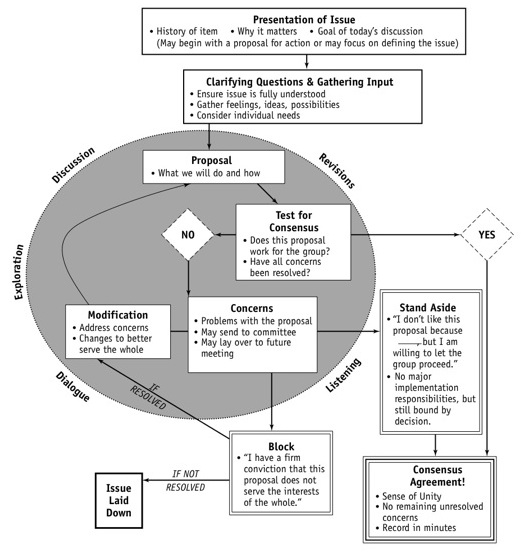
> To start, here's a neat diagram that illustrates a common process for
> consensus:
>
> http://howtosavetheworld.ca/images/consensus.jpg
>
> Don't focus on the blocking. Instead, focus on how proposals come to be.
>
> First, an issue is presented. This includes the history of the issue, why
> it
> is important, and the goals of a discussion about the issue.
>
> The issue is then explored and discussed. We gather feelings about the
> topic
> and get a feel for what everyone thinks.
>
> Only after a general idea is formulated from the group feedback does a
> formal
> proposal come about. When a proposal is created, a number of advocates can
> take responsibility for working to reach consensus about it. These
> advocates
> don't need to share the same idea, but they do recognize the importance of
> the
> issue and that it needs to be solved. Without advocates, a formal, written
> proposal cannot be made.
>
> What I'm suggesting, is that the structure of our meeting should be changed
> to:
>
> * Introductions
> * Announcements
> * Membership
> * Financial Report
> * Consensus         <--\
> ** Open Proposals   <--|
> ** Issue Discussion <--/
>
> Discussion and collaboration regarding announcements can happen outside of
> the
> meeting at a different time, or preferably on the discuss@ list. For
> example,
> announcing that you're working on a new project would be nice and would
> show
> up in the minutes, but the meeting wouldn't be used for that.
>
> Proposals would also be gone.
>
> Instead, Consensus would handle the process in that above diagram:
> Discussing
> and presenting current issues, followed by presenting a formal proposal.
> Anyone is free to bring up an issue at the space, and it is discussed for a
> maximum period of time, perhaps 15 to 20 minutes.
>
> If consensus is reached, a formal proposal is written and sent to discuss@.
> If
> not, discussion is moved to the appropriate list by those who wish to
> continue
> discussion. i.e. noc@ for digital infrastructure, bizops@ for financial
> and
> operational details, build@ for physical buildout, bureaucracy@ for
> policies,
> rules, consensus itself, etc. Each list then hosts the discussion for
> relevant
> issues. The discussion that happens works towards having a formal proposal
> that those involved can agree on.
>
> The next issue is brought up, discussed for a maximum period of time, and a
> proposal is written, or discussion continued elsewhere until a formal
> proposal
> comes about.
>
> At the next meeting, formal written proposals are brought up during Open
> Proposals. If nobody has blocked and the proposal has been open for 7 days,
> the proposal has been consensed.
>
> If anyone does block, they must have a fundamental moral issue with the
> proposal or be able to defend their block in debate. They can only block
> for a
> maximum of four weeks, but a total of three members may block a proposal
> for
> an indefinite period.
>
> If a formal proposal is blocked by one person for more than four weeks,
> they're being a stick in the mud and the proposal is considered consensed.
>
> If a formal proposal is blocked by three or more people, the proposal is
> considered dropped, though the issue may be brought up for discussion
> again at
> the next meeting.
>
> Here is an example:
>
> 1. Alice wants some space money to purchase and install a new front door
> that
> has a bigger window
> 2. Alice brings up the issue of the front door's window at the next meeting
> 3. The community discusses the window and decides the real issue is
> brightening up the front room and that it would be easier to install a
> window
> in the wall than to replace the whole front door.
> 4. Discussion takes longer than 15m, so Alice and other
> brighter-front-room-
> supporters continue discussion on build@
> 5. build@ comes up with a written proposal to purchase and install a
> window
> and sends it to discuss@
> 6. At the next meeting, the members present note that nobody has blocked
> the
> proposal, so it is considered consensed.
> 7. Treasurer dispenses money to those who want to purchase and install the
> window
> 8. We've got a new window and a less dungeony lit front room in three weeks
> time.
>
> tl;dr of the process:
>
> Proposals and Discussion sections in the weekly meeting are replaced with a
> single Consensus section, where:
>
> * Written proposals are considered for consensus
> ** If nobody blocks, it is considered consensed.
> ** If someone blocks, the issue is put in the queue for discussion
> * Issues are brought up and discussed for a max of 15 minutes
> ** If consensus is made, a formal proposal is written and sent to discuss@
> ** If consensus was not made, discussion continues outside of the meeting
>
> With these constraints on blocking:
>
> * A blocker must have a fundamental moral issue or otherwise defend their
> block in debate
> * Single person blocks may only last four weeks
> * Three or more person blocks may be indefinite
>
> tl;dr of the process in an image: http://i.imgur.com/G8fmFsE.png
> _______________________________________________
> Discuss mailing list
> [email protected]
> https://synhak.org/mailman/listinfo/discuss
>
_______________________________________________
Discuss mailing list
[email protected]
https://synhak.org/mailman/listinfo/discuss