On Friday, March 21, 2014 09:33:54 Justin Herman wrote:
> Speaking from being on other Boards and public Charity governing bodies....
>
> There are rules that exist that permit members to motion to table
> discussions or to motion to take a decision to committee. Many government
> bodies use these rules to permit everyone has a voice and topics can stay
> focused. It sets procedure and sets the rules bodies can work through
> issues and how they communicate independent views. Many Larger and smaller
> groups have adopted these rules so they can get moving forward with doing
> the work they came together to do.
We're not a government...

We're a community who wants to get things done.

What work do we need to do that cannot be done with consensus?

>
> They are the Roberts Rules of Order.
>
> All the rules may not work for us and maybe need tweaked but it is worth a
> look if you are not familiar with them.

I am quite familiar with them, and they are very different pattern than
consensus. We can not use parliamentary procedure, since we're not a
parliament.

>
> Here is a link to a quick synoposis:
> http://www.ulm.edu/staffsenate/documents/roberts-rules-of-order.pdf
>
> In addition a president or executive is commonly the one who leads the
> meeting and ensures that everyone is given a voice. (This is one of the
> reasons it is required by the state to have a president.) A president's job
> is not to affect the outcome but to allow others the fair playing field to
> speak. When motions are presented and seconded they are the person who
> ensures that procedure is followed. They are not a judge or magistrate and
> in many groups lacks voting (except in ties) in order to prevent bias.

A president or executive is an implementation of the Command pattern, which,
again, is not compatible with SYNHAK.

If SYNHAK ends up having a handful of people dictating what the rules are and
what we're going to do, that will very quickly kill off the creative spirit of
the space.

>
> An adoption of some of these rules and procedures would help to solve the
> issue of: long meetings, hurt feelings, fear of lack of transparency,
> public outbursts, and ensure that the group moved forward without being
> held up for personal reasons.

I believe that the suggestions I've made will also solve those problems. How
will adopting Robert's rules of order solve the issue of having two people
able to completely steamroll a field of diverse opinions because one makes a
motion to vote and another seconds?

That is completely not within the spirit of SYNHAK.

>
> Justin
>
> On Fri, Mar 21, 2014 at 7:36 AM, Torrie Fischer
<[email protected]>wrote:
> > On Friday, March 21, 2014 03:40:50 a l wrote:
> > > >* Do we really want to invite the non-interested public to watch us
> >
> > argue
> >
> > > about internal strife and politics?
> > >
> > >  I can understand moving internal strife to members@  so we aren't
> > >
> > > bombarding the general community with our ramblings but big issues and
> > > fundamental disagreements are going to be brought up at meetings which
> >
> > are
> >
> > > public. We have people from all walks of life show up out of the blue.
> > > Since we are a public organization interested in transparency I don't
> > > see
> > > the point of sweeping our strife under the rug. Sure we're going to make
> > > mistakes(*http://tinyurl.com/8tjspo4 <http://tinyurl.com/8tjspo4>)*  but
> > > why hide them? So long as we learn from them and don't repeat them
> >
> > there's
> >
> > > no shame in it.  If people are concerned with public appearance and not
> > > looking like a bunch of fools with a warehouse all they have to do is
> > > remember   that their emails are public and the internet never forgets.
> >
> > Right, but I feel that there is a difference between the kind of person
> > who
> > subscribes to discuss@ and the kind of person who shows up on a Tuesday
> > because they heard about us and want to see whats up. The former shows
> > some
> > knowledge of the mechanisms of mailing lists and can understand that
> > meetings
> > are dry, boring, and sometimes inflammatory.
> >
> > Those who show up on a Tuesday because "Hey, its a meeting, I wonder what
> > it'll be like" almost always leave halfway through the proposals section
> > and
> > end up wandering around the space if we're lucky to have knowledgeable
> > members
> > who want to show them around and don't have an interest in the discussion.
> >
> > I also have big issues with sweeping our strife under the rug, but I'm not
> > certain that purposefully cajoling them into watching it is any better.
> >
> > Perhaps in this case, more controversial issues can be requested to be
> > taken
> > out of the meeting in a separate meeting.
> >
> > I've sometimes thought about separating the announcements and community
> > project/event discussion from the membership, financials, proposals
> > section of
> > the Tuesday meeting with moving it to another day, but have been unable to
> > think of a good approach.
> >
> > > >* Meetings take way too freakin' long
> > >
> > > Meetings only go on forever when there are things that need
> > > discussing/hashing out. I know everyone would have been happier if the
> > > meeting on Tuesday hadn't gone on for 3 hours, but nothing would have
> > > gotten solved. I would guesstimate that the average meeting takes an
> >
> > hour.
> >
> > > There are just as many 7 minute meetings as there are 3 hour meetings.
> > > I'm not entirely against the idea but I don't see it radically changing
> > > things. Maybe I'm wrong.
> > > Maybe moving proposal discussion to email will allow people to argue
> >
> > their
> >
> > > point better, but if we've got the concerned parties in the same place
> > > at
> > > the same time why force them to take it to their inbox? There was a
> > > proposal some time ago to require people or their proxy to be present at
> > > the meeting in order to make decisions on proposals. By moving all
> > > discussion and blocking ability to the digital world we circumvent this
> > > requirement. We are a physical space made up of real people. We have to
> > > interact with each other at some point.
> >
> > I think that this workflow addresses this. Formal proposals are still
> > required
> > to be on discuss@ for at least a week.
> >
> > Example:
> >
> > 1. Issue is brought up at a meeting
> > 2. After 15 minutes of discussion, consensus is not reached, but everyone
> > agrees to move it to a non-discuss@ list
> > 3. The interested parties discuss the issue elsewhere
> > 4. A full proposal is written and submitted to discuss@ on Thursday
> > 5. The proposal is brought up for discussion at the next meeting
> > 6. Nobody blocks it, so it is carried over to the next meeting
> > 7. Nobody has still blocked it, so consensus is reached.
> >
> > I do understand your argument that this limits proposal discussion to
> > those
> > who can e-mail. However, I think that we might be underestimating the
> > people
> > involved. I definitely do see three cohorts of members in the last two
> > years:
> >
> > * Those who come to the weekly meeting just to socialize and really don't
> > participate in the discussion or proposals
> > * Those who come to the weekly meeting just to socialize and really don't
> > participate in the discussion or proposals, and they aren't active on the
> > governance discussions on the lists
> > * Those who are deeply engaged in the discussion, proposals, and mailing
> > list
> > discussions about proposals
> >
> > Perhaps an alternative is to decide if an issue is big enough that it
> > warrants
> > having a separate meeting for discussion of the issue outside of the
> > weekly
> > meeting. Or maybe even a lengthier discussion time.
> >
> > > regards,
> > > Andrew L
> >
> > I greatly appreciate your kind, thoughtful discussion and willingness to
> > suggest alternatives. Thank you for you excellence, Andrew.
> >
> > > On Fri, Mar 21, 2014 at 12:49 AM, Torrie Fischer
> > >
> > > <[email protected]>wrote:
> > > > Another lengthy mail wherein I try to rouse more discussion about
> >
> > decision
> >
> > > > making at SYNHAK.
> > > >
> > > > Right now I see two related discussions regarding implementing
> >
> > consensus
> >
> > > > at
> > > > SYNHAK:
> > > >
> > > > * A separate list for discussion about bureaucracy
> > > > * Blocking can be abused to halt progress
> > > >
> > > > I think that there is a third issue that should be considered, that is
> > > > implied
> > > > by the first that Alex brought up:
> > > >
> > > > * Do we really want to invite the non-interested public to watch us
> >
> > argue
> >
> > > > about internal strife and politics?
> > > >
> > > > And a fourth that I think 100% of the membership wants to solve:
> > > >
> > > > * Meetings take way too freakin' long
> > > >
> > > > Lets face it, meetings aren't friendly to people who just want to
> > > > visit
> > > > the
> > > > space and see what we've got to offer. Maybe we should stop catering
> >
> > them
> >
> > > > to
> > > > the public who isn't interested in governance and instead use an
> > > > opt-in
> > > > system. This is actually something that's been on my mind for a while,
> >
> > but
> >
> > > > Alex's post made me start thinking a bit more about a workable
> > > > implementation.
> > > > I feel that this also goes along with my mantra of "You can be as
> >
> > member
> >
> > > > as
> > > > you want to be".
> > > >
> > > > Perhaps we can modify the order of our weekly meeting agenda and
> >
> > repurpose
> >
> > > > the
> > > > meeting to take on the full role of a governance mechanism.
> > > >
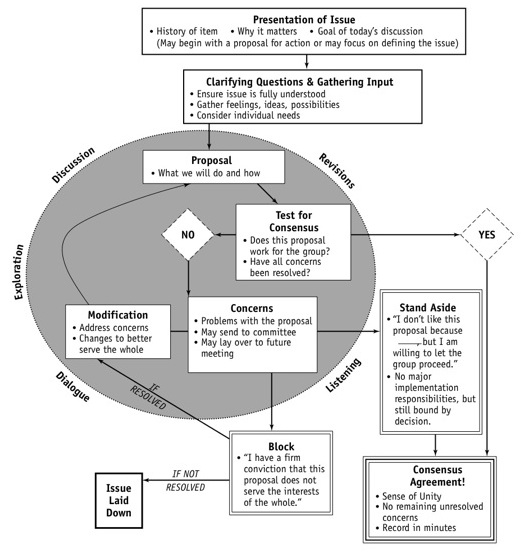
> > > > To start, here's a neat diagram that illustrates a common process for
> > > > consensus:
> > > >
> > > > http://howtosavetheworld.ca/images/consensus.jpg
> > > >
> > > > Don't focus on the blocking. Instead, focus on how proposals come to
> >
> > be.
> >
> > > > First, an issue is presented. This includes the history of the issue,
> >
> > why
> >
> > > > it
> > > > is important, and the goals of a discussion about the issue.
> > > >
> > > > The issue is then explored and discussed. We gather feelings about the
> > > > topic
> > > > and get a feel for what everyone thinks.
> > > >
> > > > Only after a general idea is formulated from the group feedback does a
> > > > formal
> > > > proposal come about. When a proposal is created, a number of advocates
> >
> > can
> >
> > > > take responsibility for working to reach consensus about it. These
> > > > advocates
> > > > don't need to share the same idea, but they do recognize the
> >
> > importance of
> >
> > > > the
> > > > issue and that it needs to be solved. Without advocates, a formal,
> >
> > written
> >
> > > > proposal cannot be made.
> > > >
> > > > What I'm suggesting, is that the structure of our meeting should be
> > > > changed
> > > > to:
> > > >
> > > > * Introductions
> > > > * Announcements
> > > > * Membership
> > > > * Financial Report
> > > > * Consensus         <--\
> > > > ** Open Proposals   <--|
> > > > ** Issue Discussion <--/
> > > >
> > > > Discussion and collaboration regarding announcements can happen
> >
> > outside of
> >
> > > > the
> > > > meeting at a different time, or preferably on the discuss@ list. For
> > > > example,
> > > > announcing that you're working on a new project would be nice and
> > > > would
> > > > show
> > > > up in the minutes, but the meeting wouldn't be used for that.
> > > >
> > > > Proposals would also be gone.
> > > >
> > > > Instead, Consensus would handle the process in that above diagram:
> > > > Discussing
> > > > and presenting current issues, followed by presenting a formal
> >
> > proposal.
> >
> > > > Anyone is free to bring up an issue at the space, and it is discussed
> >
> > for
> >
> > > > a
> > > > maximum period of time, perhaps 15 to 20 minutes.
> > > >
> > > > If consensus is reached, a formal proposal is written and sent to
> > > > discuss@.
> > > > If
> > > > not, discussion is moved to the appropriate list by those who wish to
> > > > continue
> > > > discussion. i.e. noc@ for digital infrastructure, bizops@ for
> >
> > financial
> >
> > > > and
> > > > operational details, build@ for physical buildout, bureaucracy@ for
> > > > policies,
> > > > rules, consensus itself, etc. Each list then hosts the discussion for
> > > > relevant
> > > > issues. The discussion that happens works towards having a formal
> >
> > proposal
> >
> > > > that those involved can agree on.
> > > >
> > > > The next issue is brought up, discussed for a maximum period of time,
> >
> > and
> >
> > > > a
> > > > proposal is written, or discussion continued elsewhere until a formal
> > > > proposal
> > > > comes about.
> > > >
> > > > At the next meeting, formal written proposals are brought up during
> >
> > Open
> >
> > > > Proposals. If nobody has blocked and the proposal has been open for 7
> > > > days,
> > > > the proposal has been consensed.
> > > >
> > > > If anyone does block, they must have a fundamental moral issue with
> > > > the
> > > > proposal or be able to defend their block in debate. They can only
> >
> > block
> >
> > > > for a
> > > > maximum of four weeks, but a total of three members may block a
> >
> > proposal
> >
> > > > for
> > > > an indefinite period.
> > > >
> > > > If a formal proposal is blocked by one person for more than four
> > > > weeks,
> > > > they're being a stick in the mud and the proposal is considered
> >
> > consensed.
> >
> > > > If a formal proposal is blocked by three or more people, the proposal
> >
> > is
> >
> > > > considered dropped, though the issue may be brought up for discussion
> > > > again at
> > > > the next meeting.
> > > >
> > > > Here is an example:
> > > >
> > > > 1. Alice wants some space money to purchase and install a new front
> >
> > door
> >
> > > > that
> > > > has a bigger window
> > > > 2. Alice brings up the issue of the front door's window at the next
> > > > meeting
> > > > 3. The community discusses the window and decides the real issue is
> > > > brightening up the front room and that it would be easier to install a
> > > > window
> > > > in the wall than to replace the whole front door.
> > > > 4. Discussion takes longer than 15m, so Alice and other
> > > > brighter-front-room-
> > > > supporters continue discussion on build@
> > > > 5. build@ comes up with a written proposal to purchase and install a
> > > > window
> > > > and sends it to discuss@
> > > > 6. At the next meeting, the members present note that nobody has
> >
> > blocked
> >
> > > > the
> > > > proposal, so it is considered consensed.
> > > > 7. Treasurer dispenses money to those who want to purchase and install
> >
> > the
> >
> > > > window
> > > > 8. We've got a new window and a less dungeony lit front room in three
> > > > weeks
> > > > time.
> > > >
> > > > tl;dr of the process:
> > > >
> > > > Proposals and Discussion sections in the weekly meeting are replaced
> >
> > with
> >
> > > > a
> > > > single Consensus section, where:
> > > >
> > > > * Written proposals are considered for consensus
> > > > ** If nobody blocks, it is considered consensed.
> > > > ** If someone blocks, the issue is put in the queue for discussion
> > > > * Issues are brought up and discussed for a max of 15 minutes
> > > > ** If consensus is made, a formal proposal is written and sent to
> >
> > discuss@
> >
> > > > ** If consensus was not made, discussion continues outside of the
> >
> > meeting
> >
> > > > With these constraints on blocking:
> > > >
> > > > * A blocker must have a fundamental moral issue or otherwise defend
> >
> > their
> >
> > > > block in debate
> > > > * Single person blocks may only last four weeks
> > > > * Three or more person blocks may be indefinite
> > > >
> > > > tl;dr of the process in an image: http://i.imgur.com/G8fmFsE.png
> > > > _______________________________________________
> > > > Discuss mailing list
> > > > [email protected]
> > > > https://synhak.org/mailman/listinfo/discuss
> >
> > _______________________________________________
> > Discuss mailing list
> > [email protected]
> > https://synhak.org/mailman/listinfo/discuss
 signature.asc
Description: This is a digitally signed message part.
_______________________________________________
Discuss mailing list
[email protected]
https://synhak.org/mailman/listinfo/discuss